This site is supported by our readers. We may earn a commission, at no cost to you, if you purchase through links.
Organic sprays are gentle by design—but "gentle" doesn’t mean forgiving. Apply the wrong formula to the wrong herb at the wrong time, and you’ll end up with scorched basil, clogged stomata, and an aphid problem that’s somehow worse than when you started.
The difference between a spray that works and one that backfires usually comes down to a few specific choices: what’s in the bottle, when you apply it, and where the mist actually lands. Most guides skip the detail. They tell you to spray. They don’t tell you why the undersides of leaves matter more than the tops, or why your timing window is narrower than you think.
Getting it right is straightforward once you know what to look for.
Table Of Contents
Key Takeaways
- Always match your spray to the specific pest you’re dealing with — using the wrong formula can stress your herbs and leave beneficial insects worse off.
- undersides of leaves are where most pests actually hide, so that’s where your spray needs to land, not just the tops.
- Timing your application to early morning (5–9 a.m.) or late afternoon (4–7 p.m.) makes a real difference, since midday heat and UV break down sprays before they can work.
- Reapply every 3–5 days under moderate pest pressure, always rinse herbs before eating, and discard any homemade spray that’s been stored longer than a week.
Choose The Right Organic Pest Spray

Not every organic spray works on every pest, and using the wrong one can stress your herbs or leave beneficial insects worse off. Before you mix anything, it helps to know what you’re dealing with and what’s safe to put on plants you’ll eventually eat.
Checking which products are actually approved for edible plants — and which aren’t — is easier with a guide to organic pest sprays safe for edible plants before you reach for the sprayer.
Here’s what to keep in mind when choosing the right spray for your herb garden.
Match Spray to Pest
Not every spray works on every pest. Aphids respond well to garlic and mint blends, while caterpillars need something that targets larval stages specifically.
A spray with chitin synthesis inhibition stops larvae from molting — they simply can’t develop further.
Match your spray to what’s actually chewing your herbs, or you’re just watering your problems.
Match your spray to the pest at hand, or you’re just watering your problems
For large herb storage, using inert‑gas modified atmospheres can create hypoxic conditions that suppress pest activity.
Check Herb Sensitivity
Before spraying any herb, do a quick patch test first. Apply a small amount to one or two leaves and wait 12 to 24 hours for signs of wilting, yellowing, or leaf discoloration.
Young growth burns faster, so test on mature leaves only. Log what you tested and when — that record becomes genuinely useful over time.
Use Edible-safe Ingredients
When you know a spray won’t harm what you’re eating, you can use it with confidence.
Stick to edible-safe carrier oils like olive oil or fractionated coconut oil at 1–2 tablespoons per liter.
For emulsifying, lecithin works well at around 0.5–1 percent — no soap needed.
Always mix with filtered or distilled water to keep residues off your leaves.
Avoid Harsh Detergents
Once you’ve locked in your edible-safe base, the emulsifier you choose matters just as much.
Harsh household detergents can coat leaf surfaces and block stomata, while high-foaming formulas create surface tension barriers that prevent even wetting.
Stick to castile or insecticidal soap — both are biodegradable and nontoxic to humans, pets, and beneficial insects when used at the recommended 1 teaspoon per quart.
Spray Herbs Lightly and Evenly
Getting the application right matters just as much as choosing the right spray. Too much product can stress your herbs, while uneven coverage leaves pests with plenty of hiding spots. Here’s how to spray with precision so every drop counts.
Test Leaves First

Think of the test leaf as your early warning system. Pick one leaf from the middle of the plant, mist it lightly, and wait 24 hours before proceeding.
If the test leaf looks healthy after a day, you’re good to go — but keep in mind that your homemade bug spray for plants works best when used fresh, ideally within 24–48 hours of mixing.
Look for yellowing, crispy edges, or wilting — those are signs of phytotoxic stress.
If the leaf looks fine, you’re clear to continue. Record what you used and when, so you can adjust your approach next time.
Cover Leaf Undersides

Flipping a leaf over reveals where the real pest action happens. Aphids, whiteflies, and spider mites cluster on leaf undersides — and that’s exactly where your herbal pesticide spray needs to land.
Here’s why targeting the underside matters so much for organic pest control:
- Stomatal absorption pulls spray compounds directly into leaf tissue
- Trichome microhabitats slow droplet runoff, extending contact time with soft-bodied pests
- Abaxial vein flow guides spray movement toward the leaf’s center
- Cuticle adhesion on the underside is stronger, so your mix actually sticks
Tilt your spray nozzle upward and mist slowly. Spray during cool hours so droplets don’t evaporate before stomata can absorb them. During a leaf undersides inspection, look for pale speckling or fine webbing — early signs you’re in the right place.
Don’t drench. A light, even coat is enough for soft-bodied pest control — oversaturation just causes runoff and waste.
Spray Stems and Shoots
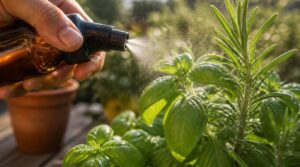
Stems and shoots are easy to overlook — but they’re prime hiding spots for pest colonies working their way up toward tender new growth.
Your herbal pesticide spray needs to reach more than just leaves. Stems have small pores called lenticels that can absorb spray compounds directly, making stem lenticel absorption a real advantage when you apply evenly and deliberately. Shoots, being young and soft, are especially vulnerable — so avoiding shoot burn means you should always spray during cool hours, never at midday.
Here’s how to handle stems and shoots with precision:
| Stem Zone | Application Method | Why It Matters |
|---|---|---|
| Lower stem base | Short, horizontal passes | Reaches pest entry points near soil |
| Mid-stem nodes | Rotate nozzle around the stem | Covers sheltered pest colonies on all sides |
| Young shoot tips | Light mist from 6–8 inches away | Prevents phytotoxic burn on tender tissue |
Targeted stem application works best when you work upward in thin, even passes. Don’t linger in one spot — managing stem runoff means stopping before liquid drips, which wastes your mix and can carry active compounds into the soil.
Adhesion on bark can be tricky since smooth or waxy surfaces repel water-based sprays. Adding castile soap as an emulsifier helps your mix cling longer. After your leaf undersides inspection, move straight to the stems — pests migrate between both zones constantly, so treating them together closes the gap. Reapply regularly every 3–7 days to maintain coverage, and always rinse shoots before any culinary use to stay on top of food safety after spraying.
Avoid Flowers and Blooms

Flowers might look harmless, but spraying near them puts beneficial pollinators at real risk. Bees follow nectar, and if spray drift reaches blooms, residue lingers on petal surfaces that foragers touch directly.
Skip any flower entirely — even a single open blossom counts.
Blooms also raise microclimate humidity, which encourages fungal spread onto nearby herb foliage.
Stop Before Runoff
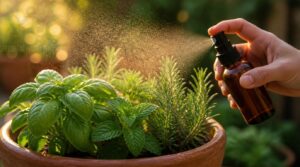
Runoff means the spray is sliding off — taking your organic pest control with it and landing in the soil below.
Lightly mist in short, even passes, holding the nozzle 12–18 inches away. On hot, dry days, spray dries within 20–60 minutes.
High humidity slows drying, so go lighter. Waxy or thick leaves pool faster, so less is always more.
Apply at The Best Time

Timing your spray can make or break its effectiveness. Even the best organic formula won’t do much if you’re applying it at the wrong moment — say, midday in scorching heat or right before a downpour rolls in. Here’s what to keep in mind when choosing the right window to spray.
Early Morning Application
The best time to spray is just after dawn. Between 5 and 9 a.m., temperatures are cooler, humidity is higher, and morning dew helps your DIY organic insecticide clings to leaf surfaces.
Calm morning air also means less spray drift, so your organic pest control lands where it’s needed — not on neighboring plants or pollinators.
Late Afternoon Spraying
Late afternoon — roughly 4 to 7 p.m. — is your second window. As temperatures drop, evaporation slows, so more spray stays on the leaves instead of disappearing into the air. Winds tend to calm down too, cutting spray drift to almost nothing.
One thing to watch: evening dew. If moisture settles on leaves before they dry, it can dilute your spray or encourage fungal issues.
Avoid Hot Sunlight
Midday sun is the enemy of any spray session. Between 9 a.m. and 4 p.m., UV exposure accelerates spray breakdown, and heat causes droplets to evaporate before they penetrate leaf surfaces. You lose efficacy — and risk scorching foliage.
Watch for these warning signs:
- Leaf edges curling or yellowing after spraying
- Droplets drying within seconds of application
- Visible wilting during peak heat hours
A simple fix: drape portable shade cloth over your herb beds. It can extend your safe spraying window by one to two hours and keeps leaf surface temperatures manageable.
Skip Windy Days
Wind doesn’t just scatter your spray — it wastes it. When gusts exceed 5 mph, droplets drift away from target leaves before they can settle, cutting your coverage and sending your homemade garden spray straight past the plant.
Spray in calm conditions, ideally when wind sits below 5 mph. Sheltered spots — beside a hedge, a trellis, or a fence — act as natural windbreaks and create microclimate spray zones where coverage stays controlled.
If a light breeze is unavoidable, switch to a finer nozzle setting and slow your passes. That keeps droplets closer to the canopy and reduces leaf burn risk from uneven contact.
Check a forecast before you start. A 24-hour wind trend helps you forecast your spray window accurately and avoid peak gusts — especially in the afternoon, when surface heating often picks up wind speed.
Wait Before Rainfall
Rain turns a well-timed spray into wasted effort. Your organic herbal spray needs dry time to bond with leaf surfaces — and if rain arrives too soon, it simply washes the residue away before pests ever encounter it.
Your target window is a 24-hour rain-free period after application. Here’s what to watch for when planning your spray:
- Check a 24-hour forecast before mixing your batch — not just a quick glance, but an hourly breakdown.
- Avoid spraying if rain is expected within 6–12 hours, since runoff risk is highest in that window.
- Reapply after any rainfall that arrives before your spray has fully dried and set.
Heavy rain is the bigger threat. A hard downpour doesn’t just dilute your spray — it physically knocks residue off leaves and can carry it into soil, where it may affect nearby beneficial insects. A light drizzle after the spray has dried, though, can actually help film-forming residues settle deeper into leaf crevices.
Castile soap in your mix improves spray adhesion, buying you a slightly better chance of rainfastness — but it won’t save a spray hit by rain within the first hour.
Reapply Safely After Monitoring
Spraying once isn’t always enough — pests are persistent, and so is rain. Knowing when and how to reapply keeps your herbs protected without overdoing it. Here’s what to watch for as you build your routine:
Inspect Herbs Weekly
Think of your weekly herb check as a health report card for your garden.
Walk through each plant and scan leaves, top and bottom — pests like aphids, whiteflies, and spider mites hide on undersides. Note any yellowing, stippling, or curling. Check stems and soil surfaces too.
Photograph what you find and log the date, weather, and pest activity so you can spot patterns before they become problems.
Reapply Every Few Days
Even with a thorough weekly inspection behind you, timing your next spray is where real pest control happens. Under moderate pest pressure, reapply every 3 to 5 days. Aphids and mites can rebound visibly within 2 to 3 days, so don’t wait.
If pests seem light, stretch to 5 to 7 days and let your herbs breathe.
Spray Again After Rain
A good downpour can wipe out hours of careful work. Most organic sprays need 4 to 6 hours to dry and bond to leaf surfaces — if rain hits before that window closes, you could lose up to 70 percent of your coverage.
Check leaves by running a finger along the surface. If it feels damp, wait and reapply.
Watch for Leaf Burn
Leaf burn can sneak up on you between applications.
Browning along leaf margins is your first red flag — it often shows up within 6 to 12 hours after spraying, especially if plants caught any direct sun. Uniform yellowing on otherwise intact tissue points to a phytotoxic reaction rather than pest activity.
Crispy edges and wilted tips mean it’s time to back off.
Adjust Spray Strength
If leaf burn appeared, your spray is likely too strong or applied too close.
Lower the nozzle pressure and start with a light mist. Keep the spray bottle at a consistent distance — around 10 to 12 inches — to prevent pooling on delicate foliage. Increase coverage gradually only once you’ve confirmed the lighter application controls the pest.
Protect Harvests and Pollinators

Getting to harvest time is the goal, and a few smart habits will carry you across the finish line safely. Organic sprays work best when you pair them with simple routines that protect both your food and the bees doing the real work in your garden. Here’s what to keep in mind as you wrap up each spray cycle.
Rinse Herbs Before Eating
Once the spray has done its job, rinsing herbs before eating is non‑negotiable.
Run cool water over leaves for at least 20 seconds, gently rubbing with your fingers to lift soil without bruising delicate greens.
Pat dry with a clean towel or spin in a salad spinner — wet herbs lose texture fast.
Never use soap; residues cling to edible surfaces.
Avoid Active Pollinators
Rinsing herbs is your final food-safety step — but the garden itself still needs protecting.
Bees and butterflies are most active mid-morning through early afternoon. That’s your no-spray window. Aim for early morning or late evening, when pollinators have mostly finished foraging.
Use a low-drift nozzle and target only pest-affected foliage. Keep spray away from any open blooms.
Store Spray Refrigerated
Once you’ve finished spraying for the day, don’t leave your leftover mixture sitting on the counter.
Pour it into a clean, opaque, sealed container and refrigerate it promptly — ideally between 2 and 8°C, tucked toward the back where temperatures stay steady.
Most homemade organic sprays stay effective for up to one week refrigerated.
Discard Spoiled Mixtures
Even refrigerated, homemade organic sprays don’t last forever. If yours smells off, looks cloudy, or has been stored longer than a week, it’s time to let it go.
Don’t pour it down the drain. Segregate it into a labeled container marked as waste and dispose of it following your local hazardous waste guidelines. Wear gloves when handling it.
Combine With Hand-picking
Sprays handle a lot, but they don’t catch everything. Manual pest removal fills that gap.
After each application, check the undersides of leaves, where pests hide, and sprays rarely fully penetrate. Targeted egg removal by hand stops the next wave of pests before it starts.
Pick carefully — you want to remove pests, not bruise healthy tissue.
Frequently Asked Questions (FAQs)
Can you eat herbs sprayed with insecticide?
Yes, but only if the product is labeled for edible crops and you’ve respected the pre-harvest interval. When in doubt, discard the herb — rinsing alone won’t remove residues from non-edible-labeled sprays.
Can herbal sprays harm beneficial insects nearby?
Herbal sprays can harm nearby beneficial insects. Essential oils like peppermint and clove irritate or kill bees and ladybugs on contact. Even spray drift reaching flowering borders puts pollinators and natural predators at risk.
How long does homemade spray stay effective?
Most homemade sprays stay effective for 1 to 7 days. Garlic and pepper blends break down fastest. Store in the refrigerator to slow decay and always discard batches that smell off.
Which herbs repel the most common garden pests?
Garlic, mint, rosemary, basil, sage, and lavender are the best herbs for natural pest control. Garlic targets aphids, mint disrupts ant trails, rosemary deters moths, lavender defends against whiteflies, and sage protects brassicas from cabbage pests.
Can companion planting replace organic sprays entirely?
Even the world’s best companion planting won’t send every pest packing. Companion planting limits mean you’ll still need organic sprays when pest surges hit, or nutrient competition crops up.
Integrated management cooperation is key for long-term, sustainable gardening.
Conclusion
Your herb garden is a living system—and every spray you apply either helps that system or strains it.
Knowing how to use organic pest spray on herbs safely means reading your plants, respecting your timing, and staying consistent without overdoing it. Small, deliberate actions compound.
A clean underside today means fewer pests next week. Rinse before you harvest, watch before you reapply, and trust what the leaves tell you.
Precision, not volume, is what protects.
- https://migardener.com/blogs/blog/migardeners-guide-to-100-organic-pesticides
- https://www.theprairiehomestead.com/2015/07/organic-pest-control-garden-spray.html
- https://raiseyourgarden.com/home/homemade-neem-oil-spray-for-organic-pest-control
- https://gardening.stackexchange.com/questions/44139/day-or-night-the-best-time-to-apply-pesticides
- https://www.thespruce.com/using-neem-oil-as-an-organic-insecticide-2132579