This site is supported by our readers. We may earn a commission, at no cost to you, if you purchase through links.
Your tomato plant looked fine on Monday. By Friday, the lower leaves wore dark rings, the stems showed faint streaks, and you weren’t sure whether to water more or less.
That moment of confusion is exactly where most tomato problems turn into real losses—not because gardeners don’t care, but because yellowing leaves and wilting stems can mean a dozen different things.
A nutrient imbalance mimics bacterial wilt. Drought stress looks almost identical to a fungal infection.
Knowing the difference between common tomato plant diseases and ordinary environmental stress is what separates a salvaged harvest from a pulled plant.
Table Of Contents
- Key Takeaways
- Is It Really Tomato Disease?
- Key Tomato Disease Warning Signs
- Common Fungal Tomato Diseases
- Bacterial and Viral Tomato Diseases
- Preventing Tomato Diseases Naturally
- Frequently Asked Questions (FAQs)
- What is the most common disease in tomatoes?
- Can I spray Dawn dish soap on my tomato plants?
- Does hydrogen peroxide stop tomato blight?
- Can you spray Dawn dish soap on tomato plants?
- How to treat a sick tomato plant?
- What are the most common tomato diseases?
- What do coffee grounds do for tomato plants?
- What is the most common disease in tomato plants?
- How can I tell what’s wrong with my tomato plants?
- What temperature conditions trigger most fungal diseases?
- Conclusion
Key Takeaways
- Many tomato problems — like wilting, yellowing, and leaf curl — come from environmental stress or watering habits, not disease, so always rule those out before reaching for a fungicide.
- Diseases leave specific clues: bacterial wilt collapses plants fast, fungal issues like early blight climb slowly from lower leaves upward, and vascular discoloration inside a cut stem is a key diagnostic tell.
- Prevention beats treatment every time — spacing plants 24–36 inches apart, watering at soil level with drip irrigation, and rotating nightshade crops every three to four years will stop most problems before they start.
- Choosing disease-resistant tomato varieties suited to your region is your strongest single move, since genetic resistance works from inside the plant before any spore or bacterium gets a foothold.
Is It Really Tomato Disease?
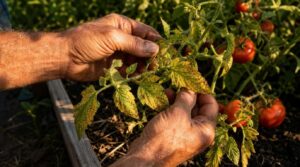
Before you reach for a spray bottle, it’s worth slowing down for a second.
Taking a moment to identify what you’re dealing with can save you time—and safe pest control methods for edible gardens can help you choose the right approach without putting your harvest at risk.
Not every tomato problem is actually a disease — many issues come straight from the environment or how the plant is being cared for.
Here’s what to check first.
Environmental Stress Signs
Before you reach for a fungicide, take a closer look — your tomato might just be stressed.
Drought stress, waterlogging damage, temperature swings, and light stress can all trigger yellow leaves, leaf curl, sunscald, and fruit cracking. Even nutrient excess throws things off. Blossom end rot, for instance, comes down to inconsistent watering, not a pathogen. Environmental problems often mimic disease closely.
Leaf Roll Causes
Leaf roll is one of those symptoms that looks alarming but often isn’t. Hot days trigger curling as leaves reduce water loss — that’s just your plant protecting itself.
Pruning Stress, high Night Temperatures, Nutrient Excess, and Herbicide Drift can all cause leaf curling too. Container Stress is another culprit, since limited soil buffers moisture poorly. Environmental stress drives most cases, not disease.
It commonly shows up in late spring leaf roll periods, affecting lower leaves first.
Blossom End Rot
Blossom end rot isn’t a disease — it’s a calcium transport problem. Your plant can’t move enough calcium to developing fruit when soil moisture swings wildly.
That black, sunken patch on the bottom? Preventive mulching steadies moisture, consistent watering techniques help too, and soil test guides your nutrient management.
Choosing BER-resistant varieties and monitoring soil pH impact gives you the best shot at recovery.
Magnesium Deficiency
Calcium isn’t the only nutrient quietly causing trouble. Magnesium deficiency follows a tell-tale leaf chlorosis pattern — older leaves yellow between the veins while the veins stay green.
That’s the chlorophyll role at work; without magnesium, your plant can’t run photosynthesis efficiently.
Sandy soils are common soil causes.
Treatment options include Epsom salt foliar sprays or a balanced fertilizer to restore plant nutrition fast.
Fruit Cracking
Fruit cracking isn’t a disease — it’s a physiological disorder caused by uneven watering or sudden rainfall after a dry spell. When water rushes in fast, the skin can’t keep up and splits.
Here’s what drives it:
- Moisture Control lapses and soil moisture management failures.
- Climate Stress from temperature swings weakening skin integrity.
- Poor Calcium Management reducing pericarp strength.
- Skipping Crack-Resistant Varieties in your planting plan.
Key Tomato Disease Warning Signs
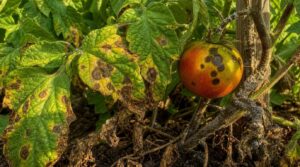
Once you know your tomato isn’t just stressed, it’s time to look closer at what the plant is actually showing you.
Diseases leave specific clues — and learning to read them makes all the difference. Here are the key warning signs to watch for.
Rotating by plant family every few years is one of the most effective ways to stay ahead of trouble — here’s a closer look at organic crop rotation methods that prevent disease buildup.
Leaf Spots and Yellowing
Spots and yellowing are your plant’s way of sending a distress signal — and reading them correctly makes all the difference.
Fungal vs bacterial causes each leave distinct clues: halo identification helps here, since bacterial leaf spot shows yellow halos, while Septoria leaf spot has dark purple margins.
Early blight, late blight, viral yellowing from Tomato Yellow Leaf Curl Virus, and nutrient chlorosis from environmental triggers all look different once you know what to look for.
Wilting and Stem Lesions
Wilting tells a story — you just have to read the stem.
Vascular discoloration, those brown streaks inside a cut stem, signal bacterial wilt, Fusarium wilt, or Verticillium wilt.
Oomycete infections and nematode damage cause softer, water-soaked lesions.
Alternaria stem canker and anthracnose show dark, sunken patches.
Stem girdling cuts off water flow fast.
Check wilting patterns: sudden collapse usually means bacteria; slow, creeping decline often points to fungi.
Fruit Rot Symptoms
Once rot takes hold, it moves fast. Lesion progression often starts as a small, water-soaked spot — then spreads into soft, collapsing tissue within days.
Fungal pathogens like gray mold, white mold, and anthracnose thrive in humidity, while bacterial spot and blossom end rot follow their own patterns.
Postharvest decay, soft rot spread, and dry rot patterns all look different, so inspect your fruit closely.
Mold or Fuzzy Growth
Fuzzy growth on your tomato plants is a clear signal that something’s wrong. Mold identification starts with texture — gray mold (Botrytis) looks like dusty ash, while powdery mildew coats leaves with a chalky white film.
Both fuzzy growths trace back to poor airflow and humidity.
For organic mold treatments, try neem oil or copper spray early.
Mold health risks rise when spores spread, so act fast.
Disease Pattern Clues
Where a disease shows up on your plant tells you almost as much as what it looks like. diagnostic clues:
- Leaf spot starts on older, lower leaves and climbs upward
- Leaf yellowing with interveinal patterns points to nutrient trouble
- Fruit cracking and leaf curling often follow weather triggers like sudden rain
- Wilting symptoms that don’t recover signal vascular damage
Tissue targets matter too — always note which part is affected first.
Common Fungal Tomato Diseases
Fungal diseases are the most common trouble you’ll run into with tomatoes, and most of them thrive when the weather turns warm and wet.
The good news is that once you know what to look for, they’re not hard to spot.
Here are the five fungal diseases most likely to show up in your garden.
Early Blight
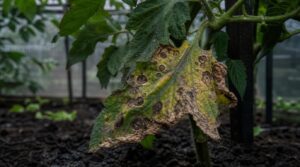
If your tomato’s lower leaves are dotted with dark, target-shaped rings, early blight has likely arrived. Caused by Alternaria solani, it follows a steady Symptom Progression — starting at the oldest leaves, then climbing upward.
| Factor | What Happens | What You Can Do |
|---|---|---|
| Fungal Life Cycle | Spores overwinter in debris | Remove all plant material after harvest |
| Spore Dispersal Methods | Rain and wind spread spores | Use drip irrigation; avoid overhead watering |
| Stem Canker Risks | Cankers weaken plant structure | Prune infected stems promptly |
| Fruit Damage Assessment | Sunken dark lesions reduce yield | Pick affected fruit early |
| Leaf Spot Spread | Spots merge, leaves drop | Apply copper fungicide at first sign |
Pair crop rotation (2–3 years) with resistant tomato varieties for the strongest defense.
Late Blight
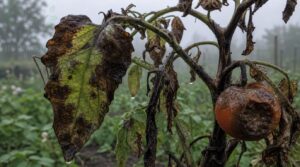
Early blight targets old leaves, but late blight moves fast — and everywhere at once. Caused by Phytophthora infestans, this pathogen thrives when temperatures drop between 10–20°C and humidity climbs above 90%.
Watch for these warning signs:
- Dark, water-soaked lesions expanding rapidly across leaves and stems
- Gray-white fuzzy Sporangia Spread visible on leaf undersides
- Stems girdling and blackening within days
- Brown, spongy fruit rot appearing suddenly
Its Potato Connection means nearby potato plants can reinfect your crop through wind-carried spores. Rotate beds every three years, apply copper fungicide early, and choose disease-resistant tomato varieties. Rotate fungicide types to avoid Fungicide Resistance buildup.
Septoria Leaf Spot
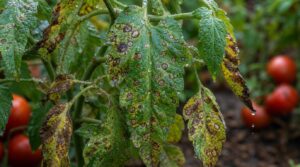
Unlike late blight’s dramatic spread, septoria leaf spot is sneaky — it builds quietly from the bottom up. Rain splash spread carries these fungal pathogens upward through your canopy all season long.
| Spot Characteristics | Defoliation Impact | Treatment Options |
|---|---|---|
| Tiny gray-centered spots | Weakens fruit production | Copper-based organic fungicides |
| Dark purple margins | Exposes fruit to sunburn | Remove affected leaves promptly |
| Fungal life cycle repeats | Reduces overall yield | Cultural controls like drip irrigation |
Powdery Mildew
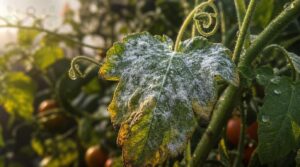
Septoria works slowly—powdery mildew can look almost harmless at first, just a light white coating on leaves. White Coating Signs mean Fungal Spore Spread is already underway.
Humidity Triggers, like warm days above 20°C with poor airflow, let it thrive across a wide Host Plant Range.
Catch it early and use Sulfur Treatment, neem solution, or organic sprays to stop it.
Southern Blight
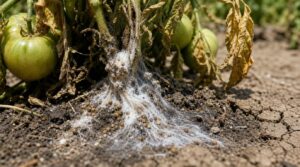
Southern Blight hits fast and low. The soilborne fungus Athelia rolfsii attacks the crown right at the soil line, causing sudden wilting and white cottony growth on the stem base.
Its Sclerotia Survival means it persists in soil for years across its Broad Host Range.
Hot Weather Outbreaks peak in midsummer.
Fight back with crop rotation, Soil Solarization under clear plastic, and keeping fruit off the ground to stop Fruit Soil Transmission.
Bacterial and Viral Tomato Diseases
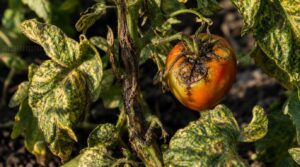
Fungi aren’t the only threat your tomato plants face. Bacteria and viruses can be just as sneaky — and sometimes harder to catch before real damage sets in.
Here are the five most common ones to know.
Bacterial Spot
Bacterial spot is one of the sneakier bacterial pathogens out there. It starts as water-soaked leaf spots with yellow halos, then darkens to brown or black on both foliage and fruit. Xanthomonas strains — X. perforans and X. euvesicatoria — are usually responsible.
Seed transmission is a real concern, so always start with certified clean seed. Copper sprays help, but copper resistance is growing, making disease-resistant tomato varieties and rapid diagnostics increasingly essential tools.
Bacterial Speck
Cooler, wet springs are prime time for Bacterial Speck — one of the trickier bacterial pathogens to catch early. Speck lesion ID comes down to size: tiny black dots, under 1/16 inch, with yellow halos. Cool Weather Spread peaks between 63–75°F.
Watch for:
- Discrete specks on fruit that won’t expand
- Reduced marketability — Fruit Market Impact is real
- Early leaf spotting on young plants
Seed Treatment Methods, copper sprays, Bactericide Timing, and sanitation practices protect your crop. Choose disease-resistant tomato varieties when possible.
Bacterial Wilt
One day your tomato looks fine — the next, it’s collapsed like a wilted flag. That’s bacterial wilt in action.
Bacterial wilt can take a thriving tomato plant from healthy to collapsed overnight
The culprit, Ralstonia solanacearum, uses an Xylem Blockage Mechanism to cut off water flow from the inside.
Among soilborne pathogens, this one’s relentless — Soil Survival Strategies let it linger in your soil for years. Warm Climate Impact accelerates spread fast.
Crop rotation, sanitation practices, and Resistant Tomato Varieties are your best defense.
Tomato Mosaic Virus
Tomato Mosaic Virus is sneaky — it spreads through touch, not bugs. Mechanical Transmission Risks are real every time you prune or tie plants without sanitizing your hands or tools. Seed Transmission Potential exists too, though it’s less common.
Watch for:
- Mosaic-patterned leaves with light and dark green patches
- Fruit Deformation Causes like uneven ripening and corky skin
- Overall stunting and poor vigor
Use certified seeds and Resistant Varieties Use where possible.
Yellow Leaf Curl Virus
Yellow leaf curl virus travels fast — whiteflies pick it up from one plant and carry it to the next within hours.
You’ll notice symptom stages clearly: young leaves curl upward, yellow at the edges, then plants turn stunted and bushy.
Economic losses can be devastating.
whitefly control early, choose resistant cultivars developed through resistant breeding, and remove infected plants immediately.
Preventing Tomato Diseases Naturally

Good news — most tomato diseases are easier to prevent than to cure. A few simple habits go a long way toward keeping your plants healthy all season.
Here’s what actually works.
Space Plants for Airflow
Think of good airflow as your first line of defense. Spacing plants 24–36 inches apart — with staggered rows for cross-ventilation — keeps canopy openness at 30–60%, so humidity drops and fungal spores have fewer chances to settle.
Vertical trellising lifts fruiting zones into moving air, while regular pruning benefits the whole plant by clearing blocked paths before disease finds a foothold.
Water at Soil Level
Airflow manages the canopy — but how you water controls what happens at ground level.
Drip irrigation delivers moisture directly to the root zone, improving nutrient mobility and soil cooling without wetting foliage. Better infiltration impact also means less splash — the main way soilborne disease travels from soil to stem.
Overhead irrigation, by contrast, creates the leaf wetness that early blight and late blight thrive on.
Rotate Nightshade Crops
Where you water matters — and so does where you plant each year.
Crop rotation is one of the most effective cultural practices for disease prevention. Keep nightshade family crops out of the same bed for three to four years.
soil pathogen reduction strategy breaks soilborne disease cycles, contributes to soil structure improvement through legume integration benefits, and lowers long-term input costs — a real economic rotation impact worth planning for.
Remove Infected Debris
Once you’ve rotated your beds, don’t overlook what’s left behind. Infected leaves and fruit are prime examples of pathogen survival risks — early blight and septoria spores overwinter in dead debris and reinfect new plants.
Bag and discard diseased material; don’t compost it unless you hot-compost above 145°F.
Sanitize your shears with 70% alcohol between cuts. Good garden hygiene and seasonal cleanup are straightforward, effective disease control.
Use Resistant Varieties
One of the disease‑resistant tomato varieties you can make is choosing disease‑resistant tomato varieties before a single spore appears.
Genetic Resistance Mechanisms work inside the plant itself — some through single‑gene protection, others through Pyramided Varieties that stack multiple resistances against late blight, early blight, and fusarium wilt.
Here’s how to choose well:
- Follow Regional Variety Selection guides from your local extension service
- Buy only seeds meeting Seed Certification Standards to guarantee resistance traits are genuine
- Diversify resistant cultivars yearly to support Consumer Market Demand and genetic variety
Frequently Asked Questions (FAQs)
What is the most common disease in tomatoes?
Bacterial wilt tops the list in warm, humid climates, but early blight, late blight, septoria leaf spot, and bacterial leaf spot run close behind — making symptom overlap analysis essential for accurate early detection.
Can I spray Dawn dish soap on my tomato plants?
Dawn dish soap might seem like a quick fix, but it’s more of a wolf in sheep’s clothing. It can burn leaves, leave residue, and won’t treat real disease.
Use insecticidal soap instead.
Does hydrogen peroxide stop tomato blight?
Hydrogen peroxide can knock back surface fungi, but it won’t stop early blight or late blight once established.
Peroxide limits are real — it dries fast, leaving no lasting protection against soil pathogens below.
Can you spray Dawn dish soap on tomato plants?
Yes, you can — but dilution and timing matter.
Use a few drops of unscented Dawn per quart of water, spray in the evening, and always test one leaf first to avoid burn.
How to treat a sick tomato plant?
One wrong move, and your whole crop could collapse overnight.
To treat a sick tomato plant, remove affected leaves, apply neem oil or copper-based fungicide, and water consistently at the soil level.
What are the most common tomato diseases?
Fungal culprits like Early Blight, Late Blight, and Powdery Mildew top the list. Bacterial Spot and Fusarium Wilt follow closely.
Climate Impact, Soil Pathogens, and Disease Cycles all shape which Treatment Methods you’ll actually need.
What do coffee grounds do for tomato plants?
Coffee grounds act like a slow-burning campfire for your soil — quietly building Soil Health through Nutrient Slow Release, Microbial Growth Aid, pH Neutralization Effect, Soil Structure Boost, Mulching benefits, and natural Pest Deterrent Use.
What is the most common disease in tomato plants?
Early blight tops the list.
Caused by Alternaria solani, it’s behind more regional outbreaks and yield loss analysis concerns than almost any other issue — and symptom differentiation from late blight or septoria leaf spot trips up even experienced growers.
How can I tell what’s wrong with my tomato plants?
Like a doctor reading symptoms, start by asking: is it stress or disease?
Look for leaf curling, plant wilting symptoms, blossom-end rot, early blight spots, or powdery mildew — your plant’s telling you exactly what it needs.
What temperature conditions trigger most fungal diseases?
Most fungal diseases thrive between 20–28°C with high humidity. That sweet spot drives spore germination thresholds and accelerates temperature-driven spread.
Keep humidity control tight — wet, warm conditions are when fungi strike hardest.
Conclusion
The best time to learn about common tomato plant diseases is before you see them. The second-best time is right now, standing in your garden with a worried eye on a spotted leaf.
You don’t need a lab or a degree—just the ability to look closely and act early.
Catch a problem in week one, and you’ll likely save the plant. Wait for week three, and you’re often just managing the loss.
- https://fieldreport.caes.uga.edu/publications/B1285/common-tomato-diseases-in-georgia
- https://extension.illinois.edu/blogs/good-growing/2025-07-11-common-tomato-diseases-garden-and-how-manage-them
- https://extension.oregonstate.edu/news/understanding-tomato-diseases-helps-gardeners-grow-confidence
- https://www.frontiersin.org/journals/plant-science/articles/10.3389/fpls.2025.1737208/full
- https://www.canr.msu.edu/resources/michigan_fresh_tomato_diseases_in_the_home_garden