
This site is supported by our readers. We may earn a commission, at no cost to you, if you purchase through links.
Most gardeners treat fall like an ending—the season when they pack up their gloves, stash the trowel, and wait for spring. But experienced growers know the opposite is true.
The work you do between the first frost and the last falling leaf shapes everything that happens when the soil warms again. Healthy soil going into winter means vigorous roots, fewer pests, and stronger plants coming out. A few well‑timed fall season gardening tasks—clearing spent crops, mulching beds, planting garlic, dividing perennials—can cut your spring workload in half and dramatically improve your harvest next year.
Table Of Contents
- Key Takeaways
- Essential Fall Garden Cleanup Tasks
- Managing Leaves and Mulch in Autumn
- Preparing Soil and Beds for Winter
- Fall Planting and Perennial Care
- Top Tools and Supplies for Fall Gardening
- Frequently Asked Questions (FAQs)
- What do gardeners do in the fall?
- What is the 70 30 rule in gardening?
- What is the 3-hour gardening rule?
- What are some fall chores?
- What should you do in the fall to prepare your garden?
- What can you do in the fall garden?
- What are some autumn garden tips?
- What to do in autumn to keep busy in the garden?
- Is fall a season of shut down in the garden?
- Why should you care for your garden in the fall?
- Conclusion
Key Takeaways
- Fall is your most productive gardening season — clearing spent crops, mulching beds, and amending soil now cuts your spring workload in half and builds a stronger foundation for next year’s harvest.
- Diseased plant material should never go into your compost bin; bag it and trash it to stop pathogens from cycling back into your soil come spring.
- Planting garlic and spring‑flowering bulbs 4–6 weeks before hard frost, then covering them with 3–6 inches of straw mulch, gives roots time to establish and protects them through the coldest months.
- A 2–4 inch mulch layer over your beds does three jobs at once — it insulates soil, retains moisture, and suppresses weeds — while cutting daily soil temperature swings by over 30°F.
Essential Fall Garden Cleanup Tasks
Fall cleanup isn’t just about tidying up — it’s how you set your garden up for a strong start next spring.
A solid fall garden cleanup checklist takes the guesswork out of knowing exactly what to tackle before the first frost hits.
A few key tasks now can prevent a lot of headaches later, from disease buildup to damaged soil. Here’s what to work through before the season fully closes out.
Removing Spent Annuals and Vegetables
Clearing out spent annuals and vegetables is one of the most rewarding fall gardening tasks you can tackle. Timing removal right — after the first hard frost blackens foliage — sets your beds up for success. Here’s why it matters:
- Pest Prevention keeps aphids and beetles from overwintering in crop debris
- Root Retention improves soil aeration, prep by leaving roots to decompose naturally
- Compost Ratio stays balanced when you chop healthy vines into short pieces
Your fall garden cleanup pays dividends all spring. Planting cover crops maintain soil health can protect the soil during the colder months.
Disposing of Diseased Plant Material
Not every plant deserves a spot in your compost bin. If diseases hit your garden this season — think black spots, wilting, or rotted roots — bag that material and send it to the trash.
Bagging and trash disposal stops compost contamination risks, cold.
For extra assurance, try solarizing debris in sealed black bags set in full sun for a week.
Always check local burning regulations before torching anything.
Consider using council composting facilities for persistent diseases.
Weeding and Clearing Garden Beds
Once diseased debris is gone, turn your attention to weed control. Fall garden preparation actually gives you an advantage here — weed identification is easier before frost, and soil moisture after autumn rains makes hand-pulling simple.
Grab weeds at the base and twist; roots come out whole.
Finish with post-weed mulch to block new seeds and support soil preparation through winter.
Cleaning and Sanitizing Garden Tools
With weeds cleared, your garden tools deserve the same attention.
Rinse off mud, then wipe pruners with 70% rubbing alcohol — effective disinfectant solutions like this stop pathogens from spreading plant to plant.
Tool drying techniques matter too; air-dry everything fully before oiling.
Apply linseed oil for protective coatings, sharpen edges for clean cuts, and rub grips with fine-grit sandpaper for solid handle maintenance.
Composting Healthy Plant Debris
Composting healthy plant debris is one of the smartest moves in fall gardening. Chop stems into 10–15 cm pieces, then layer two parts dry leaves to one part green clippings — that carbon‑nitrogen balance keeps things active.
Follow basic pile size guidelines: aim for roughly 90 cm tall. Check moisture management regularly; the pile should feel like a wrung‑out sponge.
Good shredding techniques and occasional turning support strong soil health after garden cleanup.
Managing Leaves and Mulch in Autumn
Those piles of fallen leaves aren’t just yard waste—they’re some of the best free material your garden will see all season.
How you handle them now shapes how well your soil and plants hold up through winter and bounce back in spring.
Here’s what to focus on regarding leaves and mulch this fall.
Raking and Shredding Leaves for Mulch
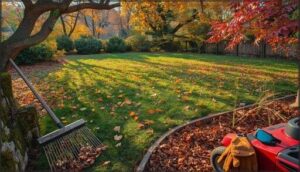
Leaves are free mulch waiting to happen — don’t bag them. Rake leaves into rows, let them dry out, then run your mower over them twice for dime-sized pieces. Good leaf drying prevents shredder clogs and speeds up compost breakdown. Keep this fall gardening rhythm simple:
- Use a wide-head rake for faster garden maintenance coverage
- Wear safety gear — gloves and glasses protect you from debris
- Check shredder settings before feeding leaves to maintain airflow
- Spread mulch 3–6 inches deep, keeping stems clear to prevent rot
Creating and Using Leaf Mold

Turning fallen leaves into leaf mold is one of fall gardening’s smartest moves.
Pile moist, shredded leaves and let fungi do the work — you’ll have rich soil conditioning material in 12 months.
| Leaf Mold Benefits | Details |
|---|---|
| Decomposition Timing | Ready in 12–24 months |
| Nutrient Profile | Calcium, magnesium, trace minerals |
| Application Techniques | 3 inches deep around perennials |
| Storage Tips | Keep in shaded, moist pile |
| Soil Conditioning | Holds 500% its weight in water |
Safe Mulching Techniques Around Plants
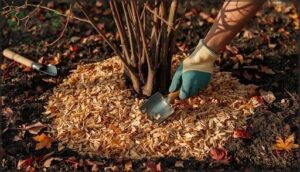
Getting mulch right is half the battle in fall gardening. Poor application timing or sloppy technique can hurt more than help. Follow these three rules for safe garden maintenance:
- Mulch Depth: Keep layers 2–4 inches thick for solid soil conditioning and plant protection.
- Trunk Clearance: Leave 2–3 inches bare around stems — volcano prevention matters.
- Material Selection: Cedar chips deter slugs; skip walnut shells near vegetables.
Mulching Garden Beds to Protect Soil
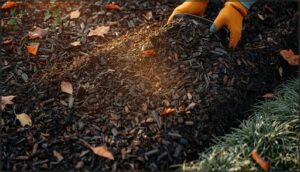
A well-mulched bed does three jobs at once — insulation, moisture retention, and weed suppression. Spread 2–4 inches across your garden beds now, before the ground freezes.
That layer cuts daily soil temperature swings by over 30°F, giving soil life a real boost. It also controls erosion through winter rains.
Good fall maintenance today means healthier soil conditioning and fertilization payoff next spring.
Preparing Soil and Beds for Winter
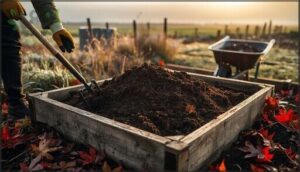
What you do to your soil in fall sets the stage for everything that grows next spring. It’s less about cleanup and more about building a foundation that your plants can actually thrive in.
Fall soil prep isn’t cleanup — it’s the foundation everything next spring will grow from
Here’s what to focus on when prepping your beds before the ground freezes.
Adding Compost and Organic Matter
Think of compost as a winter gift your soil slowly unwraps by spring. Smart compost application rates matter — spread 2 to 3 inches across average beds for real soil structure improvement. Organic matter benefits build up quietly through the cold months.
- Till gently into the top 6 inches while soil stays workable.
- Add well‑rotted manure for a nitrogen boost without burning roots.
- Water after spreading to kick‑start breakdown.
- Skip rototillers to protect beneficial microbial activity.
Planting Cover Crops for Soil Health
Cover crops do the work while you rest. For fall gardening preparation, cover crop timing matters more than most gardeners realize — winter rye goes in as late as November 15, while oats need sowing four to six weeks before hard frost.
Species selection shapes your results: hairy vetch fixes nitrogen through root nodules, and forage radish breaks compacted clay.
Mix seeding techniques, like broadcasting and pressing seeds firmly underfoot, to increase soil contact and winter biomass management.
Checking and Adjusting Soil Acidity
Once your cover crops are in, turn your attention to soil acidity — what you fix now pays off next spring. Fall gardening preparation is the perfect time for soil pH testing and a full soil assessment.
- Collect samples 6–8 inches deep using clean tools
- Mix equal parts soil and distilled water for slurry testing
- Apply lime application rates based on soil type — sandy soils need roughly 2 tons per acre
- Use sulfur acidification to lower pH, about 0.8–2.4 pounds per 100 square feet
Most vegetables prefer pH between 6.0 and 7.0, so soil and compost management together can dial in ideal conditions before winter sets in.
Avoiding Soil Compaction and Erosion
Once your soil pH is dialed in, protect that work by keeping compaction and erosion from undoing it. Raised Bed Design lets you tend plants without stepping on growing areas, preserving loose, friable soil. Traffic Path Marking with mulch or boards guides foot traffic away from beds all season.
| Strategy | Method | Benefit |
|---|---|---|
| Organic Mulch Thickness | 3–4 inches of straw or shredded leaves | Buffers raindrop impact, reduces erosion |
| Broadfork Loosening | Gently lift and wiggle — don’t over-till | Opens air channels, protects structure |
| Terrace Drainage | Low edges on slopes slow runoff | Prevents topsoil loss during heavy rain |
Cover Crop roots with Soil and Compost Management to bind particles together. Lawn Aeration and a consistent Mulch layer keep soil breathing all winter.
Fall Planting and Perennial Care
Fall doesn’t mean your planting days — it’s actually one of the best times to set your garden up for a strong comeback next spring.
A little work now, from tucking in bulbs to dividing tired perennials, pays off in a big way come April. Here’s what to focus on this season.
Planting Garlic and Spring-Flowering Bulbs
Fall planting is your window to guarantee a stunning spring.
garlic planting timing, get cloves in the ground 4 to 6 weeks before hard frost — following bulb spacing guidelines of 2 to 4 inches deep, pointy tip up.
Apply 3 to 6 inches of straw for mulch depth for bulbs.
Use chicken wire for pest protection methods.
Dividing and Replanting Perennials
Dividing perennials in fall gives roots time to settle before winter sets in. For perennial division, timing is everything — spring bloomers like hostas and daylilies split best four to six weeks before frost.
Dig six to twelve inches from the base, tease or lever clumps apart, and replant at the original depth. Finish with two to three inches of mulch protection and water deeply for two weeks.
Lifting and Storing Tender Bulbs and Tubers
Lifting tender bulbs before hard frost hits is one of the most rewarding parts of fall gardening. Dahlias, cannas, and gladiolus won’t survive freezing ground, so act after the first light frost blackens foliage.
- Temperature Monitoring: Store at 40–50°F in a ventilated, frost-free space
- Moisture Control: Use dry peat moss or vermiculite as packaging materials
- Labeling System: Tag varieties clearly and check monthly for rot
Pest prevention starts with curing bulbs a few days before storage.
Collecting and Saving Seeds
Saving seeds is one of those fall gardening tasks that pays you back every spring. For dry seed processing, let sunflower heads turn yellow and cosmos pods rattle before you collect seeds.
Wet seed extraction works differently — ferment tomato pulp for three days, then rinse.
Ideal storage conditions mean keeping seeds at 35–45°F.
Always apply plant selection criteria: choose open-pollinated, disease-free plants only.
Top Tools and Supplies for Fall Gardening
Having the right tools on hand makes fall gardening faster, easier, and a lot less frustrating. A few well-chosen supplies can mean the difference between a garden that struggles through winter and one that bounces back strong in spring.
Here’s what you’ll want in your corner this season.
1. Centurion 1222 Lopper Shear Pruner Combo
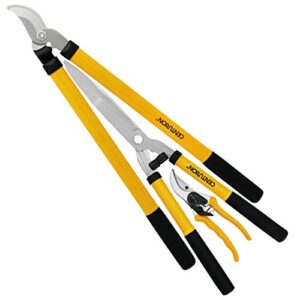
Think of the Centurion 1222 as your three-in-one fall cutting crew.
The 24-inch lopper manages branches up to 1.5 inches thick, while the 8-inch hedge shear keeps your shrubs tidy before winter sets in. Need detail work? The bypass pruner addresses twigs up to 0.75 inches cleanly. All three tools feature carbon steel blades that resist rust and sharpen easily, plus PVC foam grips that won’t slip, even on cold, damp mornings.
| Best For | Home gardeners and families who want a solid all-in-one pruning set for everyday lawn and yard work. |
|---|---|
| Primary Use | Pruning & trimming |
| Indoor/Outdoor | Both |
| Weight | 4.19 lbs |
| Material | Alloy steel |
| Ease of Use | Beginner friendly |
| Durability | Rust-resistant blades |
| Additional Features |
|
- Three tools in one kit — lopper, hedge shear, and bypass pruner — so you’re covered for most cutting jobs around the yard
- Carbon steel blades hold an edge well and resist rust, which matters when tools sit in a shed between seasons
- PVC foam grips make them comfortable to hold, even when it’s cold or wet outside
- A few buyers have run into quality control issues, like missing pieces or parts that showed up looking used
- Not built for heavy-duty or commercial work — these are weekend-warrior tools, not pro-grade
- Some users felt they were a little flimsy for the price, so expectations should stay realistic
2. Adjustable Metal Leaf Rake Long Handle
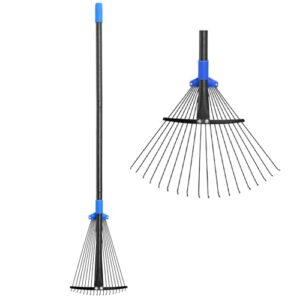
One rake, countless jobs — that’s the promise of a good adjustable leaf rake. This model’s head expands from 7.5 to 20 inches, so you can work tight garden beds or open lawn areas without switching tools.
The telescoping handle stretches up to 63 inches, keeping your back comfortable during long cleanup sessions. At around 1.8 pounds, it won’t wear you out. Collapse it down after use, and it tucks neatly onto a shed hook.
| Best For | Gardeners, campers, and yard workers of all heights who want one versatile rake that’s easy to store and haul around. |
|---|---|
| Primary Use | Leaf raking |
| Indoor/Outdoor | Outdoor |
| Weight | 1 lb |
| Material | Metal & plastic |
| Ease of Use | Easy assembly |
| Durability | Heavy-duty metal |
| Additional Features |
|
- The expandable head (8–17 inches) handles everything from tight flower beds to wide open lawns
- The telescoping handle (up to 58 inches) takes the strain off your back during long cleanup sessions
- Lightweight and collapsible — easy to store in a shed or toss in the trunk for a camping trip
- The rake head can curl or come loose over time with regular use
- The plastic width-adjustment clamp feels like the weak link and may not hold up long-term
- A few buyers felt the price didn’t quite match the build quality
3. Michigan Peat Compost Manure Blend
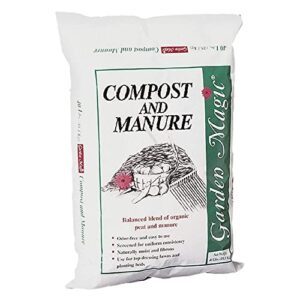
Good soil is the foundation that everything else is built on. Michigan Peat’s Compost Manure Blend gives your beds a meaningful boost before winter sets in.
Each 40‑pound bag covers about 0.75 cubic feet, spreading easily thanks to its screened, uniform texture. The blend combines organic reed sedge peat with composted animal manure — no mixing, no unpleasant odors.
Lay down a 1–2‑inch layer over your garden beds now, and your soil will be primed and ready when spring arrives.
| Best For | Gardeners who want a no-fuss, ready-to-use compost blend to enrich their soil for flowers, vegetables, raised beds, or container plants. |
|---|---|
| Primary Use | Soil enrichment |
| Indoor/Outdoor | Both |
| Weight | 40 lbs |
| Material | Organic compost |
| Ease of Use | Ready to use |
| Durability | Bag packaging |
| Additional Features |
|
- Combines reed sedge peat and composted manure in one bag — no mixing needed
- Odorless and easy to spread, works for both indoor and outdoor use
- Improves drainage and soil quality in raised beds and planters
- May contain wood chunks that can affect soil consistency
- Manure composition isn’t clearly disclosed on the packaging
- At 0.75 cubic feet per bag, larger gardens will need quite a few bags
4. Walensee Manual Lawn Aerator 15 Spikes
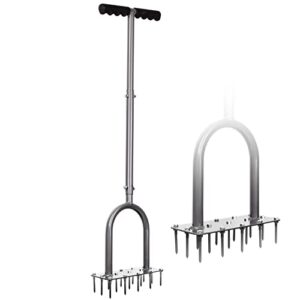
Once beds are fed and mulched, don’t forget the lawn itself.
Compacted soil is one of the biggest obstacles to a healthy lawn, and the Walensee Manual Lawn Aerator addresses it head‑on. Its 15 iron spikes penetrate up to 2.8 inches deep, opening channels for air, water, and fertilizer to reach the roots before winter.
The cushioned T‑handle and foot bar make the work easier on your back, and it’s ready to use right out of the box.
| Best For | Homeowners with small to medium yards who want an affordable, no-fuss way to keep their lawn breathing and healthy. |
|---|---|
| Primary Use | Lawn aeration |
| Indoor/Outdoor | Outdoor |
| Weight | 4.49 lbs |
| Material | Iron |
| Ease of Use | Pre-assembled |
| Durability | Powder-coated finish |
| Additional Features |
|
- 15 deep-reaching spikes (2.8 inches) do a solid job breaking up compacted soil so water and nutrients actually get to the roots
- Cushioned T-handle and foot bar take a lot of the strain out of the work — your back will thank you
- Comes pre-assembled and includes extra spikes and wrenches, so you’re ready to go right out of the box
- Spikes aren’t coated or stainless, so you’ll need to clean and dry them after every use or they’ll rust
- Larger yards or really hard soil will wear you out fast — this is a manual tool with limits
- A few buyers received theirs damaged or already used, so inspect it carefully when it arrives
5. Briliantwerk Adjustable Lawn Aerator Shoes
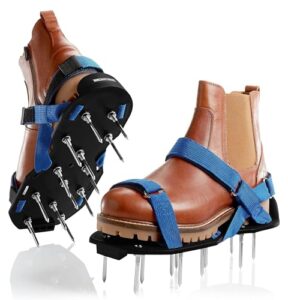
If you want to cover more ground without the back strain, the Briliantwerk Lawn Aerator Shoes are worth strapping on.
You simply walk your lawn and let the spikes do the work — 2-inch nails punch deep for serious compaction, while the 1.5-inch option manages lighter dethatching.
Hook-and-loop straps adjust to fit sizes 5 to 14, so they work over your regular boots.
It’s a low-effort way to aerate a mid-size lawn during your normal fall routine.
| Best For | Homeowners with small to mid-size lawns who want an easy, hands-free way to aerate without renting equipment. |
|---|---|
| Primary Use | Lawn aeration |
| Indoor/Outdoor | Both |
| Weight | 1.96 lbs |
| Material | Metal & epoxy |
| Ease of Use | Adjustable fit |
| Durability | Strong metal nuts |
| Additional Features |
|
- Two nail lengths (2″ and 1.5″) give you flexibility for both deep aeration and light dethatching
- Fits shoe sizes 5 to 14, so it works over your regular boots
- Great option if grip strength or bending is a challenge — just walk and let the spikes do the job
- Straps can loosen mid-walk, so expect to stop and readjust
- Not the best pick for large lawns where efficiency really matters
- Can be a pain to clean after use, especially if your yard has leaves or debris
6. CedarCraft Greenhouse Cover Steel Frame
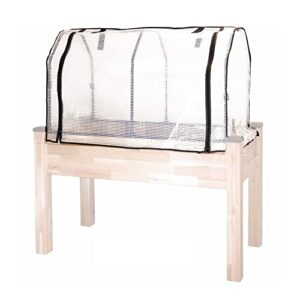
Walking your lawn is great, but protecting what’s actually growing in your beds? The CedarCraft Greenhouse Cover gives raised planters a real shield against fall’s unpredictable weather.
Its steel frame snaps together without tools and locks onto compatible planters, holding steady in moderate wind. The reinforced polyethylene cover lets in enough light while blocking frost, pests, and cold gusts. A dual zipper door makes daily access easy, so tending herbs and greens stays simple even as temperatures drop.
| Best For | Home gardeners who want to extend their growing season and protect herbs, veggies, or flowers in a raised planter from frost, pests, and chilly weather. |
|---|---|
| Primary Use | Plant protection |
| Indoor/Outdoor | Outdoor |
| Weight | 4.59 lbs |
| Material | Steel & polyethylene |
| Ease of Use | Quick assembly |
| Durability | Reinforced cover |
| Additional Features |
|
- Steel frame goes together fast—no tools needed—and clips right onto compatible planters
- Dual zipper door makes it easy to water, harvest, or check on plants without removing the whole cover
- Lets you start planting earlier in spring and keep things growing longer into fall
- Planter sold separately, so there’s an added cost to get the full setup
- May struggle to hold up in really strong or sustained winds
- Some buyers have had issues with the seams and Velcro ties wearing out over time
7. XLUX Long Probe Soil Moisture Meter
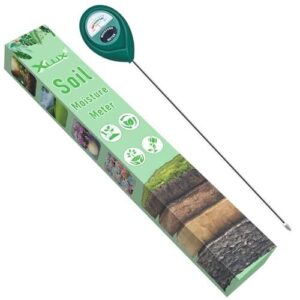
Protecting your plants from frost is only half the battle — knowing when to water them is just as important. The XLUX Long Probe Soil Moisture Meter takes the guesswork out of that.
Its 12-inch stainless steel probe reaches deep into root zones, and the color-coded dial gives you an instant reading. No batteries needed. For fall-planted bulbs or dormant perennials, this tool helps you avoid overwatering — one of the most common cold-season mistakes gardeners make.
| Best For | Gardeners who struggle with knowing when to water — whether they tend to overdo it or forget entirely. |
|---|---|
| Primary Use | Soil monitoring |
| Indoor/Outdoor | Both |
| Weight | 4.6 oz |
| Material | Metal probe |
| Ease of Use | Instant reading |
| Durability | Corrosion-prone probe |
| Additional Features |
|
- The long probe reaches deep into bigger pots, so you’re getting a real read on what’s happening at the roots
- No batteries, no setup — just stick it in and check the dial
- Color-coded zones make it dead simple to know if your plant needs water or not
- Don’t bother using it in rocky or very compact soil — the probe isn’t built for that
- You have to pull it out after a few minutes, so it’s not something you can just leave in place
- Needs to be wiped clean every time, or the probe will start to corrode
Frequently Asked Questions (FAQs)
What do gardeners do in the fall?
Fall is prime time for gardeners to clean up beds, plant bulbs, divide perennials, prep soil, and protect plants from winter.
It’s the season that sets next year’s garden up for success.
What is the 70 30 rule in gardening?
Like the 80/20 principle, the 70/30 rule splits your garden intentionally: 70 percent goes to reliable, proven plants, while 30 percent stays open for experimenting with new varieties, techniques, or crops.
What is the 3-hour gardening rule?
The 3-hour gardening rule means avoiding outdoor work between 11 a.m. and 2 p.m. during hot weather.
That’s when UV rays peak and heat stress hits hardest — for you and your plants.
What are some fall chores?
Think of fall as the garden’s final exhale before a long rest. Your chores include clearing spent plants, mulching beds, dividing perennials, planting bulbs, and storing tender tubers safely indoors.
What should you do in the fall to prepare your garden?
Getting your garden ready for winter means cleaning out spent plants, mulching beds, amending soil, and planting bulbs.
These steps protect your soil and set you up for a stronger spring.
What can you do in the fall garden?
Fall looks like an ending, but it’s actually your busiest beginning.
You can plant bulbs, divide perennials, amend soil, and clear beds — setting up everything that blooms and thrives next season.
What are some autumn garden tips?
Rake leaves, plant spring bulbs, and add compost to your beds before the ground freezes. Divide overgrown perennials, clean up diseased debris, and mulch roots for winter protection.
What to do in autumn to keep busy in the garden?
Autumn keeps you surprisingly busy if you know where to start.
Clear spent plants, plant spring bulbs, divide perennials, mulch beds, and prep your soil — there’s always something worthwhile to do outside.
Is fall a season of shut down in the garden?
Not even close. Think of fall as your garden’s second wind — a season packed with planting, protecting, and prepping that sets the stage for a thriving spring.
Why should you care for your garden in the fall?
What you do now sets the stage for next year. Fall care breaks pest cycles, builds soil health, and gives your plants a stronger start when spring rolls back around.
Conclusion
It’s no coincidence that the gardeners with the most impressive spring harvests are the ones still outside in October, hands in the soil, finishing their fall season gardening tasks while others have already packed it in.
The garden doesn’t pause—simply shifts.
Every bulb you plant, every bed you mulch, every handful of compost you work in now becomes the foundation for next year’s growth.
Fall isn’t the end. It’s your head start.
- https://botanus.com/blogs/canadia-gardening-tips-of-the-month-2/its-fall-garden-cleanup-and-bulb-planting-time
- https://www.lawnstarter.com/blog/gardening/how-to-plant-bulbs-fall/
- https://gardenbetty.com/a-fall-garden-checklist-for-maximizing-the-season-and-winterizing-your-yard/
- https://als-gardencenter.com/blogs/tips-and-inspiration/composting-101-how-to-turn-october-leaves-into-garden-gold
- https://www.gardenary.com/blog/turn-fall-leaves-into-compost