This site is supported by our readers. We may earn a commission, at no cost to you, if you purchase through links.
Most gardeners resign themselves to empty beds and grocery store produce once frost arrives, but that seasonal surrender costs the average household over $800 annually in fresh vegetables.
Growing vegetables year-round flips that script entirely, transforming idle winter months into productive harvests of kale, carrots, and lettuce that thrive in temperatures most crops fear.
The shift requires rethinking traditional garden rhythms, swapping single-season planning for a perpetual cycle where succession plantings, cold frames, and strategic crop selection keep your beds producing twelve months straight.
Master the fundamentals of seasonal extension and indoor systems, and you’ll cut your dependence on shipped produce while pulling fresh greens from the garden in January.
Table Of Contents
- Key Takeaways
- Benefits of Year-Round Vegetable Gardening
- Planning Your Year-Round Vegetable Garden
- Best Vegetables for Year-Round Growing
- Soil Preparation for All Seasons
- Protecting Vegetables From Frost and Cold
- Season Extension Methods and Tools
- Indoor Vegetable Gardening Strategies
- Monthly Guide: What to Plant Each Month
- Advanced Techniques for Consistent Harvests
- Maintenance Tips for Year-Round Success
- Frequently Asked Questions (FAQs)
- Conclusion
Key Takeaways
- You’ll slash your annual vegetable costs by over $800 and gain true food security when you master succession plantings, cold frames, and strategic crop selection that keep beds producing through all twelve months.
- Cold-hardy brassicas like kale and Brussels sprouts combined with fast-growing summer crops and perennial varieties form the backbone of year-round harvests, with proper timing extending your growing window by 12+ weeks.
- Season extension tools—cold frames, greenhouse tunnels, row covers, and automated LED indoor systems—protect crops from frost while cutting water use by 70–90% and boosting yields by 15–35% compared to single-season gardening.
- Your garden becomes a perpetual relay race when you rotate crop families on three-year cycles, adjust frost protection with each season shift, and treat every month as another planting opportunity rather than a finish line.
Benefits of Year-Round Vegetable Gardening
Growing vegetables all year changes the way you think about your garden and your grocery bill. You’ll gain independence from seasonal shortages, unpredictable prices, and long-distance shipping practices that strip flavor before produce even reaches the store.
Here’s what makes year-round gardening worth the effort.
Fresh Produce in Every Season
The promise of stepping into your garden on a January morning and harvesting crisp kale transforms how you eat and live. Year-round gardening extends your fresh harvest beyond traditional boundaries, giving you winter crops when neighbors rely on shipped produce. Cold-hardy vegetables thrive in winter gardening systems, delivering seasonal eating you can count on.
Year-round gardening lets you harvest crisp kale in January while your neighbors buy shipped produce
- Cold climate growers extend harvest windows by approximately 12 weeks using season extension techniques
- Year-round produce from your garden cuts the distance from soil to plate by 8–15 miles in urban settings
- Growing vegetables year-round increases local availability by 25% on average, filling seasonal gaps with fresh, nutrient-dense food
Self-Sufficiency and Food Security
Your garden becomes a genuine food source when you master year-round production. Year-round gardening boosts household calories from garden crops by up to 40% and shortens fresh produce gaps after disruptions by 2–3 weeks—emergency preparedness you can taste. Diversified plots reduce annual crop failure risk by 12–18%, strengthening farm resilience through every season.
| Security Benefit | Impact on Your Garden | Practical Outcome |
|---|---|---|
| Increased household calories | 40% more food available | Longer harvest windows, fewer grocery trips |
| Supply chain protection | 25% less reliance on imports | Fresh vegetables during winter shortages |
| Crop diversity gains | 6–8 distinct crops per household | Better nutrition planning, varied meals year-round |
| Emergency food resilience | 2–3 week faster recovery | Quick access to greens after natural disasters |
Sustainable gardening practices turn food security from concept into daily reality—you’re no longer waiting on trucks or worrying about empty shelves.
Vegetable gardening for beginners starts here: plant cold-hardy greens in fall, protect them through winter, and watch your food storage transform into living, growing abundance. Gardening for self-sufficiency means controlling what arrives on your plate, and gardening for food security means your family eats well regardless of external shocks or seasonal limitations.
Sustainable and Eco-Friendly Practices
Year-round systems deliver environmental wins you can measure. Drip irrigation cuts outdoor water use by 30–50%, while rainwater harvesting supplies up to 40% of annual needs—water conservation that shrinks your footprint and bills.
LEDs slash energy use by 40–60%, and composting diverts 25–40% of household waste. Sustainable gardening practices turn eco-friendly gardening from aspiration into trackable action, reducing resource demand across every season.
Planning Your Year-Round Vegetable Garden
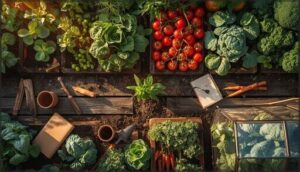
You can’t just toss seeds in the ground and hope for the best when you’re growing vegetables year-round. A solid plan keeps your garden productive through every season, from mapping out what to plant when to figuring out where each crop will thrive.
Let’s break down how to set up a calendar, maximize your space, and pick the right spots for growing both inside and out.
Creating a Seasonal Planting Calendar
Think of your planting calendar as the blueprint for year-round gardening success. By mapping out staggered sowings month by month, you’ll eliminate those frustrating harvest gaps and boost total annual yield by 15–35% compared to winging it.
Focus on 6–8 primary crops with planned rotations—this approach covers 60–75% of your production while keeping seasonal planning simple and harvest optimization on track.
Garden Layout and Space Optimization
Spatial efficiency starts with smart bed configuration—raised beds in grid layouts boost usable planting area by 15–25%, while narrow designs (0.6–0.8 m) cut stepping distance and reduce compaction.
Vertical gardening saves 30–50% of ground space for vining crops.
Companion planting within tight zones raises yield per square meter by 20–35% for cool-season greens in year-round gardening setups.
Choosing Suitable Locations (Indoors and Outdoors)
Success in year-round gardening hinges on matching crops to location. Outdoor microclimates need soil evaluation and climate assessment—check frost dates, sun exposure above 800 μmol/m²/s, and drainage.
Indoor gardening demands controlled temperature (18–22°C), humidity (50–70%), and LED lighting delivering 2.0–3.2 μmol/J.
Container gardening and greenhouse gardening bridge both worlds, letting you grow vegetables regardless of outdoor conditions.
Best Vegetables for Year-Round Growing
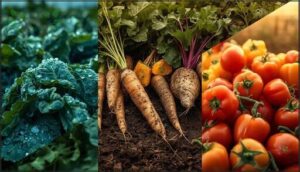
Not all vegetables are created equal in terms of year-round production, and choosing the right varieties can make or break your garden’s success. Some plants laugh at frost while others wilt at the first hint of cold, so understanding which crops fit each season is your ticket to continuous harvests.
Let’s break down the best vegetables into three practical categories that’ll keep your garden productive every month of the year.
Cold-Hardy Winter Vegetables
Brassicas—kale, broccoli, and Brussels sprouts—dominate your winter garden roster, representing 55% of cold-hardy crops in temperate zones. Their frost tolerance makes them winter warriors worth mastering:
- Kale varieties boost yield 15–40% under protective covering versus exposed plots
- Brussels sprouts gain 10–25% more head weight after fall frosts, converting starches to sugars
- Root crops like carrots show 20–50% higher sugar content post-freeze, improving flavor dramatically
Cold frames extend your winter harvest 6–12 weeks beyond normal.
Fast-Growing Summer Crops
Summer’s speed demons—radishes, lettuce, and arugula—mature in 20–40 days, letting you harvest fast and rotate often. You’ll boost your year-round gardening success with crops that thrive in 70–90°F soil temperatures and 6–8 hours of direct sun. For key results, understanding the summer harvest guide is vital for garden planning.
Plant after your last frost for explosive growth.
| Crop | Days to Harvest |
|---|---|
| Radishes | 20–30 |
| Arugula | 20–40 |
| Lettuce | 30–45 |
| Green Beans | 50–60 |
| Cucumbers | 50–60 |
Perennial and Cut-and-Come-Again Varieties
Your harvest window stretches for years once you plant perennial roots like asparagus and garlic chives—they’ll deliver 2–5 kg per square meter annually without replanting.
Cut and come again greens like kale and romaine provide 4–6 harvests per season, while microgreen crops yield 10–14 successive cuts monthly.
These cold hardy vegetables are your ticket to growing vegetables year-round with minimal effort.
Soil Preparation for All Seasons
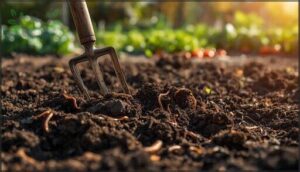
Healthy soil is the foundation of a productive year-round garden, no matter what season you’re planting for. You’ll need to focus on building organic matter, ensuring proper drainage during wet months, and maintaining consistent moisture when the weather shifts.
Let’s break down the essential soil preparation techniques that’ll keep your garden thriving through every season.
Composting and Soil Enrichment
You can’t grow year-round without feeding your soil first. Compost tea and well-aged organic matter boost soil microbes that drive nutrient cycling, increasing water retention by 15–25% and building humic acids that stabilize structure.
A simple compost bin transforms kitchen scraps into the foundation of soil health, cutting synthetic fertilizer needs by up to 40% while your soil management improves with every season.
Drainage Solutions for Winter
Good winter drainage turns waterlogged beds into productive zones. In cold climates, surface grading can cut soil saturation by 25%, while subsurface tile drains reduce root-zone waterlogging by 30–40%. Raise beds 15–20 cm for stable moisture, and slope them 1–2% to prevent frost-heave in clay. These soil preparation techniques for winter gardening give your cold hardy vegetable varieties the oxygen and frost protection they need.
Understanding the semantic structure of a text, such as analyzing theme development techniques, can also improve comprehension of gardening concepts.
Mulching for Moisture and Temperature Control
Once drainage is dialed in, mulch becomes your all-season ally. A 5–10 cm layer cuts evaporation by up to 60%, reduces weeds by 70–95%, and steadies soil temperature swings by 40–60%—perfect for cold-hardy vegetable varieties in year-round gardening. Choose your soil insulation wisely:
- Straw for moisture retention and slow nitrogen release
- Wood chips for long-lasting weed suppression
- Coconut coir for summer cooling
- Reflective mulches to trim heat gain by 1–2°C
Protecting Vegetables From Frost and Cold
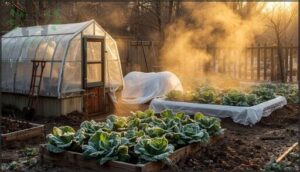
Frost doesn’t have to put an end to your harvest if you’re ready with the right protection strategies. A few simple structures and techniques can shield your crops from freezing temps, extending your season well into winter or even year-round.
Here’s a look at the most effective methods to keep your vegetables safe when the cold settles in.
Using Cold Frames and Row Covers
Cold frames and row covers form your front-line defense against freezing temperatures. Cold frames can push your growing season 2–8 weeks longer on each end, while 30–40 g/m² row cover materials boost soil temps by 2–4°C. Together, they slash frost damage probability by 60–80% in zones 6–9.
| Method | Temperature Boost | Season Extension |
|---|---|---|
| Cold frames | Zone +1.5 warmer | 2–6 weeks earlier/later |
| Row covers | +2–4°C soil temp | Continuous protection |
| Combined approach | Maximum protection | Up to 8 weeks total |
Greenhouse Tunnel Covers and DIY Solutions
Greenhouse tunnel covers offer serious season extension, adding 6–8 weeks in temperate climates. DIY film materials cost $2–6 per square meter and transmit 85–92% light. Double-layer designs with air gaps hold warmth down to -10°C.
Add automatic ventilation systems or solar-powered fans for climate control, and you’ll master year-round gardening in any zone.
Insulation and Mulching Techniques
Beyond cold frames and tunnel covers, you’ll need strategic insulation materials and mulch to lock in soil temperature gains. Organic mulches—straw or wood chips at 2–4 inches—stabilize temperatures by 2–4°C and extend harvests by 2–6 weeks.
Add thermal mass like water barrels inside insulated structures, and you’ll create a microclimate that shaves frost events by 25% while perfecting your protected gardening setup.
Season Extension Methods and Tools
When frost threatens your crops, the right structures can buy you weeks or even months of extra growing time. Cold frames, greenhouse tunnels, and smart ventilation systems each play a different role in protecting your plants and extending your harvest window.
Let’s look at how to build, choose, and automate these season-stretching tools for your garden.
Building and Using Cold Frames
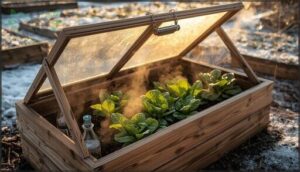
Think of cold frames as your secret weapon for protected gardening—they’re simple bottomless boxes that trap solar heat and shield cold-tolerant crops from harsh winds. Here’s how to build and use one for season extension:
- Choose rot-resistant timber or polycarbonate panels for frame materials that last 10–15 years
- Size your cold frame at 1.5 m × 2.0 m for ideal growing area
- Install automatic vent openers to reduce daily temperature management by 60–75%
- Add thermal mass like water-filled bottles to stabilize overnight temps by 3–6°C
- Apply row covers during cold snaps for 40% extra insulation
With proper ventilation systems and insulation methods, you’ll see spinach and lettuce yield 2–3 extra harvests per season—that’s winter gardening tips that actually deliver results.
Choosing and Installing Greenhouse Tunnels
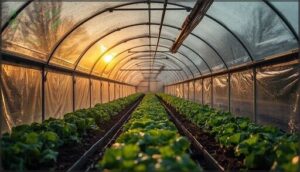
Greenhouse tunnels let you push your growing zone by 4–6 months when you pick the right tunnel materials and frame designs. Here’s your setup blueprint:
| Feature | Standard Choice | Premium Option |
|---|---|---|
| Frame | Galvanized steel (7–15 years) | Aluminum with reinforced ribs |
| Cover | UV-stabilized polyethylene | Double-layer polycarbonate panels |
| Size | 6–8 ft height × 10 ft width | Custom dimensions for your beds |
Install proper anchoring and ventilation systems—your winter gardening tips start with protected gardening strategies that work.
Automating Ventilation and Temperature Control
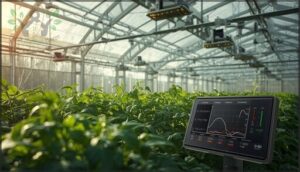
Sensors and actuators turn your greenhouse into a smart climate control hub that works while you sleep. Modern systems maintain temperatures within 2–3°C of your setpoint, cutting heating bills by up to 20% through night venting and automatically reducing disease pressure by 15–30% with stable microclimates.
- Multi-parameter sensors track temperature, humidity, and CO2 for 12–32% better consistency
- Temperature-activated vents prevent overheating during sunny winter days
- PID controllers reduce temperature swings by 40–60% during weather shifts
- Wireless networks lower installation costs by 10–25% in protected gardening strategies
- Backup sensors cut downtime by 90% during power outages
These automated sensors transform seasonal gardening into true year-round gardening—your ventilation systems handle the heavy lifting while you focus on harvests.
Indoor Vegetable Gardening Strategies
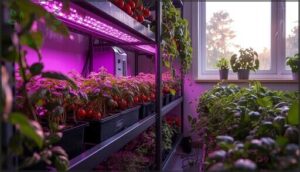
When outdoor conditions won’t cooperate, bringing your vegetable garden inside opens up a whole new world of possibilities. You’ll need the right lighting, climate control, and environmental management to replicate what nature provides outdoors.
Let’s look at the three core components that make indoor vegetable gardening successful year-round.
Selecting The Right LED Grow Lights
You’ll want LED grow lights that deliver 200–600 μmol/m²·s PPFD levels for strong leafy-green growth in your indoor gardening setup. Full-spectrum fixtures with blue (450 nm) and red (660 nm) wavelengths boost photosynthesis efficiency by up to 40%, making them ideal for year-round growing and winter greenhouse gardening.
Energy efficiency matters—look for 20–70 watts per square foot to balance light intensity with operating costs.
Controlled Environment Systems
Integrated climate control cuts seasonal yield swings by 28–45% when you pair automated venting, heating, and LED lighting in your year-round growing setup. Greenhouse gardening with multi-zone systems optimizes conditions for different crops simultaneously, boosting throughput by 12–25%.
Hydroponics and vertical farming fit neatly into controlled environments, slashing water use by 70–90%. Indoor gardening automation manages the heavy lifting.
Managing Light, Temperature, and Humidity
Your automation takes over once climate targets are set. LED grow lights push spectra optimized for canopy photosynthesis, delivering 15–25% efficiency gains. Set day temperatures at 20–22°C and night at 16–18°C for 25–40% faster crop cycles. Keep humidity between 55–65% to cut disease by 12–25%.
Here’s your quick checklist:
- Target 12–16 hour photoperiods for 20–35% winter yield boosts
- Maintain 0.5–1.0 air changes per hour for 800–1200 ppm CO₂
- Log data every 15 minutes to predict harvests within ±7%
- Use MERV 8–11 filters to reduce foliar disease 10–25%
Monthly Guide: What to Plant Each Month
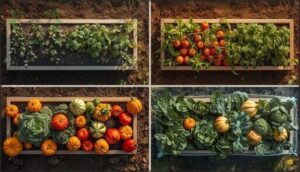
Timing is everything when you’re growing food year-round. Each season brings different opportunities and challenges, so knowing what to plant and when makes all the difference between a thriving garden and a struggling one.
Here’s a month-by-month breakdown to help you plan your planting schedule for every season.
January–March Planting Suggestions
During winter, you can reclaim control of your harvest window by starting hardy greens indoors—arugula, spinach, and lettuce germinate above 85% and give you a 14–21 day head start over direct sowing.
Focus your energy on cool season planting staples like kale, broccoli, and bok choy; transplanting them after a 4–6 week nursery phase boosts yields 15–30% while protecting roots from fluctuating soil temperature.
April–June Planting Suggestions
As soil temperatures climb past 15°C, you’re ready to shift gears from cool season crops to warm season planting. This spring gardening window offers a prime opportunity for frost protection strategies that cut losses by 40%—row covers give you an extra 4–8°C buffer while you transplant tomatoes and peppers.
Master these vegetable gardening essentials now:
- Direct-sow lettuce and spinach every 2–3 weeks
- Pre-warm trays indoors for faster germination
- Mulch transplants to lock in moisture
July–September Planting Suggestions
Late summer heat doesn’t mean your garden winds down—it’s prime time for strategic planting that bridges harvest gaps. Your summer crop selection can extend yields by succession planting bush beans and zucchini every 10–14 days. Meanwhile, start broccoli and cabbage indoors now for cool-season transplants in early September. Smart late-season sowing of radishes and turnips keeps your table stocked when soil temps hover between 18–24°C.
| Crop Type | Timing | Key Strategy |
|---|---|---|
| Fast roots (radishes, turnips) | Direct-sow mid-July | Succession every 2 weeks |
| Warm crops (beans, zucchini) | Sow through August | 10–14 day intervals |
| Cool transplants (broccoli, cabbage) | Start indoors late July | Move outdoors early Sept |
| Leafy greens (lettuce, spinach) | Late August sowing | Use 30–50% shade cloth |
| Overwintering bulbs (garlic, shallots) | Plant late August–Sept | Establishes for spring harvest |
Apply 2–3 inches of mulch to cut water needs by 20–30% during peak heat, and drape shade cloth over heat-sensitive greens when temperatures spike—you’ll maintain leaf temps within 5–8°F of ambient air.
For fall garden prep, direct-sow cold-tolerant lettuce and spinach varieties in late summer when soil stays above 16°C, achieving 85%+ germination. Growing vegetables year-round means planning now for winter bounty: garlic planted in late summer develops sturdy roots, boosting next year’s yield by 10–30%.
Indoor setups with 12–16 hour LED photoperiods deliver harvest-ready herbs in 28–40 days, perfect for gardening in different climates. Cover cropping post-harvest enriches soil with 40–60 kg nitrogen per hectare, setting up your year-round gardening system for nonstop production.
October–December Planting Suggestions
As autumn cools your garden, focus on cold-hardy crops that thrive when others fade. Direct-sow spinach and kale in zones 7–9 for December harvests, planting 6–8 weeks before the first frost when soil stays above 4°C.
Layer 2–4 inches of mulch to stabilize temps by 2–4°C, while row covers add another 4–8°C protection—essential frost protection methods for growing vegetables year-round in challenging climates.
Advanced Techniques for Consistent Harvests
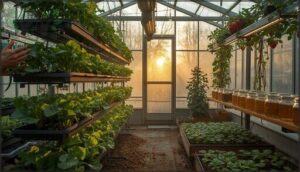
Once you’ve mastered the basics of year-round growing, you can take your harvests to the next level with techniques that boost productivity and extend your season even further.
These sophisticated methods give you more control over your growing environment, whether you’re working with a small indoor setup or maximizing outdoor space.
Here’s how to push your garden’s potential and keep those harvests coming strong all year long.
Hydroponics and Recirculating Systems
Recirculating hydroponic systems slash water use by 70–90% compared with traditional soil preparation, making year-round growing more sustainable. These gardening techniques automate nutrient management and boost vegetable gardening productivity two to five times over outdoor methods.
- System efficiency: Target EC ranges of 1.6–2.4 dS/m and pH 5.5–6.5 for ideal nutrient uptake in your year-round gardening setup
- Water conservation: Reservoirs sized at 15–30 liters per square meter stabilize nutrient concentration throughout growing cycles
- Yield potential: Hydroponic systems paired with LED lighting deliver consistent harvests in controlled environments for true year-round growing
Light Recipes for Leafy Greens
Fine-tuning your grow light systems with the right LED spectra transforms indoor year-round gardening. Red-blue ratios of 4:1 to 2:1 deliver 9–14% faster head formation in lettuce while boosting photosynthetic efficiency.
You’ll see kale and spinach thrive under 14–16 mol·m⁻²·d⁻¹ light intensity, with optimized spectra increasing biomass by 15–25% per photon compared to standard LEDs when growing vegetables year round.
Maximizing Yield in Small Spaces
Vertical farming unlocks 3–8 times more yield per square meter than horizontal layouts, turning tiny footprints into productive powerhouses.
Stack 2–4 growing levels with trellises, pair LED lighting at 200–400 μmol/m²/s with hydroponic systems, and you’ll cut water use by 40–70% while boosting harvest density by 25–40% through smart space optimization and year-round gardening techniques.
Maintenance Tips for Year-Round Success
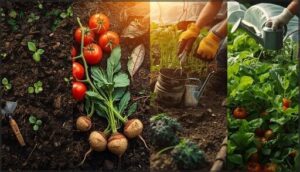
Year-round gardening isn’t just about planting the right crops—it’s about staying on top of the small, essential tasks that keep your garden healthy through every season. Success comes from building consistent routines, catching problems early, and adjusting your approach as the weather shifts.
Here’s how to maintain a thriving garden all year long without letting it take over your life.
Daily and Weekly Task Checklists
Year-round gardening thrives on consistency, not flawlessness. Your daily tasks—checking soil moisture, inspecting plant health, and adjusting covers—take just 15 minutes.
Weekly planning includes harvesting ripe crops, rotating plantings to prevent nutrient depletion, and applying the 80/20 rule to focus on high-impact activities.
Task scheduling keeps your garden productive through every season, building momentum toward true self-sufficiency.
Pest and Disease Monitoring
Weekly scouting catches 70–90% of pests before they damage your crops. Check leaves, soil, and stems for aphids, mites, or early fungal spots—threshold-based interventions slash fungicide use by 30–70% while preserving yield.
Organic pest control, like beneficial insects, cuts pesticide needs by up to 60%, strengthening soil health and supporting sustainable gardening.
Early detection turns small problems into manageable wins, keeping your self-sufficiency plan on track.
Seasonal Garden Adjustments
As seasons shift, your garden mapping and crop rotation plans need to shift with them. Adjust frost protection depth by 20–40% in spring and fall, rotate nutrient-demanding crops every 90 days, and match soil preparation to incoming climate zones—think heavier mulch for winter gardening, lighter cover for summer heat.
Seasonal pruning and tweaked spacing keep your year-round gardening productive through every calendar change.
Frequently Asked Questions (FAQs)
What vegetable varieties recover best after unexpected frost?
Don’t assume cold hardy vegetables are invincible—even kale and broccoli need smart regrowth strategies.
Brassicas, spinach, carrots, and parsnips lead in frost recovery, bouncing back with 75–90% yields when you use row covers and mulch for protecting plants from frost.
How much does a year-round garden cost annually?
Budget around $300 to $1,500 annually for ongoing expenses—energy costs, compost, and seeds dominate.
Initial investment in frames or lights pays off through labor savings and cost efficiency as your year-round vegetable gardening hits its stride.
Can container gardens produce vegetables through winter effectively?
Container gardening can yield 30–40% of summer harvests through winter using LED lighting, insulation, and frost protection.
Cold climate gardening in containers succeeds with soilless cultivation, proper soil preparation for winter gardening, and consistent temperature control.
Which vegetables need vernalization to produce properly?
Many brassicas—like broccoli, cabbage, and kale—need weeks of cold exposure (vernalization) to trigger flowering and proper head formation.
Cold tolerance alone isn’t enough; these brassica crops require specific winter conditions for successful harvests.
How do you rotate crops in continuous planting?
You’ll rotate crops by grouping vegetables into family-based blocks and cycling them through beds on a three-year schedule. This ensures the same family doesn’t repeat in one spot more than once every three years, maintaining soil health and reducing pest pressure.
Conclusion
Think of your garden as a relay race where one crop passes the baton to the next before the lane goes cold. Growing vegetables year-round demands that constant handoff—succession plantings flowing into cold frames, then migrating indoors under LEDs when frost bites hard.
You’ve now got the roadmap: twelve months of harvests hinge on treating each season as another leg in the race, not a finish line.
- https://store.tenthacrefarm.com/complete-garden-planning-system
- https://books.tenthacrefarm.com/the-permaculture-inspired-vegetable-garden/?utm_source=taf&utm_campaign=TPIVG2&utm_medium=banner1-link
- http://charleysgh.com/
- https://www.groworganic.com/
- https://abundantpermaculture.com/fast-growing-vegetables-for-a-quick-harvest