This site is supported by our readers. We may earn a commission, at no cost to you, if you purchase through links.

Your herbs won’t survive in the wrong soil—no matter how much you water them or how perfect your sunlight exposure. Root rot claims roughly 22% of herb gardens planted in poorly draining conditions, turning promising basil and rosemary into compost before they ever reach your kitchen.
The difference between thriving herbs bursting with flavor and sad, wilting plants often comes down to what’s happening beneath the surface. Getting your herb garden soil requirements right means understanding the precise balance of drainage, texture, pH levels, and nutrients that transform ordinary dirt into a growth medium your herbs actually want to live in.
Master these fundamentals, and you’ll gain the control to grow sturdy, aromatic herbs that outperform anything from the grocery store.
Table Of Contents
Key Takeaways
- Well-draining soil with 40% sand, 40% silt, and 20% clay prevents root rot (which kills 22% of herb gardens) while maintaining the water retention and aeration your herbs need to develop full flavor.
- Most culinary herbs thrive in soil with a pH between 6.0 and 7.5, and testing every six months prevents nutrient lockout that can crash your harvest by limiting iron, manganese, and other essential minerals.
- Mixing 20–30% organic matter like compost into your soil boosts basil growth by 20–40% through enhanced microbial activity and nutrient availability, but you’ll need to balance nitrogen-phosphorus-potassium ratios to maximize essential oil production.
- Container herbs demand 20–30% air-filled porosity in potting mixes (using perlite, coco coir, or vermiculite) to prevent waterlogging and root disease, while outdoor beds need 3–5% organic matter and drainage that clears water within 5–20 minutes.
Essential Soil Qualities for Herb Gardens
Your herbs won’t thrive in just any dirt—they need specific conditions to develop the flavor and resilience you’re growing them for. The right soil creates the foundation for vigorous growth, preventing the root rot and nutrient deficiencies that plague most beginner herb gardens.
The right soil creates the foundation for vigorous herb growth, preventing the root rot and nutrient deficiencies that plague most beginner gardens
Here are the four essential qualities your herb garden soil must have to give you that lush, aromatic harvest you’re after.
Importance of Well-Draining Soil

Without good drainage, your herb garden won’t survive—it’s that simple. Water infiltration and soil porosity directly impact root respiration, the foundation of vigorous growth.
Here’s what proper drainage delivers:
- Reduces root rot risk by 22% in waterlogged conditions
- Accelerates early-season growth by 12–18% compared to compacted soil
- Boosts germination consistency when infiltration improves 30–50%
Choose your potting mix and soil selection wisely—drainage systems make or break your herbs.
Ideal Soil Texture and Composition
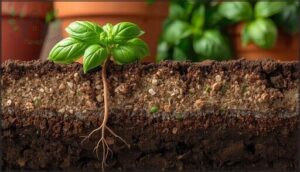
Once drainage is dialed in, soil structure and composition determine your success. You want loam—40% sand, 40% silt, 20% clay—giving you balanced water retention and nutrient balance. For containers, shift to 50–70% perlite or coir in your potting mix to prevent compaction.
Garden soil with 3–5% organic matter fuels microbial activity and mineral content, unlocking flavor you can taste.
Understanding the literature review process is essential for evaluating the scientific basis of gardening practices.
Optimal PH Range for Herbs
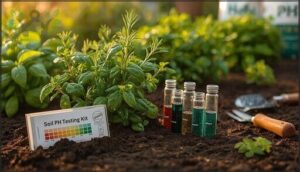
You can build the perfect soil texture, but if pH levels sit outside 6.0–7.5, nutrient availability crashes. Most culinary herbs thrive between 6.5 and 7.0—basil peaks here, rosemary tolerates slight alkalinity up to 7.5, mint adapts across 5.5–7.5. Test every six months using a soil pH testing kit.
Alkalinity effects lock out iron and manganese, while soil acidification below 5.5 risks zinc toxicity. Adjust with lime or sulfur, monitor micronutrient management, and match fertilizer application to your readings. Understanding the main topic details is vital for creating an ideal environment for herb growth.
Role of Organic Matter and Nutrients
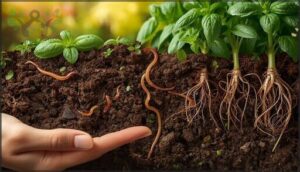
Organic matter transforms herb beds into nutrient powerhouses. Compost-enriched soils boost basil biomass 20–40% over mineral-only mixes through enhanced microbial activity and cation exchange.
Balanced nitrogen-phosphorus-potassium ratios fine-tune essential oil production; vermicompost and compost tea deliver readily available nitrate while improving nutrient content and soil composition.
Regular testing guides fertilizer application, preventing nutrient imbalances that suppress vigor by 8–12% in container herbs.
Choosing Soil for Indoor and Outdoor Herbs
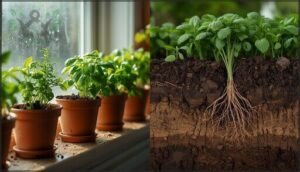
Your herbs won’t thrive in just any dirt you throw at them. Indoor and outdoor growing environments demand different soil strategies, and choosing the wrong one can mean the difference between a flourishing harvest and a disappointing flop.
Let’s break down exactly what works for containers, garden beds, and raised setups so you can nail your soil choices from the start.
Best Potting Mixes for Indoor Herb Gardens
Your indoor herb garden thrives when you master the foundation—literally. The best potting mix recipes combine 30–40% soilless base with 20–30% organic matter, plus 60–70% aeration components like perlite for container gardening success.
This balanced indoor herb soil maintains pH between 6.0 and 7.0, prevents waterlogging, and delivers oxygen to roots. Fresh potting mix and proper soil aeration methods outperform garden soil every time.
Outdoor Garden Soil Requirements
Your outdoor herb plot demands soil that works as hard as you do—loam or sandy loam textures excel because they balance water retention with compaction prevention. Target 3–5% organic matter to fuel nutrient cycling and microbial balance, while maintaining soil pH between 6.0 and 7.0.
- Test drainage: water should vanish within 5–20 minutes to prevent root rot
- Add 2–3 inches of mulch to cut soil erosion by 70% during storms
- Amend heavy clay garden soil with compost for outdoor gardening success
Raised Bed Soil Considerations
You’ll achieve faster herb establishment—up to 15% quicker—when your raised bed hits 12–18 inches deep with bulk density below 1.3 g/cm³. Proper bed depth and soil structure transform root zone performance, cutting waterlogging risk by 40% in clay soils while boosting soil aeration through coarse organic matter at 25–40% volume.
| Soil Layer | Amendment Strategy | Performance Gain |
|---|---|---|
| Base (6–8″) | 20–35% coarse sand in clay loam | Drainage class improves from imperfect to well-draining |
| Middle (4–6″) | Biochar at 5% volume + finished compost | Nutrient retention rises 12–25%; ideal C:N ratio 15:1–25:1 |
| Top (2–4″) | Mulch layer (leaf mold or composted bark) | Surface evaporation drops 20–25%; temp swings reduced 2–4°C |
Nail soil pH between 6.0–7.0 during soil preparation—deviations beyond ±0.5 units slash micronutrient availability by 40%. Mix garden soil with 10–20% composted manure to raise organic matter 2–3% per season, then monitor drainage systems with periodic testing every 6–12 weeks to keep nutrient content dialed in and excess risk down 30–40%.
Adjusting Soil for Container-Grown Herbs
Container gardening demands 20–30% air-filled porosity in your potting mix to prevent root saturation and disease.
Target soil pH between 6.0–7.0 for ideal herb nutrition and nutrient content—blends with 20–40% organic matter boost micronutrient access by 15–28%.
Container mixes holding 25–40% peat or coir slash watering needs by 20–40% while protecting root health through excellent soil aeration and water management.
Soil Preferences for Popular Culinary Herbs
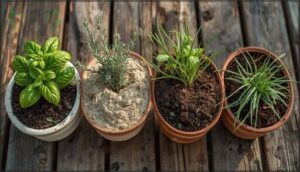
Not all herbs play by the same rules regarding soil. Each culinary favorite has its own quirks—some thrive in lean, fast-draining conditions, while others demand richer, moisture-retentive ground.
Let’s break down what basil, rosemary, mint, and chives actually need to hit their full flavor potential.
Basil Soil Needs
Basil nutrition thrives when you pair well-draining potting mix with a soil pH between 6.0 and 7.5—trials show peak essential oil production at 6.5.
Boost soil structure with 20–30% coarse compost for better water management and root health.
Use balanced fertilization (3:1:2 N:P:K ratio) to increase leaf area by up to 25% while avoiding salinity above 2 dS/m in your herb garden soil.
Rosemary Soil Preferences
Rosemary fertilization demands sandy-loam garden soil with outstanding drainage systems—waterlogging for even 24 hours triggers crown rot and destroys root health. Target a pH level between 6.0 and 7.5, ensuring calcium levels stay strong while keeping organic matter modest at 2–4%.
Soil science proves that light, aerated herb garden substrates with rapid water evacuation boost essential oil production and vigor in this Mediterranean powerhouse.
Mint Soil Requirements
While rosemary thrives in drier conditions, mint demands the opposite—consistently moist herb garden soil loaded with organic matter. You’ll want that 60–75% moisture retention sweet spot paired with a soil pH between 6.0 and 7.0 for explosive leaf production.
Mix 25–40% compost into loamy, well-draining substrates to boost essential oil yield and root quality. Mint’s moderate salinity tolerance copes with irrigation water up to 0.8 g/L without yield decline.
Chives Soil Recommendations
Where mint craves moisture, chives strike a different chord—thriving in loamy to sandy loam herb garden soil with a 6.0–7.0 pH level and 3–5% organic matter. You’ll see 20–30% faster herb growth in well-aerated substrates than in depleted potting mix.
Chive nutrition and root health depend on:
- Soil aeration with 20–30% perlite boosting shoot density 12%
- Water management maintaining 60–80% saturation
- Fertilizer tips: slow-release NPK improves 6–8 week harvests 20–30%
- Proper soil types preventing root rot incidents by 30%
Top 5 Soil Additives for Healthy Herbs
You can’t build a thriving herb garden on subpar soil—but the right additives turn ordinary dirt into a powerhouse growing medium. These soil amendments improve drainage, aeration, and nutrient retention, giving your herbs exactly what they need to flourish.
Here are five game-changing additives that’ll transform your herb garden soil from average to outstanding.
1. Organic Coco Coir Planting Chips
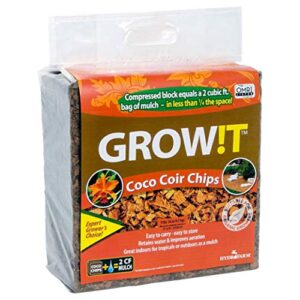
You’ll gain serious traction with organic coco coir planting chips—these compressed blocks expand into over 2 cubic feet of premium mulch that holds 8–9 times its weight in water.
When you mix coco chips at 20–30% by volume into your potting mix, you boost air-filled porosity by 8–12%, giving herb roots the oxygen they crave while maintaining excellent drainage.
Coco coir’s neutral soil pH (5.5–6.8) won’t shock your system, and it resists fungus naturally, decomposing slowly over 1.5–3 years to sustain long-term soil structure and herb growth.
Best For: Gardeners and indoor plant enthusiasts who want a sustainable, water-retentive soil amendment that improves drainage and aeration for herbs, tropical plants, or hydroponic setups.
- Holds 8–9 times its weight in water while boosting soil porosity by 8–12%, giving roots consistent moisture and oxygen without waterlogging.
- Expands from a compact 9-pound block into over 2 cubic feet of mulch, making it easy to store and transport until you need it.
- Naturally resists fungus and maintains a neutral pH (5.5–6.8), so it won’t throw off your soil balance or invite disease.
- Can’t be shipped to Oregon, limiting availability for gardeners in that state.
- Tightly compressed blocks may be tough to break apart and require soaking before use, adding an extra prep step.
- May need occasional flushing every 4–6 weeks to prevent salt buildup from irrigation water, especially in container setups.
2. Organic Rice Hulls Garden Mix
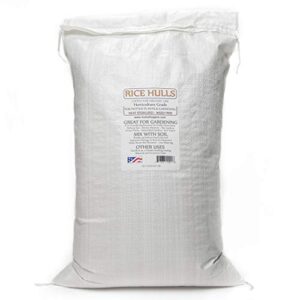
You’ll discover organic rice hulls provide a rebel’s alternative—100% biodegradable hulls that improve soil aeration by 18–42% and boost drainage faster than sand alone.
When you incorporate hulls at 15–25% by volume into raised beds or containers, you’ll cut soil crusting by up to 38% and maintain moisture 5–10% longer during drought.
Rice hull decomposition runs slow—2 to 3 years—gradually enriching organic matter while keeping macroporosity high, so your herbs breathe easy and roots penetrate deeply without compaction.
Best For: Gardeners who want long-lasting soil improvement in raised beds, containers, or herb gardens without the constant reapplication that peat or vermiculite demand.
- Cuts soil crusting by up to 38% and improves aeration by 18–42%, so your roots get oxygen and water moves through without pooling.
- Decomposes slowly over 2–3 years, meaning you’re building organic matter and structure that sticks around instead of breaking down in a season.
- Holds moisture 5–10% longer than peat during dry spells while draining 25–40% faster than sand in heavy soil—you get the best of both worlds.
- Mixed reviews on value for money, especially if you’re covering large garden areas and need multiple bags to hit that 15–25% mix ratio.
- Some users report it doesn’t hold up well against insects, which could be a problem if pests are already an issue in your beds.
- Weighs less than vermiculite or perlite, so if you need ballast or heft in your containers, you might find it too light for certain setups.
3. Natural Perlite Soil Aerator Mix
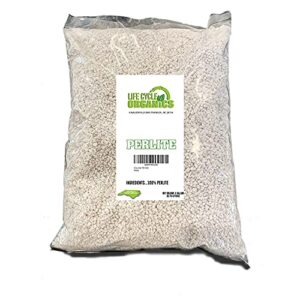
Perlite benefits deliver instant soil aeration, boosting air-filled porosity beyond 25% so your herbs’ roots seize oxygen and never drown. This pH-neutral volcanic rock won’t alter your bed’s chemistry, yet good drainage and root health soar as bulk density drops.
Mix 10–20% perlite by volume into any potting mix or potting soil, and you’ll slash compaction while drainage systems open up 30% faster than unamended soil types. For seed starting, push perlite to 30–50% and watch uniform germination enable garden optimization from day one.
Best For: Gardeners fighting heavy clay soils or anyone growing herbs and succulents in containers who needs better drainage without messing with pH levels.
- Boosts aeration and drainage fast—air porosity jumps over 25%, so roots breathe easy and waterlogging becomes rare
- Stays neutral and won’t break down over time, meaning your soil structure holds up season after season
- Works across the board—seed starting, indoor pots, outdoor beds—just adjust the ratio and you’re set
- Ships with no nutrients, so you’ll need to keep up with fertilizer to actually feed your plants
- Can arrive crushed or smaller particles than expected, which affects how well it loosens soil
- Go overboard past 30% and drainage gets too aggressive, leaving roots dry and nutrients washed out
4. Organic Vermiculite Granules For Plants
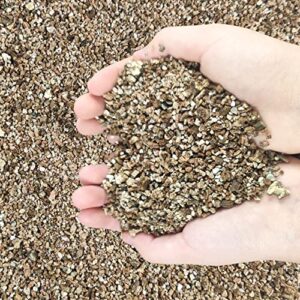
You’re claiming your garden when you layer vermiculite into your potting mix. Water retention climbs 50%, nutrient balance locks in 15–30% more minerals, and soil aeration stays open without compaction crushing root health.
Blend 15–25% vermiculite by volume with coco coir and compost, and you’ll trigger uniform moisture distribution that slashes watering frequency while organic gardening methods thrive.
This inert mineral won’t shift pH, yet it sustains plant nutrition and soil maintenance season after season without breaking down.
Best For: Gardeners who need reliable water retention and aeration in potting mixes for herbs, houseplants, or raised beds without worrying about soil compaction or pH shifts.
- Boosts water retention by up to 50% and locks in 15–30% more nutrients, cutting down how often you need to water
- Stays stable across multiple growing seasons without breaking down or messing with your soil’s pH
- Improves drainage and aeration in dense mixes, keeping roots healthy and preventing compaction
- Mixed reviews on particle size—some find it too fine or too large for their specific needs
- Packaging can arrive damaged with flimsy or torn bags, and the product itself may have excessive dust
- Reports of the material tearing or crumbling easily, which affects durability during handling
5. Desert Sand Soil Cover Mix

Desert soil benefits start where overwatering ends—this sand cover mix cuts surface evaporation by 40% and keeps soil temperature steady within 2.5°C across day-night swings, giving heat-loving basil and thyme a 15–20% emergence edge. Layer it over your potting mix or raised bed soil, and you’ll lock in herb moisture without drowning roots.
Desert gardening demands drainage, and this low-nutrient cover forces you to fertilize intentionally while soil maintenance stays minimal across garden soil types year after year.
Best For: Gardeners growing heat-loving herbs like basil and thyme who need better moisture retention and drainage without constant watering.
- Cuts surface evaporation by 40% and keeps soil temperature stable, boosting germination rates by 15–20% for Mediterranean herbs
- Excellent drainage that prevents overwatering while locking in moisture where roots need it
- Low-maintenance cover that stays effective across different soil types with minimal upkeep
- Low nutrient content means you’ll need to add fertilizers or organic matter regularly
- Can shift or get displaced during watering, requiring occasional reapplication
- Smaller bag size and higher price point compared to basic sand alternatives
Frequently Asked Questions (FAQs)
How often should I replace herb garden soil?
You’d think soil lasts forever—it doesn’t. Replace potting soil every 1–2 years for containers, refresh raised beds annually with 2–3 inches of compost, and test in-ground herb garden soil for drainage decline or pH drift.
Can I reuse soil from dead herb plants?
You can reuse soil from dead herb plants, but pathogen risk and nutrient depletion demand caution.
Soil sterilization eliminates disease threats, while composting and nutrient replenishment restore garden soil structure before replanting.
What causes white mold on herb garden soil?
White mold appears when fungal species like Sclerotinia thrive in overwatered conditions with poor air circulation.
High humidity, dense organic matter, and stagnant moisture create ideal environments for these surface fungi to colonize your containers.
Do herbs need fertilizer during winter months?
Most herbs don’t need fertilizers during winter months. Seasonal nutrient demands drop as soil microbes slow and dormancy care begins—cold climate conditions reduce nutrient uptake by 40–70%, making winter fertilization unnecessary in your herb garden.
Should I sterilize soil before planting herbs?
Less is more: sterilization wipes out beneficial microbes your herbs need. Skip it—pasteurization methods in quality potting soil balance pathogen control with microbe vitality, protecting soil quality without sacrificing the living ecosystem that fuels growth.
Conclusion
Your next harvest depends on decisions you make today—before a single seed touches soil. Nail your herb garden soil requirements now, and you’ll bypass the frustration of plants that never quite perform.
The right drainage, texture, and nutrient balance don’t just support growth—they release the full aromatic potential locked inside every variety.
Build that foundation correctly, and you won’t just grow herbs. You’ll command them.
- https://soiltesting.cahnr.uconn.edu/
- https://ipm.cahnr.uconn.edu/herbs-greenhouse/
- https://nam10.safelinks.protection.outlook.com/?url=https%3A%2F%2Fhomegarden.cahnr.uconn.edu%2F&data=05%7C02%7Cheather.zidack%40uconn.edu%7Cbb7351998b654ba8da6408dd4b938887%7C17f1a87e2a254eaab9df9d439034b080%7C0%7C0%7C638749819193498580%7CUnknown%7CTWFpbGZsb3d8eyJFbXB0eU1hcGkiOnRydWUsIlYiOiIwLjAuMDAwMCIsIlAiOiJXaW4zMiIsIkFOIjoiTWFpbCIsIldUIjoyfQ%3D%3D%7C0%7C%7C%7C&sdata=7ZLyGwcTglbPIVmEvldaK3w5VGQDnLbhYv5Y81sznI4%3D&reserved=0
- https://www.ncbi.nlm.nih.gov/books/NBK481583/
- https://writers.com/common-themes-in-literature