This site is supported by our readers. We may earn a commission, at no cost to you, if you purchase through links.
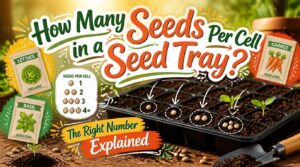
Sow one seed per cell and gamble on a 15% empty-cell rate. Sow two, and that rate drops to 2%. That gap alone tells you why so many trays come out of the germination chamber looking like a jack-o’-lantern’s grin, gaps where seedlings should be.
How many seeds per cell in a seed tray depends on seed size, age, and vigor, not habit or guesswork. A fresh bean seed and a three-year-old parsnip seed don’t deserve the same treatment, and treating them identically wastes tray space, seed stock, or both.
Get the ratio right, and you’ll thin less, waste less, and fill every cell with a plant worth transplanting.
Table Of Contents
- Key Takeaways
- Sow Two Seeds Per Cell
- Use One Seed for Reliable Crops
- Sow More for Tiny Seeds
- Increase Seeds for Older Packets
- Avoid Overcrowding Seed Tray Cells
- Thin Seedlings The Right Way
- Match Seeds to Cell Size
- Calculate Your Tray Needs
- Transplant Seedlings Without Setbacks
- Frequently Asked Questions (FAQs)
- How many seeds should I put in a seedling tray?
- How long is a 72 cell seed tray?
- How deep should you plant seeds in trays?
- What causes leggy or stretched seedlings in trays?
- Can you reuse seed trays from previous seasons?
- Whats the best soil mix for seed trays?
- How often should you water seedlings before transplanting?
- Conclusion
Key Takeaways
- Sowing two seeds per cell drops empty-cell rates from 15% to 2% at 85% germination, making it the safest default for most vegetables.
- Match seed count to seed condition: use one seed for fresh, large, high-vigor seeds like squash or beans, two to three for tiny seeds like lettuce and herbs, and up to four for old or low-viability seed lots.
- Overcrowding cells causes root tangling, nutrient competition, poor airflow, and higher risk of damping-off disease, so more seeds isn’t always better.
- Calculate your seeds and trays using target plant count divided by germination rate plus a survival buffer, then round the resulting cell count up to the next full tray.
Sow Two Seeds Per Cell
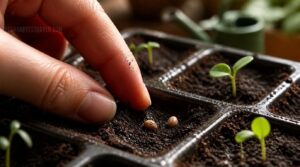
If you’re not sure where to start, sowing two seeds per cell is the safest bet you can make. It costs you almost nothing extra and quietly fixes the biggest headache new growers face. Here’s why this simple habit works so well.
If you want a solid list to start from, these easy spring flowers to grow from seed are forgiving picks that reward the double-sowing trick with strong, reliable germination.
Best Default for Beginners
Two seeds per cell is your germination insurance, plain and simple.
- Boosts sowing confidence for new gardeners
- Doubles seedling success rates instantly
- Cuts empty cells from 15% to 2%
- Works at 85% average germination rates
One seed per cell demands near-perfect viability. Sowing more than one seed hedges your bet without wasting your starter kit essentials.
Prevents Empty Tray Cells
An empty cell is wasted space and wasted time. Redundancy benefits show up fast: two seeds sowed means mitigating failure before it happens.
| Seeds Sown | Empty Cell Rate |
|---|---|
| One | 15% |
| Two | 2% |
That’s germination insurance for rapid establishment and consistent density across the tray.
Works for Most Vegetables
That germination insurance doesn’t discriminate by species. Carrots, peppers, brassicas, beets—sowing two seeds per cell works as a universal default across most vegetable gardening because it balances seedling density against seed cost.
Once these seedlings are transplanted, you can take advantage of beneficial-insect attraction by planting flowering species nearby.
- Carrots: erratic germination, benefits from backup
- Peppers: slower to sprout, needs a buffer
- Brassicas: uniform vigor once thinned
Rounder spacing follows naturally, giving you consistent tray coverage without guesswork.
Adjust for Germination Rate
That default ratio only holds if your germination rate matches the seed tag. Check the tag’s percentage first—calculating sowing density off stale numbers skews everything downstream.
Old lots or rough conditions call for bumping seeds to sow upward. Monitor emergence at 7–14 days, track results by seed lot, and adjust next season’s rate. That’s how you nail expected viable per cell counts consistently.
Use One Seed for Reliable Crops
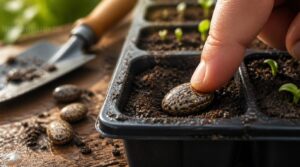
Not every crop needs the two-seed safety net. When your seeds are fresh, large, or easy to handle, one per cell gets the job done. Here’s when you can trust a single seed to carry the whole cell.
Fresh High-quality Seeds
Not all seeds deserve the one-seed-per-cell strategy—only the ones with a proven track record. Fresh, high-vigor seed lots with documented purity and packing dates germinate at 80% or higher, letting you skip the backup seed entirely.
Check moisture content and storage history before trusting a single seed; a lot stored cool, dry, and traceable to its harvest date gives you reliable seedling production without gambling on empty cells.
Large Easy-handled Seeds
Eight to fifteen millimeters puts a seed squarely in the "easy" category, big enough to grip with fingers or a dibber and place accurately, cell by cell.
Thick seed coats shrug off rough handling, while stored energy reserves fuel faster, sturdier germination—raising beginner success rates. High color contrast makes visual placement simple.
- Fewer wasted seeds
- Less second-guessing
- Faster tray setup
- Confidence with every planting
Squash, Beans, Cucumbers
Three warm-season staples, cucumbers, squash, and beans, all belong to families with big, sturdy seeds built for one-per-cell sowing. Fresh Cucurbit seed germinates at 75-95%, so trellised cucumbers and vine-borer-prone squash rarely need backup seeds.
Since these seeds need space to stretch out before transplant day, starting them in 32-cell trays with 2-inch cells built for community gardens gives their vigorous roots the room they need to thrive.
Bush beans reach harvest in 50-60 days without crowding stress. Skip multi-sowing here; thinning strong seedlings later just wastes what good genetics already gave you.
Saves Seed and Space
One seed per cell means efficient seed conservation — no multisowing, no thinning losses, just direct seed-to-plant math.
Pack 32 or 50-cell trays at full maximizing tray density, since every cell counts toward your harvest instead of backup insurance.
This compact layout planning approach scales cleanly, too, from windowsill trays to modular benches, without recalculating your seed starting math each time.
Sow More for Tiny Seeds
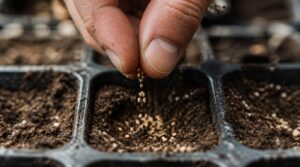
Tiny seeds play by different rules than the big, easy-to-handle ones you just sowed one at a time. Lettuce, herbs, and other fine seeds germinate unevenly, so a single seed per cell leaves too much to chance.
Here’s how to adjust your sowing rate and technique to get consistent results with these small, fussy seeds.
Lettuce and Herbs
Tiny lettuce and herb seeds behave differently than beans or squash, so sowing two to three per cell is the safer bet. Fresh seed still germinates at 75–95%, but shallow sowing (1/8 to 1/4 inch) makes uneven emergence common.
- Keep soil at 60–70°F
- Water gently at soil level
- Watch for damping-off in crowded cells
Thin later once true leaves form.
Uneven Germination Patterns
Why do some cells sprout in three days while neighbors stay silent for a week? Dormancy variability within a seed lot means genetically diverse seeds break dormancy at different rates. Add temperature gradients, moisture uniformity gaps, and seed coat permeability differences, and germination rate becomes unpredictable.
This is exactly why sowing more than one seed per cell boosts germination probability and protects your overall seed germination success before seedling thinning begins.
Two to Three Seeds
Managing seed density for tiny seeds means landing on two to three seeds per cell as your working number. This range balances seed savings against early population reliability, mitigating empty cells without wasting stock.
Once true leaves appear, thin down to the strongest seedling. Sowing more than one seed per cell here directly accounts for germination rate variability, keeping overall seed germination success on track.
Light Surface Sowing
Some seeds, like petunia and lettuce microgreens, skip burial entirely. Press seeds onto the moist surface rather than covering them, since germination depends on light exposure, not depth.
Use a folded card or dilute sand mix for even distribution. Mist gently, add a humidity dome, and keep grow lights 2–4 inches above the tray, 14 hours daily, to trigger reliable germination.
Increase Seeds for Older Packets

Old seed packets don’t play by the same rules as fresh ones, and germination rates can drop well below what the label promises. That’s when you need to rethink your sowing count, not just stick with the usual two-per-cell habit. Here’s what to keep in mind before you plant that aging stash.
Reduced Seed Viability
Old seed packets don’t fail randomly. Storage heat and moisture speed up aging, while oxidative stress quietly damages tissue over years in the envelope.
Onion and parsnip seeds lose viability within one to two years; squash and tomato hold on for five or more if kept cool and dark.
A quick germination test—count sprouts from ten seeds—tells you what you’re really working with before sowing.
Four Seeds Maximum
Once viability drops, bumping up to four seeds per cell is your ceiling, not a starting point. Beyond that, you’re inviting root tangling and competition for oxygen, nitrogen, and water—multisowing that backfires.
Four gives weak stock a fighting chance without crowding the cell into a mortality trap. Snip extras after true leaves form, keeping only the strongest sprout for propagation.
Test Germination First
Guessing wastes seed and space. A quick papertowel germination test on a sample of ten to twenty seeds tells you actual seed emergence rates before you commit trays.
Count sprouts at day 7 and again at day 14, then divide by total tested to get your germination percentage.
- Above 85%: sow two per cell
- 70–85%: sow three
- Below 70%: consider four
Replace Weak Seed Stock
Sometimes the numbers just don’t add up, and that’s your signal. If seed viability testing shows germination below 60%, don’t keep sowing extra seeds to compensate. Check for shriveled seeds, document the germination failure, and request seed lot replacement.
Storage impact assessment matters too—poorly kept lots degrade fast. Fresh stock restores emergence rates, cuts seedling mortality, and protects your overall propagation success rate.
Avoid Overcrowding Seed Tray Cells
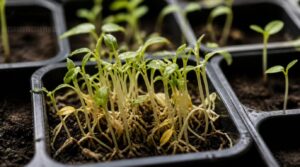
More seeds per cell isn’t always better, and past a certain point, you’re working against your seedlings instead of for them. Once you cross that four-seed ceiling, crowding starts causing real problems below and above the soil line. Here’s what happens when too many seeds compete for the same small space.
Root Tangling Risks
Picture roots as traffic in a roundabout with no exit—too many cars, no one moves. Overcrowded cells force roots to circle instead of spreading, causing root disturbance and stunted root architecture. This limits soil aeration and water absorption, while girdling roots choke stem bases over time.
Overcrowded roots circle like traffic with no exit, choking growth instead of spreading toward it
Left unchecked, tangling raises seedling mortality and weakens overall root health during propagation.
Nutrient Competition
Every seedling in an overcrowded cell is fighting for the same pinch of nitrogen and phosphorus—there’s no split decision here. Exploitation competition lets faster roots grab nutrients first, while interference competition uses root exudate compounds to block neighbors outright.
- Rhizosphere microbes mediating uptake
- Mycorrhizal networks redistributing nutrients unevenly
- Root exudates altering soil chemistry
This cellular tug-of-war undermines your horticultural success rate before true leaves even form.
Poor Airflow Problems
Think of an overcrowded cell like a clogged air filter—dense growth traps stagnant, humid air right at the soil line, just as dirty filters or clogged return vents restrict a home’s airflow. Damaged ductwork and improper system sizing cause similar dead zones.
Poor air circulation in nursery management slows transpiration, stresses germination, and lowers survival, since seedlings depend on moving air as much as HVAC systems depend on unobstructed ducts.
Damping-off Disease Risk
Damping-off doesn’t discriminate—Pythium, Rhizoctonia, Fusarium, Phytophthora, and Alternaria all exploit crowded, humid cells. Overcrowding traps moisture, feeding these pathogens fast.
Cut risk through soil drainage optimization, sanitized trays, and even watering. Beneficial microbes like Trichoderma add another defense.
Give seedlings breathing room, and you protect germination rates, seed viability, and long-term transplant survival across your propagation efforts.
Thin Seedlings The Right Way
Once multiple seedlings pop up in the same cell, you’re left with a choice to make. Only one plant can stay, so the extra sprouts need to go. Here’s exactly how to thin them without hurting the one you’re keeping.
Keep The Strongest Sprout
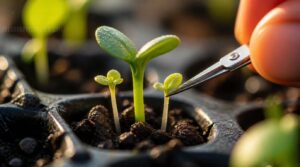
Once two or three seedlings crowd one cell, you’ve got to choose. Selecting dominant seedlings means picking the tallest, sturdiest stem with the healthiest color—that’s your keeper.
Judge by vigor, not sentiment. The rest get cut, protecting primary roots from disturbance so your strongest sprout keeps every advantage toward solid germination and eventual transplant survival.
Snip Weaker Seedlings
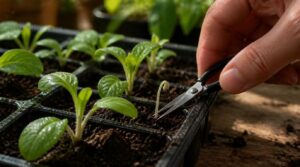
Grab clean scissors, or better yet micro snips, and cut weaklings right at the soil line—thin pale stems, sparse leaves, or seedlings leaning toward light are your targets. Cutting instead of pulling prevents root disturbance to the keeper. Sterilize blades with alcohol between cells.
Time it once true leaves emerge, then water gently afterward to settle the surviving root ball.
Avoid Pulling Roots
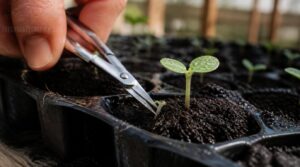
Never yank a keeper’s neighbor—tugging disturbs the root ball and shreds mycorrhizal networks the survivor depends on. Scissors sever cleanly at the soil line without pulling on shared soil.
Keep the medium moist beforehand; dry cells make roots cling tighter, increasing breakage risk during thinning and raising desiccation odds for the plant staying put.
Thin After True Leaves
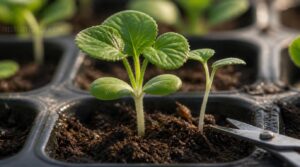
Timing matters as much as technique. Wait until seedlings show two to three true leaves—not just cotyledons—since this signals independent photosynthesis and root systems sturdy enough to survive thinning.
- Leggy, pale stems mean overcrowding and warrant earlier action
- Even canopy formation signals successful nutrient competition prevention
- Healthy true leaves confirm recovery capacity after cuts
Thin too early, before true leaves emerge, and you risk stunting the very seedling you’re trying to save.
Match Seeds to Cell Size
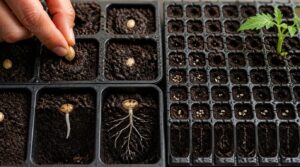
The number of seeds you sow only tells half the story, since the tray itself sets its own limits. Cell size determines how much room roots have to stretch and how fast the soil dries out between waterings. Here’s how the most common tray sizes stack up against what you’re planting.
Large Seeds Need Room
Squash, beans, and cucumbers need legroom, not a cramped closet. Give these seeds deep cells for taproot development and root system expansion before transplanting.
| Cell Type | Best For |
|---|---|
| 32-cell, 2" | Melons, squash |
| 50-cell | Beans, cukes |
Shallow cells invite soil compaction and stunted seedling vigor optimization—size your cells per tray to plant spacing requirements before sowing.
Small Cells Dry Quickly
Physics works against you here: less soil volume means less water reserve, so moisture evaporation rates climb fast in cramped cells.
A 32-cell tray loses moisture roughly 20% quicker than a 50-cell setup under identical airflow, raising rapid dehydration risks and surface crust that blocks germination.
Counter this with light, frequent misting rather than heavy watering—it curbs microenvironment water loss without drowning seedlings.
32. cell Tray Uses
Two-inch cells make 32-cell trays the go-to for large-seeded crop management — melon seedling space, cucumber growth capacity, and pumpkin root development all demand that extra room early on. Squash tray efficiency improves too, since roots spread before transplant shock sets in.
For seedling planning, run a seed tray cell count calculator on cells to sow across these plug formats before committing seed stock.
50. cell Tray Uses
50-cell trays, with 1.75-inch cells, hit the sweet spot for medium cell capacity — enough room for brassica seedling space and lettuce sowing density without wasting tray real estate. Herbs thrive here too.
This balanced tray usage suits crops needing moderate root development before transplant.
Run the Seed Tray Cell Count Calculator first — it clarifies cells to sow and trays needed for accurate seedling planning.
128. cell Tray Timing
128 cells buy you volume, but timing runs tighter. Expect germination in 3 to 14 days, with emergence windows of 5 to 21 days depending on species.
Hold 65 to 75°F for uniform speed, use a humidity dome early, and pre-soak slow crops. Fast growers hit transplant window by 4 to 6 weeks — check counts with the Seed Tray Cell Count Calculator.
Calculate Your Tray Needs
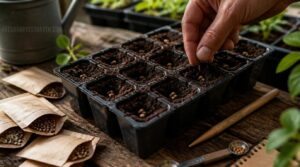
Once you’ve matched your seeds to the right tray, the next step is doing the math so you don’t run short or waste seed stock. This comes down to a handful of numbers working together, not guesswork. Here’s how to walk through that calculation from start to finish.
Desired Plants Count
Everything traces back to one number: how many mature plants you actually want in the garden bed. That’s your target plants figure, and it drives everything upstream, cells to sow, seeds to sow, even tray choice.
Think about garden bed planning and target population density before touching a seed packet. A Seed Tray Calculator or Planting Spacing Tool makes this math painless.
Germination Rate Estimate
Once you’ve got your target plants number, plug in a realistic germination rate estimate rather than guessing. Fresh seed usually runs 75-95%, but seed longevity matters: seeds over two years old often drop below 70%. Species specificity counts too—test with a 100-seed sample under proper temperature conditions.
A Seed Tray Calculator does the math for you once you’ve got real viability testing data.
Survival Rate Buffer
Your germination rate estimate only tells half the story. Real trays face cold snaps, uneven watering, and slow emergers—so build in a survival rate buffer, usually 10-20% above your germination number, to cover those losses.
Older or uneven seed lots need a bigger cushion. Fresh, uniform seed? Trim it back. This buffer keeps your seeds-to-sow count realistic before you run the final formula.
Seeds Per Cell Formula
Now put your buffer to work: cells needed = target seedlings ÷ germination rate, then seeds per cell = expected yield ÷ cells sown.
Sowing two seeds per cell at 85% germination drops empty cells to 2%, versus 15% with one seed.
Multiply germination by survival to get expected viable plants per cell before committing your final seed count.
Round Tray Count Up
Once your cells-to-sow math lands on a fraction, always round up, never down. Dividing 500 seedlings by 85% germination gives you 588.2 cells, so buy trays covering 589. A 128-cell tray means five trays, not 4.6.
This ceiling-function habit mirrors tray counting accuracy in pharmacy work, where partial rows still count toward the total.
Transplant Seedlings Without Setbacks
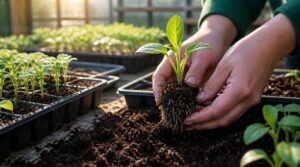
All that careful sowing and thinning work pays off only if the move to permanent soil goes smoothly. Seedlings raised in trays are tender, and a rough transplant can undo weeks of progress in a single afternoon. Here’s what you need to get right, step by step.
Harden Seedlings Outdoors
Skip straight outdoors and tender seedlings scorch overnight. Hardening off toughens stems and leaves gradually.
- Day one: 1–2 hours morning sun, shaded midday
- Add an hour daily over two weeks
- Shield from wind exceeding 15 mph
- Cover if nights drop below 50°F
After 10–14 days of steady exposure, sturdy stems and dark green leaves signal readiness for the transplant window.
Water Before Transplanting
Dunk pots in a tray of water for 30–60 minutes before moving day; you want root ball hydration uniform throughout, not just surface-damp.
Skip past an hour, though, or nutrients leach out. Check garden soil too: it should feel like a wrung sponge. Pre-watering beds 12–24 hours ahead, especially in heat, cuts transplant shock a lot.
Handle Roots Gently
Ease each seedling free by cradling the root ball, never yanking the stem. Root volume stays intact when you support from below.
- Brush old soil off gently
- Tease circling roots outward
- Trim only dead roots
- Keep roots moist, never dry
- Use breathable gloves for grip
Rough handling invites transplant shock and undercuts your horticultural success rate before roots even touch new soil.
Plant at Proper Spacing
Spacing at transplant time isn’t guesswork, it’s math. Give tomatoes 18 to 36 inches and lettuce 6 to 8, matching mature size to airflow needs.
Tight rows invite disease; proper gaps support uniform germination patterns carried into the bed and reduce root crowding long after the seed tray’s forgotten.
Reduce Transplant Shock
Every step from germination onward exists to protect root ball integrity at this final move. Choose a cool, overcast window for the best transplant timing, water thoroughly beforehand, and handle roots gently, no tugging, no bare-root exposure.
Mulch afterward for moisture retention, add shade cloth if sun’s intense, and hold off fertilizing until roots settle. That’s nutrient shock prevention in practice, not theory.
Frequently Asked Questions (FAQs)
How many seeds should I put in a seedling tray?
More seeds won’t guarantee more plants — that’s the irony. Two seeds per cell balances germination and root competition best; at 85% germination, empty cells drop from 15% to just 2%, giving reliable results without wasted vigor.
How long is a 72 cell seed tray?
Standard tray dimensions run about 5 cm long by 28 cm wide, though tray length variations exist (53–54 cm). This footprint fits greenhouse bench spacing and 1020 flats perfectly, simplifying your seed tray cell count calculator work for propagation and planting density planning.
How deep should you plant seeds in trays?
Depth math matters more than gardeners assume: planting at two to three times seed width governs germination success.
Tiny seeds need surface sowing for light exposure; medium seeds go 1/4–1/2 inch deep; deep-rooted crops need more room for root development.
What causes leggy or stretched seedlings in trays?
Weak light below 2000 lux, warm-spectrum bulbs lacking blue wavelengths, temperatures above 70°F, crowded cells, and poor airflow all cause stretching. Fix it with supplemental grow lights, cooler air, and proper spacing during propagation.
Can you reuse seed trays from previous seasons?
Yes—rigid plastic trays without cracks or warping handle multiple seasons well. Clean thoroughly, sanitize to remove pathogens, and dry completely before storage. Thin trays warp under heat; replace them once cracks reach the base or drainage fails.
Whats the best soil mix for seed trays?
Light, airy, and sterile: that’s your formula. Mix 40% inert media with 60% organic substrate, keep 30% air-filled porosity, and choose a nutrient-poor base to prevent leggy growth before true leaves appear.
How often should you water seedlings before transplanting?
Water every 1 to 3 days during germination, checking soil color and using a moisture meter; bottom watering reduces damping-off risk. Morning watering lets foliage dry, cutting disease risk as humidity and temperature drive evaporation rates.
Conclusion
A market grower once ran two trays side by side, one seeded with fresh stock, one with a three-year-old packet, and the fill-rate gap told the whole story.
That’s the real answer to how many seeds per cell in a seed tray: match the count to the seed’s actual vigor, not habit. Skimp, and you’ll thin forever. Get the ratio right, and every cell becomes a plant worth keeping.
- https://homesteadandchill.com/seed-starting-101
- https://go.unl.edu/seedstorage
- https://yardandgarden.extension.iastate.edu/how-to/germination-requirements-annuals-and-vegetables
- https://extension.umn.edu/planting-and-growing-guides/starting-seeds-indoors
- https://www.bootstrapfarmer.com/blogs/how-to-grow-seedlings/the-ultimate-seed-starting-guide