
This site is supported by our readers. We may earn a commission, at no cost to you, if you purchase through links.

Garlic pulled too soon looks like a win—plump, green, and promising. Two weeks later, it becomes a shriveled disappointment that won’t last the month. Timing is everything with garlic, and the plant signals readiness if you know what to watch for.
The leaves hold the answer: brown lower ones, green upper ones, and a specific ratio that indicates the bulbs beneath have peaked. Missing this window—in either direction—causes months of effort to unravel fast.
Learning proper harvest techniques means reading these signals, preparing soil correctly, and handling each bulb like it matters—because it does.
Table Of Contents
- Key Takeaways
- When is Garlic Ready to Harvest?
- Prepare Garlic Before Harvesting
- How to Harvest Garlic Properly
- Avoid Garlic Harvesting Mistakes
- Cure Garlic for Storage
- Store and Use Harvested Garlic
- Frequently Asked Questions (FAQs)
- Can you use garlic right away after harvesting?
- What is the 10 minute garlic rule?
- What are common garlic growing mistakes?
- When should garlic planted in October be harvested?
- What is the proper way to harvest garlic?
- Is it possible to leave garlic in the ground too long?
- What happens if it rains during harvest?
- Can you harvest garlic in the morning?
- How deep should you plant garlic originally?
- What pests attack garlic during growing season?
- Conclusion
Key Takeaways
- Your garlic tells you when it’s ready — harvest when roughly half the lower leaves have browned while the upper leaves stay green.
- Stop watering 7–14 days before you dig, and never pull bulbs from wet soil — moisture is the fastest route to rot.
- Lift bulbs with a fork, grip at the crown, and keep the wrappers intact — one rough dig can ruin a bulb’s entire storage life.
- Curing at 60–70°F with good airflow for 10–21 days is what turns a fresh-pulled bulb into garlic that feeds your kitchen for months.
When is Garlic Ready to Harvest?
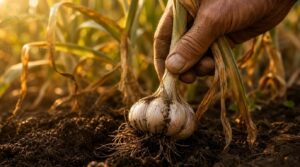
Knowing when to pull your garlic is half the battle — go too early and you lose flavor, wait too long and the bulbs start to crack.
Timing really comes down to reading your plant’s cues — signs your garlic is ready to harvest can save you from bulbs that are either underdeveloped or already falling apart underground.
Luckily, your plants give you plenty of signals when they’re ready. Here’s what to look for.
Leaf Color Changes
Leaf color is your first reliable maturity indicator. As day length shortens and cooler nights arrive, leaf senescence begins — chlorophyll breaks down, and yellowing lower leaves appear.
Water stress effects and sunlight sugar interaction deepen those changes.
When the lower leaves start to turn brown while upper leaves stay green, your garlic is signaling it’s nearly time.
Hardneck Garlic Readiness Signs
Once you spot browning on those lower leaves, hardneck garlic sends a few more signals worth checking. The onset of a leaf yellowing indicator often shows the bulbs are nearing maturity.
Look for these four readiness signs:
- Neck Softness — the stem above the bulb feels less firm
- Clove Visibility — individual cloves press through the outer skin
- Wrapper Integrity — papery layers stay dry and intact
- Bulb Compactness — the bulb feels dense, not flabby
When 40–50% of leaves have browned, do a quick test dig to confirm.
Softneck Garlic Readiness Signs
Softneck garlic plays by slightly different rules than hardneck. Watch for yellowing lower leaves while upper leaves remain green — that’s your first sign. Then check these five signals:
| Readiness Sign | What to Look For |
|---|---|
| Leaf color as maturity indicator | Lower leaves yellow; top stays green |
| Neck softness | Stem above bulb feels pliable |
| Bulb weight | Feels heavy for its size |
| Clove development | Multiple layers visible under skin |
| Ground tap test | Bulb lifts cleanly with little resistance |
Trust the combination, not just one sign.
Scape Appearance and Timing
Once you’ve read softneck signals, shift your eyes upward — hardneck garlic sends a different message through its scapes.
Watch for these timing cues:
- Height benchmarks: Scapes reach 18–36 inches before bulbs fully mature
- Color cues: Green or purple stems signal active growth
- Curvature types: Some curl into a full loop; others stay straighter
- Bud development: A swelling tip means the scape is maturing fast
- Maturity timing: Cut scapes at the loop stage to redirect energy into bulb development
Test Digging for Mature Bulbs
When scapes alone aren’t enough, dig up one test bulb to confirm bulb maturity. Choose spots across a sampling grid for uniform results.
Probe depth matters — go 8–9 inches to lift cleanly. Check bulb diameter (3–4 cm is ideal), inspect root distribution for even coverage, and look for tight papery skin.
These test-dig indicators tell you exactly when you’re ready.
Regional Harvest Timing Guidelines
Where you live shapes your harvest calendar more than almost anything else. In the Southern U.S., soil moisture windows close early — plan to pull bulbs in late May or June. Zones 6–7 shift to late June through mid-July, while cooler Zones 3–5 extend into mid-July to early August.
Rainfall patterns and latitude-based calendars significantly influence timing, making climate zone adjustments essential for precise scheduling.
Prepare Garlic Before Harvesting
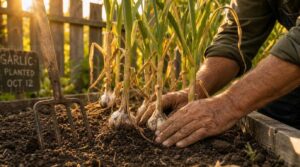
Good timing gets you halfway there — good prep gets you the rest of the way. Before you pull a single bulb, a few simple steps will protect your harvest from rot, bruising, and frustration.
Knowing the signs that onions are ready to harvest means you’ll handle fully mature bulbs that store far longer with far less loss.
Here’s what to do before the fork hits the ground.
Stop Watering Before Harvest
Stop watering 7 to 14 days before harvest — this is your Mold Prevention Strategy and it works.
Dry soil triggers four essential changes:
- Moisture Reduction Benefits firm up outer skins through the Skin Tightening Process
- Sugar Concentration Boost deepens flavor and storage quality
- Root Zone Hardening strengthens bulb structure
- Soil dryness makes lifting clean and damage-free
Managing soil moisture before garlic harvest is that simple.
Wait After Rainfall
Rain right before harvest? Don’t panic — just wait. Give the bed 3 to 5 dry days after any rain event. Use the soil crumbling test: squeeze a handful; it should fall apart, not clump.
A soil moisture meter reading under 12% confirms you’re good. Morning sun drying speeds things up.
Smart weather window planning keeps managing soil moisture to prevent bulb rot simple.
Check Soil Dryness
Your finger test tells the truth fast: Push a finger 1 to 2 inches into the soil—if it feels gritty and crumbly, you’re ready. A moisture meter reading confirms this with numbers.
Texture influence matters too: Sandy beds dry quicker than clay.
Watch for a crust cue on the surface—pale, firm, slightly cracked soil indicates dryness, which helps bulbs cure faster after lifting.
Avoid Harvesting in Mud
Muddy soil is a setup for failure. When the ground is too wet, bulbs slip, necks tear, and fungi move in fast. Proper soil amendment improves drainage, ensuring next season’s dry-day harvest starts smoothly.
Timing dry windows between rain events gives you the control you need. Bypass any muddy spot entirely—don’t force it. Tool cleanliness matters here too; mud transfers pathogens, risking further damage.
By prioritizing these steps—avoiding wet conditions, maintaining clean tools, and enhancing soil structure—you safeguard your bulbs and streamline future harvests.
Gather The Right Tools
Once your soil is ready, grab the right tools before you start. A garden fork and hand trowel are your two must-haves — these essential digging tools do most of the work.
Conduct a quick tool safety check before heading out. Clean, sharp edges protect bulbs; dull or rusty ones cause damage. Keep mesh bags or paper bags nearby to carry bulbs immediately after lifting.
How to Harvest Garlic Properly
Getting garlic out of the ground takes more care than most people expect.
A few simple steps make the difference between clean, undamaged bulbs and ones that won’t last the season.
Here’s exactly how to do it right.
Loosen Soil Around Bulbs
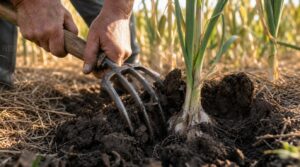
Before you pull a single bulb, loosen the soil in a wide circle around each plant — about 8 to 12 inches deep. This root zone aeration breaks up compacted layers without damaging crowns. Good crumbly soil texture, improved by incorporating organic matter and maintaining drainage pathways, makes lifting easy.
Proper timing of seasonal loosening and reducing soil moisture before harvest helps avoid bruising and splitting.
Use a Garden Fork or Spade
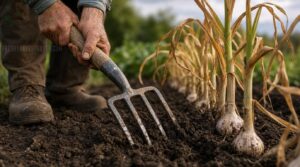
Once the soil is loose, grab the right tool — and the choice matters.
- Garden fork — best for sandy or loamy beds; tines slide under bulbs cleanly
- Spade — better for dense, clay-heavy soil; the blade cuts cleanly along root lines
- Blade vs tine — forks reduce skin damage; spades offer more leverage
- Tool grip comfort — hold low on the handle to control pressure
- Tool maintenance — keep edges sharp and tines rust-free for consistent performance
Insert either tool 8–9 inches from the stem, then lever upward.
Lift Bulbs Without Pulling Leaves
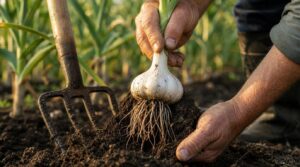
With the fork pivoted and soil released in a radial pattern around the bulb, you’re ready to lift. Grip the plant at the crown — never the leaves. Use the clump support method: slide one hand under the loosened soil cluster and raise it straight up. This leaf shield approach keeps stalks intact and bulbs unbruised.
| Step | Action | Why It Matters |
|---|---|---|
| 1 | Crown grip at base | Prevents leaf tearing |
| 2 | Radial soil release | Frees roots evenly |
| 3 | Fork pivot upward | Lifts without force |
| 4 | Support the clump | Reduces bruising |
| 5 | Smooth upward motion | Keeps wrappers intact |
These proper digging techniques for garlic make the difference between a bulb that stores for months and one that rots in a week.
Shake Off Loose Soil Gently
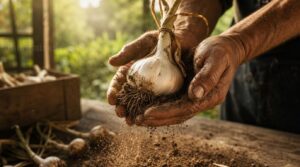
Once the bulb is lifted, give it a quick shake to dislodge loose soil clumps. This initial step requires minimal force, allowing sandy soil to fall away naturally. For clay soil, which clings stubbornly, avoid excessive disturbance and stop before applying pressure.
Use your fingers to gently brush away any remaining soil that shaking misses. Avoid twisting or scrubbing, as these actions risk damaging the bulb.
Preserve the protective wrappers surrounding the bulb throughout the process. Once cleaned, proceed to the next step without delay.
Separate Damaged Bulbs Immediately
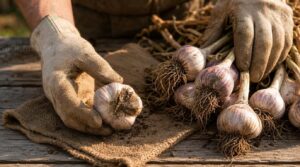
As soon as you spot a bruised, split, or pierced bulb, set it aside — don’t let it sit with the rest. This isolation protocol matters more than it seems. Inspect neighboring bulbs for soft spots right away. Place damaged ones in sealed containers, label damaged batches, and sanitize tools before continuing.
These postharvest handling techniques for garlic bulbs are your first defense against bulb rot prevention and mold inhibition.
Avoid Garlic Harvesting Mistakes
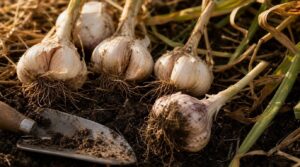
Even experienced gardeners make a few slip-ups at harvest time, and garlic is less forgiving than it looks. The good news is that most mistakes are easy to avoid once you know what to watch for.
Here are the six most common ones worth keeping on your radar.
Pulling Garlic Too Early
Impatience is the enemy of a good harvest. Dig too soon, and you risk small bulb formation, underdeveloped skins, and taste deficiency. Immature garlic also causes reduced shelf-life and higher disease vulnerability.
To avoid these issues, use test digging: pull a single bulb and inspect it. This method helps determine readiness without compromising the entire crop.
Identifying harvest time for garlic means timing garlic harvest based on leaf color, not guesswork. This ensures optimal maturity and quality.
Waiting Until Bulbs Split
Waiting too long is just as costly as harvesting too early. Once bulbs start splitting open, the outer wrappers weaken, and reduced moisture pockets disappear, leaving cloves exposed to rot.
Watch for clear clove delineation, a papery neck, and natural soil looseness around the base — these are your real signs that garlic is ready for harvest.
Respect split timing benefits by pulling just before full separation.
Washing Bulbs After Harvest
Rinsing your freshly pulled garlic might feel satisfying, but it’s one of the costliest mistakes you can make. Washing bulbs adds moisture that invites mold before curing even begins. Instead, brush off dirt gently but don’t wash — dry brushing with a soft brush protects its papery skin.
Never wash freshly harvested garlic — brush off dirt gently and let it cure dry
For stubborn clumps, use gentle misting with dry air or a fan. This approach maintains moisture control while addressing dirt without risking excess water.
Air drying with careful moisture management ensures your bulbs remain storage-ready, preserving their quality and longevity.
Bruising or Piercing Bulbs
Even one bad dig can turn a perfect bulb into a throw-away. Rough postharvest handling—like catching bulbs with tool burrs or forcing stuck roots—causes bruising and piercing that invites rot quickly. For proper digging techniques, keep tools rust-free and sharp.
Practicing bruise detection right after lifting is critical; soft spots indicate that damage isolation is needed immediately.
Wet soil hazards compound these risks, so always harvest in dry conditions to prevent bulb splitting effectively.
Leaving Harvested Garlic in Sun
Direct sun after harvest may seem harmless, but it is one of the fastest ways to ruin garlic. Sun exposure causes overheating, which drives moisture out unevenly, leading to skin cracking and setting the stage for later rot.
For warm-climate garlic harvests, move bulbs immediately to a dry, shaded, well-ventilated spot. Ensure airflow spacing of two to four inches, implement daily turning, and monitor for dry, papery skins before storage.
Harvesting in Wet Soil
Wet soil is just as damaging as direct sun. Stop watering 2 to 3 weeks out, and if it’s rainy around harvest time, wait 24 to 48 hours after rainfall. Check soil moisture reduction before harvest by pressing two inches deep — it should feel like a damp sponge, not soup.
Watch for these wet-soil warning signs:
- Soil too wet means cloves crush under their own weight when lifted
- Standing water blocks surface drainage and delays safe digging
- Mud sticks to bulbs even after shaking, trapping moisture inside wrappers
- Skipping soil drying techniques before pulling garlic greatly shortens storage life
- Without rapid air circulation and immediate post-harvest drying, mold spreads quickly
Use mud-resistant bags and move bulbs to shade right away to mitigate damage.
Cure Garlic for Storage
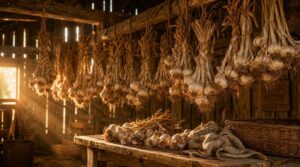
You’ve done the hard work of harvesting — now curing is what separates garlic that lasts all winter from garlic that rots by September. It’s a simple process, but the details matter more than most gardeners expect.
Here’s what you need to know to get it right.
Why Garlic Needs Curing
Skipping the curing process is one of the fastest ways to lose a good harvest. Postharvest curing and storage techniques exist for a reason: moisture reduction protects your bulbs from rot, while wrapper strengthening forms a natural barrier against pests.
Proper air circulation during garlic curing can’t be overstated: the importance of this step drives flavor development and shelf life extension, keeping your garlic table-ready for months.
Best Curing Temperature and Location
Now that you know why curing matters, let’s talk about where and at what temperature to do it.
A dry shaded area with cool, dry, well-ventilated airflow is your target. Aim for these conditions:
- Ideal temperature around 60–70°F (15–21°C)
- Best humidity between 60–70%
- Consistent air circulation on all sides
- A shade location away from direct sunlight
An insulated curing space like a shed works perfectly.
Hanging Versus Rack Drying
Once you’ve got your space ready, choose between two solid methods: hanging braids or drying on benches with mesh racks. Hanging assists shape preservation and keeps air circulation front and center during garlic curing—airflow dynamics work naturally around each bulb.
Rack drying on benches excels in space efficiency and manages bigger batches faster, reducing drying time by one to three days with minimal labor effort. This method prioritizes air circulation’s importance while streamlining the process for larger volumes.
Keep Stems and Roots Attached
Leave the stalks and roots attached throughout the entire curing period—do not cut the tops or trim the roots yet. The stems act as natural airflow regulators, keeping bulbs suspended without skin contact. They also provide stem sun protection and work as a moisture reservoir, releasing trapped humidity gradually.
Root collar integrity remains intact this way, improving curing uniformity. Just brush off dirt gently, but don’t wash.
How Long Curing Takes
Curing time varies by variety. Hardneck types as a rule finish in 10 to 14 days under ideal conditions, while softneck varieties need 14 to 21 days. Temperature acceleration matters — keep your space between 60 and 70°F with humidity below 60 percent.
A gentle fan provides airflow enhancement that speeds the process noticeably. In cool, humid climates, expect seasonal curing time adjustments of up to six to eight weeks.
Signs Garlic is Fully Cured
Your garlic is ready when it tells you — and it will. Check for these five cues:
- Neck Dryness — tight and firm necks, pencil-thin and brittle
- Skin Crispness — dry and papery skins that rustle when touched
- Clove Wrappers — loose, non-sticky layers that peel cleanly
- Root Shriveling — brittle roots resembling stiff brush fibers
- Bulb Firmness — resists gentle pressure at the center
Move fully cured bulbs to cool dry dark storage with humidity below 60%.
Store and Use Harvested Garlic
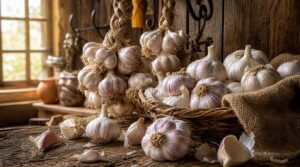
All that curing work pays off — now it’s time to make sure your garlic actually lasts.
How you trim, store, and use it makes the difference between bulbs that go six months strong and ones that turn soft by October.
Here’s what to do from this point forward.
Trimming Roots and Tops
Once your garlic has fully cured, it’s time for a quick cleanup before storage. Use sterile scissors to trim roots to about ¼–½ inch — this root moisture reduction step speeds drying and discourages mold. Cut tops down to 1–2 inches above the bulb.
Post-lifting timing matters: clean, disease-free cuts heal faster and extend shelf life greatly.
Best Long-Term Storage Conditions
Think of your cured bulbs as sleeping through winter — they need the right conditions to wake up perfect. Store them in a cool, dry, dark place at 55–65°F with humidity levels around 60%.
Follow these five essentials:
- Temperature Control: Stay between 55–65°F consistently
- Humidity Levels: Keep below 60% to prevent mold
- Air Circulation: Space bulbs 2–3 inches apart
- Breathable Containers: Use mesh bags or burlap
- Mold Monitoring: Check monthly; remove soft bulbs immediately
Hardneck Versus Softneck Storage Life
Not all garlic stores equally. Softneck varieties last 9–12 months thanks to thicker wrapper thickness and a higher number of cloves, which slows moisture loss naturally. Hardneck types—despite their bold flavor—keep for only 4–6 months.
For long-term preservation, ideal temperature ranges differ: 32–40°F for hardnecks and 60–65°F for softnecks, with consistent humidity management below 70%. Know your garlic type and store it accordingly.
Selecting Seed Garlic
Once you’ve sorted your eating stock, set aside your best bulbs — label them as seed garlic right away so nothing gets mixed up.
Good selection of seed garlic for next season comes down to five things:
- Choose climate-appropriate varieties proven in your zone
- Pick bulbs with uniform clove size throughout
- Confirm non-sprouted cloves with firm, intact skins
- Use only disease-free stock — no soft spots or lesions
- Verify accurate varietal labeling before storing seed cloves separately
Checking Stored Garlic for Spoilage
Your seed garlic is set — now keep a close eye on everything stored nearby. Check bulbs every week or two.
Look for signs of mold: white, green, or black fuzz on skins. Assess the odor as well — a sour or ammonia-like smell signals trouble.
Inspect the texture: soft or rubbery cloves indicate spoilage. Identify sprouts early, as they can accelerate decay.
Control moisture to prevent issues from escalating. Vigilance stops small problems before they ruin your entire harvest.
Using Green Garlic and Scapes
Green garlic and scapes go straight from the ground to your kitchen. Use green garlic raw in salads for a mild, fresh flavor — it’s a natural nutrient boost.
Quickly sauté scapes with olive oil and lemon for bright flavor pairings. Freeze chopped greens in airtight bags when you have extra.
Both shine in soups, pestos, and spring dishes.
Frequently Asked Questions (FAQs)
Can you use garlic right away after harvesting?
Yes, you can. Fresh flavor is bright and mild right after digging.
Just brush off soil, skip washing for moisture control, and use within a few days — no curing needed for quick prep.
What is the 10 minute garlic rule?
The 10 minute garlic rule is a quick skin test: after digging, let the bulb sit exposed for 10 minutes.
If the outer wrapper dries without feeling clammy, its rapid moisture check confirms your harvest timing is right.
What are common garlic growing mistakes?
Common mistakes include over-fertilizing, improper planting depth, inadequate spacing, and no crop rotation.
Excessive irrigation, harvesting too late, skipping the curing process, and failing to avoid watering garlic before harvest leave bulbs overripe or prone to rot.
When should garlic planted in October be harvested?
Garlic planted in October is usually ready by June or July. Watch leaf color as your main indicator of maturity — harvest when roughly half the lower leaves have browned.
What is the proper way to harvest garlic?
Watch the leaves — they’re your best signal. When lower leaves brown and five to six green ones remain, it’s time. Loosen soil gently, lift the bulb clean, and never pull.
Is it possible to leave garlic in the ground too long?
Yes — absolutely. Once the leaves signal readiness, every extra day underground risks bulb splitting open, soil-borne rot, rodent damage, and nutrient depletion. Delayed curing follows, cutting storage life dramatically.
What happens if it rains during harvest?
Rain during harvest spells trouble fast. Wet soil causes equipment bogging, slip hazards, and drying delays.
Mold growth spreads quickly on damp bulbs, risking yield reduction and disrupting the garlic curing process.
Can you harvest garlic in the morning?
Absolutely — morning is the sweet spot. Dawn’s soil firmness makes lifting easier, and early moisture reduction keeps wrappers clean.
Work within a cool daylight harvest window to enjoy sun avoidance benefits and protect bulbs.
How deep should you plant garlic originally?
Plant garlic cloves 2 inches deep in most climates. In colder zones, go 3 to 4 inches. Always point the tip up. Depth by zone matters more than most gardeners realize.
What pests attack garlic during growing season?
Thrips damage, aphid spread, leek moth larvae, bulb mites, and nematode infestations are your main threats.
Good disease management and organic pest control methods keep fungal diseases, fungal rot prevention, and pest prevention on track.
Conclusion
The harvest is the proof of the season’s patience. Every choice you made—reading the leaves, timing the digging, curing each bulb with care—shows in what’s hanging in your storage now. Knowing the proper way to harvest garlic transforms a simple garden crop into something that feeds your kitchen for months.
Don’t rush it, don’t skip the curing, and don’t ignore what the plant tells you. The bulb always knows.
- https://garlicgods.com/blogs/news/garlic-harvesting-signals-how-to-know-when-your-garlic-is-ready
- https://keeneorganics.com/harvesting-garlic/?srsltid=AfmBOoqb0pQ6IdryFv7Ta34G6RpGf7sG3i752LTnT_9xn1hs7LNN0HzU
- https://awaytogarden.com/the-tricky-matter-of-when-to-harvest-garlic/
- https://www.gardenary.com/blog/garlic-harvesting-your-quick-guide-to-determining-the-perfect-time
- https://www.thespruce.com/harvesting-garlic-1402402