This site is supported by our readers. We may earn a commission, at no cost to you, if you purchase through links.
A single night at 28°F can wipe out an entire apricot harvest before the sun even clears the horizon. Ice forms inside plant cells fast, rupturing walls and draining tissue of moisture in ways that show up weeks later as blackened, hollow buds. Bloom stage makes trees especially defenseless, since a flower’s reproductive tissue tolerates far less cold than dormant wood does.
Growers who lose crops rarely lose them to one brutal freeze. They lose them to hesitation, waiting an extra hour to run sprinklers or skipping mulch because the forecast looked borderline.
Protecting fruit trees from frost comes down to timing, technique, and knowing your orchard’s specific weak points, from low-lying frost pockets to young bark that hasn’t hardened off yet. The methods ahead will show you exactly when and how to act.
Table Of Contents
- Key Takeaways
- How Frost Damages Fruit Trees
- Assessing Your Orchard’s Frost Risk
- Step-by-Step Frost Protection Methods
- Choosing Cold-Hardy Fruit Tree Varieties
- Recovering Trees After a Frost Event
- Frequently Asked Questions (FAQs)
- At what temperature do fruit trees need to be covered?
- Do I need to cover my peach tree when it freezes?
- What fruit trees can survive frost?
- How do I protect my fruit trees in the winter?
- What does baking soda do for fruit trees?
- Do peach trees need frost protection?
- What to use to cover fruit trees from frost?
- What is the critical temperature for frost damage on fruit trees?
- Should I spray my fruit trees with water before a freeze?
- At what temperature should I cover my fruit trees?
- Conclusion
Key Takeaways
- Bloom-stage buds are most vulnerable to frost, tolerating far less cold than dormant wood, so cover trees at 32–34°F and act before sunset rather than waiting on borderline forecasts.
- Running sprinklers at 0.08–0.15 inches per hour from 34°F until ice melts protects buds through latent heat release, but stopping mid-freeze can cause more harm than not starting at all.
- Site selection matters as much as species choice: low-lying frost pockets, elevation changes of just 100 meters, and young trees with thin bark all increase risk, so prioritize protection accordingly.
- After a frost, wait until buds swell to assess damage and prune, since cutting too early makes it impossible to distinguish live tissue from dead wood.
How Frost Damages Fruit Trees

Frost doesn’t just nip your trees, it attacks them at the cellular level, and knowing how that damage happens changes how you fight it. Temperature thresholds, ice formation, growth stages, and species all play a role in what your orchard can survive. Here’s what’s actually happening inside those branches and blossoms when the mercury drops.
For young or tender trees especially, protecting plants with cloches during frost events can shield delicate tissue before ice crystals ever get the chance to form.
Critical Temperature Thresholds Explained
Critical temperatures aren’t one magic number, they’re a range your trees shift into stress mode within, varying by species, bud stage, and even cooling rate. A slow drop lets tissue adjust; a fast plunge overwhelms it.
Hydrated, actively growing tissue near bud break tolerates far less cold than dormant wood, which is why spring freeze events cause disproportionate damage.
Extreme cold can lead to cellular mechanisms damage through processes like cytorrhysis.
Ice Crystal Formation in Cells
Once temperatures cross that threshold, ice doesn’t just form outside your tree’s cells, it invades them. Water inside migrates toward intracellular nucleation sites, rupturing walls from within. Fast freezes outpace osmotic dehydration risks, trapping moisture before it escapes.
Ice doesn’t stay outside a tree’s cells during a fast freeze, it invades them, rupturing walls before moisture can escape
Healthy cytoskeletal ice modulation offers some resistance, while slow thawing brings recrystallization damage, compounding the harm freezing weather already caused.
Most Vulnerable Growth Stages
Not every phenological stage carries equal risk. Bud swelling and bloom stage mark peak frost sensitivity, since exposed reproductive organs can’t tolerate freezing like dormant tissue can.
Bud break brings delayed leaf expansion; flower set losses cut yield directly. Fruit sizing suffers when frost strikes early, and post-blossom drop follows poor pollination. Young trees fare worst, lacking mature cold hardiness.
Frost-Sensitive Vs Frost-Tolerant Species
Not all species play the same game. Apricots and almonds sit at the sensitive end, blooming early with thin-walled tissue, while apples and pears show sturdier cold hardiness.
Dormancy timing explains much of this gap. Late-flowering varieties dodge frost windows entirely, and Antonovka apples survive extreme cold at roughly 70% rates—proof that species selection shapes your orchard’s odds before frost ever arrives.
Assessing Your Orchard’s Frost Risk

Not every orchard faces the same level of risk, and knowing yours changes how you plan. Your zone, your land, and the age of your trees all play a part in how much protection you actually need. Here’s what to look at before frost season hits.
If your orchard leans toward tender or young trees, pairing your risk assessment with frost-sensitive plant covers built for cold snaps can make all the difference.
USDA Hardiness Zone Considerations
Your zone number is only a starting point, not a guarantee. Pull up the plant hardiness zone map for your address and check whether you’re 6a or 6b — that half-zone precision matters, since it’s built on 1991–2020 climate normal data. A tree rated for zones 4-8 needs true cold hardiness to survive your area’s actual winter lows.
Site and Microclimate Factors
Ever notice how one corner of your property always frosts first? That’s your microclimate talking, not your zone map. Topographic frost pockets form in low spots where cold air drains and settles. Elevation shifts of just 100 meters swing overnight lows several degrees.
Plant on slopes, not depressions — south-facing ground catches more solar radiation, shortening frost duration near water bodies and wind drainage corridors.
Young Trees Vs Mature Trees
Because thinner bark means less protection, young trees suffer more winter injury than mature specimens with developed cold hardiness. Growth Rate Differences matter too: saplings pour energy into shoots, not defense.
Mature trees draw on deep root system strength and stored reserves for structural wind stability, while young ones face drought stress vulnerability and weaker pest defense maturity. Prioritize young trees first in your agricultural frost mitigation plan.
Step-by-Step Frost Protection Methods
Once you know your orchard’s risk, it’s time to act. You have several proven methods at your disposal, from physical barriers to strategic water and heat use. Here’s exactly how to put each one to work.
Covering Trees With Frost Blankets

A blanket is only as good as its seal. Match fabric weight to the forecast: lightweight cloth for a light 30°F dip, heavyweight for a hard freeze near 22°F.
Drape it fully to the ground and weigh down every edge with rocks or soil, keeping fabric off buds.
Pull covers back once temperatures climb above freezing to prevent overheating.
Running Sprinklers for Ice Insulation
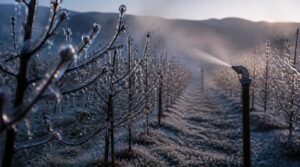
Sprinklers sound counterintuitive, but freezing water actually protects your trees. As ice forms, it releases latent heat, keeping buds near 32°F even when air drops lower.
Run sprinklers at 0.08 to 0.15 inches hourly, starting at 34°F and continuing until ice melts naturally. Since even a brief interruption can let temperatures dip below the danger point, pair this method with these seasonal plant frost care protection strategies to build a more complete cold-defense plan.
- Space heads for uniform coverage
- Keep ice clear, not cloudy
- Watch flow rates closely
- Never stop mid-freeze
Mulching to Retain Soil Heat
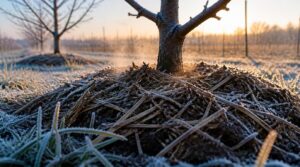
Roots don’t freeze in isolation, they respond to what’s happening at the soil surface, and that’s where mulch earns its keep. A 5–10 cm layer of straw or compost buffers daytime heat and slows nighttime cooling, keeping root zones warmer when frost threatens.
Apply in late summer for early-season protection; avoid overly thick layers that smother growth. Moisture retention amplifies the insulating effect.
Using Heaters and Wind Machines
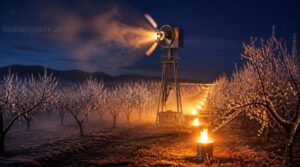
Mulch guards the roots, but when temperatures dive well below 28°F, you need active heat. Wind machines break the inversion layer, mixing warm air downward for a 2–5°F gain—space units roughly 300 feet apart for overlap. Add propane heaters at the perimeter for border protection.
Watch fuel logistics and weather monitoring closely; efficiency depends on it.
Choosing Cold-Hardy Fruit Tree Varieties
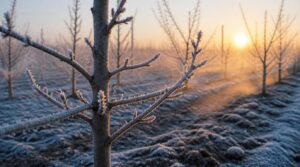
Blankets and sprinklers buy you time, but the right variety saves you the trouble altogether. Some trees shrug off deep freezes that would wreck a less hardy cousin, and that difference comes down to genetics, not luck. Here’s what to look for when picking varieties and rootstocks built for your zone.
Best Late-Flowering Cultivars
Timing is everything with frost defense, and late-flowering varieties buy you the safety margin you need. Stone fruit varieties like Harogem apricots delay bloom past killing frosts, while late pome selections shift bud maturity toward safer weeks.
Nut tree timing and grapevine ripening follow suit, and even garden roses like Desdemona show how climate adaptation pushes flowering later for reliable, frost-resistant results.
Cold-Tolerant Rootstocks by Zone
What grows below ground matters as much as bloom timing. G 935 toughness stands out, with LT50 values between -16°C and -19°C, ideal for your coldest zones.
G 30 and Bud 9 suit medium-risk soils, matching M 26’s hardiness. G 41 performs unevenly, so pair it with strong root system depth. Match rootstock types to your plant hardiness zone and soil drainage for real climate adaptation.
Avoiding Late-Winter Nitrogen Fertilizer
Good rootstock choices only go so far if you undercut them with poor timing at the fertilizer bag.
Skip nitrogen in late winter—cold winter—cold soils slow nitrification and raise volatilization risk once thaws hit. Wait for bud swelling, then apply 40–60% as a spring top-dress. Slow-release formulas curb leaching and match nitrogen to actual dormancy-to-bloom demand.
Recovering Trees After a Frost Event
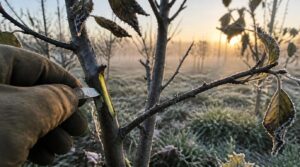
Even with your best efforts, a hard frost can still slip past your defenses. Don’t panic and don’t reach for the pruning shears right away, though—recovery starts with a clear-headed look at what actually happened to your trees. Here’s how to assess the damage and get your orchard back on track.
Evaluating Bud and Branch Damage
Cut a few twigs and check before you panic. Slice buds lengthwise with a sharp blade — brown, mushy centers mean bud kill; green or tan tissue means life. Test 100 buds per sample for accuracy.
- Pistil damage: dark brown centers signal death
- Shoot browning: tips drying back
- Branch dieback: dead wood beyond buds
- Regenerative growth: new shoots near damage
Pruning Frost-Damaged Wood
Grabbing the loppers too early costs you healthy wood. Wait until buds swell, not before, so you can tell live from dead tissue by scraping bark for green cambium.
Make angled cuts just above healthy buds, sterilizing tools between trees. Focus renewal cuts on vigorous shoots near the base, and watch new growth over the next two to six weeks.
Supporting Tree Recovery Long-Term
Healing doesn’t stop once you’ve made your cuts—it’s a years-long process. Watch bark, cambium, and vascular tissue for five to ten years, tracking bud break and shoot growth annually.
- Test soil nutrients regularly
- Introduce mycorrhizal fungi for root recovery
- Brace weak limbs to prevent breakage
- Watch for canker-causing pathogens
- Photograph trunk changes yearly
Consistent vigor monitoring protects nutrient transport and safeguards next year’s crop yield.
Adjusting Next Season’s Protection Plan
Every frost event teaches you something—so use it. Update your protection protocol with a post-event performance review, noting what worked.
| Adjustment | Trigger | Action |
|---|---|---|
| Extend coverage | Spring/fall changes | 90 min post-sunset |
| Soil checks | Frost window | Every 6 hours |
| Cold pockets | 5m elevation shift | Priority alert |
Run equipment readiness audits before bud break, and map microclimate risk zones for next season.
Frequently Asked Questions (FAQs)
At what temperature do fruit trees need to be covered?
Picture blossoms as fragile lanterns, easily snuffed by cold’s breath. Cover trees at 32°F or below, and start protection earlier—around 34–35°F—for sensitive petals in bloom. Watch forecasted lows closely, and cover by sunset for best results.
Do I need to cover my peach tree when it freezes?
Yes, especially during bloom stage or pink bud. Peaches flower early, making them prone to late spring frosts. Below 32°F, use frost blankets to prevent bud kill—exposed wet tissue at these stages suffers rapid frost damage.
What fruit trees can survive frost?
Cold snaps, hot picks: Honeycrisp apples shrug off -40°F, Meteor sour cherries thrive in Zone 3, and Antonovka apples post 70% survival in brutal cold—proof that cold hardiness and smart hardiness zone matching beat frost every time.
How do I protect my fruit trees in the winter?
Winterizing plants means layering defenses: frost blankets and tree wrap for trunks, mulch around roots, thermal battery water buckets overnight, correct sprinkler application rates for ice insulation, frost shield sprays on buds, and wind machines when temperatures dip critically low.
What does baking soda do for fruit trees?
A tablespoon of baking soda per gallon of water raises leaf surface alkalinity, inhibiting fungal spore germination and preventing powdery mildew.
Rotate applications to avoid salt buildup, and always pair this with your broader frost protection methods for season-long orchard health.
Do peach trees need frost protection?
Peach trees absolutely need frost protection — their bloom stage sensitivity is high, and late frost easily causes fruitlet abortion. Watch spring temperature fluctuations closely; cover trees below 28°F to prevent frost damage during this fragile window.
What to use to cover fruit trees from frost?
Reach for spun-bonded polypropylene (45–5 oz/sq yard) over plastic—it breathes, preventing moisture buildup. Frost blankets, burlap, or old fleece jackets work as low tunnels or cloches. Secure edges with stakes, avoiding direct branch contact.
What is the critical temperature for frost damage on fruit trees?
Your critical threshold sits at 27°F, where cellular rupture begins in blossoms and buds. Full bloom is most vulnerable, near -1 to -2°C. Stone fruits suffer earlier than apples—species tolerance varies, so monitor local microclimate shifts closely.
Should I spray my fruit trees with water before a freeze?
Yes, spraying works: freezing water releases latent heat, holding buds near 32°F. Run sprinklers continuously from 34°F until thaw, covering the full canopy evenly.
Watch wind and ice weight, since heavy buildup risks branch breakage.
At what temperature should I cover my fruit trees?
Funny how two nights can both hit freezing yet damage differently — microclimate temperature dips matter. Cover trees at 27°F, the critical freezing point for cell rupture, but drop that threshold to 34°F once blossoms open, given their sharper sensitivity.
Conclusion
A single orchard heater burning through a 28°F night can save thousands of dollars in fruit for a few gallons of fuel—that’s the math frost protection runs on.
Protecting fruit trees from frost isn’t about eliminating risk; it’s about stacking small, deliberate actions until the odds tip your way. Know your thresholds, watch your microclimates, and act before the thermometer forces your hand. Your trees survive on your decisiveness, not luck.