This site is supported by our readers. We may earn a commission, at no cost to you, if you purchase through links.
A single aphid can produce 80 offspring in one week without mating—and by midsummer, that math turns a thriving tomato bed into a sticky, wilting mess faster than most gardeners expect. Vegetable garden pests don’t announce themselves; they work quietly under leaves, inside stems, and just below the soil line until the damage is already done.
Knowing what you’re dealing with changes everything. The difference between losing a crop and saving it often comes down to catching the right clue at the right time—a silvery leaf scar, a cleanly severed seedling, frass near a bored stem.
Table Of Contents
- Key Takeaways
- Identify Vegetable Garden Pests
- Recognize Pest Damage Patterns
- Control Sap-Sucking Insects
- Manage Beetles and True Bugs
- Stop Caterpillars and Borers
- Handle Soil-Dwelling Garden Pests
- Prevent Pests With Garden Maintenance
- Encourage Beneficial Pest Predators
- Top 10 Garden Pest Control Products
- 1. Harvest Guard Plant Frost Cover
- 2. Espoma Organic Insecticidal Soap Spray
- 3. Natria Neem Oil Pest Disease Control
- 4. Bonide Captain Jacks Deadbug Brew
- 5. Bonide Thuricide BT Caterpillar and Moth Control
- 6. BioLogic Ecomask Beneficial Nematodes Pest Control
- 7. Faicuk Yellow Sticky Traps for Plant Insects
- 8. Live Hb Beneficial Nematodes Soil Treatment
- 9. Liquid Garlic Insect Repellent Concentrate
- 10. Kraftex Conductive Copper Foil Tape
- Frequently Asked Questions (FAQs)
- What are the most common pests in vegetable gardens?
- What bug is eating my vegetable garden?
- What is the best pest control for vegetable gardens?
- What are the common pests in vegetables?
- How to get rid of vegetable garden pests?
- When is the best time to inspect for pests?
- How do weather conditions affect pest activity levels?
- What are signs of pest resistance to treatments?
- Should I remove infected plants or treat them?
- Can pests spread between neighboring garden plots?
- Conclusion
Key Takeaways
- Catching pest damage early—whether it’s silvery leaf scarring from thrips, dark frass under hornworms, or sticky honeydew from aphids—is the single most important skill for saving a crop before it’s too late.
- No single control method wins every battle; the most effective approach layers physical barriers like row covers, targeted organic sprays like Bt or neem oil, and beneficial insects like ladybugs or parasitic wasps matched to the specific pest.
- Soil-dwelling pests like cutworms, wireworms, and root maggots cause the most invisible damage, making cardboard collars around transplants, beneficial nematodes, and regular crop rotation your best defenses underground.
- Consistent garden hygiene—removing plant debris, rotating crops on a four-year schedule, and inspecting plants twice a week at dawn or after dusk—prevents most infestations from ever gaining a foothold.
Identify Vegetable Garden Pests
Knowing what you’re dealing with is half the battle in any garden. Vegetable pests come in several distinct groups, each with their own habits, damage patterns, and weak points. Here’s a look at the main ones you’re likely to encounter.
Once you know which group you’re dealing with, you can start reading the clues they leave behind—and pest damage patterns in vegetable gardens make that identification a whole lot easier.
Aphids and Whiteflies

Aphids are tiny, soft-bodied insects, usually 1–3 mm long, clustering on tender stems and leaf undersides. Whiteflies look like powdery white moths — just 1–2 mm — and scatter in visible clouds when disturbed.
Both pierce plant tissue to extract sap, excrete sticky honeydew, and can transmit viruses like cucumber mosaic virus and tomato yellow leaf curl virus.
Thrips and Spider Mites
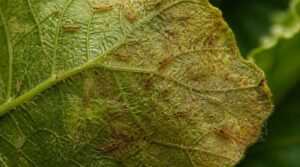
Thrips and spider mites are even smaller and harder to spot than aphids or whiteflies.
Adult thrips measure just 1–2 mm — like a moving splinter — with fringed wings, while two-spotted spider mites are barely 0.5 mm, appearing as tiny dots on leaf undersides. Spider mites are actually arachnids, so they carry eight legs as adults.
Beetles and Squash Bugs
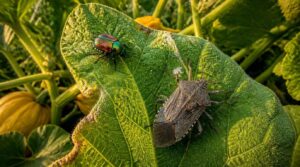
Beetles and squash bugs are a different challenge — you can see them coming. Japanese beetles measure 8–11 mm with metallic green bodies and copper wing covers, while squash bug adults stretch to 14–16 mm, flat and gray-brown.
Both are large enough to spot by eye, making early garden pest identification your strongest first move.
Caterpillars and Hornworms
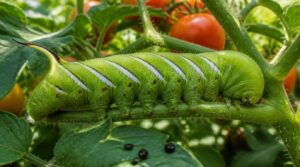
While beetles announce themselves in broad daylight, caterpillars are masters of camouflage. Tomato hornworms (Manduca quinquemaculata) grow nearly 4 inches long yet blend seamlessly into foliage — their bright green bodies marked by eight V-shaped white stripes.
Your first clue is usually large dark pellets of frass on leaves below, long before you spot the caterpillar itself. Natural enemies like beneficial Braconid wasps can help control these pests.
Slugs and Root Pests
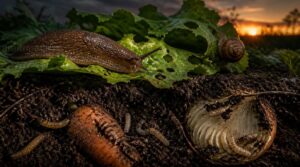
Not all damage starts above ground. Slugs and snails chew ragged holes in lettuce and seedlings overnight, leaving silvery slime trails as their calling card.
Below the soil, root maggots, wireworms, and carrot rust fly larvae tunnel through carrots, onions, and tubers — often undetected until harvest reveals the destruction.
Recognize Pest Damage Patterns

Before you can fight back, you need to know what you’re dealing with. Pest damage leaves behind clues — and once you learn to read them, your garden becomes a lot easier to protect. Here are the key damage patterns to watch for.
Chewed Ragged Leaf Edges
Ragged, missing leaf edges are often your first clue that something is feeding in your garden. Caterpillars chew uneven holes and large missing sections, leaving dark frass pellets nearby. Slugs feed after dark on tender leaves close to the soil, while grasshoppers attack in full sun from the garden’s edge. Here’s what to look for:
- Caterpillar damage: ragged holes with frass on leaf surfaces or along midribs
- Slug feeding: irregular notches on low leaves, worst after rain or irrigation
- Grasshopper chewing: large jagged margins, dry-looking, no slime trails
- Flea beetles: small round shotholes scattered across leaf blades
Earwigs leave a shredded, scraped appearance rather than clean cuts. Cutworms sever seedlings entirely at soil level rather than chewing leaf edges.
Sticky Honeydew on Leaves
Sticky leaves are a red flag you shouldn’t ignore. Aphids, whiteflies, mealybugs, and scale insects all excrete honeydew — a sugary waste that coats lower leaves, stems, and even fruit below. Left alone, black sooty mold follows.
Check leaf undersides first; that’s where most of these pests hide. Ants trailing up stems are a reliable tip-off — they’re farming the honeydew.
Silvery Patches and Stippling
Two distinct clues point to thrips and spider mites: silvery leaf scarring and fine stippling. Thrips scrape cells and leave shiny, collapsed patches — often with tiny black fecal specks nearby. Spider mites pierce individual cells, creating countless pale pinpoint dots.
Unlike chewing damage, leaf edges stay intact with both pests, which helps you tell them apart fast.
Severed Seedlings at Soil
You walk out to the garden at sunrise and find healthy seedlings tipped over — stems cut clean at soil level. That’s a cutworm. These nocturnal larvae do their work between dusk and dawn, severing stems within the lowest 2 centimeters.
Slide a collar of cardboard around each transplant, 5 cm above and 3 cm below the soil, and they can’t reach it.
Tunnels in Roots
Cut into a struggling carrot or stunted onion and you’ll likely find the culprit hollowed inside. Root maggots leave winding, decay-filled cavities; wireworms bore cleaner, circular channels. Here’s what to watch for:
- Midday wilting despite moist soil
- Yellowing leaves with no visible foliar pest
- Roots that feel light and hollow
- Foul smell when harvested
Crop rotation and nematodes break the cycle.
Control Sap-Sucking Insects

Sap-sucking insects are some of the sneakiest troublemakers in the vegetable garden — small enough to overlook, but capable of collapsing a healthy plant fast. Knowing what you’re dealing with is the first step to stopping them. Here’s what to watch for and how to respond.
Aphid Infestation Signs
Aphids are easy to miss at first — until the damage tells the story for them. Look for curled or cupped new growth, yellowing leaves, and colonies of 1–3 mm pear-shaped insects clustered on shoot tips and leaf undersides. Cast skins left after molts are a reliable identification clue.
Honeydew Residue coats stems and leaves with a tacky film, inviting Sooty Mold that blackens surfaces and cuts photosynthesis. Watch for ants moving in orderly lines up your plants — Ant Farming behavior signals an active aphid colony below.
Population Spread happens fast. In warm weather, numbers can double every 2–3 days through asexual reproduction, with nymphs dispersing to neighboring plants on the wind.
| Aphid Sign | What It Means |
|---|---|
| Leaf Distortion | Feeding pressure on new growth |
| Sooty Mold patches | Honeydew buildup present |
| Ant activity on stems | Aphid colony likely nearby |
Natural predators like ladybugs target these colonies effectively — their presence often confirms pest damage symptoms worth addressing.
Whitefly Clouds and Viruses
Whiteflies are sneaky in a way aphids aren’t. Disturb an infested plant and you’ll trigger a whitefly cloud — hundreds of 2mm adults lifting off at once, drifting to neighboring plants and depositing virus inoculum as they probe new tissue.
They transmit Begomoviruses and Criniviruses, causing yellowing, leaf curl, and stunted yields.
Reflective mulch, yellow sticky traps, and parasitic wasps help break the cycle before it spreads.
Thrip Leaf Scarring
Thrips do their damage quietly. Unlike whiteflies, there’s no dramatic cloud — just silver leaf damage appearing on young growth, where feeding collapses mesophyll tissue into sunken, papery patches. You’ll often spot dark excrement specks within the scars.
Early monitor new growth habits catches thrips before scarring spreads. Neem oil and insecticidal soap reduce populations; lacewing larvae provide reliable biological backup.
Spider Mite Webbing
Spider mites are harder to spot than most pests. Look for fine silk webbing on leaf undersides — it’s translucent, almost dusty, and most visible in hot, dry conditions that accelerate reproduction. Check new growth and leaf axils first.
The silk slows contact sprays, so treat early with insecticidal soap or horticultural oil before colonies establish.
Soap and Neem Sprays
Both insecticidal soap and neem oil work well against aphids, whiteflies, and thrips.
Mix soap at 1–2 tablespoons per gallon of water; apply neem in early morning or late evening to prevent leaf burn. Test on a small area first, avoid blooming plants, and reapply every 7–14 days as needed.
Manage Beetles and True Bugs
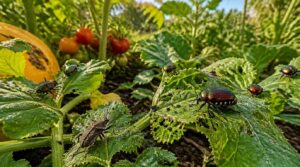
Beetles and true bugs hit hard and fast — some can strip a plant bare before you even notice the damage. Knowing which pest you’re dealing with changes everything about how you respond. Here are the five most common offenders and what they do to your garden.
Japanese Beetle Skeletonizing
Japanese beetles are hard to miss — 13mm, metallic green, with copper-brown wing covers. Adults emerge in early summer, peak fast, and can skeletonize entire plants within days by stripping leaf tissue between the veins. Roses, grapes, beans, and linden trees take the hardest hits.
Handpick them in early morning when they’re sluggish, or apply neem-based sprays during peak activity.
Cucumber Beetle Wilt Risks
Cucumber beetles — both spotted and striped (Acalymma vittatum) — do more than chew leaves. They carry bacterial wilt (Erwinia tracheiphila), depositing it directly into feeding wounds. Once inside, the bacteria clog your plant’s vascular system, causing sudden wilting and full collapse fast.
Early season management is critical. Beetles emerge when soil temperatures hit 54–62°F, targeting young transplants first. Use floating row covers during establishment, and try trap crop strategies to pull beetles away from your main cucurbit block.
Potato Beetle Defoliation
The Colorado potato beetle (Leptinotarsa decemlineata) can strip a potato plant bare within five days. Adults chew leaf margins; larvae skeletonize foliage, leaving only veins behind.
- Pre-bloom defoliation above 30% cuts yield substantially
- Larvae cause more damage than adults per insect
- Target younger, tender growth first
- Monitor weekly during late spring emergence
- Use Bt sprays for early larval control
Flea Beetle Shotholes
Flea beetles punch holes in leaves that look like tiny shotgun blasts — round pits ranging from 1.5 to 3.2 mm scattered across the surface. Young brassicas, spinach, and tomato transplants take the hardest hit.
Row covers protect seedlings early; yellow sticky traps monitor adult activity. When populations surge, neem or insecticidal soap keeps damage manageable.
Squash Bug Wilting
Squash bugs are slow-moving but destructive — their phytotoxic saliva triggers vascular tissue collapse, leaving vines limp and dying fast. Scout leaf undersides for egg cluster detection early; nymph feeding damage compounds quickly through summer’s seasonal population peaks.
Use row cover protection on young plants, then apply neem oil or insecticidal soap once bugs appear.
Stop Caterpillars and Borers

Caterpillars and borers are some of the most destructive pests you’ll face in a vegetable garden — they work fast and don’t leave much behind. Knowing exactly what you’re dealing with makes all the difference between losing a crop and saving it. Here’s what to watch for and how to stop each one.
Tomato Hornworm Damage
Few garden pests cause destruction as fast as the tomato hornworm. Mature larvae reach up to 4 inches long and can strip entire branches overnight. Look for ragged holes in upper leaves, dark frass pellets on foliage, and exposed fruit.
Handpick them promptly, or apply Bacillus thuringiensis kurstaki while caterpillars are still small for reliable organic control.
Cabbage Worm Holes
Cabbage worms hit brassicas differently than hornworms — the damage is subtler but spreads fast. These pale green caterpillars chew ragged, irregular holes starting at leaf margins, then work inward. As larvae grow, they tunnel between leaf veins, leaving parchment-thin patches.
Check leaf undersides weekly for tiny yellow eggs; remove infested leaves immediately and apply Bt kurstaki while caterpillars are still small.
Squash Vine Borer Frass
Unlike cabbage worms that feed openly on leaves, squash vine borers work from the inside — and by the time you notice something’s wrong, they’ve already done serious damage. Your first clue is sawdust-like orange-brown frass pushed out from a small entry hole near the stem base. That material signals an active larva tunneling through the plant’s core.
- Your vine collapses overnight despite adequate watering
- You split the stem and find hollowed tunnels packed with frass
- The whole plant dies before a single fruit ripens
Monitor stems weekly during early summer, remove heavily infested plants promptly, and use row covers before moths lay eggs.
Corn Earworm Feeding
Corn earworms take a different approach than borers — they enter through the silk at the ear tip and start feeding immediately. A mature larva can consume 8 to 15 kernels, leaving visible frass packed at the tip.
Usually, only one larva survives per ear due to cannibalism between siblings competing for the same space.
Bt Caterpillar Control
Bacillus thuringiensis (Bt) is your most reliable organic weapon against caterpillars like tomato hornworms, cabbage worms, and armyworms. The kurstaki strain (BtK) targets Lepidoptera specifically — once a larva ingests treated foliage, feeding stops within hours.
Apply Bt early, reapply every 5–7 days, and avoid spraying during active bee foraging. It integrates cleanly into any integrated pest management plan without harming beneficial insects.
Handle Soil-Dwelling Garden Pests
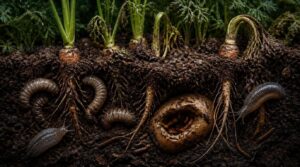
Some of the worst garden pests never show their faces — they work underground, where you can’t easily spot them until the damage is done. Cutworms, slugs, root maggots, and wireworms quietly destroy roots, sever seedlings, and hollow out tubers before most gardeners even know there’s a problem.
The most destructive garden pests never surface — they silently sever roots and hollow tubers underground
Here’s what to watch for and how to fight back.
Cutworm Seedling Damage
Cutworms are sneaky — they do their worst damage after dark. Nighttime stem cutting at or just below soil level leaves seedlings collapsed by morning, often with leaves still intact. That sudden wilt isn’t disease; it’s a cutworm.
Protect transplants early with soil barrier collars, apply beneficial nematode application to infested beds, and practice mulch management by keeping debris minimal.
Slug and Snail Trails
Slugs and snails announce themselves with a silvery slime trail — that glistening, mucus ribbon of water, glycoproteins, and minerals that dries matte by midday. Check damp surfaces early in the morning when trails are freshest. Overlapping trails signal real pressure.
Use copper tape barriers or coarse grit to block movement, and remove decaying mulch where they shelter.
Root Maggot Tunnels
Root maggots don’t announce themselves until the damage is done. By the time you see wilting carrots or stunted onions, the larvae have already carved winding, irregular tunnels through the root flesh. These meandering paths collapse vascular tissue, block water uptake, and open the door to rot bacteria.
Pull suspicious roots early — soft spots and surface scarring are your clearest early detection signals.
Wireworm Tuber Holes
Wireworms move silently through soil, boring round to elongated holes — 1 to 4 mm wide — directly into developing potato tubers. Cut a suspicious tuber open and you’ll find shallow tunnels running just under the skin.
High soil moisture draws them closer to the surface, intensifying damage. Rotate out of root crops for two or more seasons to break their cycle.
Beneficial Nematode Treatments
Think of beneficial nematodes as a living pesticide you release directly into the soil. These microscopic roundworms from the genera Steinernema and Heterorhabditis parasitize wireworms, root maggots, and cutworms, killing them within 24 to 48 hours.
Apply as a water drench when soil temperatures sit between 60 and 85°F and moisture is high for best results.
Prevent Pests With Garden Maintenance

Most pest problems don’t start with insects — they start with gaps in garden care that give insects an easy foothold. A few consistent habits throughout the season can cut down on infestations before they ever take hold. Here’s what to build into your routine.
Rotate Vegetable Crops
Crop rotation is one of the most reliable preventative measures in sustainable gardening. Moving crop families to different beds each season breaks pest life cycles before they establish. A four-year schedule keeps nightshades, brassicas, cucurbits, and legumes cycling through separate beds. Legumes also fix nitrogen naturally, boosting soil health for whatever follows.
- Rotate brassicas away from beds with clubroot history
- Place legumes before heavy feeders like tomatoes
- Keep nightshades and cucurbits on separate four-year cycles
- Use soil tests after each rotation to guide amendments
Remove Plant Debris
Once you’ve sorted your rotation schedule, turn your attention to what you leave behind in the beds. Dead stems, fallen leaves, and spent vines are prime overwintering habitat for aphids, beetles, and moth larvae.
A thorough debris removal schedule — after harvest and again in early spring — cuts pest populations before they ever get a foothold.
Use Floating Row Covers
Clearing out dead plant matter does a lot of heavy lifting, but it can’t stop a flying pest mid-flight. That’s where floating row covers earn their place. This lightweight fabric creates a physical barrier against aphids, beetles, caterpillars, and moths while still letting in light, air, and water.
Here’s what they do well:
- Temperature benefits: Covers raise air temps by 2–6°F, protecting tender crops from late frosts and cool mornings.
- Pest exclusion: Bury or pin the edges tightly — any gap is an open door for crawling insects.
- Season extension: Use them in early spring and again in fall to stretch your harvest window without heavy structures.
For crop compatibility, lighter fabrics suit pest exclusion on greens like lettuce and spinach; heavier weights handle frost. Just remember — fruiting crops need the covers removed during flowering so pollinators can do their job.
Space Plants Properly
Row covers handle flying pests beautifully, but spacing your plants is what stops problems from taking root in the first place.
Ideal row spacing — usually 6 to 18 inches depending on the crop — keeps air moving freely between plants, cuts humidity, and reduces foliar diseases like powdery mildew. Crowded plants trap moisture; spaced ones breathe.
| Spacing Benefit | What It Prevents | Crop Example |
|---|---|---|
| Airflow through spacing | Powdery mildew, fungal spread | Zucchini, tomatoes |
| Root zone allocation | Nutrient competition, weak growth | Carrots, potatoes |
| Sunlight distribution | Shading, uneven vigor | Lettuce, peppers |
Plant density benefits go beyond disease — roots explore more soil volume, absorbing nitrogen and potassium without competing with neighbors. That translates directly into stronger, more productive plants season after season.
Monitor With Sticky Traps
Sticky traps are one of the simplest early-warning tools in integrated pest management. Here’s what to know:
- Yellow cards catch whiteflies and winged aphids; blue cards target thrips more effectively.
- Hang traps just above the canopy and adjust height as plants grow.
- Check and count by pest group once weekly.
- Replace cards when dust or debris covers the adhesive.
- Pair trap counts with direct leaf inspection for accurate identification.
Encourage Beneficial Pest Predators

Not every pest battle needs a spray bottle. Some of the most effective defenders in your garden are already out there—you just need to make them feel welcome. Here are the beneficial insects worth encouraging and what each one brings to the fight.
Ladybugs for Aphids
Ladybugs are one of the most effective natural predators for aphid control. A single adult can consume about 100 aphids daily, and larvae eat even more.
Release them at dusk onto infested plants, water first to encourage them to stay, and plant dill or sweet alyssum nearby. Watch out for ants — they’ll actively defend aphid colonies against your beneficial insects.
Lacewing Larvae Benefits
Green lacewings punch well above their weight. Each larva can devour over 1,000 aphids before reaching adulthood — plus thrips, spider mites, whiteflies, and mealybugs. That’s a broad pest range few beneficial insects can match.
- Release 1 larva per square foot bi-weekly during active infestations
- Use egg releases monthly for long-term population establishment
- Plant chamomile or dill to improve adult retention
- Expect 2–4 weeks of active predation per larva
- Reduce insecticide use by up to 99% with consistent releases
Parasitic Wasp Control
Parasitic wasps work quietly — but the evidence shows up fast. Aphid mummies turning tan or black, white braconid cocoons on hornworm backs, and blackened whitefly pupae all confirm wasps are active.
Leave parasitized hornworms in place; removing them kills developing beneficials. Plant dill, fennel, or alyssum nearby, and avoid pyrethroids, which wipe out these allies on contact.
Hoverfly Larvae and Pollination
Hoverfly larvae are silent workhorses in your garden. Legless and wormlike, each larva hunts down aphid colonies using mouth hooks, consuming several hundred aphids before pupating. Female hoverflies place eggs directly beside aphid colonies, so newly hatched larvae find prey within centimeters.
Once adults emerge, they visit dill, fennel, and calendula blooms, actively pollinating while multiple generations cycle through your season.
Ground Beetle Slug Hunting
Ground beetles are among the most effective natural predators of slugs in your vegetable garden. Species like Pterostichus melanarius (12–18 mm) and Carabus nemoralis (up to 30 mm) patrol after dark, using strong mandibles to target both slug eggs and juveniles.
- They shelter under mulch and stones by day
- Hunt actively along drip lines and bed edges at night
- Eat slug eggs (2–4 mm), small juveniles, and cutworms
- Overwinter as adults, emerging in spring to protect new seedlings
- Avoid deep tillage and broad-spectrum sprays — both destroy beetle populations
Keep permanent ground cover like straw mulch or leaf litter to sustain them season to season.
Top 10 Garden Pest Control Products
Knowing what to use is just as important as knowing what you’re dealing with. The right product can mean the difference between saving your crop and watching it disappear overnight. Here are ten pest control options worth keeping on hand in your garden toolkit.
1. Harvest Guard Plant Frost Cover
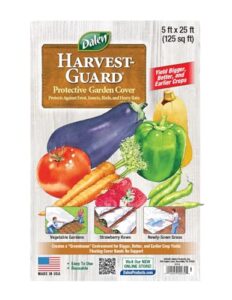
Harvest Guard row cover does double duty in the vegetable garden — it blocks frost and keeps insects off your crops. The lightweight, breathable non-woven fabric lets sunlight and rain pass through while physically excluding cabbage moths, flea beetles, and cucumber beetles before they ever reach your plants.
Lay it directly over rows or drape it over hoops, then secure the edges with soil or stakes. At 5 x 25 feet, it fits most raised beds and row plantings easily.
| Best For | Home gardeners who want an easy, no-fuss way to protect vegetables and fruits from frost, pests, and harsh weather across multiple growing seasons. |
|---|---|
| Product Form | Fabric Sheet |
| Control Method | Physical Barrier |
| Primary Pests | Birds, Insects, Rabbits |
| Organic Safe | Yes |
| Use Environment | Outdoor |
| Size/Volume | 5 x 25 Feet |
| Additional Features |
|
- Breathable fabric lets sunlight and air through, so you can leave it on without worrying about cooking your plants
- Works as both a frost shield and a pest barrier — two problems, one cover
- Reusable and made in the USA, so it holds up season after season
- Thin material can tear in strong winds, so you’ll need to stake or weigh down the edges
- May need a second layer when temps drop well below freezing
- Pricier upfront than basic burlap or other traditional covers
2. Espoma Organic Insecticidal Soap Spray
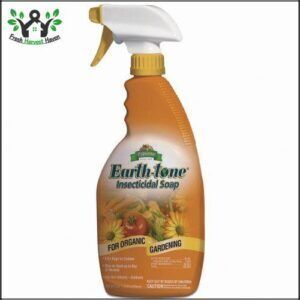
Row covers keep pests off by force. Espoma Organic Insecticidal Soap Spray takes a different approach — it kills on contact when you can’t exclude insects anymore. Formulated with potassium salts of fatty acids and no animal-based ingredients, it targets soft-bodied pests like aphids, whiteflies, mealybugs, and spider mites.
Spray both leaf surfaces thoroughly, ideally in the early morning. Repeat applications are often needed since it won’t protect against new arrivals once dry.
| Best For | Gardeners who want an organic, plant-based option for knocking out soft-bodied pests on vegetables, fruit trees, and houseplants without harsh chemicals. |
|---|---|
| Product Form | Liquid Spray |
| Control Method | Contact Kill |
| Primary Pests | Aphids, Mites, Scale |
| Organic Safe | Yes |
| Use Environment | Indoor/Outdoor/Greenhouse |
| Size/Volume | 24 Ounces |
| Additional Features |
|
- Plant-based formula with no animal ingredients — genuinely organic and low-odor
- Works across a wide range of settings: indoors, outdoors, greenhouses
- Hits a solid list of common pests like aphids, mites, and mealybugs on contact
- Spray nozzle can be a pain to open or refill
- No residual protection — once it dries, new pests can move right in
- Some orders have arrived with leakage, so check the bottle when it shows up
3. Natria Neem Oil Pest Disease Control
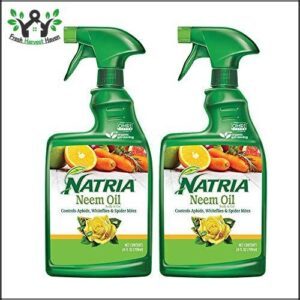
Where Espoma manages pest contact, Natria Neem Oil goes further — it’s an insecticide, miticide, and fungicide in a single bottle. The active ingredient, clarified hydrophobic extract of neem oil, coats soft-bodied pests like aphids, whiteflies, spider mites, and mealybugs while suppressing powdery mildew, black spot, and rust.
Spray both leaf surfaces thoroughly, avoiding midday heat to reduce leaf burn risk. Shake well before use, and test sensitive plants first.
| Best For | Gardeners who want one product that handles both pests and fungal disease on roses, vegetables, and fruit plants — especially those gardening organically. |
|---|---|
| Product Form | Liquid Oil Spray |
| Control Method | Contact Kill |
| Primary Pests | Aphids, Whiteflies, Spider Mites |
| Organic Safe | Yes |
| Use Environment | Outdoor |
| Size/Volume | 24 Ounces (2-Pack) |
| Additional Features |
|
- Pulls triple duty as an insecticide, miticide, and fungicide, so you’re not juggling multiple products
- Safe to spray right up to harvest day, which is a big deal for edible gardens
- Works on a wide range of common problems — aphids, spider mites, whiteflies, powdery mildew, black spot, and more
- Over-spraying can cause leaf yellowing, so you need to be careful with application
- Won’t do much against Japanese Beetles, so you’d need something else for that
- Requires a good shake before each use — skip that step and you’re not getting the full formula
4. Bonide Captain Jacks Deadbug Brew
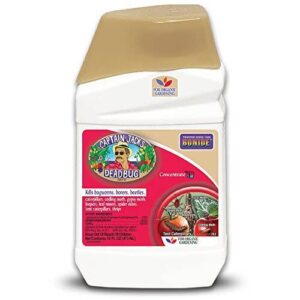
Neem oil manages the surface-level pest pressure well, but if caterpillars, thrips, or beetles are the real problem, you need something that works from the inside out.
Bonide Captain Jack’s Deadbug Brew uses spinosad — a naturally fermented compound from soil bacteria — that target pests ingest through treated plant tissue. It’s OMRI Listed for organic use, covers vegetables, fruits, and ornamentals, and won’t substantially harm beneficial predators.
Apply in the evening, and reapply weekly or after rain.
| Best For | Organic gardeners dealing with caterpillars, beetles, or leaf miners who want a soil-bacteria-based spray that won’t wipe out their beneficial insects. |
|---|---|
| Product Form | Liquid Concentrate |
| Control Method | Ingestion Kill |
| Primary Pests | Moths, Beetles, Caterpillars |
| Organic Safe | Yes, OMRI Approved |
| Use Environment | Outdoor |
| Size/Volume | 16 Ounces |
| Additional Features |
|
- Uses spinosad, a naturally fermented active ingredient that’s OMRI Listed for organic gardening
- Works on a wide range of tough pests — caterpillars, beetles, leaf miners, bagworms, and fungus gnats
- Gentler on predatory beneficial insects compared to broad-spectrum pesticides
- Needs reapplication every week or after rain, which adds up fast
- Has to be applied in the evening to avoid harming bees
- Mixed results on mites and some smaller gnat species, so it’s not a universal fix
5. Bonide Thuricide BT Caterpillar and Moth Control
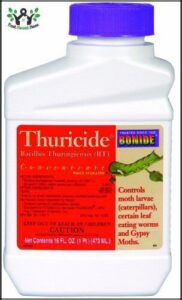
When caterpillars are the main threat, Bonide Thuricide BT is hard to beat. Its active ingredient — Bacillus thuringiensis var. kurstaki — is a naturally occurring soil bacterium that stops feeding almost immediately after larvae ingest it. It targets tomato hornworms, cabbage worms, and tent caterpillars without harming bees or ladybugs.
Mix 1/2 to 4 teaspoons per gallon, coat both leaf surfaces thoroughly, and reapply every 5–7 days or after heavy rain. You can spray it right up to harvest day.
| Best For | Gardeners dealing with caterpillar infestations who want an organic-approved solution that’s safe around pollinators and can be used right up to harvest day. |
|---|---|
| Product Form | Liquid Concentrate |
| Control Method | Ingestion Kill |
| Primary Pests | Loopers, Hornworms, Caterpillars |
| Organic Safe | Yes, Organic Approved |
| Use Environment | Outdoor |
| Size/Volume | 16 Ounces |
| Additional Features |
|
- Targets nasty caterpillars like hornworms and cabbage worms without touching bees or ladybugs
- You can spray it the same day you harvest — no waiting period needed
- Works on vegetables, fruits, trees, and ornamentals, so it pulls weight across the whole garden
- You need solid coverage on both sides of every leaf, which takes more time and effort
- Rain washes it off, so you’ll be reapplying more often during wet stretches
- Lower concentration than some alternatives, and it can smell pretty unpleasant to work with
6. BioLogic Ecomask Beneficial Nematodes Pest Control
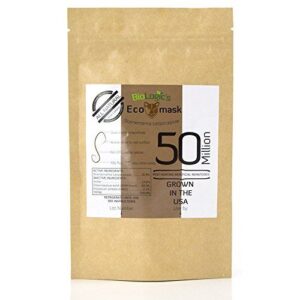
BioLogic Ecomask puts 50 million Steinernema carpocapsae nematodes to work beneath the soil. These microscopic roundworms target flea larvae, cutworms, and armyworms by entering hosts and releasing symbiotic bacteria that kill from the inside out.
Mix with water and apply in the evening using a hose sprayer — fine nozzle screens can trap live nematodes, so keep the flow path open. Moist soil is essential, so water the area before and after treatment.
| Best For | Homeowners and gardeners who want a chemical-free way to wipe out soil pests like fleas, cutworms, and fungus gnats without worrying about kids or pets nearby. |
|---|---|
| Product Form | Liquid Nematode Mix |
| Control Method | Biological Soil |
| Primary Pests | Fleas, Armyworms, Fungus Gnats |
| Organic Safe | Yes, Non-GMO |
| Use Environment | Lawn and Garden |
| Size/Volume | 50M Nematodes/2,000 Sq Ft |
| Additional Features |
|
- 50 million nematodes cover up to 2,000 sq ft — solid bang for the buck on larger lawns and garden beds
- Completely non-toxic to pets, children, and plants, so you’re not trading one problem for another
- Targets multiple pests at once, hitting larvae and pupae right where they live in the soil
- Needs refrigeration before use and has to be applied at just the right time — evening or shade only — which adds some planning
- Moist soil is non-negotiable, meaning you’ll need to water before and after every treatment
- Heat can tank its effectiveness, making it a trickier pick for hot, dry climates
7. Faicuk Yellow Sticky Traps for Plant Insects
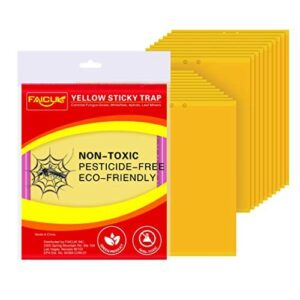
Faicuk Yellow Sticky Traps are a simple, passive way to cut flying pest populations before they spiral out of control. Each dual-sided 6×8-inch card is coated in high-tack adhesive and engineered in bright yellow to attract aphids, whiteflies, thrips, and fungus gnats.
Place them just above the plant canopy — one trap per 25 square feet — and keep them away from foliage to prevent accidental leaf contact. Each trap stays effective for up to six months.
| Best For | Home gardeners and plant enthusiasts who want a simple, no-fuss way to keep flying pests like fungus gnats, aphids, and whiteflies under control indoors or out. |
|---|---|
| Product Form | Adhesive Trap |
| Control Method | Physical Trap |
| Primary Pests | Fungus Gnats, Aphids, Whiteflies |
| Organic Safe | Yes, Non-Toxic |
| Use Environment | Indoor/Outdoor |
| Size/Volume | 20 Traps (6×8 In) |
| Additional Features |
|
- Dual-sided adhesive means you’re catching pests from every angle, not just one direction
- Non-toxic and waterproof — safe to use around kids, pets, and delicate plants
- Flexible enough to cut into custom shapes, so you can fit them around trickier spots
- Not the right tool for general household pests like fruit flies — these are built for plant insects specifically
- The adhesive is seriously strong, so accidental skin or leaf contact can be a real hassle
- Ground-level placement can accidentally snag lizards, crickets, or other harmless critters
8. Live Hb Beneficial Nematodes Soil Treatment
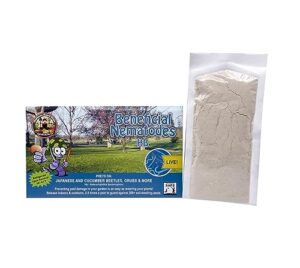
Think of Hb nematodes as microscopic hunters working the soil for you. Live Hb Beneficial Nematodes contain Heterorhabditis bacteriophora, a parasitic roundworm that enters grubs, cutworms, and beetle larvae through natural body openings, then releases bacteria that kill the host within 24–48 hours.
Apply in early morning or evening when soil temperatures sit between 66–91°F. Keep the soil moist before and after application, and use the mix within six hours of activation.
| Best For | Homeowners and gardeners who want an organic, chemical-free way to wipe out soil pests like grubs, ants, and beetle larvae without worrying about harm to kids or pets. |
|---|---|
| Product Form | Liquid Nematode Mix |
| Control Method | Biological Soil |
| Primary Pests | Grubs, Ants, Beetles |
| Organic Safe | Yes, Organic |
| Use Environment | Outdoor/Soil |
| Size/Volume | 50M Nematodes |
| Additional Features |
|
- Targets a wide range of soil pests — grubs, cutworms, termites, weevils, and more — all without synthetic chemicals
- Safe around humans and pets, so no need to keep anyone off the lawn after application
- Simple to apply — just mix with water and spray, no special equipment needed
- Tight application window — once activated, you’ve got six hours to get it in the ground
- Needs refrigeration and can’t be frozen, so storage requires a little planning
- Timing and temperature matter a lot — too hot, too cold, or poor soil moisture and the nematodes won’t perform
9. Liquid Garlic Insect Repellent Concentrate
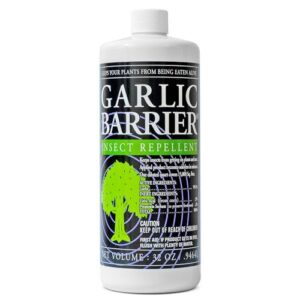
Garlic has been keeping pests off crops for centuries — and the Liquid Garlic Insect Repellent Concentrate puts that old-world trick in a modern 32 fl oz bottle. It repels aphids, mites, beetles, and caterpillars, and it’s OMRI Listed for organic use.
Mix 1 part concentrate to 9 parts water, load it into any pump or backpack sprayer, and treat leaf surfaces before pest pressure builds. One limitation: avoid spraying on blooming plants, since the strong sulfur odor can discourage pollinators.
| Best For | Home gardeners and small-scale growers who want an organic, chemical-free way to keep insects, birds, and garden critters away from their plants. |
|---|---|
| Product Form | Liquid Concentrate |
| Control Method | Repellent |
| Primary Pests | Aphids, Beetles, Caterpillars |
| Organic Safe | Yes, OMRI Listed |
| Use Environment | Indoor/Outdoor/Greenhouse |
| Size/Volume | 32 Ounces |
| Additional Features |
|
- OMRI Listed, so it’s safe for certified organic gardens — no synthetic chemicals involved
- Works on a wide range of pests, from aphids and mites to deer and squirrels
- Scales easily with any standard sprayer, indoors or out
- The garlic smell is strong and lingers after application
- Skip it on blooming plants — it can send pollinators running
- Results aren’t guaranteed; weather and local conditions can affect how well it works
10. Kraftex Conductive Copper Foil Tape
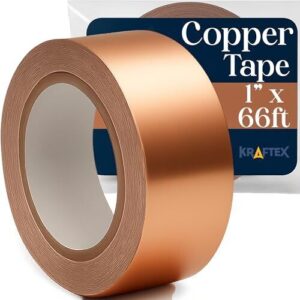
Slugs don’t need much — just a moist night and an unguarded pot. Kraftex Copper Foil Tape gives them a reason to turn back.
At 1/4 inch wide and 66 feet long, one roll wraps dozens of containers. The conductive adhesive keeps overlapping sections electrically continuous, so there are no dead spots in the barrier.
Press it firmly onto a clean, dry rim, close the ring completely, and you’ve built a perimeter slugs and snails reliably avoid.
| Best For | Gardeners, electronics hobbyists, and crafters who need a reliable, flexible copper tape for everything from slug barriers to EMI shielding and soldering projects. |
|---|---|
| Product Form | Adhesive Copper Tape |
| Control Method | Physical Deterrent |
| Primary Pests | Slugs and Snails |
| Organic Safe | Yes, Chemical-Free |
| Use Environment | Indoor/Outdoor |
| Size/Volume | 1 In x 66 Feet |
| Additional Features |
|
- Conductive adhesive keeps overlapping sections connected, so your barrier or circuit stays solid with no weak spots
- 66 feet goes a long way — plenty for wrapping pots, lining enclosures, or stocking up for multiple projects
- Works indoors and out, so it pulls double duty in the garden and the workshop
- Edges are sharp, so you’ll want to handle it carefully — especially when cutting or pressing it into tight spots
- The thin foil can tear if you’re not gentle during application, which gets frustrating fast
- The roll has no sidewalls, so it unfurls easily and can be a bit fiddly to work with
Frequently Asked Questions (FAQs)
What are the most common pests in vegetable gardens?
Every garden has its uninvited guests. The most common culprits are aphids, whiteflies, caterpillars, beetles, spider mites, slugs, and cutworms — each targeting different crops and causing distinct, recognizable damage.
What bug is eating my vegetable garden?
Several types of bugs could be the culprit. Aphids, beetles, caterpillars, and slugs are the most common offenders — each leaving distinct damage patterns that tell you exactly who’s responsible.
What is the best pest control for vegetable gardens?
No single product wins every battle. The best pest control combines physical barriers, organic sprays, and beneficial insects — matched to the specific pest you’re facing.
What are the common pests in vegetables?
Vegetables practically come with a built-in pest buffet. Aphids, whiteflies, thrips, spider mites, beetles, caterpillars, slugs, and root maggots are the most common culprits — each targeting different plants in different ways.
How to get rid of vegetable garden pests?
Start by identifying the pest correctly — the right fix depends on knowing what you’re dealing with. Then act fast: remove by hand, spray with insecticidal soap, or apply Bt for caterpillars.
When is the best time to inspect for pests?
Like a doctor catching illness early, timing your inspections matters. Check at early morning and 1–2 hours after sunset — those windows reveal the most pest activity before pests hide.
How do weather conditions affect pest activity levels?
Weather shapes pest behavior directly.
Warm temperatures between 65–80°F accelerate aphid reproduction, while hot, dry days above 85°F trigger spider mite surges.
Rain knocks soft-bodied insects off plants; mild winters mean heavier spring pressure.
What are signs of pest resistance to treatments?
When a product stops working even though you’re applying it correctly, that’s resistance. Survivors stay mobile, populations rebound in days, and switching brands within the same IRAC group changes nothing.
Should I remove infected plants or treat them?
It depends on the problem. Fungal infections with limited spread are often treatable; remove affected leaves and apply copper or sulfur. But virus- or bacteria-infected plants usually come out — no spray fixes them.
Can pests spread between neighboring garden plots?
Yes — pests spread freely between neighboring plots. Winged aphids and whiteflies fly to fresh growth; slugs crawl across moist soil at night; shared tools and transplants carry hidden eggs and mites.
Conclusion
A single missed inspection can unravel months of careful work before you’ve ever harvested your first ripe tomato. Vegetable garden pests thrive on inattention—but they simply don’t stand a chance against a gardener who recognizes the signs early.
Check your plants twice a week, respond fast, and lean on beneficial insects alongside targeted treatments. The garden doesn’t demand ideal; it rewards your consistent presence, a sharp and practiced eye, and the will to act.
- https://www.gardeners.com/blogs/insect-pest-control-articles/plant-pest-photo-gallery-5288
- https://ucanr.edu/blog/over-fence-alameda-county/article/battling-summer-vegetable-garden-pests-gardeners-guide
- https://courses.savvygardening.com/organic-pest-control-for-the-vegetable-garden
- https://www.jppestservices.com/blog/6-surprising-statistics-about-pest-infestation
- https://creativecommons.org/licenses/by-nc-nd/2.0/