This site is supported by our readers. We may earn a commission, at no cost to you, if you purchase through links.
Most gardeners plant a row of lettuce, harvest it once, and pull the spent stalks—never realizing the same bed could keep producing for months. Cut-and-come-again growing breaks that cycle, turning a single sowing into a rolling harvest that outlasts anything you’d replant from scratch.
The mechanism is straightforward: leafy greens like kale, chard, and loose‑leaf lettuce regenerate continuously from a central crown, provided you harvest selectively and maintain the conditions that drive regrowth.
Soil fertility, harvest timing, and varietal selection all shape how reliably that regeneration happens.
Harvesting leafy greens for continuous yield isn’t complicated, but it does reward precision over guesswork.
Table Of Contents
- Key Takeaways
- Choosing Leafy Greens for Continuous Harvest
- Preparing Beds and Planting for Ongoing Yield
- Step-by-Step Harvesting for Maximum Regrowth
- Scheduling and Timing Your Leafy Green Harvests
- Maintaining Plant Health for Continuous Production
- Frequently Asked Questions (FAQs)
- What leafy vegetable can be harvested multiple times?
- Can I continuously harvest spinach?
- What pests commonly attack leafy green crops?
- How much water do leafy greens need?
- Which fertilizers work best for continuous harvesting?
- Can you harvest leafy greens in winter?
- What soil pH is ideal for leafy greens?
- Can leafy greens grow well in containers?
- How do grow lights affect leafy green production?
- What companion plants benefit leafy green crops?
- Conclusion
Key Takeaways
- Choosing the right cultivar from the start—loose-leaf lettuce, kale, Swiss chard, or arugula—determines how long your harvest window stays open and how quickly plants bounce back after each cut.
- The one-third rule is non-negotiable: remove only the outermost leaves, leave at least two-thirds of the plant intact, and wait 7–14 days between sessions so the crown keeps driving energy into new growth.
- Soil prep and post-harvest fertility directly control regrowth speed, so work compost into the top 15 cm before planting and follow every cut with a nitrogen-rich feed within a day or two.
- Succession planting every 7–14 days, matched to your climate and the bolting signals each variety gives you, is what turns a single bed into a system that produces continuously across the whole season.
Choosing Leafy Greens for Continuous Harvest
Not every leafy green will give you that steady, cut-today-pick-again-next-week rhythm you’re after. The variety you choose from the start shapes how long your harvest window stays open and how quickly plants bounce back after picking.
Picking the right variety from day one means you’ll enjoy a reliable cut-and-come-again cycle, as explained in this guide to harvesting leafy green vegetables for continuous regrowth.
Here’s what to look for when making your selections.
Best Cut-and-come-again Varieties
Not all leafy greens regenerate equally well — and choosing the right cut-and-come-again varieties is what separates a one-time harvest from weeks of continuous production. These perform consistently:
- Loose-leaf lettuce reaches harvestable size in about 30 days
- Kale varieties overwinter and sweeten after frost
- Swiss chard produces reliably for several months from a single sowing
- Arugula & mizuna, spinach, and Asian greens all respond well to repeated outer-leaf removal
For best timing, consider the cut-and-come-again method guidelines.
Selecting for Climate and Season
Cool‑season varieties like spinach and lettuce thrive between 55°F and 70°F, but bolt fast once heat pushes past 80°F. For continuous harvest across changing seasons, match your selections to your climate window.
Frost‑hardy options like kale handle dips to 28°F, while shade‑tolerant cultivars and bolt‑resistant, day‑length adapted greens extend your seasonal planting range when succession planting into warmer or shorter-light conditions.
plant cool‑season crops early to increase yields before the last frost.
Disease-resistant and High-yield Options
Variety selection doesn’t stop at climate fit. Choosing cultivars with downy mildew resistance, corky root tolerance, and leafminer resistant lines keeps plants productive through multiple cuts, supporting true continuous harvest without mid-season decline.
Multi-resistant hybrids like Prodigio combine high-yield baby leaf output with broad disease packages, so cut-and-come-again beds stay dense longer. That’s yield optimization and sustainable gardening working together from the start.
Preparing Beds and Planting for Ongoing Yield
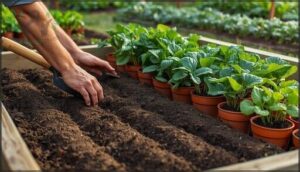
Getting a continuous harvest starts long before you ever pick a leaf — it starts with how you set up your beds. The way you prepare your soil, time your plantings, and space your crops determines whether you’re picking greens all season or scrambling after one flush.
Here’s what to focus on before you sow a single seed.
Soil Preparation and Amendments
Your bed’s foundation determines how often you can harvest, not just how well plants grow. Loose, well-draining soil with a pH between 6.0 and 7.0 promotes strong regrowth after every cut. Focus on three priorities:
Getting the soil right from the start sets you up for a much longer harvest window, as these spring vegetables that thrive in well-drained beds show.
- Organic Matter Incorporation – Work 2–5 cm of finished compost into the top 15 cm.
- Drainage Enhancement – Build raised beds at least 15 cm high to prevent waterlogging.
- Nutrient Balancing – Blend roughly 30 % topsoil, 40 % compost, and 20 % perlite for steady soil fertility.
Succession Planting Techniques
Staggering your sow dates is the engine behind continuous gardening.
Sow small batches every 7 to 14 days using calendar scheduling built backward from your first frost date, and you’ll maintain overlapping harvesting intervals without bulk waste.
Staggered bed layouts divide a standard 4×8 bed into timed strips, supporting harvest management and risk management by limiting pest or frost exposure to one batch at a time.
Optimal Spacing and Thinning Methods
Spacing isn’t just logistics — it’s the foundation of your CutandComeAgain system.
For Continuous Gardening success, thin looseleaf Leafy Greens to 6–8 inches apart in stages, snipping at soil level to protect roots. Follow Baby Leaf Spacing and Row Width Guidelines to improve airflow and disease control.
In containers, adjust Container Plant Density as part of smart Crop Management and reliable Harvesting Techniques.
Step-by-Step Harvesting for Maximum Regrowth
Harvesting leafy greens the right way is what separates a plant that keeps giving from one that fizzles out after a single cutting.
How you cut, what you leave behind, and how much you take at once all determine whether your greens bounce back strong or struggle to recover.
Here’s exactly what to do at each step.
Cut-and-come-again Harvesting Method
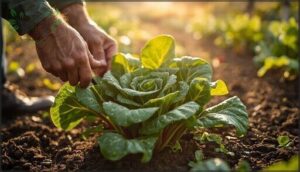
The cut-and-come-again method is the backbone of continuous crop yield — you harvest only the outermost leaves, leaving the crown untouched so the plant keeps driving energy into new growth. This facilitates leaf nutrient cycling and root zone health over weeks or months.
Follow this sequence:
- Identify the oldest outer leaves first
- Leave at least 3–4 healthy inner leaves intact
- Harvest in the morning when leaves are fully hydrated
- Space pickings 7–10 days apart for harvest frequency optimization
Proper Tools and Leaf Removal Techniques
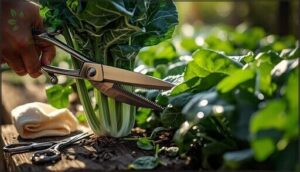
Your tools are the difference between a plant that bounces back fast and one that stalls. Sharp shears or pruners make clean cuts on tougher stems like kale; scissors handle softer leaves without tearing.
Use hand support to stabilize the base, angle cutting slightly so moisture sheds off the wound, and sanitize blades between beds — because every leafy green harvesting session either builds or quietly undermines your next yield.
The 1/3 Rule to Avoid Plant Stress
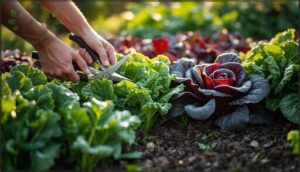
Remove only one-third of the plant per session — this is the cornerstone of cut and come again gardening. Protecting leaf area balance preserves photosynthetic capacity, keeping roots healthy and hormonal response stable.
- Harvest outer leaves first
- Leave two-thirds intact
- Wait 7–14 days between harvesting intervals
- Apply this across all leafy greens
- Consistent stress mitigation drives continuous crop yield
Preventing Damage to Regrowth Points
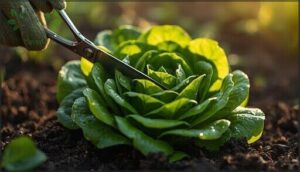
Every new leaf your plant will ever give you originates from one small zone — the crown. Protecting it isn’t optional; it’s the whole game.
Every leaf your plant will ever grow comes from the crown — protect it, and you protect everything
| Mistake | Better Practice |
|---|---|
| Cutting into the crown | Leave 1.5–2 inches above the base |
| Dull blade tearing tissue | Use sharp, sterile cutting tools |
| Twisting leaves aggressively | Apply minimal twisting force at the leaf base |
| Skipping tool sanitation | Disinfect before each cut-and-come-again session |
Precise stem cuts, combined with consistent leaf base support, keep those regrowth points intact across every harvest.
Scheduling and Timing Your Leafy Green Harvests
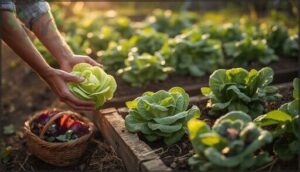
Knowing when to harvest is just as important as knowing how.
Pull too early and you slow the plant down; wait too long and you’re fighting bitterness or a bolt that’s already underway.
Here’s what to watch for when timing your leafy green harvests.
Recognizing Maturity and Harvest Readiness
Knowing when leafy greens are ready comes down to reading a few reliable signals.
Leaf size cues are your starting point—leaf lettuce hits its mark at 4 to 6 inches, spinach at 6 to 8 inches, kale at 8 to 10 inches.
Pair that with color vibrancy, texture firmness, and central growth patterns.
Bolting warnings, such as a rising central stem, mean harvest immediately.
Determining Ideal Harvesting Intervals
Once you’ve nailed harvest readiness, intervals become your next lever. Looseleaf lettuce generally turns around in 5 to 7 days; kale and Swiss chard weekly; spinach, closer to 7 to 10 days.
Harvesting intervals shift with temperature impact, light duration, soil moisture, and nutrient levels—so treat these windows as baselines, not fixed rules. Cut and come again only works when regrowth actually keeps pace.
Adjusting Timing for Seasons and Varieties
Intervals don’t live in a vacuum—they shift with the season. Cool weather around 15–18°C accelerates regrowth, tightening harvesting intervals. Once temperatures climb past 24°C, cool-season leafy greens bolt faster, so the cut-and-come-again method demands earlier, more frequent cuts.
- shorten intervals as daylength effects speed leaf production
- switch to heat-tolerant varieties like New Zealand spinach
- extend intervals as photoperiod management becomes critical
- use tunnels to maintain slow but steady regrowth cycles
Maintaining Plant Health for Continuous Production
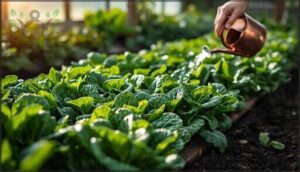
A great harvest is only half the battle — what you do afterward determines whether your plants keep producing or quietly give up.
Consistent care after each cutting is what separates a one-time yield from a garden that feeds you all season long.
Here’s what to focus on to keep your leafy greens healthy and productive.
Watering and Fertilizing After Harvest
After each cut, your recovery window starts immediately. Water deeply in the morning so plants stay hydrated through the day’s heat — Morning Moisture matters more than frequency.
Let Balanced Light Feedings of nitrogen-rich fertilizer follow the harvest within a day or two, because Nitrogen Refeed Timing drives faster leaf regeneration.
Mulch Moisture Retention stabilizes the Root Zone Aeration, your soil needs to move nutrients efficiently.
Monitoring for Bolting and Pest Issues
Watching your leafy greens closely between harvests keeps your cut-and-come-again gardening on track. Check for these issues at least twice a week:
- Bolting Indicators — a fast central shoot, smaller leaves, or bitter taste signals it’s time to replant.
- Aphid Scouting — inspect leaf undersides for colonies; populations can double within days.
- Leafminer Detection — pale tunneling or blister marks on young leaves mean adults are laying eggs nearby.
- Flea Beetle Monitoring and Slug/Snail Signs — small shotholes or silvery slime trails confirm feeding damage that reduces harvestable leaf area.
Managing Regrowth and Extending Harvest Season
Once older plants slow down, layering cold frame usage with row cover timing keeps your leafy greens producing well past the first frost.
Monitor temperatures closely — covering plants when readings dip below 45°F preserves leaf quality.
Pair that with nutrient recycling through side-dressing after each cut-and-come-again harvest, and you’re running a regenerative gardening system that delivers continuous crop yield across multiple seasons.
Frequently Asked Questions (FAQs)
What leafy vegetable can be harvested multiple times?
Almost every leafy green in your garden qualifies. Leaf lettuce, kale, Swiss chard, spinach, and arugula all support cut-and-come-again gardening, delivering continuous crop yield through repeated, well-timed harvesting techniques.
Can I continuously harvest spinach?
Yes, spinach allows repeated harvests.
Using cut-and-come-again gardening techniques, you can pick outer leaves every few weeks, preserving leaf texture, nutrient density, and flavor profile while extending harvest frequency well into the season.
What pests commonly attack leafy green crops?
Aphid infestations, caterpillar damage, slug and snail activity, leafminer tunneling, and thrips feeding are the most common threats to leafy greens, each capable of reducing yield and quality if left unmanaged.
How much water do leafy greens need?
Most leafy greens need about 1 to 5 inches of water per week, keeping the top few inches of soil consistently moist without letting it dry out completely between waterings.
Which fertilizers work best for continuous harvesting?
Nitrogen ratios drive leaf production more than any other factor.
For continuous cutting, liquid foliar feeds like fish emulsion (5-1-1) applied every two to three weeks replenish what harvesting removes, keeping regrowth steady.
Can you harvest leafy greens in winter?
You can absolutely harvest leafy greens in winter.
Cold-hardy winter varieties like spinach, kale, and mache keep producing through frost when given basic cold protection like row covers or low tunnels.
What soil pH is ideal for leafy greens?
Most leafy greens thrive in a soil pH between 0 and 0, where nutrient availability stays consistent. A target of 5 balances soil fertility well for mixed beds of lettuce, kale, and spinach.
Can leafy greens grow well in containers?
leafy greens thrive in containers when pot depth, drainage design, and light exposure align.
Small Space Gardening and Balcony Gardening Tips both confirm it works reliably.
How do grow lights affect leafy green production?
Grow lights drive photosynthesis intensity through PPFD levels, spectrum composition, and photoperiod duration.
Targeting a DLI optimization around 14–17 mol·m⁻²·day⁻¹ accelerates leafy greens growth while improving energy efficiency across your entire indoor setup.
What companion plants benefit leafy green crops?
Companion planting pairs leafy greens with Allium repellents, marigold pest control, nitrogen‑fixing peas, aromatic herb allies, and flowering beneficial insects — core organic gardening and sustainable food systems strategies that strengthen vegetable gardening and leafy greens production naturally.
These core organic gardening strategies strengthen vegetable gardening and leafy greens production naturally.
Conclusion
Consistent harvesting leafy greens for continuous yield is less about taking from your garden and more about entering a conversation with it—one where careful removal invites generous return. The crown doesn’t deplete; it responds.
Respect the one-third threshold, restore fertility after every cut, and match your intervals to what each cultivar actually signals. Do that consistently, and your bed stops being a single-use resource.
It becomes a system that compounds its own productivity, season after season.
- https://gardeningsg.nparks.gov.sg/page-index/horticulture-techniques/cut-and-come-again/
- https://underatinroof.com/blog/how-to-grow-salad-mix-and-leafy-greens-beginners-guide-to-cut-and-come-again-harvests
- https://backyardveggiegarden.com/2025/09/13/how-to-harvest-lettuce-kale-spinach-and-other-leafy-greens-so-they-keep-growing/
- https://homesteadandchill.com/how-to-harvest-kale-leafy-greens/
- https://www.marysheirloomseeds.com/blogs/news/growing-swiss-chard-from-seed-to-harvest