This site is supported by our readers. We may earn a commission, at no cost to you, if you purchase through links.

Most gardeners pack up their tools when the first frost hits and don’t look back until March. That’s eight months of growing potential left sitting in cold, empty soil. A well-designed raised bed changes that math entirely.
Raised garden beds for year-round growing give you control over the one variable that usually ends a season early: soil temperature. With the right depth, material, and cover, your beds hold heat longer, drain better, and stay workable weeks after in-ground plots freeze solid. A 12-inch bed filled with the right mix warms faster in spring and resists temperature drops in fall.
The setup decisions you make now—width, material, soil ratio, and season extenders—determine whether you harvest in January or wait for May.
Table Of Contents
Key Takeaways
- A 12-inch-deep raised bed filled with the right soil mix warms faster in spring and holds heat longer into fall, giving you weeks of extra growing time that in-ground plots can’t match.
- Your material choice determines the bed’s lifespan: galvanized steel lasts 20-plus years and retains soil temperature better, while cedar runs 10–15 years at a lower upfront cost and lighter weight.
- A soil mix of 40% organic matter, 30% loam or sand, 20% perlite, and 10% worm castings keeps pH between 6.0 and 7.0 and feeds roots consistently through every season.
- Cold frames, hoop houses, and row covers turn a seasonal bed into a year-round system — stagger your cool-season crops every 2–3 weeks and you’ll be harvesting well past first frost.
Plan Your Year-Round Raised Beds

Good planning is what separates a bed that struggles through one season from one that works all year long.
Before you plant a single seed, a few key decisions about size, depth, and layout will shape everything that follows.
Getting the basics right from the start makes everything easier—this guide to warm season vegetable gardening walks you through exactly what to consider before you break ground.
Here’s what to get right from the start.
Best Bed Width
Keep your raised bed dimensions between 3 to 4 feet wide — that’s the sweet spot for garden bed design. This width allows you to reach the center without stepping on the soil, protecting root structures from compaction.
This width also ensures Movement Comfort and Furniture Fit around the bed, providing Partner Space for two gardeners to work side by side. It guarantees full Bedframe Compatibility for any raised bed construction setup.
Ideal Bed Depth
Once you’ve nailed the width, depth becomes your next decision. A 12 inches deep bed works well for lettuce, herbs, and radishes. Increase it to 18 inches for better moisture retention, root penetration, and crop compatibility with carrots or beets.
Deeper soil holds seasonal water-holding capacity longer, warms steadily with your raised bed soil mix, and keeps drainage material doing its job year-round.
Consider that the ideal bed height often matches typical bed height ranges for comfortable access.
Sun and Orientation
Depth sorted — now think about light. South-Facing Beds capture the highest daily sunlight totals in temperate climates, giving heat-lovers like tomatoes their best shot. Aim for 6 to 8 hours of direct sunlight, or at least 4 to 6 hours for greens.
Use East-West Alignment to share light evenly across both sides. This ensures balanced exposure for plants on opposing bed edges.
Shade Mapping, Solar Path Planning, Reflective Mulch, and microclimate adjustments all support better temperature management and season-extender performance. These strategies optimize growing conditions while mitigating extremes.
Pathway Spacing
Once your beds face the right direction, how you move between them matters just as much. Garden pathways shape your whole workflow. Follow these four rules for smart garden design:
- Use a Standard Path Width of 24–30 inches minimum
- Leave Turning Clearance of 6 feet at each bed end
- Space Stepping Stone Intervals every 2–3 feet
- Set a Path Gradient of 1–2 percent for Path Surface Drainage
Easy Harvest Access
Raise your beds 18–24 inches to harvest produce without painful bending. For taller setups, step-stool integration ensures every inch remains accessible.
Rounded corners prevent sleeve snags, while grab-handle designs simplify repositioning. Tool-free panels enable quick soil checks without hassle.
| Feature | Benefit |
|---|---|
| Harvest Zone Labels | Find crops fast |
| Rounded Corners | Snag-free movement |
Build Beds for Four Seasons
The material you build with determines how well your bed holds up through freezing winters and blazing summers. Not every option fits every yard, budget, or body.
Pairing the right raised bed material with a solid winter garden watering schedule helps your soil stay consistently moist without waterlogging roots during cold snaps.
Here’s what you need to know before you pick one.
Cedar Versus Steel
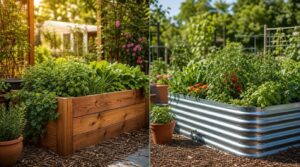
Cedar and steel both earn their place in year-round raised bed growing, but they suit different gardeners. Cedar’s higher upfront cost is offset by its lighter weight, simplifying installation and relocation. Conversely, steel excels in durability, with galvanized beds lasting 20-plus years and retaining soil temperature more effectively under full sun.
Your climate’s suitability and tolerance for maintenance frequency should ultimately guide the choice.
Long-Lasting Materials
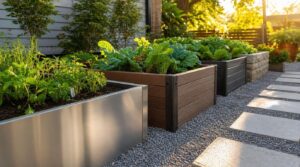
Not all beds are built to last — but the right materials can take you well beyond a single decade. Here’s what holds up season after season:
- Stainless Steel Frames resist rust for 25–50 years
- Composite Board Systems won’t warp, crack, or absorb moisture
- Recycled Plastic Lumber stays stable under UV without fading
- Stone Masonry and High Performance Concrete offer near-permanent structure
Cedar, redwood, and pressure-treated wood with corner brackets and deck screws remain reliable 10–15 year options.
Winter Insulation Options
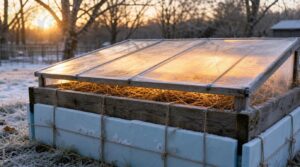
Cold soil is the enemy of year-round growing — but you can fight back.
Insulate bed rims using closed-cell foam or rigid board panels to prevent heat loss through the edges. Add a mulch insulation layer 3–4 inches deep.
Layer thermal blanket wraps, cold frames, or row covers on top to trap warmth overnight.
Portable Bed Designs
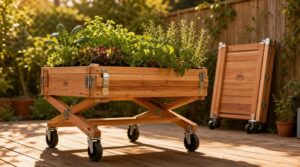
Flexibility is the secret weapon of small-space gardening. Portable raised garden beds with foldable frames and integrated wheels let you chase sunlight as seasons shift. Their lightweight materials keep the total weight manageable for one person.
Quick locking mechanisms enable setup in under two minutes, while compact storage ensures the entire bed folds flat for winter.
DIY garden beds built this way are genuinely budget-friendly raised beds worth trying.
Accessibility and Ergonomics
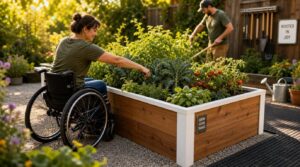
Good raised garden beds work for everyone. Keep your reach height between 24 and 36 inches to avoid straining over the edge. Wheelchair paths need at least 36 inches of clearance around the bed to ensure accessibility.
Place tool storage within 18 inches of the bed rail for convenience. Anti-fatigue mats and high visual contrast edges enhance safety and comfort in small gardening spaces, benefiting all users.
Fill With Productive Soil

Good soil is the engine behind everything your raised bed can do.
Get the mix wrong and even the best seeds won’t reach their potential.
Here’s what goes into building a foundation that feeds your plants all year long.
Soil Mix Ratio
Most gardeners overthink this, but raised bed soil composition comes down to a simple formula. Mix 40 percent organic matter, 30 percent mineral texture balance using loam or sand, and 20 percent perlite or coarse sand for drainage.
Add 10 percent worm castings to boost microbial inoculant ratio. Target pH optimization between 6.0 and 7.0.
This water retention component keeps roots thriving season after season.
Compost for Nutrients
Soil mix gets you started, but compost keeps your beds producing. Finished compost usually holds 1–2% nitrogen, 0.5–1% phosphorus, and 1–2% potassium — solid Compost NPK Ratios for steady nutrient management. Nutrient release timing is gradual, not sudden, ensuring roots feed consistently over months.
Apply 1–2 inches yearly as a topdress to maintain soil health. This approach supports long-term fertility without abrupt spikes.
Micronutrient supply — including boron, zinc, and copper — comes free with good organic matter and smart composting habits.
Drainage Amendments
Even with a great compost routine, poor drainage can drown your roots fast. That’s where Perlite Integration and Coarse Sand Use come in — mix 20% of either into your bed for real soil drainage solutions.
Gypsum Benefits clay-heavy spots through flocculation, while Biochar Porosity builds long-term structure. Always lay Drainage Fabric Placement at the base to keep soil drainage channels clear without losing your mix.
Annual Soil Settling
Your raised bed will drop 2–4 inches every year — that’s normal settlement, not failure. Clay and high-moisture soils compact faster, so Settlement Monitoring matters: check bed height each spring. Differential Settlement creates uneven spots if your Base Soil Preparation was inconsistent.
Fix it by top-dressing with compost, boosting organic matter and soil health. Adjustable Bed Mechanisms help level things quickly.
Mulch Moisture Control
Mulch does more than look tidy — it’s your front-line moisture management tool. Apply it right and you can cut irrigation needs by up to 70 percent in hot weather. Here’s how to get it working:
Applied correctly, mulch alone can slash irrigation needs by up to 70 percent in hot weather
- Mulch Thickness: Lay 2–4 inches for ideal water retention
- Ring Placement: Keep mulch 2 inches from stems to prevent rot
- Material Porosity: Use straw or bark for airflow and soil moisture retention
- Seasonal Mulch Choice: Switch to reflective mulch in summer, deeper organic layers in fall
Pair this with drip irrigation and moisture monitoring monthly.
Plant for Continuous Harvests

A raised bed doesn’t have to sit idle for half the year. With the right crops planted at the right times, you can pull something fresh from your beds in every season.
Here is how to build that rhythm from spring through winter.
Spring Cool-Season Crops
Spring is your first real window for cool-season crops in raised garden beds. Start with spinach seed timing around soil temps of 40–60°F for steady 6–8-week harvests. Pea germination range hits 40–75°F, while radishes’ early harvest comes in just 22–30 days. Kale frost extension keeps your bed productive near freezing.
Space Brassica seeds 6–12 inches apart and add compost for strong early spring planting.
Summer Trellised Vegetables
Summer is prime time for vertical gardening in your raised garden beds. Warm-season crops like pole beans, cucumbers, and indeterminate tomatoes thrive on a trellis — yielding two to three times more per square foot than ground-sprawling plants.
- Trellis Materials: Use galvanized steel posts or cedar frames rated to hold 60+ lbs per linear foot.
- Support Spacing: Set posts 4–6 feet apart to stabilize heavy summer crop vines.
- Training Pruning: Pinch tomato laterals weekly; redirect cucumber vines every 7–10 days.
- Harvest Timing: Pick beans every 1–3 days to keep production running strong.
- Shade Strategies: Let taller trellised crops shield heat-sensitive neighbors from afternoon sun.
Fall Succession Planting
Think of fall succession planting as harvest sequencing on a timer. Stagger your sowing every 2–3 weeks starting in late summer.
Radishes and spinach mature in 25–45 days, enabling crop phasing that fills gaps naturally.
Use row covers as a frost barrier when temperatures drop below 40°F.
Match your sowing dates to your local temperature windows, and you’ll keep picking well into autumn.
Winter Frost-Hardy Greens
Winter doesn’t shut your beds down — it just changes the playlist. Kale, spinach, mache, and tatsoi are cold-tolerant champions, surviving down to 20°F with row covers and cold frame gardening in place.
Frost actually triggers a natural flavor boost, sweetening leaves without bolting prevention becoming a concern.
Sow winter greens 6 weeks before first frost for perfect harvest timing.
Four-Bed Crop Rotation
Rotating crops through four beds is the backbone of a continuous gardening cycle.
Done right, it stabilizes yields, cuts pest pressure, and keeps soil fertility management on autopilot.
- Pest Disruption — Moving plant families breaks soil-borne disease cycles yearly
- Nutrient Balancing — Legumes fix nitrogen before leafy greens follow
- Soil Microbe Boost — Varied root depths improve structure and drainage
- Yield Stability — Rotation raises productivity 10–25% in home plots
- Rotation Recordkeeping — Track bed assignments annually using a simple four-year map
Extend and Maintain The Season

The growing season doesn’t have to stop when temperatures drop. A few smart tools and habits can keep your raised beds productive through frost, dry spells, and everything in between.
Here’s what works.
Hoop Houses and Covers
A hoop house transforms your raised bed into a year-round growing machine. Clear polyethylene film—6 to 12 mil thick—transmits 80 to 90 percent of light while trapping warmth.
Double-layer polyethylene film creates a sealed air gap that significantly reduces nighttime heat loss. Always use wind-anchoring clips and roll-up sidewalls to manage ventilation mechanics.
| Cover Material | Key Benefit |
|---|---|
| Double-layer PE film | Air Gap insulation |
| Light Diffusion fabric | Reduces leaf scorch |
| UV-stabilized fleece cover | Lasts 3–5 years |
Cold Frames for Winter
Cold frames take solar work further. Place yours in full sun, tilting the glazing southward to capture low winter light.
Twin-wall polycarbonate outperforms glass for frost protection—it’s lighter and won’t shatter in freezes.
Add thermal mass inside, such as water-filled jugs, to store and release heat overnight.
Automatic vent openers manage lid ventilation, eliminating the need to monitor the frame on mild days.
Smart siting and microclimate management transform these simple boxes into reliable season extenders for winter vegetable production.
Drip Irrigation Setup
Drip irrigation system setup keeps your beds thriving without daily effort. Start with a 1/2-inch mainline sizing run to each bed, then branch off with drip tape or emitter tubing. For year-round raised bed growing, these basics make all the difference:
- Use pressure-compensating emitters on sloped layouts for even water delivery.
- Add a screen or disc filter selection before emitters to prevent clogging.
- Connect a timer integration with multi-zone capability for hands-free scheduling.
Fertilizer injection through a Mazzei-style injector lets you feed crops during every watering cycle — a smart move for garden irrigation that saves time and boosts yields.
Holiday Light Warmth
Once your drip system is humming, don’t overlook a surprisingly practical trick: incandescent holiday lights strung inside hoop houses or cold frames can bump soil temperature by a few degrees on freezing nights. That small boost matters for frost-resistant crops. Warm LED strings work too, and they’re safer for outdoor wiring.
The ambient warm glow doubles as mood-boosting light while quietly extending your season.
Pest and Disease Checks
Even the most productive beds can unravel fast if pests slip through unnoticed. Scout weekly, focusing on spots with past pressure. Use sticky traps to track flying insects and a 10× lens for leaf spot identification. Check microclimates where humidity builds. Log symptoms in a digital symptom log with photos.
Your scouting schedule, paired with pest-resistant varieties and seedling protection, keeps problems manageable before they escalate.
Frequently Asked Questions (FAQs)
Will perennials survive winter in a raised bed?
Yes, many perennials survive winter in raised beds — but hardiness zoning matters. A 2–4 inch mulch layer protects the root zone moisture and crown protection, especially where freeze-thaw cycles cause heaving.
Is October too late to plant?
October isn’t too late — it depends on your frost date and climate zone. In zones 7 and warmer, Late-Season Sowing of cool-season crops like spinach and radishes still works well.
Can raised beds be used on rooftops or balconies?
Rooftops and balconies can work — but only if the structure supports the load.
Check building code compliance first, use a lightweight soil mix, and install proper waterproofing and wind-uplift protection.
How do you water raised beds during vacation?
Set a drip timer before you leave. Programmable timers paired with soaker hoses handle daily watering automatically.
Add a rain barrel integration as a backup water supply.
Remote moisture sensors let you monitor soil from anywhere.
Which vegetables grow well together in one bed?
Good neighbors make good gardens." Beans fix nitrogen for corn, basil shields tomatoes, and radishes clear space for lettuce. Smart companion planting turns one bed into a high-yield, self-supporting system.
How do children help safely in raised beds?
Kids thrive with child-sized, kid-safe tools and supervised watering using lightweight cans.
Assign clear child planting roles, enforce a hand-washing routine after soil contact, and use safety signage to keep little gardeners confident and safe.
Conclusion
What’s stopping you from growing food in January? With raised garden beds for year-round growing, the answer is probably nothing.
The right depth holds heat. The right soil drains fast. The right cover keeps frost out. These elements combine to create an environment where plants thrive even in winter.
You’ve mapped the beds, built for four seasons, and planted with purpose. Every month on the calendar now has something worth harvesting.
That’s not a hobby garden anymore—that’s a system.
- https://durablegreenbed.com/best-materials-raised-garden-beds
- https://glplanters.com/blog/best-wood-for-raised-garden-beds
- https://www.timberlanegardens.com/pages/cedar-vs-metal-raised-garden-beds
- https://extension.unh.edu/blog/2024/04/how-utilize-raised-beds-small-space-gardening
- https://extension.umn.edu/planting-and-growing-guides/companion-planting-home-gardens