This site is supported by our readers. We may earn a commission, at no cost to you, if you purchase through links.
Most gardeners blame poor harvests on bad weather or bad luck.
The real culprit is usually sitting in a bag in the shed.
A single nutrient imbalance—too much nitrogen, not enough boron—can quietly redirect your tree’s energy away from fruit and toward leaves, or cause developing fruit to drop before it ever ripens.
Understanding how fertilizer affects fruit tree yield isn’t about following a generic feeding schedule.
It’s about knowing what each nutrient does at each stage of growth, from the moment flower buds form to the week before harvest.
Get that right, and your trees will show you the difference.
Table Of Contents
Key Takeaways
- Too much nitrogen pushes your tree into leaf overdrive, stealing energy from fruit set and sweetness — balance it with potassium and boron to keep harvests on track.
- Soil pH between 6.0 and 7.0 acts as the master switch for nutrient availability; even a well-fed tree can’t access locked-up nutrients if that window is missed.
- Timing your fertilizer to match growth stages — early spring for roots and canopy, midsummer for fruit development, post-harvest for reserve recovery — matters as much as what you apply.
- A soil test before fertilizing isn’t optional if you want results; it tells you exactly what’s missing, what’s excessive, and where to put your money.
Why Fertilizer Changes Fruit Yield

Fertilizer doesn’t just feed your tree — it shapes what that tree decides to do with its energy. Get the nutrients right, and your tree channels that energy into flowers, fruit, and flavor rather than endless leafy growth. Here’s how each piece of that puzzle works.
The details behind that balance — what to apply, when, and how much — are all covered in this guide to fertilizing fruit trees for better size, sweetness, and firmness.
Flower Bud Initiation
Before your tree ever sets a single fruit, it has to make a quiet but critical decision — grow more leaves, or start forming flowers. That decision happens at flower bud initiation, and fertilizer plays a direct role in which way the tree goes.
The tree’s critical node count determines when buds become irreversibly floral.
Fruit Set and Retention
Once buds form, the next test is whether flowers actually set fruit — and stay on the tree long enough to develop.
Pollen tube growth depends heavily on boron and zinc. Without adequate levels, pollen germinates poorly and fertilization fails before it starts. Cross pollination also plays a role, but even compatible pollen can’t compensate for nutrient gaps.
- Carbohydrate reserves fuel early fruit development
- Water stress during bloom triggers fruit drop
- Excess nitrogen shifts energy toward foliage, not retention
- Phosphorus bolsters root function and nutrient uptake stability
- Fertilizer timing before bloom builds the nutrient foundation
Temperature impact matters too — warm conditions accelerate pollen tube growth, improving set. Keep nutrient balance steady, and your tree keeps more fruit where it belongs.
Leaf Growth and Photosynthesis
Fruit retention sets the stage — but what happens in the leaves determines how much fuel your tree actually has to grow that fruit.
Leaf growth and photosynthesis are where fertilizer earns its keep. Leaves are your tree’s solar panels, and their efficiency depends almost entirely on nutrient balance.
Nitrogen drives leaf production, directly influencing chlorophyll synthesis. More chlorophyll means better light interception and stronger photosynthetic efficiency. But here’s the balance act: too much nitrogen pushes excessive foliage at the expense of fruit.
Phosphorus promotes early root activity, which in early spring allows rapid uptake of nutrients right as leaves expand. Healthy roots feed healthy leaves.
Magnesium sits at the center of every chlorophyll molecule. Without it, leaves yellow, stomatal regulation weakens, and the whole photosynthetic process slows down.
| Nutrient | Role in Leaves | Deficiency Impact |
|---|---|---|
| Nitrogen | Chlorophyll production, leaf expansion | Pale leaves, reduced canopy |
| Magnesium | Chlorophyll molecule structure | Yellowing, lower photosynthesis |
| Phosphorus | Root uptake, early leaf development | Slow spring growth |
| Iron | Electron transport in chloroplasts | Interveinal chlorosis |
| Zinc | Enzyme function, leaf size regulation | Small, distorted leaves |
Foliar feeding during active leaf expansion in May–June delivers micronutrients directly where they’re needed — fast. It’s a targeted fix, not a replacement for soil nutrition.
Keep leaf nutrient balance steady, and your canopy works harder all season long.
Fruit Size and Sweetness
Strong leaves power a stronger harvest — but what actually ends up in your hand at picking time comes down to carbohydrate supply and nutrient balance.
- Potassium for fruit sweetness drives sugar concentration and soluble solids content
- Adequate water availability during cell division prevents size-limiting stress
- Sun exposure enhances sugar synthesis for sweeter, more evenly colored fruit
- Boron helps carbohydrate transport from leaves directly into developing fruit
- Balanced calcium maintains cell expansion and texture through ripening
Apply potassium at the right time, and your fruit shows it.
Timing matters as much as amount—get both right with these summer soil and fertilizer tips to avoid the burn that undoes your hard work.
Yield Versus Tree Vigor
More fertilizer doesn’t always mean more fruit. Push tree vigor too hard with heavy nitrogen, and your tree puts energy into shoots and leaves instead of fruit.
Yield vigor balance is the goal — moderate, controlled growth where nutrients feed the harvest, not the canopy. Precise fertilizer application rates and smart pruning keep that balance working in your favor.
Key Nutrients That Drive Harvests
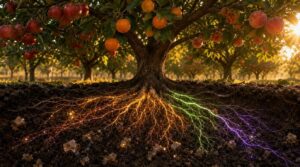
Every harvest starts long before fruit appears — it starts with what you’re feeding your trees. The right nutrients do very different jobs, and knowing which one does what changes how you fertilize. Here are the five that matter most.
Nitrogen for Canopy Growth
Nitrogen is the engine behind your tree’s canopy growth. Canopy nitrogen levels directly control how much Rubisco — the enzyme powering photosynthesis — your leaves can produce.
More leaf mass means more light captured, more sugars made, and more energy available for fruit.
Early spring is the right time to feed, when soil hits 55°F and buds are breaking.
Phosphorus for Roots
While nitrogen builds the canopy above ground, phosphorus quietly does the heavy lifting below. It drives root cell division, fuels early establishment, and shapes how deep and wide your root system grows. Without enough of it, young trees struggle to anchor themselves and can’t efficiently pull water or other nutrients from the soil.
Root phosphorus uptake happens mainly through specialized transporters on root cells, and these transporters ramp up activity when phosphorus is scarce — your tree is basically searching harder when supplies run low. Mycorrhizal fungi boost this further; mycorrhizal phosphorus exchange extends your root’s effective reach far beyond what the roots alone could cover.
When phosphorus runs low, roots search harder — and mycorrhizal fungi extend that reach even further
For best results, focus on banding phosphorus fertilizer near the drip line rather than broadcasting it broadly. This improves direct root contact and reduces waste. About 0.3 lb P per tree each season promotes consistent root development and flower formation. Keep soil pH between 6.0–7.0, since phosphate soil availability drops sharply above 7.0 — even a well-fed tree can’t access locked-up nutrients.
Potassium for Fruit Quality
Potassium is the nutrient that turns a decent harvest into a great one. It drives sugar transport to fruit, boosting sweetness and soluble solids in apples and citrus alike. It also promotes anthocyanin and carotenoid synthesis, giving fruit deeper, more even color at harvest.
Beyond appearance, potassium strengthens cell walls, improving firmness at harvest and extending shelf life during cold storage.
Magnesium and Chlorophyll Health
Magnesium is the quiet workhorse behind every green leaf on your fruit tree. It sits at the center of the chlorophyll molecule, and without enough of it, chlorophyll synthesis breaks down — leaves turn yellow between the veins, a classic sign of leaf chlorosis.
That interveinal yellowing often starts on older leaves first, then spreads. Left uncorrected, it can reduce fruit weight by up to 15%.
Boron and Zinc Benefits
Boron and zinc are small players with an outsized impact. Boron promotes cell wall formation and drives pollen tube growth — without it, fertilization stalls and fruit set drops.
Zinc powers the enzymes behind chlorophyll production and carbohydrate partitioning between leaves and fruit.
Together, foliar boron and zinc sprays can raise apple pollen germination from 58% to 87%, cutting ripening time by up to 12 days.
Soil Tests Guide Better Fertilizing
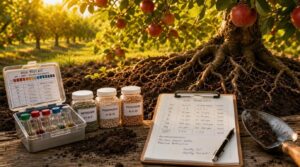
Before you spend a single dollar on fertilizer, a soil test tells you exactly what your trees are working with. It takes the guesswork out of the equation — no more applying nutrients your soil already has in abundance, or missing ones that are quietly holding your harvest back. Here’s what a good soil test actually reveals.
Ideal PH Range
Think of soil pH as the master switch for your fertilizer investment. If it’s off, even the best nutrients stay locked out of reach.
The ideal pH window for most fruit trees falls between 6.0 and 7.0. Here’s how that breaks down by tree type:
- Apples and pears — best near 6.0 to 6.5
- Peaches and plums — aim for 6.0 to 6.5 for strong calcium uptake
- Cherry trees — keep close to 6.0 to prevent zinc lockout
- Citrus trees — thrive between 6.0 and 6.5 depending on rootstock
- Blueberries — need much more acidic soil, around 4.5 to 5.5
pH testing guidelines recommend checking your soil every two to three years. Use lime to raise soil acidity that’s too low, or elemental sulfur for pH adjustment when levels run too high. Always retest after any amendment — don’t assume one treatment solves it permanently.
Micronutrient Availability
Once pH is dialed in, micronutrient availability becomes your next variable. Even at ideal pH, nutrients like zinc, iron, and boron can stay locked in the soil — especially in sandy soils prone to leaching.
Chelated formulations keep these nutrients soluble longer.
Mycorrhizal fungi and root exudates naturally improve uptake, while targeted foliar sprays quickly correct visible deficiency symptoms like interveinal chlorosis or stunted growth.
Organic Matter Levels
Micronutrients don’t work in a vacuum — the soil’s organic matter levels shape how well everything moves through the root zone.
Organic matter percentage directly affects three things:
- Water retention — it holds up to 20x its weight in water
- Nutrient release — microbial biomass breaks down compost slowly, feeding roots over time
- Cation exchange capacity — higher organic matter holds calcium, magnesium, and potassium longer
Adjusting Fertilizer Recommendations
Once you have your soil test results in hand, the next step is putting them to work. A high organic matter reading means nutrients release more slowly — so you can often reduce fertilizer rates without sacrificing yield.
Recent manure applications or a legume cover crop can cut your nitrogen needs considerably, since both contribute plant-available N to the soil.
Fertilizer Timing and Application Methods
Getting the nutrients right is only half the job — when and how you apply them matters just as much. A well-timed feeding can mean the difference between a strong harvest and a season of missed potential. Here’s what you need to know about timing your applications and placing fertilizer where your trees can actually use it.
Early Spring Feeding
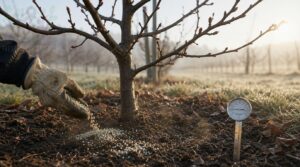
Early spring is when your trees wake up hungry. Once soil temperature hits 55°F, bud break begins and roots start pulling in nutrients again.
That’s your window. Apply a balanced fertilizer — around 0.5–1 lb for young trees, 1–2 lb for mature ones — right along the drip line and water it in well.
Mid-summer Fruit Support
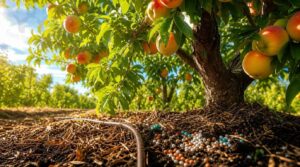
By midsummer, your trees are deep in the work of building fruit. This is when nutrient management matters most.
- Stick to slow-release fertilizer — it feeds steadily without triggering leafy growth that robs fruit of sugars.
- Set your irrigation scheduling to water deeply once or twice weekly.
- Mulch application cuts soil moisture loss by around 25 percent.
- Fruit thinning in early July directs more energy to the fruit that stays.
- Canopy pruning and pest monitoring keep your trees productive and clean through peak season.
Post-harvest Nutrient Recovery
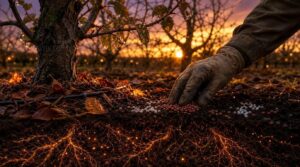
Once the harvest is done, most growers walk away — but that’s exactly when your trees start building next year’s crop. Post-harvest feeding replenishes the reserves your tree spent producing fruit.
Apply Post-Harvest Calcium and Potassium Replenishment within two to six weeks of fruit drop.
Pair that with a Boron Foliar spray and Slow Release granules near the drip line, and layer Organic Mulch to lock in moisture and support nutrient cycling through dormancy.
Drip-line Fertilizer Placement
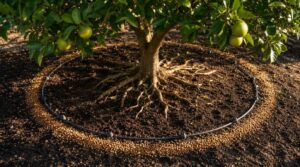
Where you place fertilizer matters just as much as what you use. Position granules or inject nutrients at the drip line — the outer edge of the canopy — where feeder roots are most active.
- Keep the placement radius 0.5–0.75 meters from the trunk
- Use pressure-compensating emitters for even coverage
- Space emitters to match soil type and row spacing
- Flush lines after fertigation integration to prevent salt buildup
Preventing Leaching and Burn
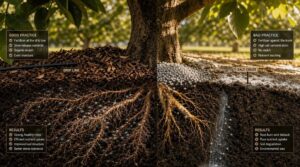
Too much fertilizer at once is like overwatering — it pushes nutrients past the roots before trees can use them. Nutrient leaching and fertilizer burn are both avoidable with the right habits.
| Risk | Prevention Strategy |
|---|---|
| Nutrient leaching | Use slow-release fertilizer and nutrient split application |
| Fertilizer burn | Keep granules at the drip line, away from the trunk |
| Salt buildup | Monitor soil EC regularly and irrigate deeply |
| Runoff loss | Apply mulch over the root zone to slow water movement |
Time your applications carefully — application timing matters. Pair each feeding with irrigation management: water deeply but infrequently. Run soil tests seasonally to stay ahead of imbalances before they cost you yield.
Top 3 Fruit Tree Fertilizer Products
Knowing what to feed your trees is one thing — finding the right product is another. There are a lot of options on the market, but a few stand out for fruit trees specifically. Here are three worth keeping on your radar.
1. Miracle Gro Fruit Citrus Plant Food Spikes
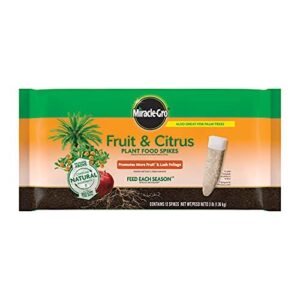
If you want a low-fuss option that actually achieves effective outcomes, Miracle-Gro Fruit & Citrus Spikes are worth considering. The 10-15-15 N-P-K formula gives fruit trees a strong boost of phosphorus and potassium — exactly what drives fruit set and quality.
You simply drive the spikes into the soil at the dripline each spring and fall. No mixing, no measuring.
Each box includes 12 pre-measured spikes, covering most home orchards cleanly.
- Just push the spikes in at the dripline and you’re done — no mixing, no measuring, no watering in
- The 10-15-15 formula leans heavy on phosphorus and potassium, which is exactly what fruit trees need to produce more and bigger fruit
- Works for a wide range of trees and even some fruiting shrubs like blackberries, so one box goes a long way
- Hard or rocky soil can make the spikes tough to insert and prone to breaking
- Only recommended twice a year, so if your soil has specific deficiencies, this formula might not fully cover them without a soil test first
- Placement matters — too close to the trunk or wrong spacing can throw off nutrient balance rather than help it
2. Gardenwise Ten Ten Ten Slow Release Fertilizer
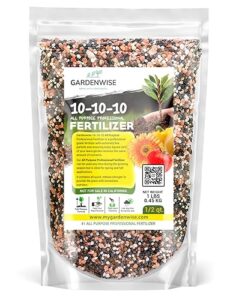
If the spikes felt too hands-off for your style, Gardenwise Ten Ten Ten gives you more control. Its balanced 10-10-10 NPK delivers equal nitrogen, phosphorus, and potassium — solid all-around support for most fruit tree species.
The slow-release granules feed for up to 8 weeks, so you’re not chasing weekly applications. Spread them along the drip line, water in lightly, and you’re done.
One note: the 1 lb package works for a single tree or two, but larger orchards will need multiple bags.
- Balanced 10-10-10 NPK means you’re covered on all fronts — roots, foliage, and blooms get equal attention.
- Slow-release formula feeds for up to 8 weeks, so you’re not out there every week with a watering can.
- Works in garden beds and indoor pots, making it flexible for all kinds of growing setups.
- The 1 lb bag is pretty small — if you’ve got a big orchard or large lawn, you’ll be buying several bags.
- Easy to overdo it, and too much can cause nutrient burn or runoff, so you have to measure carefully.
- Not an option for hydroponic or aquatic systems, so it’s strictly a soil-based product.
3. Miracle Gro Citrus Avocado Mango Feed
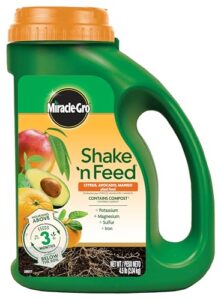
If your trees are citrus, avocado, or mango, this one’s built for them. Miracle-Gro Citrus Avocado Mango Feed is a granular, continuous-release formula with an 8-2-10 NPK ratio — plus magnesium, iron, and sulfur to fill the micronutrient gaps those species are prone to.
Spread it along the drip line, water it in, and it feeds for up to three months. One 4.5 lb bag supports a moderate canopy comfortably. Avoid the trunk — direct contact causes burn.
- Feeds for up to three months, so you’re not out there every few weeks with a watering can
- Packed with magnesium, iron, and sulfur — the exact nutrients citrus and tropical trees tend to run low on
- Works for both in-ground trees and container plants, which gives you some flexibility
- Apply it too often and you risk overloading your trees with nutrients — every three months is the limit
- Not safe to use near trunks or leaves, so you have to be a little careful with placement
- Skip it entirely for seedlings or any plant that’s already been over-fertilized
Frequently Asked Questions (FAQs)
When should I stop fertilizing before harvest?
Stop all nitrogen fertilizers 4–6 weeks before harvest. You can continue light potassium feeds up to 3 weeks out. This enhances sweetness without pushing new leaf growth that delays ripening.
Can over-fertilizing cause my fruit to drop early?
Yes, over-fertilizing can trigger early fruit drop. Excess nitrogen shifts energy into leafy growth, raises ethylene production, and disrupts the hormonal balance your tree needs to hold developing fruit until harvest.
Does mulch reduce how much fertilizer trees need?
Mulch pulls double duty — it holds moisture and slowly feeds your soil. Organic mulch reduces fertilizer needs modestly, letting you apply smaller, targeted doses without sacrificing yield.
How does rainfall timing affect fertilizer effectiveness?
Rainfall timing matters more than most growers realize. Light rain within 24 hours after application dissolves granules and moves nutrients into the root zone fast. Heavy downpours do the opposite — they leach nitrogen beyond reach.
Should fertilizer rates change as trees age?
Yes, fertilizer rates must shift as trees age. Young trees need more nitrogen to build roots and canopy. Mature trees need less nitrogen but steady potassium and phosphorus to sustain fruit quality.
Conclusion
Your fruit tree is like a long-distance runner — it only performs when it’s fueled right, at the right moments.
Now that you understand how fertilizer affects fruit tree yield, you can stop guessing and start feeding with intention.
Match nutrients to growth stages, test your soil before adjusting, and time each application to where the tree’s energy actually needs to go.
Do that consistently, and the harvest speaks for itself.
- https://pmc.ncbi.nlm.nih.gov/articles/PMC10019695
- https://orchardpeople.com/episode-64-when-to-fertilize-fruit-trees
- https://intermag.eu/post-harvest-orchard-fertilization
- https://soiltesting.cahnr.uconn.edu/suggested-fertilizer-practices-for-tree-fruits
- https://www.frontiersin.org/journals/plant-science/articles/10.3389/fpls.2024.1300683/full