This site is supported by our readers. We may earn a commission, at no cost to you, if you purchase through links.
Grab a bottle of organic neem oil or insecticidal soap, and most gardeners feel good about the choice. No harsh chemicals, no synthetic residues—just a safer way to manage pests. That confidence isn’t unreasonable, but it glosses over something entomologists have documented for decades: organic sprays can and do kill beneficial insects.
The label "organic" tells you where an ingredient comes from. It doesn’t tell you how it behaves once it contacts a lacewing larva or a foraging honey bee. Pyrethrin, for example, comes from chrysanthemum flowers—and it disrupts a pollinator’s nervous system on contact just as efficiently as many synthetic alternatives.
Knowing which sprays pose the highest risk, and when, gives you real control over what happens in your garden.
Table Of Contents
- Key Takeaways
- Organic Sprays Aren’t Always Harmless
- Sprays That Spare Beneficial Bugs
- Top 5 Organic Pest Sprays
- Protect Beneficials While Spraying
- Frequently Asked Questions (FAQs)
- Does Garden safe insecticidal soap kill bees?
- Why should you use insecticides in your garden?
- Is neem oil good for garden pests?
- What are natural pest control methods?
- Does neem oil affect beneficial insects?
- How harmful are organic pesticides?
- How do organic sprays compare in cost to synthetics?
- Can pests develop resistance to organic spray products?
- Which beneficial insects recover fastest after organic exposure?
- Conclusion
Key Takeaways
- The "organic" label tells you an ingredient’s origin, not how it behaves in your garden — pyrethrin, for instance, can knock down a honey bee just as fast as synthetic alternatives.
- Timing your spray after dusk and skipping open flowers can dramatically cut harm to beneficial insects without sacrificing pest control.
- Not all organic options carry the same risk: Bt targets caterpillars almost exclusively, while spinosad and pyrethrin can be acutely toxic to pollinators while wet.
- Before reaching for any spray, scouting your garden first often reveals that resident predators — lady beetles, lacewings, parasitic wasps — are already keeping pest populations in check.
Organic Sprays Aren’t Always Harmless
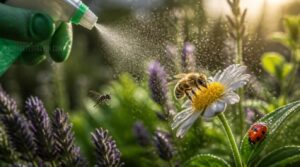
Reaching for an organic spray feels like the safe choice — but "natural" doesn’t automatically mean harmless to every insect in your garden. Some of the most common organic options can hurt the very beetles, bees, and parasitic wasps you’re counting on. Here’s what you need to know before you start spraying.
Before you reach for that bottle, it’s worth understanding when organic pest sprays are truly safe for edible plants — timing and application matter more than the "organic" label alone.
Natural Does Not Mean Selective
The word "organic" signals safety to most gardeners — but it doesn’t signal selectivity.
Many botanical and mineral-based sprays disrupt insect physiology broadly, meaning they can’t distinguish a pest aphid from a beneficial lacewing.
Oils and soaps damage cell membranes on contact regardless of species.
Non-target mortality is a real and documented consequence, not a rare exception.
Beneficial Insects Most at Risk
Not every garden ally faces the same risk. Honey bees are particularly vulnerable, especially when sprays land on flowering plants during daytime foraging.
Parasitoid wasps show impaired host-finding after exposure to plant-based oils.
Lacewing larvae, predatory beetles, hoverflies, and spiders all suffer measurable harm — yet they’re the insects quietly keeping your pest populations in check.
Providing continuous floral resources helps sustain these beneficial insects throughout the growing season.
Pollinators Versus Pest Predators
Pollinators and pest predators aren’t the same crowd, even though they share your garden. Bees work daylight hours; lady beetles and lacewings shift activity across multiple life stages, hunting continuously through the season.
- Bees peak during open-flower windows
- Lacewings hunt at dusk and into night
- Lady beetles disperse after flowering plants attract prey
- Parasitoid wasps need floral resource availability to sustain populations
- Ground beetles overwinter in hedgerows, emerging when pests do
Habitat complexity keeps both groups present and functional.
Direct Contact Increases Harm
The moment spray droplets land on a beneficial insect’s body, the damage begins. Contact toxicity peaks while wet, and the concentration sitting on the cuticle causes rapid knockdown, sometimes within minutes. Lady beetles and lacewings don’t survive that window well.
When spray droplets land, contact toxicity peaks instantly — lady beetles and lacewings rarely survive that window
Even insects outside your direct target area — caught in the spray drift zone — face the same risk.
Residue Timing Changes Toxicity
Timing matters more than most gardeners realize. Spinosad, for instance, is highly toxic to bees while wet, but becomes far safer once dry — residues dry within hours, dramatically reducing risk. UV exposure, rain, and wind accelerate this breakdown further.
Even so, sublethal residue accumulation across repeated applications can quietly weaken bee colonies over a season, so don’t underestimate the slow toll.
Sprays That Spare Beneficial Bugs

Not every organic spray treats beneficial insects the same way. Some are genuinely selective, meaning they target specific pest types while leaving predators and pollinators largely untouched — but the details matter. Here’s how the most common options actually stack up.
Bt Targets Caterpillar Pests
Bacillus thuringiensis (Bt) is about as targeted as a pest control tool gets — it works almost exclusively on caterpillars, leaving most beneficial insects untouched.
- Bt’s Cry toxins bind to midgut receptors unique to caterpillar guts, causing pore formation and death
- Early-instar caterpillars are most vulnerable; older larvae need higher doses
- Midgut proteolysis activates the protoxin — mammals lack this enzyme, so Bt is safe for people and pets
- Resistance can develop through midgut receptor mutations, so rotating Cry toxin strains helps
- Lacewings, parasitic wasps, and predatory beetles show little to no toxicity from Bt exposure
Spray when caterpillars are actively feeding, especially young ones — that’s when targeted pest control delivers the most reliable results.
Soaps Affect Soft-bodied Insects
Unlike Bt, insecticidal soap doesn’t discriminate by species — it works by disrupting cuticle waxes and cell membranes, pulling moisture out of soft-bodied insects until they collapse.
Aphids, mealybugs, and spider mites are highly vulnerable.
Beneficials with thicker cuticles fare better, but direct contact still poses risk, so spray at dusk and target pest hotspots only.
Neem Can Harm Larvae
Neem oil spray works differently from soaps — it doesn’t kill on contact so much as disrupt larval development from the inside out. Azadirachtin interferes with ecdysone pathways, the hormonal signals larvae need to molt and grow. Without those cues, affected larvae stall mid-development and often die before pupating.
Larvae also stop feeding on treated foliage, which protects your plants but can expose nontarget species unexpectedly.
Spinosad is Risky When Wet
Spinosad has a split personality regarding pollinator safety — relatively benign once dry, but a real hazard while wet.
Research confirms that wet spinosad residues remain highly toxic to bees for roughly three hours after application. During that window, any bee or beneficial insect contacting treated foliage faces acute risk. After drying, toxicity drops markedly.
Here’s what shapes that wet risk window:
- Evaporation rate — humidity and cool temperatures slow drying, extending exposure time for foraging bees
- Canopy density — dense foliage traps moisture, keeping droplets wet longer than open plantings
- Formulation type — some liquid concentrates cling to leaf surfaces and dry slower than wettable powders
- Drift during application — wet spray can carry to adjacent flowering plants, disrupting pollinator foraging in untreated areas
- Aquatic invertebrate risk — runoff from wet applications can reach nearby water bodies, where spinosad is acutely toxic to aquatic invertebrates
Dew re-wetting dried residues overnight also reactivates exposure risk, so evening applications don’t fully eliminate the hazard if temperatures drop and dew forms before morning foragers arrive.
Your safest move is applying spinosad at least three hours before peak pollinator activity and avoiding forecasted rain or high humidity.
Pyrethrin Harms Pollinators Quickly
Pyrethrin is one of the most pollinator-hostile sprays in the organic toolkit. Contact with wet residues causes immediate nervous system disruption — bees lose coordination, wing fanning fails, and navigation collapses fast.
Even sublethal doses impair floral memory and foraging efficiency, meaning exposed workers struggle to relocate rewarding flowers. Bystander insects, like hoverflies, show reduced feeding activity after brief exposure, too.
Top 5 Organic Pest Sprays
Not all organic sprays are created equal, and choosing the right one makes a real difference for your garden’s allies. Some options target pests precisely, while others come with trade-offs you’ll want to know before reaching for the bottle. Here are five that earn their place in an organic toolkit.
1. Pure Cold Pressed Neem Oil
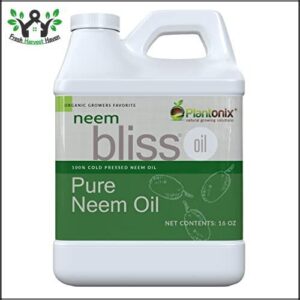
Cold-pressed neem oil is one of the more complex tools in your organic garden arsenal. Its active compound, azadirachtin, works as a feeding deterrent and growth regulator rather than an outright killer — meaning pests stop reproducing and feeding, but don’t drop immediately.
That slower action can feel frustrating, though it’s part of what makes neem relatively gentler than contact pesticides.
Even so, avoid spraying open flowers, as concentrated mixes can harm bee larvae and eggs.
| Best For | Home gardeners and natural living enthusiasts who want a chemical-free way to protect plants and support skin or hair care routines. |
|---|---|
| Formulation | Pure oil concentrate |
| Active Ingredient | Cold-pressed neem oil |
| Target Pests | Aphids, spider mites |
| OMRI Listed | No |
| Application Method | Foliar spray or soil soak |
| Volume / Size | 16 fl oz |
| Additional Features |
|
- 100% pure and cold-pressed, so you get the full spectrum of natural compounds without any fillers or additives
- Versatile enough to use as a garden pesticide, soil treatment, or diluted personal care ingredient
- Sourced from quality neem regions in India, making it a reliable option for organic growing
- Has a strong, persistent smell that can linger after application on plants or skin
- Solidifies in cooler temperatures, so you’ll need to warm the bottle before every use
- The bottle opening is tricky to control, which makes pouring messy and can leave oily residue behind
2. Safer Insecticidal Soap Concentrate
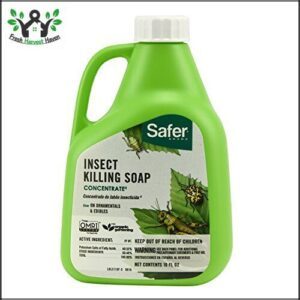
Where neem oil works slowly, Safer’s Insecticidal Soap Concentrate acts fast. Its active ingredient — potassium salts of fatty acids — punches through the waxy cuticle of soft-bodied pests like aphids and spider mites, causing rapid dehydration on contact.
Spray it at dusk, skip open flowers, and residue toxicity drops within hours. That makes it one of the safer contact options for gardens where pollinators are active. Don’t use it in direct sun or above 90°F, though — leaf scorch becomes a real risk.
| Best For | Gardeners dealing with active soft-bodied pest infestations who want a fast-acting, organic-approved solution safe enough to use on edibles, houseplants, and in spaces shared with kids and pets. |
|---|---|
| Formulation | Spray concentrate |
| Active Ingredient | Potassium fatty acids |
| Target Pests | Aphids, whiteflies, mites |
| OMRI Listed | Yes |
| Application Method | Diluted foliar spray |
| Volume / Size | 16 fl oz |
| Additional Features |
|
- Kills aphids, spider mites, mealybugs, and other soft-bodied pests on contact — no waiting around for results
- OMRI-listed for organic use and breaks down within 7–10 days, so there’s no lingering residue in your soil or on your food
- One 16 oz bottle makes around 6 gallons of spray, so it goes a long way for the price
- Only works on direct contact, so you’ll need thorough coverage — especially on leaf undersides — and may need to reapply for heavy infestations
- Can’t be applied in full sun or heat above 90°F without risking leaf scorch, which limits your spray window on hot days
- The concentrate can solidify in cold storage, so you’ll need to warm it up before mixing in cooler weather
3. Monterey BT Organic Caterpillar Spray
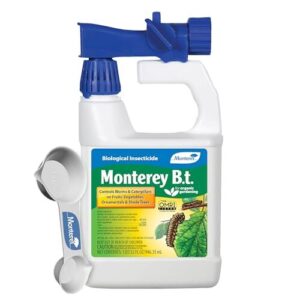
Unlike soap or neem, Monterey Bt targets only caterpillars — cabbage loopers, tomato hornworms, tent caterpillars — and leaves bees, earthworms, and lady beetles completely unharmed. The active ingredient, Bacillus thuringiensis subspecies kurstaki (BtK), works as a stomach toxin: caterpillars must ingest treated foliage before feeding stops.
Apply it early in the instar stage for best results. Once serious defoliation has begun, efficacy drops. It’s OMRI listed and safe to use right up to harvest day.
| Best For | Organic gardeners dealing with caterpillar infestations on vegetables, fruit trees, or ornamentals who want an effective, bee- and beneficial-insect-safe solution. |
|---|---|
| Formulation | Ready-to-spray liquid |
| Active Ingredient | Bacillus thuringiensis |
| Target Pests | Caterpillars, worms |
| OMRI Listed | Yes |
| Application Method | Trigger or tank sprayer |
| Volume / Size | 31 oz |
| Additional Features |
|
- Kills caterpillars specifically — bees, earthworms, and ladybugs are left completely unharmed
- OMRI listed and safe to apply right up to harvest day, making it ideal for certified organic growing
- Mixes instantly and works with standard trigger or pressure-tank sprayers
- Can unintentionally harm non-pest caterpillars that would otherwise become butterflies or moths
- Needs to be applied early — once heavy defoliation has started, it loses effectiveness
- Repeated applications throughout the season are usually necessary, and pressure sprayers can be tough to operate for those with limited strength or mobility
4. Harris Food Grade Diatomaceous Earth 4lb
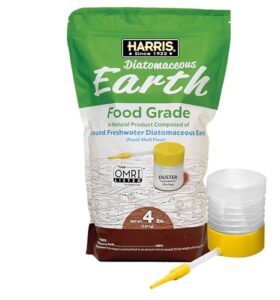
Harris Food Grade Diatomaceous Earth takes a purely mechanical approach. Made from 100% freshwater DE, it kills fleas, ants, roaches, and crawling insects by abrading and drying out their exoskeletons — no chemistry involved.
Moisture kills its efficacy, so dry conditions are non-negotiable. Keep it away from flowering plants, since silica particles can embed in bee pollen-collecting hairs. Spot-apply it to cracks, soil lines, and feeding areas. Its OMRI-listed, food-grade formula makes it safe around pets and children.
| Best For | Pet owners, organic gardeners, and anyone who wants a chemical-free way to control fleas, roaches, ants, and other crawling pests indoors or around livestock. |
|---|---|
| Formulation | Fine powder |
| Active Ingredient | Diatomaceous earth |
| Target Pests | Fleas, ants, roaches |
| OMRI Listed | Yes |
| Application Method | Powder duster |
| Volume / Size | 4.2 lb |
| Additional Features |
|
- 100% food-grade and OMRI-listed, making it safe to use around kids, pets, and even in animal feed
- Works purely through mechanical action, so insects can’t build resistance the way they do with chemical pesticides
- Comes with a powder duster for easy, targeted application in cracks, soil lines, and tight spaces
- Loses all effectiveness when wet, so it won’t work in humid areas or outdoors during rainy conditions
- The ultra-fine powder is messy and can clog standard vacuum filters if you over-apply
- Heavy infestations often need multiple rounds of treatment and may require pairing with other control methods to fully clear
5. Wondercide Natural Yard Pest Spray
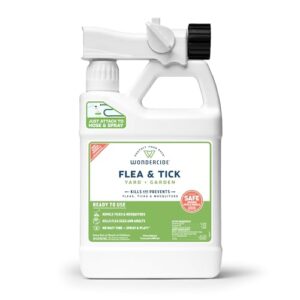
Wondercide takes a different approach: cedar oil as the active ingredient, which works through contact and repellent action against mosquitoes, ticks, fleas, and ants. The ready-to-use formula connects directly to a garden hose, covering up to 5,000 sq ft per 32 oz bottle — no mixing required.
The company markets it as safe for bees and butterflies when applied as directed. Avoid spraying open flowers. Residual protection usually lasts one to two weeks, so plan reapplication every four to five weeks.
| Best For | Families with kids and pets who want an effective, chemical-free yard treatment that’s gentle on pollinators and easy to apply with a garden hose. |
|---|---|
| Formulation | Hose-end liquid |
| Active Ingredient | Cedarwood essential oil |
| Target Pests | Fleas, ticks, mosquitoes |
| OMRI Listed | No |
| Application Method | Hose-end spray |
| Volume / Size | 32 fl oz |
| Additional Features |
|
- Plant-based cedar oil formula is safe for kids, pets, and pollinators when used as directed
- Covers up to 5,000 sq ft per bottle with no mixing — just attach to a hose and spray
- Tackles multiple pests (mosquitoes, ticks, fleas, and ants) in one application
- Residual protection only lasts 1–2 weeks, requiring reapplication every 4–5 weeks
- Heavy rain or low water pressure can reduce how well it works
- The cedarwood scent is strong and may linger after application
Protect Beneficials While Spraying
You don’t have to choose between controlling pests and protecting your garden’s good bugs — it mostly comes down to how and when you spray. A few practical habits can cut the risk to beneficial insects without sacrificing efficacy. Here’s what to keep in mind before you reach for that bottle.
Spray After Pollinators Leave

Bees are back in the hive by early evening — and that’s your window. Evening spray timing gives residues a full night to dry before pollinators return. Even organic products can harm foragers on contact, so spraying at dusk is one of the simplest forms of pollinator protection you can practice.
Apply only when air is calm. Managing spray drift matters because temperature inversions at dusk can push fine droplets unpredictably into nearby gardens or hedgerows.
Avoid Open Flowers
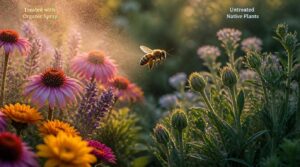
Open flowers are an invitation — to pollinators and to risk.
When blooms are fully open, nectar exposure risks rise sharply. Visiting bees, butterflies, and beneficial predators are drawn directly to treated surfaces.
- Pyrethrin sprays can knock down honey bees within minutes on contact
- Neem oil residues on open petals affect larval development
- Phytotoxicity on petals from soap and oil sprays can damage blooms
- Floral resource depletion speeds up when pollinators abandon treated patches
Stagger your planting with staggered bloom timing and direct pollinators toward native nectar alternatives away from sprayed areas.
Spot-treat Pest Hotspots
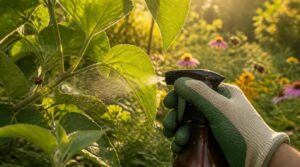
Think of spot-treating as surgical precision — you cut out the problem without disturbing the rest of the garden’s balance.
Target a 2–3 foot radius around affected plants. Direct your fine mist to leaf undersides, where aphids and mites cluster. Monitor honeydew residue to track active pest populations. Always assess non-target risks before spraying.
| Spot-Treatment Focus | Why It Matters |
|---|---|
| Leaf undersides | Pests congregate there |
| 2–3 ft radius | Limits non-target exposure |
| Calm conditions only | Mitigates spray drift |
| Honeydew monitoring | Confirms active hotspots |
| 7–10 day intervals | Reduces resistance risk |
Spot-treating pest hotspots cuts non-target exposure by up to 80% compared to whole-plant applications — a meaningful gain for pollinator health and beneficial insects alike.
Use Row Covers First

Before you reach for any spray, row covers offer something better: zero chemical exposure for beneficial insects. Draping lightweight, spun-bonded fabric over seedlings physically blocks cabbage worms, flea beetles, and root maggot flies without harming a single ladybug or parasitic wasp working nearby.
Heavier fabric even provides frost protection in early spring. Just remember to vent on warm days and remove covers when crops flower.
Scout Before Every Spray

Walking a field before you spray is one of the simplest habits in IPM monitoring — and one of the most overlooked. Here’s what to check each time:
- Identify pest life stages — eggs and larvae respond differently than adults
- Count beneficials present — if predators outnumber pests, skip the spray
- Map hotspots — treat only where pressure is concentrated
- Check the weather forecast — rain within 24 hours reduces efficacy
- Log everything — dates, pest type, and your action threshold decision
Frequently Asked Questions (FAQs)
Does Garden safe insecticidal soap kill bees?
Like a bee landing on a wet leaf, timing is everything. Garden Safe Insecticidal Soap can kill bees on direct contact, but once dry, risk drops to nearly negligible — so avoid spraying blooms during foraging hours.
Why should you use insecticides in your garden?
Pest pressure is real. Left unchecked, insects can devastate crops, spread disease, and invite secondary infestations. Protecting plant health and preventing economic damage starts with knowing when — and how — to act.
Is neem oil good for garden pests?
Yes, neem oil works well against aphids, whiteflies, and mealybugs. Its active compound, azadirachtin, disrupts feeding and larval development. It also suppresses fungal diseases, making it a practical two-in-one organic garden spray.
What are natural pest control methods?
Natural pest control methods include biological controls like releasing lady beetles, using row covers, planting insectary strips, applying targeted organic sprays, and deploying yellow sticky traps or pheromone traps to monitor and disrupt pest populations.
Does neem oil affect beneficial insects?
Neem oil does affect beneficial insects. Its active compound, azadirachtin, disrupts feeding and can impair predator mobility. Larvae and soft-bodied beneficials face the greatest risk, though populations can rebound if exposure stays limited.
How harmful are organic pesticides?
Think of organic pesticides like a controlled burn — useful, but fire doesn’t ask which plants it spares. Non-target toxicity is real. Even approved products can harm beneficials through residual impact and cumulative exposure.
How do organic sprays compare in cost to synthetics?
Organic sprays usually cost 20–30% more per acre than synthetics. DIY options can cut that gap noticeably. Long-term, healthier soil often reduces how much you need to spend overall.
Can pests develop resistance to organic spray products?
Yes — pests can and do develop resistance to organic sprays. Detoxification enzyme upregulation, behavioral avoidance, and thicker cuticles all play a role. Rotating products and limiting spray frequency helps slow this process considerably.
Which beneficial insects recover fastest after organic exposure?
Lady beetles bounce back in 3–5 days with nectar nearby. Lacewings follow in 7–14 days. Hoverflies return within a week once flowers reopen. Bt-treated areas see the fastest recolonization overall.
Conclusion
Some gardeners hesitate here, worried that cutting back on sprays means losing the battle against pests. It doesn’t.
Understanding whether organic pest sprays harm beneficial insects is what shifts you from reactive spraying to intentional gardening.
Spray after dusk. Skip the open blooms. Target only what you see.
The lacewings, hoverflies, and bees doing quiet work across your garden aren’t collateral damage you have to accept—they’re allies worth protecting.