
This site is supported by our readers. We may earn a commission, at no cost to you, if you purchase through links.

Most seeds don’t fail because they’re old, fussy, or planted at the wrong depth. They fail because mix around them stays too wet, dries too fast, or packs down like a brick.
I’ve seen healthy tomato and pepper seeds turn sluggish in heavy potting soil, then spring to life in a lighter, airier blend built for germination.
The best soil for starting seeds feels soft, drains fast, holds steady moisture, and gives fragile roots room to breathe.
Once you understand what that mix needs to do, choosing a bagged blend or making your own gets far less mysterious.
Table Of Contents
- What Makes Seed Starting Soil Best
- Key Ingredients in Seed Starting Mix
- Peat Moss Vs Coconut Coir
- Seed Starting Mix Vs Potting Soil
- Best DIY Seed Starting Recipes
- How to Prepare and Use Mix
- Common Seed Starting Soil Problems
- Top 9 Seed Starting Mixes
- 1. FoxFarm Ocean Forest Potting Soil
- 2. Miracle Gro Potting Mix
- 3. Miracle Gro Houseplant Potting Mix
- 4. Back to the Roots Seed Starting Mix
- 5. Espoma Organic Seed Starter Potting Soil
- 6. Midwest Hearth Natural Seed Starter Soil
- 7. Miracle Gro Indoor Seed Starting Mix
- 8. Burpee Organic Coconut Coir Seed Starting Mix
- 9. Doter Organic Seed Starter Soil
- Frequently Asked Questions (FAQs)
- Is it too late to plant seeds in October?
- What are the biggest mistakes when sowing seeds?
- What kind of soil should I plant seeds in?
- Can I start seeds in regular potting soil?
- Can I reuse seed starting soil next season?
- How long does seed starting mix stay fresh?
- Should I sterilize seed starting soil before use?
- Whats the ideal depth for planting seeds?
- Do all seeds need darkness to germinate?
- How long does seed starting soil stay fresh?
- Conclusion
What Makes Seed Starting Soil Best
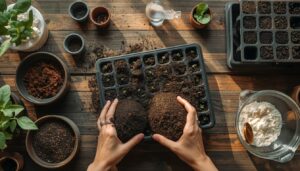
Choosing the right soil for starting seeds is more than just grabbing any bag from the shelf. There are a few key qualities that make all the difference for healthy germination.
For simple tips on soil mixes, fast-sprouting seeds, and watering, this beginner seed starting guide is a helpful place to start.
Here’s what you’ll want to look for as you get started.
Fine Texture for Seed-to-soil Contact
When you work with a seed starting mix that has fine granulation and consistent particle size uniformity, you’re giving your seeds the best chance for even germination.
Fine texture controls surface roughness, regulates capillary action, and ensures moisture distribution balance.
This soil texture helps with seed placement precision, so each tiny root finds its footing without getting lost or overwhelmed.
Moisture Retention Without Waterlogging
Once your seeds are nestled into that fine-textured mix, the next challenge is balancing water retention and drainage.
Capillary Action Control keeps moisture available without pooling, while Water Holding Granules and Moisture Buffering Additives—like coir or vermiculite—prevent rapid drying. Surface Evaporation Management and a thin Drainage Layer Optimization help avoid waterlogging, keeping roots moist but never suffocated.
Fast Drainage and Strong Aeration
After you’ve solved moisture balance, fast drainage and strong aeration become your best allies.
A seed starting mix with the right Vermiculite Perlite Ratio and a Lightweight Coir Blend ensures roots breathe and water moves freely.
Here’s what you want:
- Drainage Rate Calibration (5–15 min)
- Adequate aeration
- Pore Size Distribution
- Capillary Action Balance
- Fast drain mix with perlite
Low Salt and Balanced Nutrient Levels
Once your mix drains well, you’ll want to keep salt levels low and nutrients balanced. Salt-Free Media prevents osmotic stress, while Micronutrient Balance promotes steady root growth. Conductivity Monitoring ensures gentle fertilizer doses, not sudden spikes.
Here’s how these factors compare in practice:
| Feature | Effect on Seedlings |
|---|---|
| Salt-Free Media | Prevents root burn |
| Gentle Fertilizer | Steady, safe nutrient flow |
Ideal PH for Germination
A well-balanced soil pH is the secret sauce for reliable seed germination. Most vegetable seeds thrive with a Target pH Range of 5.5–6.5, though Species pH Preferences vary. Here’s what matters:
- Neutral pH promotes steady emergence
- pH level affects nutrient uptake
- Adjustment Techniques keep pH balanced
- Monitoring Tools guarantee consistency
- Microbial pH Effects boost early vigor
Lightweight Structure for Root Growth
When you fill your trays with a lightweight texture, you’re giving young roots the freedom to stretch and breathe. Aeration and drainage let root hairs form quickly, while root zone uniformity keeps moisture balanced. Even after drying, a light mix re-wets easily, supporting root system flexibility and healthy root growth dynamics.
| Root Hair Formation | Light Mix Re-wetting | Root Zone Uniformity |
|---|---|---|
| Encourages fine roots | Quick moisture recovery | Balanced water and air |
| Boosts early vigor | Prevents compaction | Reduces stress |
| Enhances strong growth | Aids rehydration | Promotes flexibility |
Key Ingredients in Seed Starting Mix
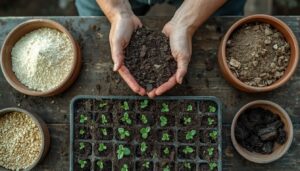
When you’re starting seeds, the mix you use makes all the difference. Each ingredient plays a unique role in helping your seedlings grow strong and healthy.
Here’s what you’ll want to look for as you build or choose your seed-starting mix.
Peat Moss for Moisture Retention
Ever wondered how seeds stay moist without drowning? Peat moss is your secret weapon. Its capillary action forms a reliable moisture buffer, absorbing water fast and releasing it slowly. You get steady soil moisture, gentle evaporation control, and hydraulic conductivity that helps roots breathe. Here’s why peat moss stands out:
- Rapid water absorption
- Slow water release rate
- Prevents waterlogging
Coconut Coir as a Peat-free Option
Looking for a peat-free, sustainable growing media?
Coconut coir offers excellent water retention, expands easily with Coir Brick Hydration, and keeps your seed starting mix light and fluffy. Thanks to Coir Cation Exchange and Coir Microbial Inoculation, roots get steady nutrients and balanced pH.
Coir Temperature Insulation protects seedlings, while Coir Storage Longevity means your mix stays fresh season after season.
Perlite for Airflow and Drainage
Imagine your seed starting mix as a sponge full of air pockets—perlite is what keeps those pockets open.
Thanks to Perlite Porosity Benefits and unique Perlite Particle Shape, your seedlings enjoy steady aeration and rapid drainage. Perlite Water Channels whisk away excess moisture, preventing soggy roots, while Perlite Mix Lightness and Perlite Longevity Maintenance make sure the soil stays fluffy and stable.
Vermiculite for Moisture Balance
Think of vermiculite as your seed starting mix’s gentle reservoir, offering Slow Water Release and steady soil moisture management. It’s excellent for water retention, yet won’t drown roots, thanks to Capillary Action and balanced drainage.
Vermiculite also promotes pH Stabilization, helps with Trace Element Supply, and aids Temperature Regulation, making your mix airy, consistent, and safe for fragile seedlings.
Screened Compost in Small Amounts
While vermiculite balances moisture, a pinch of fine screened compost brings something extra—gentle nutrient availability, organic matter, and microbial inoculation. Used sparingly, compost boosts water retention and soil life without spiking EC levels.
For best results:
- Source mature, screened compost.
- Rinse salts if needed.
- Monitor EC to avoid salt stress.
This approach promotes steady, healthy seedling growth.
Worm Castings for a Gentle Nutrient Boost
If you’re after a gentle nutrient boost, worm castings are your ally. They offer slow release NPK, humic acid benefits, and trace mineral supply—feeding seedlings steadily without overwhelming roots.
Microbial inoculation from castings enhances disease resistance and organic matter breakdown.
Just be sure to choose castings quality standards—fully aged and contaminant-free—to keep your seed starting mix balanced and nutrient-rich.
Why Sand is Rarely Needed
After worm castings, you might wonder about sand—but for seed starting, sand rarely improves your mix. Most growers skip it because:
- Sand increases carbon footprint and resource extraction.
- Handling comfort drops as trays get heavier.
- Mix homogeneity suffers, causing uneven drainage.
- Root oxygenation is better with perlite, vermiculite, peat moss, or coco coir—these maintain moisture and airflow far more reliably.
Peat Moss Vs Coconut Coir
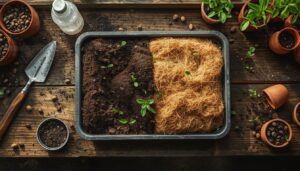
For seed starting, peat moss and coconut coir are the two most popular choices for moisture management.
Each has its own strengths and quirks that can affect your seedlings’ success. Let’s look at how these options compare in the ways that matter most for your trays and cells.
Water-holding Differences
Ever wonder why peat moss feels like a sponge, while coconut coir acts more like a woven net? Peat’s retention ratio is 6–8 times its weight, holding moisture deep for steady capillary action.
Coir, with its airy particle size, balances water retention and drainage, preventing waterlogging and speeding up evaporation.
Organic matter influences both, shaping how roots access moisture.
| Material | Retention Ratio | Evaporation Rate |
|---|---|---|
| ————–: | : | |
| ————–: | : | |
| —————: | ||
| Peat Moss | 6–8× | Slow |
| Coconut Coir | 4–7× | Moderate |
| Mixed Organic | 5–7× | Balanced |
PH and Salt Considerations
If you’re aiming for reliable germination, pay close attention to pH balance and salinity impact. Peat moss is prone to lower pH, while coir leans neutral, simplifying soil pH management for seeds.
Electrical Conductivity Monitoring helps spot salt issues early. Use distilled water and pH Buffering Agents for pH adjusted mixes.
Here’s a quick comparison:
| Material | Typical pH | Salinity Risk |
|---|---|---|
| ————-: | : | |
| ———-: | : | |
| ————-: | ||
| Peat Moss | 5.5–6.5 | Moderate |
| Coconut Coir | 6.5–7.0 | Low |
| Compost | Variable | High |
Sustainability and Environmental Impact
While you weigh peat moss against coconut coir, it’s clear that eco-friendly gardening is more than a trend—it’s a responsibility.
Renewable material sourcing and zero waste packaging support regenerative gardening, while peat-free, sustainable growing media alternatives protect biodiversity.
Choosing coir over peat reduces carbon footprint and favors low impact production.
| Option | Environmental Benefit |
|---|---|
| Coconut Coir | Renewable, peat-free, low carbon |
| Peat Moss | Depletes bogs, higher impact |
Performance in Seed Trays and Cells
Although both peat moss and coconut coir anchor seeds well, their Moisture Equilibrium and Pore Architecture shape how roots grow and breathe. Coir’s Capillary Transport keeps water evenly distributed, while peat’s Thermal Stability moderates temperature swings. For Emergence Uniformity, fine-textured seed starting mix ensures drainage and aeration, so every cell helps healthy seed germination.
| Feature | Peat Moss | Coconut Coir |
|---|---|---|
| Moisture Equilibrium | High | Moderate |
| Thermal Stability | Strong | Good |
| Pore Architecture | Fine, dense | Open, airy |
Which Option Suits Beginner Gardeners Best
If you’re new to seed starting, coconut coir feels like a clean slate—easy sterilization, simple instructions, and a forgiving texture.
Peat moss offers strong moisture hold but can compact.
For most, a Budget Pack of pre-mixed blend with coir suits low-skill setup and cost-effective seed starting practices.
DIY seed starting mix formulation is straightforward with organic materials.
| Option | Beginner Benefits |
|---|---|
| Coconut Coir | Simple, forgiving, clean |
| Peat Moss | Moisture, but compacts |
Seed Starting Mix Vs Potting Soil

Choosing the right soil for your seeds can make all the difference in their early growth. Seed starting mixes and potting soils aren’t created equal, and each has a unique purpose.
Let’s look at what sets them apart and how to pick the best option for your seedlings.
Structural Differences Between The Two
Ever notice how seed starting mixes feel like a cloud, while potting soil acts more like a packed blanket? The secret lies in Fiber Length Variation and Bulk Density Contrast. Seed mixes use lightweight and fluffy particles, optimizing drainage and aeration, while potting soils rely on coarser shapes and higher Cation Exchange Capacity.
| Seed Mix | Potting Soil |
|---|---|
| Fine, fluffy | Coarse, dense |
| Fast drainage | Slow drainage |
| Quick root growth | Slower expansion |
| Low decomposition | Higher decomposition |
Why Potting Soil is Often Too Heavy
Imagine trying to grow seeds in a soggy sponge—potting soil’s High Organic Content and Compacted Particle Structure create a Waterlogged Mix with Low Aeration Capacity.
Heavy Additive Ratio means poor drainage and dense soil texture, slowing root expansion.
You want lightweight and fluffy structure for seedlings, not a packed blanket.
| Property | Seed Mix |
|---|---|
| Aeration | High |
| Drainage | Fast |
| Structure | Fluffy |
| Texture | Lightweight |
Disease Risks With Garden Soil
Heavy garden soil is a risky guest in seed trays, bringing Pathogen Contamination, Heavy Metal Exposure, and Legionella Dust Risk indoors. Fungal Spore Transmission and Soilborne Bacterial Infections can trigger damping off or fungus gnats, especially without soil sterilization.
For safer seedlings, focus on pathogen control from the start.
| Risk Factor | Impact |
|---|---|
| Pathogens/Metals | Disease, toxicity |
| Fungal/Bacterial | Damping off, gnats |
When to Switch Seedlings to Potting Mix
Once you’ve sidestepped garden soil’s risks, timing your seedling transplant matters just as much. Wait for two true leaves, strong root development, and steady light thresholds.
Moving seedlings too late risks root matting and transplant shock; too early, and growth stalls.
A gradual shift preserves seedling health.
Here’s a quick guide:
| True Leaf Count | Root Development | Light Thresholds |
|---|---|---|
| 2+ leaves | Roots visible | 12+ hrs/day |
| 3–4 leaves | Roots circling | 14+ hrs/day |
| 1–2 leaves | Sparse roots | 10–12 hrs/day |
| 4+ leaves | Matting roots | 16 hrs/day |
Best Uses for Each Growing Medium
Once seedlings show strong roots and true leaves, each growing medium fulfills its purpose. Seed starting mixes—like peat moss, coco coir, and soil block mix—shine for germination, while potting soil, boosted with organic worm castings or cactus perlite, helps mature plants.
Here’s a quick comparison:
| Medium | Best Use |
|---|---|
| Orchid peat | Delicate seeds |
| Hydroponic coir | Fast germination |
| Humidity vermiculite | Moisture control |
| Cactus perlite | Drainage boost |
| Organic worm castings | Root nutrition |
Best DIY Seed Starting Recipes
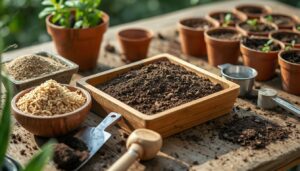
If you’d rather mix your own seed-starting soil, you’ve got plenty of options to suit every need. Each recipe brings its own strengths, depending on how you want your seedlings to grow.
Let’s look at some practical blends you can try at home.
Basic 1:1:1 Seed-starting Mix
If you want a seed starting mix that’s simple, effective, and easy to troubleshoot, the classic 1:1:1 ratio—peat moss, vermiculite, and perlite—never goes out of style.
This blend offers:
- Balanced moisture retention
- Excellent aeration for root health
- Consistent light penetration
- Low salt for gentle starts
- Straightforward batch sterilization process for safety
All-purpose Coir or Peat Blend
An all-purpose seed starting blend using coco coir or peat moss gives you reliable moisture retention and aeration, perfect for trays or cell packs. Mycorrhizal inoculants and organic wetting agents boost root vigor, while mix sterilization techniques and bulk ingredient sourcing keep costs low and shelf life extended.
You’ll find this recipe gentle, sustainable, and simple for beginners and experts alike.
Fast-drain Mix for Overwatering Risks
If you’re concerned about overwatering, a fast-drain mix is your safety net. By boosting mix porosity and drainage capacity, you prevent waterlogging and promote aeration.
Try this blend:
- Two parts coir or peat
- Two parts perlite
- One part vermiculite
- Test drainage timing—water exits rapidly.
- Watch for overwatering symptoms; adjust as needed.
Rapid water exit means roots stay healthy.
Nutrient-nudge Mix for Longer Indoor Starts
Think of this nutrient nudge mix as a lunchbox for indoor seedlings, steady rather than rich.
Use seed starting mix ingredient ratios of 2 parts coir or peat, 1 part perlite, 1 part vermiculite, plus 1/2 part screened compost.
Slow-release nutrients, microbial inoculants, good moisture retention, nutrient availability, shelf-life stability, and cost-effective sourcing support an extended germination window with less fuss.
Soil-block Mix for Sturdy Seedlings
Ever notice how a sturdy soil block feels like a miniature fortress for seedlings? You need a mix that balances Block Compression Resistance with Root Penetration Ease and Moisture Uniformity Control. The right blend keeps Block Shape Stability and helps soil block planting methods.
- High drainage and aeration
- Fine texture for seedling development
- Reliable soil structure
- Block Sterilization Process for disease prevention
How to Pre-moisten Homemade Mix Properly
| Cue | Goal | Why |
|---|---|---|
| Sponge-like Consistency | Moisture Content Measurement | 1–2 drops |
| Temperature Equilibration | Mix Rest Period | 24 hours |
| Surface Dry Layer | rapid water absorption | seedling moisture management |
This promotes water retention, moisture retention, and balancing water retention and drainage, so your trays stay evenly damp, never puddled, cool, fluffy, breathable, and truly ready for sowing.
How to Prepare and Use Mix
Even a great seed-starting mix works best when you handle it the right way from the start. A few simple steps make a big difference in germination, moisture balance, and early root growth.
Here’s how to get your mix ready and use it well in trays, cells, or small pots.
Moistening The Mix Before Sowing
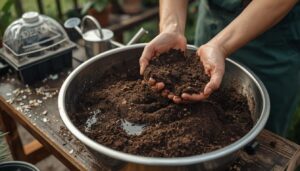
Get this step right, and germination starts on steady ground. Use a sensible Pre-wetting Ratio for Uniform Saturation, with lukewarm Water Temperature to support moisture retention and water retention.
Your Moisture Indicator is simple: the mix should clump, then crumble, never drip. That seedling moisture management balances water retention and drainage, while Dome Humidity aids waterlogging prevention well.
Filling Trays Without Compacting Soil
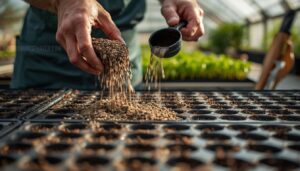
Once your mix is evenly moist, fill trays using Layered Pouring and Gentle Tapping to encourage Air Pocket Creation. Shake Settling helps the lightweight blend settle naturally, preventing compaction and supporting soil aeration.
Surface Leveling ensures even drainage, especially when using perlite for aeration. Leave a gap below the rim—about one centimeter—so water won’t overflow or disturb seeds later.
Sowing Depth and Seed Spacing Basics
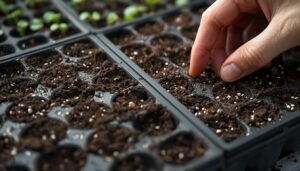
With trays leveled and airy, your next step is all about Depth Ratio Guidelines and Spacing Density Tips. Seed starting guidelines recommend sowing most seeds at one to two times their diameter, using Uniform Cover Technique for tiny seeds. For healthy seed germination:
- Depth Placement Accuracy prevents drying or retreat
- Row Spacing Strategy reduces competition
- Fine seeds need gentle coverage
- Soil Characteristics Essential for Germination support uniform emergence
Watering Methods That Prevent Soggy Roots
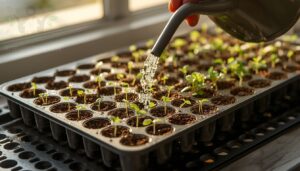
Once seeds are spaced just right, focus on moisture regulation. Bottom Watering or a Capillary Mat lets water wick up, avoiding soggy tops and keeping roots happy. A fine Misting Schedule prevents surface compaction, while a narrow Watering Can Nozzle gives control.
Tray Elevation improves air flow and good drainage, balancing water retention, so seed tray watering promotes strong, healthy roots.
Temperature and Airflow for Healthy Germination
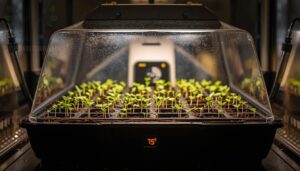
After perfecting your watering, turn your attention to temperature control and airflow—two pillars of steady seed germination. Heat Mat Management paired with Thermostat Regulation keeps your seed starting mix at that sweet spot, usually 65–75°F.
Airflow Optimization matters just as much: a small fan, Humidity Dome Control, and mindful Light Cycle Timing all help maintain aeration and prevent fungal mishaps.
When to Fertilize After True Leaves Appear
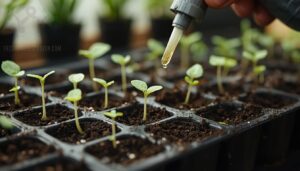
Once you spot that true leaf cue—usually two or three true leaves—it’s time for a gentle starter fertilizer dosage. Begin your feeding schedule with a diluted organic liquid fertilizer, focusing on the root growth trigger, not just rapid top growth.
Watch for a pale leaf color signal; this guides nutrient uptake, keeps seedling vigor high, and promotes steady seedling growth.
Common Seed Starting Soil Problems
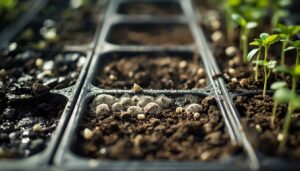
Even the best seed-starting mix can run into trouble if conditions aren’t quite right. There are a handful of common issues you’ll want to watch for as your seedlings grow.
Here’s what to keep an eye out for next.
Damping-off From Overly Wet Mix
Ever notice seedlings collapsing despite careful moisture retention? That’s classic damping-off, driven by poor drainage and low aeration.
Pathogen Identification is key—Pythium thrives in wet mixes.
Watch for Oxygen Deficiency Symptoms: pale stems, mushy roots. Use Drainage Testing Methods, Mix Sterilization Techniques, and Airflow Management Strategies to combat this.
Here’s what helps:
- Increase perlite for drainage
- Bottom-water, avoid pooling
- Sterilize mix
- Improve airflow
- Let surface dry between waterings
Leggy Seedlings From Poor Conditions
If your seedlings seem stretched thin and pale, you’re likely facing leggy growth from insufficient light, temperature fluctuations, or overcrowded containers. Inconsistent watering and nutrient deficiency also play a part, weakening stems and slowing leaf development.
Meeting light requirements, ensuring soil quality with proper moisture retention, and supporting steady nutrient uptake will help keep your seedlings stout and healthy.
Surface Algae and Crusting Issues
Have you noticed a slimy green film or a pale, hard crust forming on your seed trays? Surface algae thrives when water retention and light combine, while crusting blocks moisture and air.
Algae Light Management and Surface Sand Mulch help prevent these issues.
Use Crust Removal Techniques, Bottom Watering Method, and Airflow Enhancement to restore drainage, aeration, and soil pH balance for healthy germination.
Fungus Gnats in Organic-heavy Mixes
If your organic seed starter seems to attract tiny flies, you’re facing fungus gnats—a common headache in mixes with good water retention. Their larvae thrive in moist, organic-rich seedstarting mix.
To keep them at bay, use Larval Habitat Management and Surface Barrier Techniques, monitor adult activity, and time moisture carefully. Biological Control Agents offer extra protection, making indoor gardening safer and easier.
Stunted Roots From Dense Soil
Dense soil acts like a tight shoe—roots can’t stretch, breathe, or explore. Compaction Hypoxia and reduced pore volume cause root tip stunting and limited root penetration, leaving plants stressed and slow.
Dense soil traps roots like a tight shoe, starving them of air and leaving plants stunted, stressed, and slow
For healthy growth, focus on compaction prevention, aeration, and drainage. A lightweight blend makes all the difference.
- Poor root expansion
- Oxygen starvation
- Stunted taproots
- Slow shoot growth
- Higher disease risk
How to Test Drainage, Texture, and PH
When soil feels tight and roots stall, testing and evaluating seed starting soil can save your seedlings. Try a Drainage Test Timing—water should clear within 15 minutes.
For Texture Particle Sizing, sieve for particles under 2 mm. Use a pH Test Kit and the Moisture Weight Method to check pH balance and air space evaluation, ensuring healthy soil quality.
Top 9 Seed Starting Mixes
Choosing the right seed starting mix can make all the difference for healthy seedlings. There are plenty of trusted options, each with its own strengths.
Here’s a look at nine mixes that gardeners rely on for reliable germination and growth.
1. FoxFarm Ocean Forest Potting Soil
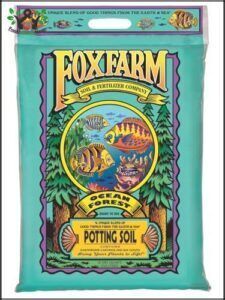
FoxFarm Ocean Forest Potting Soil stands out for its blend of aged forest products, sphagnum peat moss, sandy loam, fish meal, crab meal, and earthworm castings. You’ll notice the mix feels light and airy, offering excellent drainage and moisture retention—ideal for root growth. Its pH hovers between 6.3 and 6.8, supporting healthy germination.
While nutrient-rich, it’s best to mix Ocean Forest with a milder medium for delicate seedlings, since its “hot” profile can overwhelm young roots.
| Best For | Gardeners who want a nutrient-rich, ready-to-use potting mix for containers, houseplants, and outdoor plants, especially when growing established plants or heavy feeders. |
|---|---|
| Brand | FoxFarm |
| Package Size | 12 qt bag |
| Primary Blend | Forest humus, loam, peat |
| Nutrient Charge | High natural nutrients |
| Water Balance | Moist yet airy |
| Best For | Containers and mixed planting |
| Additional Features |
|
- Rich blend of forest humus, peat moss, sandy loam, fish meal, crab meal, and earthworm castings provides strong natural nutrition.
- Light, fluffy texture supports healthy root growth with good moisture retention and drainage.
- Ready to use straight from the bag with a near-optimal pH and no need for initial nitrogen fertilizer.
- Its “hot” nutrient profile can be too strong for delicate seedlings unless mixed with a milder medium.
- Can attract fungus gnats and may need pest-control measures in some setups.
- Costs more than standard potting mixes and may need extra perlite for better drainage indoors or in humid conditions.
2. Miracle Gro Potting Mix
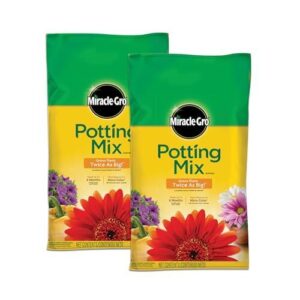
If Miracle-Gro Potting Mix feels like a more predictable middle ground, it blends peat moss and perlite with added plant food, ensuring moisture retention, airflow, and feeding that lasts up to six months.
Its fine and lightweight texture aids seed contact and early root growth, though it can compact over time. For seed trays, especially if overwatering is a concern, lighten it with extra perlite.
| Best For | Gardeners who want a reliable, all-purpose potting mix with built-in feeding for indoor or outdoor container plants, and who do not mind amending it slightly for better aeration in seed trays or moisture-sensitive setups. |
|---|---|
| Brand | Miracle-Gro |
| Package Size | 8 qt bags (2-pack) |
| Primary Blend | Peat moss, perlite |
| Nutrient Charge | Feeds up to 6 months |
| Water Balance | Can run dense |
| Best For | General container plants |
| Additional Features |
|
- Feeds plants for up to 6 months, which cuts down on the need for frequent fertilizing.
- Works well for a wide range of container-grown plants, including flowers, herbs, vegetables, shrubs, and roses.
- Fine, lightweight mix with peat moss and perlite helps with moisture retention, airflow, and early root growth.
- Can feel dense and may compact over time, so extra perlite or pumice may be needed for better drainage and aeration.
- Not sterile, so some users report fungus gnats, soil mites, or other organisms in the mix.
- Bag quality and mix consistency can vary, with occasional reports of dry texture, wood pieces, or poor resealing for storage.
3. Miracle Gro Houseplant Potting Mix
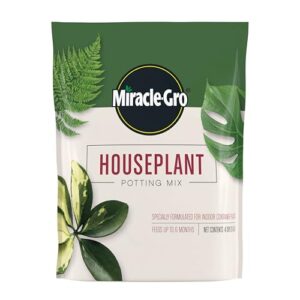
If you’re looking for a seed-starting mix that keeps things simple and tidy indoors, Miracle Gro Houseplant Potting Mix stands out. Its blend of peat, coir, and perlite offers a fine, fluffy texture that helps seeds settle snugly, while the integrated fertilizer feeds young roots for up to six months.
You won’t wrestle with fungus gnats, since there’s no compost or bark. It’s easy to handle, fits well in nursery pots, and maintains moisture without soggy bottoms—ideal for beginners seeking reliable results.
| Best For | Indoor plant owners who want an easy, ready-to-use potting mix that keeps pests at bay and supports healthy growth. |
|---|---|
| Brand | Miracle-Gro |
| Package Size | 4 qt bag |
| Primary Blend | Peat moss, coir, perlite |
| Nutrient Charge | Feeds up to 6 months |
| Water Balance | Balanced for houseplants |
| Best For | Indoor houseplants |
| Additional Features |
|
- Ready-to-use with built-in fertilizer for up to six months.
- Reduces fungus gnat problems thanks to a compost- and bark-free formula.
- Maintains moisture while offering good drainage, ideal for most houseplants.
- The fluffy mix may require more product to fill larger pots.
- Fertilizer only lasts six months, so you’ll need to feed plants again after that.
- Not suitable for outdoor or heavy-feeding plants; lacks compost and bark.
4. Back to the Roots Seed Starting Mix
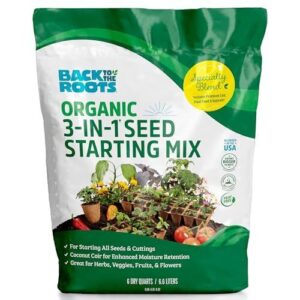
A peat-free blend like Back to the Roots Seed Starting Mix offers a gentle, eco-friendly foundation for seedlings. You’ll notice coconut coir, worm castings, gypsum, and mycorrhizae working together to hold moisture and boost root vigor.
The dolomitic limestone keeps pH steady, while yucca extract improves water distribution.
It’s packaged in a 6-quart bag, expands easily, and suits herbs, veggies, or flowers. If you want organic, USA-made soil that encourages healthy germination without peat’s environmental drawbacks, this mix fits the bill.
| Best For | Gardeners looking for a peat-free, organic seed starting mix that’s gentle on the environment and supports strong, healthy seedlings. |
|---|---|
| Brand | Back to the Roots |
| Package Size | 6 qt bag |
| Primary Blend | Coir, castings, gypsum |
| Nutrient Charge | Organic nutrients included |
| Water Balance | Retentive with drainage |
| Best For | Seed trays and pots |
| Additional Features |
|
- Eco-friendly blend avoids peat, lowering environmental impact.
- Boosts root growth and water retention with mycorrhizae and yucca extract.
- Made in the USA and certified 100% organic.
- Small bag opening makes rehydration a bit tricky.
- Mold can develop if seed trays are covered too tightly.
- Occasional issues with fungus gnats and inconsistent germination.
5. Espoma Organic Seed Starter Potting Soil
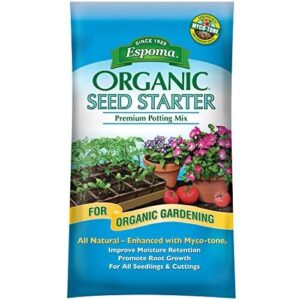
If you want a mix that’s both organic and engineered for strong seedling roots, Espoma Organic Seed Starter Potting Soil stands out. You’ll find a gentle blend of sphagnum peat moss and perlite, enriched with yucca extract and lime for balanced pH.
Myco-tone mycorrhizae help roots branch out quickly, supporting uniform sprouting. The texture is airy and fine, so seeds nestle easily and moisture stays steady.
It’s sold in a 16-quart bag, ideal for trays and free from synthetic additives.
| Best For | Gardeners who want an organic, chemical-free seed starter mix that encourages strong root growth and easy sprouting. |
|---|---|
| Brand | Espoma |
| Package Size | 16 qt bag |
| Primary Blend | Peat moss, perlite |
| Nutrient Charge | No synthetic fertilizer |
| Water Balance | Fine and airy |
| Best For | Seeds and cuttings |
| Additional Features |
|
- All-organic blend with mycorrhizal inoculant for better root development
- Fine, airy texture perfect for seed and cutting propagation
- Works well with bottom-watering systems and standard seed trays
- Some bags arrive damaged or taped due to packaging issues
- Mix can dry out quickly if not watered regularly
- May contain small clumps or sticks that need sifting for tiny seeds
6. Midwest Hearth Natural Seed Starter Soil
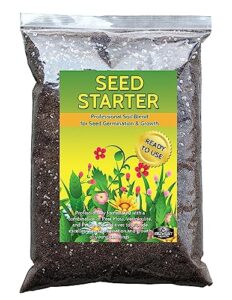
Midwest Hearth Natural Seed Starter Soil offers a ready-to-use blend that’s similar to what professional growers rely on. You get peat moss, perlite, and vermiculite—ingredients that create a fine, airy texture and keep moisture balanced without drowning roots.
The mix fits snugly into seed trays, making it easy to handle and sow.
If you notice organic chunks, don’t worry—they add structure. Just remember to moisten it well before planting, as the soil arrives dry and needs hydration to support germination.
| Best For | Home gardeners and beginners who want an easy, professional-quality seed starter mix for vegetables and other plants. |
|---|---|
| Brand | Midwest Hearth |
| Package Size | 4 dry qt bag |
| Primary Blend | Peat, perlite, vermiculite |
| Nutrient Charge | Low added nutrition |
| Water Balance | Moisture-controlled blend |
| Best For | Seed trays |
| Additional Features |
|
- Ready to use and easy to handle in standard seed trays.
- Keeps seeds moist without waterlogging, helping early growth.
- Works for a wide variety of plant types.
- Needs thorough rehydration before planting since it’s dry out of the bag.
- Holds moisture longer, so overwatering can slow germination.
- Some organic chunks may settle, and nutrient amendments might be needed.
7. Miracle Gro Indoor Seed Starting Mix
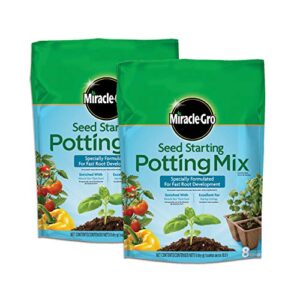
Have you ever wondered why so many gardeners swear by Miracle Gro Indoor Seed Starting Mix? This blend brings together sphagnum peat moss and perlite, creating a lightweight, airy environment that promotes rapid root growth and high germination rates. It’s enriched with gentle plant food, so your seedlings get a head start without risk of burn. Because it skips compost and bark, you won’t battle fungus gnats. Pre-moisten for best results, fill your trays, and enjoy consistent moisture—just keep an eye on watering.
| Best For | Indoor gardeners looking to start seeds or root cuttings with minimal hassle and high success rates. |
|---|---|
| Brand | Miracle-Gro |
| Package Size | 8 qt bags (2-pack) |
| Primary Blend | Indoor soilless blend |
| Nutrient Charge | Enriched with plant food |
| Water Balance | Consistent moisture |
| Best For | Indoor seeds and cuttings |
| Additional Features |
|
- Supports strong root growth and high germination rates.
- Reduces risk of fungus gnats thanks to compost-free formula.
- Easy to use—just pre-moisten and fill trays.
- Not ideal for mature plants or outdoor use.
- May need extra nutrients as seedlings grow.
- Requires careful watering to avoid root problems.
8. Burpee Organic Coconut Coir Seed Starting Mix
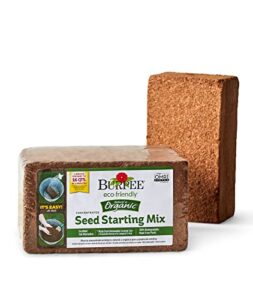
Looking for a seed-starting mix that’s both eco-friendly and reliable? Burpee Organic Coconut Coir Seed Starting Mix fits the bill, expanding from compact bricks into a fluffy, debris-free medium.
You’ll appreciate how coconut coir holds moisture evenly, yet drains well, so roots stay healthy and oxygenated. This OMRI-listed blend is certified organic, derived from recycled husks, and resists disease naturally.
It’s easy to store, simple to hydrate, and works beautifully for vegetables, herbs, and flowers—especially if you’re aiming for sustainable gardening.
| Best For | Gardeners who want an organic, eco-friendly seed-starting mix that’s easy to use and store. |
|---|---|
| Brand | Burpee |
| Package Size | 2 bricks, 16 qt expanded |
| Primary Blend | Coconut coir |
| Nutrient Charge | Needs added nutrients later |
| Water Balance | Retentive and aerated |
| Best For | Seed starting base |
| Additional Features |
|
- Expands quickly into a soft, moisture-retentive medium for seeds.
- Certified organic and naturally resists disease.
- Reduces storage space and shipping weight thanks to compressed bricks.
- Needs careful watering to avoid dry spots during rehydration.
- Not a complete potting soil—extra nutrients may be needed as plants grow.
- Can dry out after expansion and might need re-wetting before reuse.
9. Doter Organic Seed Starter Soil
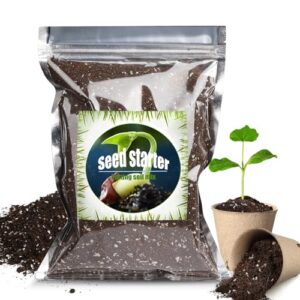
Curious how a compact bag can deliver such reliable germination? Doter Organic Seed Starter Soil blends peat moss, coconut coir, perlite, and worm castings for a light, airy texture that keeps seeds moist but never soggy.
You won’t need to mix or amend—just open and sow. The gentle nutrients suit vegetables, herbs, and flowers, while the near-neutral pH helps roots thrive.
It’s ideal for small batches, though the actual bag size is modest, so plan accordingly if you’re starting many trays.
| Best For | Home gardeners who want a simple, ready-to-use organic mix for starting seeds in small batches. |
|---|---|
| Brand | Doter |
| Package Size | 1 qt bag |
| Primary Blend | Peat, perlite, vermiculite |
| Nutrient Charge | Early nutrients included |
| Water Balance | Balanced moisture |
| Best For | Seeds and propagation |
| Additional Features |
|
- No mixing needed—just open the bag and sow.
- Supports fast germination with balanced moisture and nutrients.
- Suitable for vegetables, herbs, and flowers.
- Small bag size may not be enough for bigger projects.
- Price is higher compared to buying bulk soil.
- Some confusion about actual volume versus weight.
Frequently Asked Questions (FAQs)
Is it too late to plant seeds in October?
Not necessarily.
October can still work for fast, cold-tolerant crops like lettuce, arugula, kale, and spinach, especially indoors or under cover. Warm-season seeds are usually too late unless you’re starting them inside for later transplanting.
What are the biggest mistakes when sowing seeds?
Nothing says “master gardener” like burying seeds too deep, drowning them, and parking trays in dim, chilly drafts.
Dirty containers, dry pockets, old seed, and skipping hardening off also sabotage germination and invite disease early.
What kind of soil should I plant seeds in?
Plant seeds in a light, fine-textured mix made from peat moss or coconut coir, plus perlite or vermiculite.
It should stay evenly moist, drain quickly, feel fluffy, and be low in salts and strong fertilizer.
Can I start seeds in regular potting soil?
Like walking in mud, starting seeds in regular potting soil can work, but it’s often too heavy, too wet, and too fertilized, which may slow germination, burn seedlings, or invite damping-off, pests, and early setbacks.
Can I reuse seed starting soil next season?
Yes, you can reuse it next season if you sterilize it, check for compaction, flush out salt buildup, and blend in fresh perlite or a new mix, because older media often stays wetter and may carry pests.
How long does seed starting mix stay fresh?
As the saying goes, time tells all: seed starting mix usually stays fresh 1 to 2 years in a cool, dry, sealed container, but an opened bag often slips to 12 months, especially in humidity.
For best results, keep the mix in cool dry dark storage to maintain its sterility.
Should I sterilize seed starting soil before use?
Usually, no. Fresh commercial seed-starting mix is already pasteurized, so heating it again isn’t needed.
Sterilize only reused, compost-heavy, or contaminated mix, especially after damping-off. If you do, heat it to 180–200°F for 30 minutes.
Whats the ideal depth for planting seeds?
Don’t bury the lead—or the seed: plant most seeds 1 to 3 times their diameter deep.
Tomato and pepper seeds go 1/8 to 1/4 inch deep, while tiny lettuce or herb seeds need only pressing.
Do all seeds need darkness to germinate?
Not every seed needs darkness. Some, like lettuce, germinate more in dim conditions, while others need light or don’t care much.
Your safest move is to check the packet, because species and even cultivars differ.
How long does seed starting soil stay fresh?
Past its prime, seed starting soil is best used within 3 to 6 months, though sealed, cool, dark storage can keep it fresh for 6 months.
If it gets damp, sour, clumpy, or moldy, replace it.
Conclusion
Choosing the right soil for starting seeds can literally make or break your gardening dreams. With the perfect blend, you’ll be on your way to nurturing healthy, thriving seedlings.
The best soil for starting seeds should feel soft, drain fast, and hold steady moisture. By understanding what makes a great seed starting mix and using our expert tips, you’ll set yourself up for success.
Happy growing, and may your seedlings flourish!