This site is supported by our readers. We may earn a commission, at no cost to you, if you purchase through links.

Squeeze a dwarf citrus into a 3-foot tree pit between sidewalk and curb, and you’re playing a different game than your grandfather did with his backyard orchard. Limited soil volume means nutrients wash out fast, roots hit concrete instead of spreading wide, and a single wrong feeding schedule can stall fruit set for a whole season. That’s why picking the right fruit tree fertilizers for urban gardens matters more than most gardeners realize.
Granular blends, liquid feeds, spikes, and slow-release beads all promise results, but they work on wildly different timelines and suit different growing setups. Get the NPK ratio wrong on a young Meyer lemon and you’ll grow leaves for years instead of lemons.
Here’s what actually works, tree by tree, container by container.
Table Of Contents
- Key Takeaways
- Top 7 Fruit Tree Fertilizers for Urban Gardens
- 1. Jobe’s Organics Fruit Nut Granular Fertilizer
- 2. FoxFarm Liquid Trio Fertilizer Set
- 3. Fox Farm Big Bloom Liquid Plant Food
- 4. Jobe’s Fruit Citrus Fertilizer Spikes 15 Count
- 5. Dr Earth Natural Wonder Fruit Tree Fertilizer
- 6. Miracle Gro Citrus Avocado Mango Plant Food
- 7. Jobe’s Organics Fruit Citrus Granular Fertilizer
- Match Fertilizer to Your Urban Tree
- Choose The Right NPK Ratio
- Compare Organic and Synthetic Fertilizers
- Liquid, Granular, or Fertilizer Spikes?
- Support Roots, Soil, and Fruit Quality
- Fertilize Containers Without Salt Buildup
- Time Applications for Healthy Growth
- Correct PH and Micronutrient Deficiencies
- Prevent Fertilizer Burn and Runoff
- Frequently Asked Questions (FAQs)
- What is the best all-around fertilizer for fruit trees?
- What is poor man’s fertilizer?
- What month should you fertilize fruit trees?
- Is 10-10-10 a good fertilizer for fruit trees?
- How often should I fertilize a young urban fruit tree?
- Can I use regular garden fertilizer on fruit trees?
- Whats the best fertilizer for a small city yard?
- How do I know if Im overfertilizing my tree?
- Conclusion
Key Takeaways
- Match your fertilizer to your tree’s life stage: young trees need extra nitrogen to build roots and canopy, while bearing trees need potassium-rich blends like 5-10-10 to focus energy on fruit instead of leaves.
- Container trees burn through nutrients much faster than in-ground trees, so they need quarter-strength liquid feeds every 2-4 weeks, monthly water flushes, and slow-release beads to avoid salt buildup.
- Timing matters as much as the fertilizer itself—feed lightly before spring bud break, cut off nitrogen after August 1st, and stop feeding entirely once trees go dormant for winter.
- Urban soil often causes hidden deficiencies like iron chlorosis or alkaline lockup from tap water, so watch for pale, vein-yellowed leaves and treat with chelated iron or pH-adjusting amendments rather than more fertilizer.
Top 7 Fruit Tree Fertilizers for Urban Gardens
Your urban orchard doesn’t need a warehouse of supplies, just the right fertilizer doing the right job at the right time. From granular blends that feed slowly to liquid formulas that work fast, these seven products cover every stage your trees go through. Here’s what actually earns a spot on your shelf.
Before stocking up, check this guide to choosing fruit tree fertilizers for backyard orchards so your picks match your soil and each tree’s growth stage.
1. Jobe’s Organics Fruit Nut Granular Fertilizer
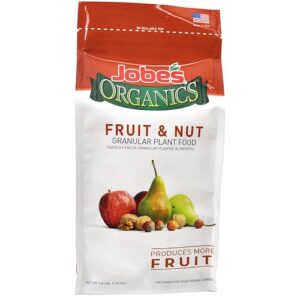
If your fruit trees look hungry, Jobe’s Organics Fruit Nut Granular Fertilizer feeds them right. This 4-pound bag delivers a 3-5-5 NPK ratio with Biozome microorganisms that speed up soil breakdown, so roots absorb nutrients faster.
It’s OMRI listed, meaning no synthetic chemicals touch your soil. Expect a slight chicken-manure smell and reapplication every 4-8 weeks during the growing season. For citrus, stone fruits, or nut trees crowded into tight urban plots, it’s a reliable, low-fuss starting point.
| Best For | Home gardeners with citrus, stone fruit, or nut trees who want an organic, low-fuss feeding routine during the growing season. |
|---|---|
| Form | Granular |
| NPK Ratio | 3-5-5 |
| Weight | 4 lbs |
| Target Plants | Fruit, citrus, nut |
| Reapplication Frequency | 4-8 weeks |
| Organic Certified | Yes, OMRI listed |
| Additional Features |
|
- OMRI listed for organic gardening, with no synthetic chemicals
- Boosts microorganism activity in soil for stronger root development
- Works across a wide range of fruit, citrus, and nut trees
- Gives off a slight odor similar to chicken manure
- Can spill or get messy during handling
- Needs reapplication every 4-8 weeks for best results
2. FoxFarm Liquid Trio Fertilizer Set
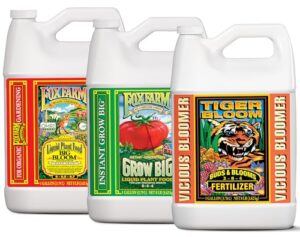
Granular feeding is only half the equation, and that’s where the FoxFarm Liquid Trio Fertilizer Set earns its shelf space. You get Big Bloom, Grow Big, and Tiger Bloom, each in 3-gallon bottles, greenhouse-tested since 1984 for consistency.
Grow Big pushes nitrogen for leafy growth; Tiger Bloom brings phosphorus and potassium for fruiting. Mix carefully, though. This concentrate demands precise dilution, and periodic flushing keeps salt buildup from souring your urban soil.
| Best For | Gardeners growing roses, tomatoes, houseplants, or vegetables who want a complete liquid feeding system for both indoor and outdoor plants. |
|---|---|
| Form | Liquid |
| NPK Ratio | Varies by stage |
| Weight | 3 gal (384 oz) |
| Target Plants | Roses, tomatoes, veggies |
| Reapplication Frequency | Periodic |
| Organic Certified | Not stated |
| Additional Features |
|
- Covers every growth stage, from vegetative growth to bud development and fruit production
- Greenhouse-tested formulation with a proven track record since 1984
- Low pH Tiger Bloom formula helps keep micronutrients stable and easy to mix
- Requires periodic flushing to prevent salt buildup in soil
- Concentrated formula means careful dilution is needed to avoid over-fertilization
- Price has climbed noticeably in recent years, which may affect long-term value
3. Fox Farm Big Bloom Liquid Plant Food
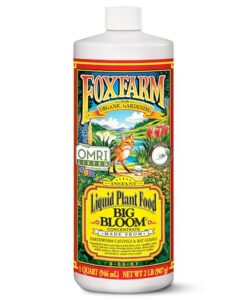
Buying Big Bloom on its own makes sense if you already own a nitrogen source and just need bloom support. Bat guano and earthworm castings drive that 0-0.5-0.7 ratio, feeding potassium for flowers and fruit set.
Norwegian kelp and rock phosphate round out the mix, and it’s OMRI Listed, so organic growers stay compliant. Water in at every feeding, no measuring headaches, no burn risk when you follow label dilution.
| Best For | Gardeners who already have a nitrogen fertilizer in rotation and want an organic, low-burn boost for flowering and fruiting plants. |
|---|---|
| Form | Liquid concentrate |
| NPK Ratio | 0-0.5-0.7 |
| Weight | 2 lbs |
| Target Plants | Fruits, veggies, ornamentals |
| Reapplication Frequency | Regular dilution use |
| Organic Certified | Natural ingredients |
| Additional Features |
|
- Natural nutrient sources (earthworm castings and bat guano) support healthy blooming and fruiting without burning plants
- Liquid concentrate mixes easily and absorbs quickly, working well with hose-end sprayers, siphon mixers, drip irrigation, or foliar spray
- Versatile for indoor houseplants, outdoor gardens, and greenhouses, and pairs well with other FoxFarm nutrients like Grow Big and Tiger Bloom
- Low nitrogen content means it can’t support vigorous vegetative growth on its own
- Requires dilution before every use, plus frequent shaking since natural ingredients tend to settle
- Costs more per volume than synthetic fertilizers and may attract deer or other wildlife due to its organic ingredients
4. Jobe’s Fruit Citrus Fertilizer Spikes 15 Count
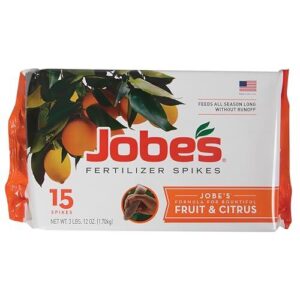
If liquid feeding sounds like too much fuss, spikes solve that problem fast. Jobe’s spikes carry an 8-11-11 ratio built from bone meal and feather meal, hammered into the dripline with no mixing or measuring.
Each spike doses itself, so overfeeding isn’t a worry, and the 15-count pack covers larger bearing trees through both spring and fall rounds. Sandy soil? Pre-drill a pilot hole first, or the spike may snap on you.
| Best For | Home gardeners who want a low-effort way to feed fruit, citrus, and nut trees without mixing or measuring liquid fertilizer. |
|---|---|
| Form | Spikes |
| NPK Ratio | 9-12-12 |
| Weight | 12 oz |
| Target Plants | Fruit, citrus, nut |
| Reapplication Frequency | Up to 6 months |
| Organic Certified | Not stated |
| Additional Features |
|
- Pre-measured spikes take the guesswork out of feeding and help prevent over-fertilization or runoff
- Slow-release formula feeds trees for up to 6 months, covering both spring and fall applications
- Simple to insert around the dripline, with rubber caps included to protect the spikes during hammering
- Sandy or compacted soil often requires a pre-drilled pilot hole, adding an extra step
- Spikes can still break during installation even with the rubber caps
- Results depend on the tree’s existing health and soil conditions, so outcomes can vary
5. Dr Earth Natural Wonder Fruit Tree Fertilizer
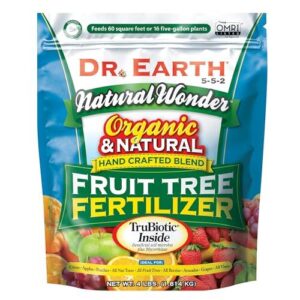
Feeding a tree biology, not just chemistry, is the whole idea behind Dr Earth’s 5-5-2 mix. TruBiotic microbes and mycorrhizae colonize roots and access nutrients already sitting in your soil, while feather meal, fish bone meal, and kelp release slowly all season.
It’s OMRI listed, so organic growers get a clean, non-GMO option safe for containers or in-ground beds. Dig it into the planting hole at transplant, then water it in — that’s what kicks the microbial activity into gear.
| Best For | home growers who want an organic, microbe-rich fertilizer for citrus, apples, peaches, nut trees, berries, grapes, and avocados, whether planting new trees or feeding established ones. |
|---|---|
| Form | Granules |
| NPK Ratio | 5-5-2 |
| Weight | 4.5 lbs |
| Target Plants | Fruit trees, berries, vines |
| Reapplication Frequency | Year-round top-dress |
| Organic Certified | Organic ingredients |
| Additional Features |
|
- TruBiotic beneficial microbes and mycorrhizae help roots access nutrients already present in the soil
- Slow-release organic ingredients like fish bone meal and kelp support season-long root and fruit development
- Versatile enough for transplanting or year-round top-dressing on established plants
- Can produce a temporary barnyard-like smell after application
- May attract small flies if not mixed into the soil properly
- Some users find they need more than the recommended amount to see noticeable results
6. Miracle Gro Citrus Avocado Mango Plant Food
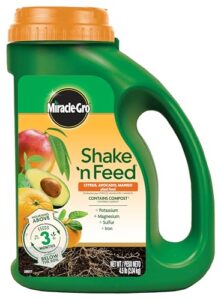
Six weeks is the feeding window here, and that slow-release nitrogen means less risk of burn between doses. Each bag covers roughly fourteen feedings on a standard 10-foot canopy, with magnesium, iron, and manganese baked in to fight chlorosis and keep enzyme activity humming for fruit set.
Work granules into the top few inches of soil, water thoroughly, and you’re set. It suits established in-ground trees and containers alike, making it a solid pick for growers who want yield without overthinking the schedule.
| Best For | This plant food is best for gardeners growing citrus, avocado, or mango trees, whether planted in-ground or in containers, who want an easy way to correct common nutrient deficiencies. |
|---|---|
| Form | Granules |
| NPK Ratio | Not specified |
| Weight | 4.5 lbs |
| Target Plants | Citrus, avocado, mango |
| Reapplication Frequency | Every 3 months |
| Organic Certified | Not stated |
| Additional Features |
|
- Feeds trees for up to 3 months with a slow-release granule formula
- Delivers key micronutrients—potassium, magnesium, sulfur, and iron—to support root strength and fruit development
- Works equally well for indoor and outdoor, container or in-ground planting
- Must be reapplied every 3 months to maintain effectiveness
- Needs careful application, since contact with trunks and foliage should be avoided
- Some users have found the container lid difficult to open
7. Jobe’s Organics Fruit Citrus Granular Fertilizer
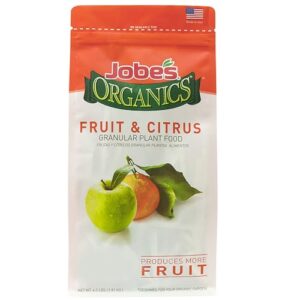
When you’d rather feed your soil than fight it, this 4-pound bag earns its spot. The 3-5-5 NPK ratio plus Biozome microorganisms breaks down organic matter fast, feeding roots naturally instead of forcing growth.
It’s OMRI listed rather than USDA organic certified, so pair it with natural pest control methods that skip harsh chemicals for a truly gentle garden routine.
It’s OMRI listed, pet-safe, and works on lemon, lime, peach, and calamansi alike. Expect a strong manure-like smell for a day or two.
Reapply every 4-8 weeks, work it into topsoil, and water in for healthier root systems without synthetic chemicals.
| Best For | Gardeners who grow lemon, lime, peach, or calamansi and want an organic, chemical-free way to feed roots and boost fruit yield. |
|---|---|
| Form | Granules |
| NPK Ratio | 3-5-5 |
| Weight | 4 lbs |
| Target Plants | Fruit, citrus plants |
| Reapplication Frequency | 4-8 weeks |
| Organic Certified | Yes, OMRI listed |
| Additional Features |
|
- OMRI listed and free of synthetic chemicals, so it’s safe for organic gardening
- Safe to use around kids and pets when applied as directed
- 3-5-5 NPK ratio supports strong roots, seed development, and healthier soil
- Strong manure-like odor during and shortly after application
- Can attract flies or other pests if not worked into the soil properly
- Needs reapplication every 4-8 weeks during the growing season to keep results going
Match Fertilizer to Your Urban Tree
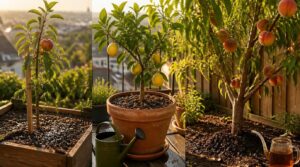
Grabbing any fertilizer off the shelf won’t cut it once you factor in what your tree actually needs. A young apple sapling, a potted lemon tree, and a mature peach tree in the ground each want something different from their feeding schedule. Here’s how to line up the right fertilizer with your specific tree and growing setup.
Young Versus Bearing Trees
A young tree and a bearing tree are basically running different businesses. Young trees pour energy into root and shoot development, so they need higher nitrogen for canopy building.
Bearing trees shift priorities toward flower bud formation and fruit production, favoring potassium-rich blends like 5-10-10. Too much nitrogen on a bearing tree means lush leaves, disappointing harvests.
In-Ground Versus Container Trees
Roots tell the real story here. In-ground trees stretch deep, tapping steady moisture and diverse soil nutrients, while container roots stay boxed in, drying fast and demanding frequent feeding.
Pots swing wildly in temperature; ground soil stays buffered. That’s why containers need slow-release fertilizer and consistent drip line application, while in-ground trees reward you with decades of stable, long-term growth. Understanding temperature control benefits is important for the health of trees in varying environments.
Citrus, Mango, and Avocado
Citrus, mango, and avocado aren’t apple trees in disguise—each demands its own playbook. Citrus wants soil pH near 6.0-6.5; mango flowering hinges on dry-season triggers; avocado ripens off-tree, so root health matters more than fruit-day feeding.
- Citrus: balanced NPK, iron correction
- Mango: balanced feeding, no nitrogen excess
- Avocado: organic matter, container root management
- All three: slow-release or liquid fertilizer works
Apple, Pear, and Stone Fruits
Apples, pears, and stone fruits play by cool-climate rules, unlike their tropical cousins.
Bearing apples and pears want 5-10-10 or 8-8-8 for fruit quality, while stone fruits need Epsom salt (1 tbsp/9 sq ft) for magnesium.
Cap nitrogen at 1 lb yearly for dwarf trees—overfeeding sacrifices flower buds for leaves.
Prune annually, watch for pests, and adjust soil pH for luscious harvests.
Available Space and Tree Size
Feeding matters less if your tree can’t physically grow into its roots. Tree pits offer only a few cubic feet, capping mature size unless you deepen the soil.
Match rootstock to space:
- Tight pits: dwarf, 6–10 ft
- Planting strips: semi-dwarf, 12–20 ft
- Open yards: standard, 25+ ft
Choose a compact growth habit before you choose fertilizer.
Choose The Right NPK Ratio
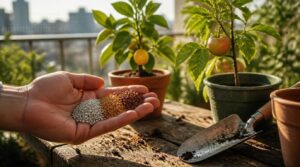
Those three numbers on every fertilizer bag aren’t random, and getting them right makes the difference between a tree that sulks and one that thrives.
Your ideal ratio shifts depending on whether you’re growing a young sapling, a bearing apple tree, or a container citrus fighting alkaline tap water.
Here’s how to read the numbers and match them to what your tree actually needs right now.
Nitrogen for Young Trees
Think of nitrogen as the construction crew for a young tree—it builds canopy and roots before fruit ever matters.
Cap dwarf trees at 1 pound yearly; excess nitrogen sacrifices flower buds for leafy growth.
Leaf tissue near 20-22 g/kg confirms proper dosing.
Choose slow-release organic blends timed to spring uptake, supporting root development without disrupting phosphorus-potassium balance.
Potassium for Better Fruiting
Once your tree’s framework is built, potassium takes over as the nutrient that fills out fruit quality and sweetness. It drives sugar transport, strengthens cell walls for firmer fruit, and boosts drought tolerance.
For bearing apples and pears, switch to 5-10-10 or 8-8-8 blends—this shift helps fruit set, color, and size right when your tree needs it most.
Phosphorus and Root Growth
Below the surface, phosphorus quietly rewrites your tree’s root architecture—triggering lateral root formation and root hair proliferation so roots forage more soil.
- Deficiency slows primary elongation
- Roots branch toward topsoil
- Mycorrhizal associations extend reach
- Uptake transporters ramp up
- Root biomass strengthens overall
Apply phosphorus-rich organic or slow-release fertilizer via root zone application—roots can’t chase what they can’t reach.
Balanced Fertilizer During Establishment
Getting a new tree through its first couple years is about equal parts nitrogen, phosphorus, and potassium—balanced fertilizer builds root development without pushing lopsided growth.
| Ratio | Purpose | Timing |
|---|---|---|
| 10-10-10 | Establishment | Every 6-8 weeks |
| Banded | 2-4" from trunk | Split applications |
| Watered-in | Nutrient movement | After each feeding |
Pair with a soil test for organic fertilizer accuracy.
When 10-10-10 Works
Six situations call for straight 10-10-10: young trees still building scaffold branches, in-ground plantings without a soil test, spring growth boost before bud break, mixed urban orchards needing one simple product, root zone feeding during establishment, and container trees fed at quarter strength.
Skip it once bearing trees need fruit set support—that’s when potassium-heavy blends take over for balanced nutrient uptake.
Compare Organic and Synthetic Fertilizers
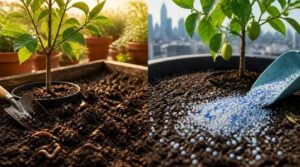
Organic and synthetic fertilizers both feed your fruit trees, but they go about it in pretty different ways. Your choice affects everything from soil biology to how fast your tree responds, so it’s worth knowing the tradeoffs before you buy.
Here’s what actually separates the two camps and where each one earns its keep in your urban garden.
Soil Health and Microbes
Underneath every luscious apple or peach is a thriving underground workforce.
Organic fertilizers feed beneficial microorganisms, boosting microbial biomass carbon and soil respiration rates. Nitrogen fixing microbes and phosphorus-solubilizing microbes free up nutrients naturally, while compost tea inoculates roots with life.
Synthetic blends skip this step entirely—so if lasting soil health matters to you, organic feeding builds richer, more resilient urban soil.
Mycorrhizal Fungi Benefits
Think of mycorrhizae as your tree’s underground trading partners. These beneficial fungi extend root systems, boosting phosphorus uptake by up to 50% while pulling in zinc and copper roots alone can’t reach.
They improve water absorption during dry spells, activate disease defense pathways, and build soil structure through glomalin. The payoff? Stronger root development and better fruit quality season after season.
OMRI Certification Standards
That little seal on the bag isn’t decoration—it’s proof. OMRI Listed means an independent nonprofit reviewed the ingredients against NOS standards before your organic fertilizer ever hit shelves.
Manufacturers submit ingredient lists, get evaluated, then face annual renewal to stay listed. USDA oversight keeps the whole process honest, so when you buy OMRI-certified, you’re feeding urban soil without the guesswork.
Immediate Versus Gradual Feeding
Certification tells you what’s inside, but timing tells you when your tree actually gets fed. Liquid fertilizer delivers nitrogen fast for quick shoot development, while slow-release fertilizer and fertilizer spikes feed roots gradually, reducing soil salinity spikes.
Match release rate to fruit set demands and root growth patterns—foliar feeding bridges gaps when trees need an immediate boost between organic fertilizer applications.
Environmental Safety Considerations
Feeding your tree right also means protecting the block it grows on. Choose slow-release formulations to cut runoff during rain events, skip application near storm drains, and time feedings away from peak bloom to shield pollinators. Store bags sealed to prevent leaching into groundwater.
Balanced NPK ratios support soil health and mycorrhizal networks—sustainable, ecofriendly gardening that keeps your urban water supply clean.
Liquid, Granular, or Fertilizer Spikes?
The form your fertilizer comes in matters just as much as what’s in it. Liquids, granules, and spikes each feed your tree on a different schedule, and your space, your patience, and your tree’s needs all play a part in picking the right one. Here’s how these three formats stack up.
Fast-Acting Liquid Fertilizers
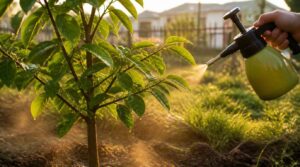
When your tree needs help now, not next month, liquid fertilizer delivers rapid nutrient uptake through roots and leaves alike. Foliar application puts nitrogen to work within 24 to 72 hours, fueling quick fruit development during flowering.
Apply along the drip line during morning application timing, when cooler temps slow evaporation. Surfactant-enhanced coverage spreads nutrients evenly across foliage for fast-release results.
Slow-Release Granular Formulas
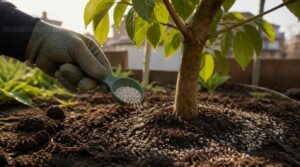
Speed’s great when you need it, but patience wins for long-term root development. Slow-release granular formulas use biodegradable polymer blends and controlled pore design to meter nitrogen over 8-16 weeks.
Why it works:
- Coating erodes gradually
- Environmental factors influence timing
- Feeds soil health steadily
- Organic fertilizer options reduce runoff
Perfect for busy urban gardeners tending fruit trees.
Convenient Fertilizer Spikes
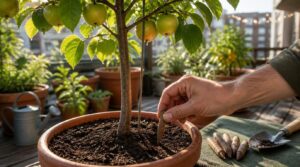
No mixing, no mess, no guesswork—just push and go. Fertilizer spikes like Jobes Organics 9227 deliver pre-measured NPK straight to the root zone, with slow nutrient release rate cutting burn risk.
| Spike Benefit | Urban Payoff |
|---|---|
| Pre-measured dosing | No mixing errors |
| Slow release | Prevents salt buildup |
| Compact storage | Saves shed space |
| Root-zone targeting | Faster uptake |
Perfect urban space benefits for tight-plot fruit trees.
Continuous-Release Feeding Technologies
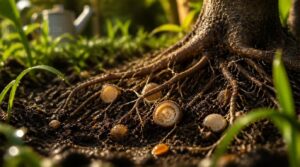
Since polymer coatings hydrolyze gradually, they release nutrients on a curve, not a dump. That’s continuous-release fertilizer science: matrix systems degrade predictably, warmer soil speeds delivery, moisture regulates flow.
Three wins for urban garden care:
- Steady fruit tree nutrition for months
- Root zone targeting near the drip line
- Reduced runoff versus single feedings
Slow nutrient release keeps roots fed without the guesswork.
Best Forms for Small Spaces
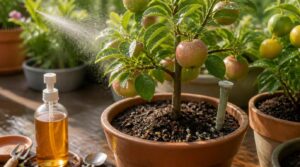
When patio space is tight, match the form to your routine.
Liquid vs granular options comes down to speed versus convenience: liquid fertilizer feeds fast through irrigation, while slow-release granules stretch feeding to every 2-4 months. Spikes for container trees keep dosing simple near the drip line. Foliar sprays add targeted, space-saving nutrition when soil room runs short.
Support Roots, Soil, and Fruit Quality
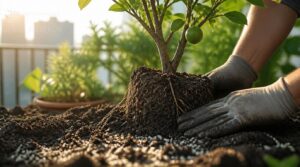
A good fertilizer does more than feed leaves; it builds the tree from the ground up. Your root systems, your soil, and your harvest all benefit when you get the nutrient mix right. Here’s what that support actually looks like in practice.
Stronger Urban Root Systems
Roots run the show. Feed them right and your fertilizer’s nutrients actually reach fine root hairs that drive root system strength and Deep Root Growth.
Good fertilizing habits support:
- Lateral Root Development in shallow urban pockets
- Root Zone Aeration for oxygen-hungry roots
- Organic matter decomposition that builds soil health
That’s real anchorage against wind, drought, and sidewalk stress.
Improved Soil Structure
Good fertilizer doesn’t just feed your tree, it feeds the soil web that holds everything together. Organic matter decomposition triggers microbial glue formation, gluing mineral particles into stable clumps.
That’s soil aggregation stability at work: better macropore development, stronger texture improvement, and humic acid buildup from active soil microbes. Your urban soil goes from compacted to crumbly, resilient, and alive.
Better Fruit Flavor
Ever bite into a store-bought peach that tastes like wet cardboard? That’s a sugar acid balance gone wrong.
A cardboard-flavored peach is just a sugar acid balance gone wrong
Steady fertilization fuels sugar transport for real sweetness, while proper nutrition builds:
- Aroma compound boost
- Ripeness timing accuracy
- Flavor stability post-harvest
- Cultivar aroma profiles
- Balanced soil pH
Feed roots right, and your urban orchard delivers genuinely luscious, aromatic fruit flavor.
Enhanced Color and Fragrance
Sweetness sells the bite, but color and scent close the deal at the farmers market. Boron and potassium drive Color Intensity Boost, deepening anthocyanins for richer reds and purples.
| Nutrient | Effect |
|---|---|
| Boron | Pigment uniformity |
| Potassium | Color stability |
| Ethylene | Faster ripening aroma |
| Terpenes | Fragrance complexity |
| Cold storage | Scent preservation |
Fragrance Compound Teamwork creates true pigment-volatile balance in your urban orchard.
Late-Season Fruiting Support
Once color sets in, don’t ease off the fertilizer schedule. Late-Season Fruiting Support means shifting toward potassium-heavy blends for Sugar Accumulation Support and Fruit Firmness Maintenance as harvest nears.
- Boost potassium for sugar concentration
- Add magnesium sulfate for leaf vigor
- Spray calcium for firmer rinds
- Include zinc for Color Development Boost
This late bloom nutrition keeps fruit production strong right through your final urban harvest.
Fertilize Containers Without Salt Buildup
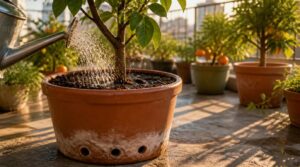
Container trees play by different rules than their in-ground cousins, and salt buildup is the price you pay for ignoring that.
Potting mix drains fast, nutrients wash out even faster, and your feeding routine has to keep pace or your tree pays for it.
Here’s what that routine actually looks like, step by step.
Frequent Container Feeding
Container roots live in a tiny fraction of the soil an in-ground tree enjoys, so nutrients vanish fast.
Frequent container feeding—every 1 to 2 weeks in active season—keeps root zones fed without overwhelming them. Pair each dose with a thorough watering to spread nutrients evenly.
Skip feeding once dormancy hits; frozen or inactive roots simply can’t absorb what you’re offering.
Quarter-Strength Liquid Applications
Frequent feeding only works if you cut the strength way down. Quarter-strength liquid applications—about a quarter of the label’s rate—deliver steady nutrient absorption through leaves and roots without dumping salts into cramped potting mix.
Mix a balanced 10-10-10 liquid fertilizer, water first, then feed every 2 to 4 weeks. This keeps root zone feeding gentle, helps nitrogen balance, and protects dilution safety during active growth.
Controlled-Release Fertilizer Beads
Think of beads as tiny time-release capsules for your urban garden: pick ones rated 3-4 months, work them into the root zone at planting, and let coating thickness do the rest.
Warmer soil speeds diffusion, cooler soil slows it—temperature sensitivity means release timing shifts seasonally.
This steady drip prevents salt buildup better than any liquid schedule ever could.
Monthly Soil Flushing
Once a month, run plain water through every pot until it drains freely from the bottom—that’s your flushing cycle, and it drives the salt leaching process that keeps roots breathing.
Poor drainage undermines the whole effort, so check your pots first.
Afterward, replenish nutrients with a light feeding, since flushing washes out the good with the bad and prevents overfertilization.
Alkaline Tap Water Problems
If your tap water tests above 8.5 pH, your citrus is fighting soil pH balance issues, not nutrient shortage. Alkaline water triggers nutrient lockup, blocking iron and causing chlorosis. Treat leaves with chelated EDDHA foliar application.
That same water scales water heaters, corrodes plumbing, and builds appliance limescale—signs worth testing before it stunts your harvest too.
Time Applications for Healthy Growth
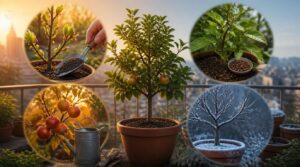
Timing your feedings matters just as much as picking the right fertilizer mix. Your fruit trees follow a seasonal rhythm, and feeding at the wrong moment can undo all your hard work. Here’s how to time every application for strong, healthy growth all year long.
Feeding Before Spring Bud Break
Timing is everything with fruit trees, and pre-bud fertilizer timing sets the whole season’s tone.
Apply 2 to 4 weeks before bud swell, favoring phosphorus and potassium over nitrogen for root strength and fruit set.
Check soil temperature first—below 40°F, roots can’t absorb nutrients.
Water in thoroughly afterward, and skip winter feeding altogether; dormant roots simply won’t use it.
Quarterly Young-Tree Applications
A young tree’s roots grow fast, so its diet needs to keep pace. Quarterly applications align feeding with each growth spurt, delivering frequent light feeding instead of one heavy dose.
Use balanced 10-10-10 blends for root zone nutrition and soil structure improvement. Time doses to spring and midsummer seasonal timing windows—the sweet spots for young tree fertilization in any urban garden.
Avoiding Late-Summer Nitrogen
Here’s a hard stop worth marking on your calendar: cut nitrogen after August 1st.
Late-summer nitrogen forces soft, tender growth that winter freezes punish hard, and it stalls sugar development in citrus, mango, and stone fruits alike.
Check leaf color and soil nitrate levels first—if vigor’s still high, skip feeding. Switch to slow-release, low-N formulas if your urban garden truly needs a boost.
Low-Nitrogen Fall Feeding
So once August’s nitrogen ban is settled, shift gears: early fall is prime time for a Low-Nitrogen Fall Feeding push.
A light, quick-release dose kickstarts root activity while soil’s still warm, banking carbohydrates for spring instead of pushing leaves.
Pair it with a Slow Release Fertilizer or Organic Fertilizer leaning potassium-heavy, and you’re setting up real winter hardiness prep.
Winter Dormancy Fertilizer Pause
Once true dormancy hits, put the fertilizer bag away entirely. Roots stop pulling nutrients, so feeding now just risks salt burn and hurts microbial activity conservation.
Your seasonal feeding guide should include:
- Watch soil temps, not the calendar
- Skip fertilizer near freezing soil
- Trust root dormancy support
- Prevent frost damage from new growth
- Resume at bud break for spring restart timing
Correct PH and Micronutrient Deficiencies
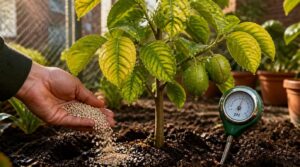
Urban soil throws curveballs your fruit trees can’t handle alone, especially when alkaline tap water and tight root zones limit what nutrients actually reach the leaves.
Yellowing between veins, stunted buds, and cracked fruit all point back to specific deficiencies you can pinpoint and fix.
Here’s how to read those warning signs and give your trees exactly what they’re missing.
Correcting Iron Chlorosis
Pale leaves with green veins mean your soil’s locking up iron, not lacking it—classic alkaline soil trouble.
Fight back with chelated iron drenches, a light soil pH adjustment using elemental sulfur, or trunk iron injection for stubborn cases.
Foliar spray treatments green things up fast, but pair them with soil correction for lasting results.
Managing Zinc and Manganese
Iron’s not the only troublemaker in alkaline soil—zinc and manganese deficiencies often ride shotgun.
Zinc deficiency shows up as stunted, pale new growth; manganese chlorosis mimics iron trouble but improves with lower soil pH instead.
Watch micronutrient antagonism: too much zinc blocks manganese uptake. Foliar-spray both in cool spring mornings, and feed container trees monthly—tight root zones burn through micronutrients fast.
Preventing Boron Deficiency
Boron gets overlooked because trees need only trace amounts, but skimping causes misshapen fruit and corky flesh in apples and pomegranates.
Boron soil testing catches trouble before symptoms show. Keep pH in range—alkaline soil locks boron up.
Use split boron applications timed to bloom, and lean on foliar boron spray during fruit set for fast correction without overdoing it.
Supplying Magnesium Safely
Peach and citrus leaves turning pale between the veins? That’s classic magnesium hunger. Epsom salt at 1 tablespoon per 9 square feet fixes chlorophyll production fast.
- Pair with slow release fertilizer
- Watch soil pH
- Space doses from calcium
- Skip if kidney issues exist
Keep supplemental magnesium modest—your tree’s roots, not a pharmacy, dictate safe daily amounts.
Prevent Fertilizer Burn and Runoff
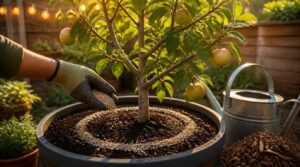
More fertilizer isn’t always better, and in tight urban yards, a heavy hand can scorch roots or send nutrients straight into the storm drain. Getting the timing, placement, and amount right protects your tree and keeps your little patch of city soil healthy too.
Here’s exactly how to feed your trees without the burn or the waste.
Measure Tree-Specific Dosages
Guessing at dosage is how burned roots happen. Use tree height dosing (grams per meter) for young trees, or switch to DBH adjustments—grams per centimeter of trunk diameter—once trees mature.
Factor in soil type, since sandy soil demands higher doses than loam. Container trees need their own scaled-down math.
Always follow up with post-application monitoring, checking leaf color two weeks out.
Keep Fertilizer From Trunks
Think of the trunk as a tree’s skin—fertilizer touching it is like salt rubbed into a cut. Keep granules 12 inches away, feeding only the root zone toward the drip line where feeder roots actually work.
Sweep stray granules off bark immediately. Choose slow-release fertilizer near the base, and save liquid or foliar application for spots that won’t pool against the trunk.
Water Before and After
A dry root zone drinks up fertilizer salts like a sponge, so water first to dilute them and prevent burn. Afterward, water again—this salt dilution technique drives nutrients down to feeder roots for real absorption.
A slow, steady pour beats a quick splash: it stops runoff, keeps distribution even, and skips the trunk entirely.
Avoid Overfeeding Dwarf Trees
More isn’t better with dwarf trees—it’s just an invitation for leaf scorch and weak fruit set. Watch for dark green leaves with burnt edges; that’s your nutrient imbalance signal to back off.
Start every first application at half the label’s dwarf tree dosage. In pots, pair a slow-release fertilizer with regular checks to dodge salt buildup before it damages roots.
Minimize Urban Nutrient Runoff
Backing off dosage protects roots, but what happens downstream matters too. Mulch mats catch nutrient runoff before storms wash it toward drains, while bioswales and rain gardens near tree pits filter what escapes.
Soil testing accuracy keeps you from overapplying in the first place. Choose slow-release fertilizer over fast-release synthetics, and consider permeable paving nearby—sustainable agriculture starts with what stays in your home orchard’s soil.
Frequently Asked Questions (FAQs)
What is the best all-around fertilizer for fruit trees?
Picture a backyard heavy with ripening fruit, roots thriving in rich soil. Your best bet blends a balanced NPK ratio with micronutrients and soil biology support in one slow-release formula built for urban conditions.
What is poor man’s fertilizer?
Poor man’s fertilizer" is old garden slang for snow melt nitrogen—free winter moisture feeding soil.
Pair it with compost kitchen scraps, aged manure, seaweed foliar spray, or lake plain mulch to boost microbial activity and soil health regeneration cheaply.
What month should you fertilize fruit trees?
Say your balcony espalier apple sat untouched last April—by June it sulked, fruitless. Spring bud break is your window: feed then, follow with a light early summer feed, then stop nitrogen by July for solid application timing.
Is 10-10-10 a good fertilizer for fruit trees?
Yes, when your soil tests deficient. 10-10-10 delivers equal NPK for balanced vegetative and fruiting growth. Apply lightly, early spring, at 5–1 lb per tree, watering thoroughly to prevent burn and salt buildup near roots.
How often should I fertilize a young urban fruit tree?
Think of your young tree like a toddler at the table: small, frequent meals beat one big feast. Follow a quarterly feeding schedule, using slow-release fertilizer for balanced nutrition, pausing completely once winter dormancy sets in.
Can I use regular garden fertilizer on fruit trees?
A balanced 10-10-10 works fine if your soil test confirms it. Match the NPK ratio to your tree’s stage, spread evenly to the drip line, and skip high-nitrogen blends after midsummer to avoid frost-damaged growth.
Whats the best fertilizer for a small city yard?
For tight lots, Jobe’s Organics Fruit Nut Granular Fertilizer wins best overall—slow-release, microbe-enhanced, and gentle on container root space.
Dr Earth Fruit Tree Fertilizer and EarthPods Fruit and Citrus Plant Food work well too, guarding against salt buildup while balancing urban soil pH.
How do I know if Im overfertilizing my tree?
Crispy brown leaf margins and curled tips are your first warning flare. Watch for leaf burn symptoms, wilting despite watering, and stunted roots—classic overfertilization clues signaling salt buildup. A quick soil test confirms it before damage spreads.
Conclusion
Right fertilizer, right timing, right tree—that’s the formula that turns a cramped sidewalk pit into a fruit-producing powerhouse.
The best fruit tree fertilizers for urban gardens won’t fix bad soil overnight, but they’ll feed roots, build sugar, and coax blooms out of trees that have every excuse to sulk.
Your citrus doesn’t care about your square footage. Feed it right, water it smart, and watch a 3-foot pit outproduce your grandfather’s whole orchard.