
This site is supported by our readers. We may earn a commission, at no cost to you, if you purchase through links.
Drop a tomato seed into 50°F soil and it’ll sit there, stubborn and silent, for weeks—maybe longer. Warm that same soil to 75°F, and germination often kicks off within days. That gap isn’t luck; it’s biochemistry, governed by enzymes, hormones, and cellular water uptake that only switch on within precise thermal windows.
Understanding seed germination temperature requirements separates gardeners who fight their soil from those who work with it. Every species carries its own cardinal range—a minimum, optimum, and maximum threshold shaped by its native habitat.
Get the numbers right, and you’ll turn guesswork into predictable, uniform emergence.
Table Of Contents
- Key Takeaways
- Why Temperature Controls Seed Germination
- Optimal Seed Germination Temperature Ranges
- Crop-Specific Germination Temperature Requirements
- How Temperature Extremes Affect Seeds
- Managing Temperature for Reliable Germination
- Frequently Asked Questions (FAQs)
- What temperature kills germination?
- How hot is too hot for seed germination?
- How cold is too cold for seeds to germinate?
- Will seeds germinate in 100 degree weather?
- Can I scarify seed coats to speed up germination?
- Is it safe to pre-soak seeds before planting?
- Which seeds should never be soaked before sowing?
- How long should seeds stratify before spring planting?
- Conclusion
Key Takeaways
- Every seed has its own cardinal temperature range (minimum, optimum, maximum), and hitting the optimum—usually 65–75°F for most vegetables—gives you the fastest, most uniform germination.
- Temperature drives the biochemistry directly: warmth speeds up enzyme activity and shifts hormone balance (gibberellins up, ABA down), while cold stalls the process and extreme heat denatures proteins and kills seeds outright.
- Soil temperature matters far more than air temperature, so checking soil at planting depth with a real thermometer beats guessing based on the calendar or the weather forecast.
- Tools like mulch, heat mats, and cold stratification let you actively manage soil temperature and stability, which improves germination success even more than simply cranking up the heat.
Why Temperature Controls Seed Germination

Temperature isn’t just a background factor in germination—it’s the switch that flips seeds from dormant to active. Every seed you plant is running on an internal clock governed by heat, from the enzymes that wake it up to the hormones that decide when it’s safe to grow.
If you’re gardening somewhere winters linger, understanding your soil’s temperature threshold makes all the difference, and this guide to spring gardening in cold climates breaks down exactly when to start.
Temperature is the switch that flips a seed from dormant to active, running its internal clock from wake-up enzymes to growth hormones
Here’s what’s actually happening beneath the soil surface, and why those numbers on your thermometer matter so much.
Seed Metabolism and Enzyme Activity
Warmth wakes a seed’s engine. Rising temperature accelerates enzyme activation pathways—amylases and proteases—driving glycolysis and respiratory energy production for radicle growth. Hormone-regulated metabolism shifts too: gibberellins climb, ABA falls.
Lipid mobilization releases fatty acids as carbon fuel, while amino acid synthesis builds proteins for new tissue. Below ideal ranges, these biochemical processes stall; germination simply waits.
The glyoxylate cycle function allows lipid-to-carbohydrate conversion in oilseeds during germination.
Imbibition and Water Uptake
Before enzymes fire up, seeds have to drink. Imbibition—the water absorption process—kicks off within minutes as the testa and micropyle soak up moisture, swelling cells and triggering cellular hydration effects.
Seed coat permeability decides the pace: thin coats imbibe fast, waxy ones lag. Warmth widens the water potential gradient, pulling moisture inward faster and setting up everything that follows.
Dormancy-regulating Plant Hormones
Once water floods in, hormones take over. Abscisic acid (ABA) keeps embryos dormant until warmth triggers its decline, letting gibberellins (GA) rise and override that repression.
Ethylene signaling speeds ABA breakdown; cytokinins fuel cell division; auxin shifts sensitivity. This hormone crosstalk, driven by temperature-dependent gene expression, decides exactly when dormancy breaking happens—and whether your seeds sprout on schedule.
Minimum, Optimum, Maximum Temperatures
Every seed obeys three cardinal limits: minimum, optimum, and maximum. Below minimum, growth halts; above maximum, proteins denature. The best zone—65–75°F for most vegetables—maximizes speed and vigor.
- Minimum: growth threshold
- Optimum: fastest, most uniform emergence
- Maximum: heat damage begins
- Range varies by species
- Temperature-dependent gene expression governs each shift
Soil Versus Air Temperature
Since air thermometers lie about what seeds actually feel, smart growers check the soil instead. Moisture acts as a heat buffer, so wet ground shifts slowly while dry soil spikes several degrees past air temperature.
A simple soil thermometer takes the guesswork out of timing, letting you match your planting schedule to the seasonal gardening tips for beginners instead of the calendar alone.
Mulch insulation slows both warming and cooling. Depth matters too: seeds at 5-10cm lag behind surface swings, so measure where you plant.
Optimal Seed Germination Temperature Ranges
Every seed has a temperature sweet spot, and knowing yours changes everything about your success rate. Vegetables split into distinct camps based on their native climates, each with its own ideal range. Here’s how those ranges break down, plus what happens when temperatures wander outside them.
Most Vegetables: 65–75°F
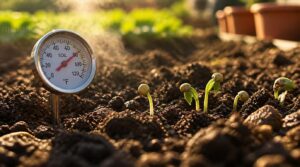
Sixty-five to seventy-five degrees Fahrenheit is the sweet spot for most vegetable seeds—period. Enzyme activity peaks, imbibition proceeds quickly, and radicles emerge on schedule.
Plant at proper seed depth, keep soil moisture steady, and germination uniformity improves dramatically.
Track soil temperature at planting depth rather than guessing; a $10 thermometer beats intuition every time you’re timing a spring sowing.
Cool-season Crops: 50–68°F
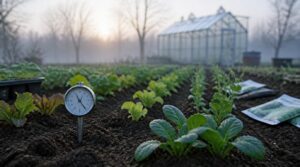
Lettuce, spinach, and peas thrive when soil sits between 50 and 68°F, favoring slower, gentler metabolic activation over brute heat. Push past 68°F and germination rate climbs briefly before uniformity collapses into patchy stands.
Early spring sowing rewards patience: monitor soil temp at planting depth, choose cold-tolerant varieties, and resist the urge to rush warm-season timing onto cool-season crops.
Warm-season Crops: 70–85°F
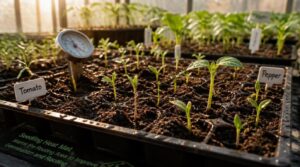
Tomatoes, peppers, cucumbers, and melons want it warm: 70–85°F soil drives peak germination rate. Near 80°F, temperature-dependent gene expression accelerates enzyme activity, cutting emergence time to 5–10 days. Seed vigor matters—fresh, high-quality seed germinates faster than old stock.
Beans and squash prefer 70–75°F; okra tolerates higher heat. Heat mats speed soil warming when spring soil lags behind these ideal ranges.
Temperature Stability and Fluctuations
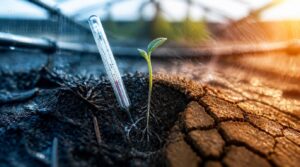
Hitting the right temperature isn’t enough—you need it to hold steady. Swings beyond 2–5°C disrupt thermal shock prevention, damaging membranes and stalling temperature-dependent gene expression.
Soil temperature buffering via mulch curbs diurnal fluctuation control issues; compacted, waterlogged beds swing harder. In greenhouse temperature control setups, consistency drives germination uniformity factors, making fluctuation impact assessment essential before trusting any seed batch’s timeline.
Germination Speed Versus Success
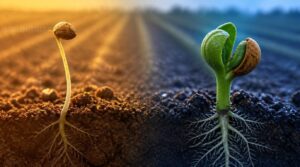
Fast isn’t always best. Warmer soil speeds germination speed, but ideal range benefits favor success rate over raw pace—cooler-tolerant seeds germinating slowly still reach higher final percentages.
- Warmth increases success via faster enzyme activity
- Gibberellins rise, boosting speed versus uniformity
- Extremes stretch lag time, hurting seed viability
- Steady moisture management prevents oxygen deprivation
- Stability beats speed for uniform stands
Crop-Specific Germination Temperature Requirements

Every crop carries its own temperature blueprint, shaped by where it evolved and how its seed coat behaves. Knowing these specifics turns guesswork into precision, letting you time each planting for maximum success. Here’s what the numbers look like, crop by crop.
Tomatoes, Peppers, and Eggplants
Nightshades crave warmth: tomatoes hit peak germination at 70–80°F, peppers need 75–85°F, and eggplants top the chart at 80–90°F. Below 65°F, emergence stalls badly.
Tomatoes sprout in 5–10 days, peppers in 7–14, eggplants in 7–12. Minor swings (5–10°F) won’t hurt, but consistent warmth—via heat mats or reflective mulch—drives faster, more uniform seedling emergence.
Lettuce, Spinach, and Peas
Cool-season crops flip the script entirely. Lettuce germinates best between 60–70°F, spinach favors 45–65°F to dodge bolting, and peas tolerate 45–70°F. Keep soil moisture consistent—crusting ruins emergence.
Temperature fluctuations beyond normal ranges stress seedlings, so stagger plantings every 10–14 days. Days under 75°F keep lettuce tender and peas podding well past first sprout.
Carrots, Parsnips, and Beets
Root crops share one demand: soil between 50–68°F for reliable germination. Carrots, parsnips, and beets all fall here, though warmer soil speeds emergence at the cost of woody texture.
Loose, well-drained ground prevents forking. Mulch stabilizes temperature swings during emergence, protecting germination rates when spring soil moisture fluctuates unpredictably.
Herbs and Annual Flowers
Beyond roots, herbs and flowers split into two camps. Basil germination favors 70–85°F, sprouting in 5–7 days; cilantro prefers 60–75°F but bolts past 85°F—watch that heat sensitivity. Zinnias want 70–75°F soil warmth for uniform stands; petunias and calendula settle for 65–70°F. Time herb planting and annual flower spacing around these ranges for sturdy, aromatic seedlings.
Direct-sown Versus Indoor Seeds
Sowing seed directly means the soil calls the shots: germination consistency indoors beats outdoor beds every time, since heat mats hold steady temperatures seed packets specify. That’s why tomatoes and peppers start in trays.
Direct sowing skips transplant shock entirely—no disturbed roots—while indoor starts need grow lights and monitoring to avoid legginess. Choose based on your crop’s minimum soil temperature and your tolerance for risk.
How Temperature Extremes Affect Seeds
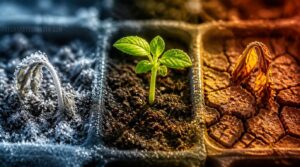
Every seed has a temperature comfort zone, and stepping outside it comes with consequences. Push too far in either direction—too cold or too hot—and germination doesn’t just slow down, it can stop altogether. Here’s what happens to your seeds when temperatures swing to extremes, and how to spot the trouble before it costs you a season.
How Cold Slows Germination
A seed sitting in cold soil isn’t dormant by choice—it’s stalled. Cold enzyme activity slows starch breakdown, water uptake delay stretches imbibition, and membrane stiffening blocks nutrient transport. Abscisic acid lingers, reinforcing hormonal dormancy instead of releasing it.
Since soil temperature often trails air temperature, seeds planted too early simply wait—sometimes for weeks—before conditions align with their ideal temperature range.
How Heat Damages Seeds
Where cold merely stalls a seed, heat actively injures it. Above the ideal temperature, protein denaturation unravels enzymes seeds need for germination, while membrane lipid peroxidation causes cell leakage and viability loss.
Amylase and respiratory enzymes lose function, starving embryos of energy. Heat also degrades antioxidant defenses, compounding oxidative damage—thermal regulation isn’t optional; it’s what keeps germination viable at all.
Temperatures That Stop Germination
Every species has hard boundaries—cross them and germination simply won’t happen. Below 32°F, freezing point inhibition locks seeds solid; above 100°F, thermal death point triggers irreversible heat denaturation effects. Between these critical temperature thresholds sits the germination failure range, where temperature-dependent gene expression shuts down entirely, regardless of moisture or soil quality.
Germinating Seeds in 100°F Weather
100°F doesn’t have to end your germination window. Soak seeds first to speed imbibition, then sow in shaded seedbeds to hold surface temps near 90°F.
Water deeply each morning, add mulch insulation, and check root-zone readings with soil temperature probes—not a heat mat—since heat tolerance varieties still need moisture management to establish.
Recognizing Temperature-stressed Seedlings
Your seedlings talk before they collapse—learn the dialect. Leaf curling and scorched margins signal heat stress; chlorosis under cold points to stalled chlorophyll production. Watch for necrotic tips, wilting despite moist soil, and compact canopy growth.
Catch these early, and hardening off (not a rushed heat mat fix) prevents transplant shock down the road.
Managing Temperature for Reliable Germination
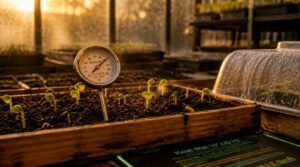
Knowing the ideal temperature range for your seeds is only half the job; you still have to hit that range in real soil, real trays, real weather. That takes a few practical tools and habits, not guesswork. Here’s what actually gets you there.
Measuring Soil Temperature Correctly
Numbers only matter if you trust them, so calibrate your probe first and insert it 2–4 inches deep with full soil contact.
Take morning readings at a fixed time, letting the probe stabilize 3–5 minutes.
Adjust for moisture—wet and dry soils skew results—and avoid readings right after rain or irrigation.
Using Seedling Heat Mats
A calibrated probe tells you the truth; a heat mat lets you act on it. Placed under trays with a thermostat set to 70–85°F, mats speed germination and stabilize root-zone warmth for indoor seed starting.
- Never run mats unplugged from a controller
- Keep cords dry
- Check moisture often
- Use waterproof mats
- Limit runtime to two weeks
Stabilizing Temperatures With Mulch
Where mats warm from below, mulch buffers from above—2 to 4 inches of straw or bark cuts soil swings by 2–5°F, cutting evaporation 25–50%.
| Material | Thickness | Effect |
|---|---|---|
| Straw | 2–3 in | Cools shoulder-season soil |
| Bark | 3–4 in | Long-lasting insulation |
| Compost | 2–4 in | Steady moisture release |
Keep mulch off stems to prevent rot.
Cold Stratification for Dormant Seeds
Mulch buffers what’s above ground; some seeds need winter itself to trigger germination.
Cold stratification exposes seeds to 34–41°F for 4–12 weeks, softening seed coats and shifting hormone balance—ABA drops, gibberellins rise. Mix seeds with damp sand, refrigerate, then sow warm. Match duration to species: trees need longer than annuals, and overdoing it can hurt seed viability.
Timing Sowing for Optimal Warmth
Every seed has a calendar written in soil degrees, not months. Skip the wall calendar; check dawn soil temperature for three straight days instead. For warm crops, wait for 60–65°F and nights above 50°F—that’s your weather-based planting window.
- Rake mulch back to warm soil
- Use low tunnels for early starts
- Harden off transplants gradually
Frequently Asked Questions (FAQs)
What temperature kills germination?
Sustained heat above 122°F (50°C) triggers protein denaturation and rapid seed viability loss; hydrated seeds absorb heat faster, hitting lethal thresholds sooner than dry ones.
Most vegetables stop germinating entirely once soil holds steady above 95°F (35°C).
How hot is too hot for seed germination?
Above 85°F (29°C), germination rates drop sharply.
Past 95°F (35°C), enzyme inactivation and protein denaturation kill embryo tissue outright—your heat tolerance limits get crossed, and soil overheating turns warm-season promise into outright germination failure.
How cold is too cold for seeds to germinate?
Below 5°C (41°F), imbibition in cold soil stalls and metabolic activation halts. Near freezing, ice risks rupturing seed coats. Cool-season tolerance bottoms out around 4°C; anything colder demands cold stratification before germination temperature F conditions turn favorable.
Will seeds germinate in 100 degree weather?
Like a telegraph line overheating in July: mostly not, and not well. Soil temps near 100°F trigger heat stress, water uptake issues, and seed viability loss—germination stalls, emergence turns uneven, and many vegetable seeds simply won’t sprout until conditions cool.
Can I scarify seed coats to speed up germination?
Yes: mechanical scarification—sanding or nicking—breaches hard seed coats, boosting permeability for water and oxygen. Chemical scarification works too, but demands care. Combine with proper moisture and temperature as pre-planting preparation for faster, more uniform germination.
Is it safe to pre-soak seeds before planting?
Think of soaking as a shortcut through a locked gate: it softens seed coat hardness, speeding water uptake. Safe if you control soaking duration limits (8–12 hours), use room-temperature water, and discard floaters before planting.
Which seeds should never be soaked before sowing?
Skip soaking delicate seeds like lettuce, pelleted coatings, and tiny seeds such as basil or dill. Light-requiring seeds and mucilaginous coatings like chia clump or lose seed coat permeability, disrupting dormancy cues and even sowing.
How long should seeds stratify before spring planting?
Winter doesn’t rush, and neither should you. Give most seeds 4 to 8 weeks of cold treatment near 34–41°F, checking species-specific guides—moisture stays moderate, never soggy, until you warm trays gradually for reliable spring planting.
Conclusion
Most gardeners assume warmer soil guarantees faster germination, but seeds reward precision, not excess. Push past a species’ maximum threshold and enzymes denature, imbibition stalls, and emergence collapses entirely.
Mastering seed germination temperature requirements means reading soil like a thermometer reads intent: patient below optimum, ruthless above it. Your thermometer becomes as essential as your trowel.
Get the range right, and soil stops resisting, becoming a quiet partner doing work you once forced by hand.