This site is supported by our readers. We may earn a commission, at no cost to you, if you purchase through links.

Your zucchini plants just dumped six pounds of squash on you, and your kitchen has exactly one countertop. Sound familiar? Apartment gardeners hit this wall every August — a bumper harvest, zero pantry space, and a pot too big for a two-burner stove.
Here’s the thing: you don’t need a farmhouse kitchen to can safely. You need the right garden canning supplies for apartment gardeners, sized and stacked to fit a 400-square-foot galley kitchen without taking over your life.
Grab your jars — let’s build a setup that actually fits where you live.
Table Of Contents
- Key Takeaways
- Top 10 Apartment Canning Supplies
- 1. Ball wide mouth glass mason jars
- 2. Mason Regular Mouth Canning Lids
- 3. Granite Ware Enamelware Water Bath Canning Kit
- 4. Ball Secure Grip Jar Lifter
- 5. PrepWorks Canning Funnel for Jars
- 6. Progressive International Canning Scoop Red
- 7. Aifeier ET canning tools kit
- 8. Stainless Steel Fine Mesh Strainer Set
- 9. Presto 01781 Pressure Canner and Cooker, 23 qt, Silver
- 10. Bonsenkitchen immersion hand blender
- Choose Apartment-Friendly Canning Methods
- Match Supplies to Garden Crops
- Save Space While Canning
- Buy Safely and Budget Wisely
- Frequently Asked Questions (FAQs)
- What is the 70 30 rule in gardening?
- What is the best canning kit for beginners?
- What is something every gardener needs?
- What is the 5 4 3 2 1 method for gardening?
- Can I can food using an induction stovetop apartment setup?
- How do weighted gauges differ from dial pressure gauges?
- Can fermentation crocks be used in tiny kitchens?
- Whats the difference between Weck jars and Ball jars?
- Conclusion
Key Takeaways
- Match your canning method to your food’s acidity: water bath or steam canning works for high-acid foods like jams and pickles, while low-acid vegetables and meats require pressure canning at 10-15 PSI to kill botulism spores.
- A compact core toolkit—jars, lids, a jar lifter, a funnel, and a properly sized pot—covers most apartment canning needs without requiring a full farmhouse setup.
- Space-saving strategies like stackable jars, vertical pantry shelving, and multi-use tools let apartment gardeners can efficiently even in kitchens under 400 square feet.
- Lid and equipment safety checks (fresh single-use lids, verified seals, calibrated gauges) are non-negotiable since improper sealing risks botulism contamination.
Top 10 Apartment Canning Supplies
You don’t need a basement or a barn to can your garden haul—you just need the right gear picked for a smaller footprint. Some tools handle the heavy lifting, others just make your life easier, and a few are non-negotiable for safety. Here’s the lineup worth clearing shelf space for.
Once your canning setup is sorted, keeping the harvest coming is just a matter of good timing—this guide to vegetable planting and care can help you plan what to grow next.
1. Ball wide mouth glass mason jars
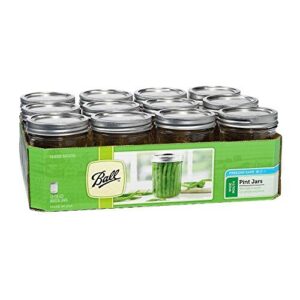
One jar does it all in a tight kitchen — that’s the case for Ball wide mouth glass mason jars. That 3.5-inch opening swallows whole tomatoes and chunky salsa without a fight, and cleaning’s a breeze since your brush reaches every corner.
They’re BPA-free, dishwasher safe, and made in the USA, running 16 or 32 ounces. Stackable, reusable, freezer-safe — perfect when counter space is basically nonexistent. Your grandkids won’t inherit these; you’ll wear them out first.
| Best For | Home cooks and crafters who want a reliable, made-in-the-USA glass jar for canning, meal prepping, or DIY projects. |
|---|---|
| Material | Glass |
| Dishwasher Safe | Yes |
| Primary Use | Canning/Storage |
| Weight | 5.6 lbs |
| Home Kitchen Use | Yes |
| Care Instructions | Dishwasher safe |
| Additional Features |
|
- BPA-free, food-grade glass that’s dishwasher safe for easy cleanup
- Comes with matching lids and bands for a complete, ready-to-use set
- Versatile enough for food storage, canning, décor, or gifting
- Glass construction means jars can break if dropped or mishandled
- Lids and bands are required for a proper airtight seal
- Listed dimensions are placeholder values, so actual jar size isn’t clearly specified
2. Mason Regular Mouth Canning Lids
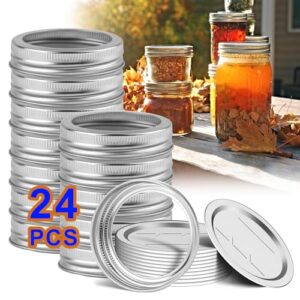
Those jars need a good lid, and this is where botulism risk gets real. These regular mouth lids use a semirigid sealing compound that compresses against the 2 3/8-inch rim, forming a true vacuum during processing.
They’re single-use for canning — no shortcuts here — though the metal rings can be reused if they’re not dented or rusted. Tinplate steel with a food-grade coating resists corrosion. Press the center after cooling; if it doesn’t flex, you’re sealed and safe.
| Best For | Home canners and DIY food preservers who want a reliable, airtight seal for jams, pickles, spices, and other pantry staples stored in regular mouth Mason jars. |
|---|---|
| Material | Stainless Steel |
| Dishwasher Safe | Not specified |
| Primary Use | Sealing Lids |
| Weight | 0.2 kg |
| Home Kitchen Use | Yes |
| Care Instructions | Sterilize before use |
| Additional Features |
|
- Food-grade silicone ring and semirigid sealing compound create a true, airtight vacuum seal for safe canning
- Rust-resistant stainless steel and tinplate construction stands up to repeated use without warping
- Generous 24-piece set (12 lids and rings) offers great value for frequent canning projects
- Lids are single-use for canning, so you’ll need to restock them regularly even though rings can be reused
- Fit can run tighter on Kerr jars compared to Ball jars, so double-check compatibility before buying
- Freezer safety isn’t guaranteed across all units, so cold storage carries some risk of warping
3. Granite Ware Enamelware Water Bath Canning Kit
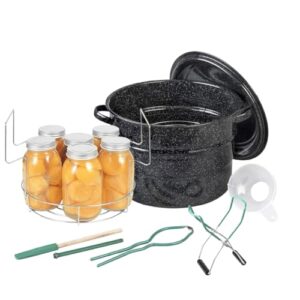
Once your lids are sealed and safe, you still need something to actually cook those jars in—and this 21.5-quart enamelware kit is basically canning-in-a-box for anyone short on cabinet space. It packs a rust-proof chromed rack, a five-piece toolset, and the pot itself, all nesting together for storage. Fits 7 quarts, 9 pints, or 12 half-pints.
One catch: skip the glass or induction stovetop. This kit needs gas or electric coils. Hand-wash it, dry it fast, and it’ll outlast your enthusiasm for pickles.
| Best For | Home canners and preserving beginners who want an all-in-one, space-saving kit for making jams, jellies, pickles, and blanched vegetables. |
|---|---|
| Material | Enameled Steel |
| Dishwasher Safe | No, hand wash |
| Primary Use | Water Bath Canning |
| Weight | 4 lbs |
| Home Kitchen Use | Yes |
| Care Instructions | Hand wash only |
| Additional Features |
|
- Complete kit with pot, rack, and five essential tools all nesting together for easy storage
- Rust-proof chromed rack fits 7 quarts, 9 pints, or 12 half-pints for flexible batch sizes
- Magnetic lid lifter makes hygienic, hands-free lid sterilization simple
- Won’t work on glass or induction cooktops—gas or electric coils only
- Requires hand washing and quick drying to prevent rust on the enamel and steel
- Built for water bath canning only, not suitable for pressure canning heavier vegetables
4. Ball Secure Grip Jar Lifter
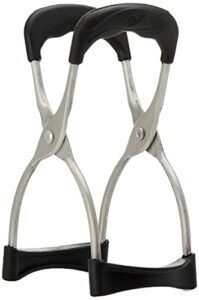
Pulling scalding jars out of that enamelware pot barehanded? Not happening. This is where the Ball Secure Grip Jar Lifter earns its drawer space.
The spring hinge pops open automatically after each lift, so your wrist isn’t doing extra work. Molded, textured grips cradle jars from half-pint to quart without slipping, and it works with regular or wide mouth jars alike. Stainless steel construction shrugs off boiling water and steam without warping.
Wash it, dry it, check that hinge—that’s the whole maintenance list.
| Best For | Home canners and kitchen cooks who need a safer, more secure way to lift hot jars out of boiling water without risking burns or drops. |
|---|---|
| Material | Stainless Steel |
| Dishwasher Safe | Not specified |
| Primary Use | Jar Handling |
| Weight | Not specified |
| Home Kitchen Use | Yes |
| Care Instructions | Manual gripping |
| Additional Features |
|
- Molded, textured grip holds regular-sized jars firmly, even when wet or hot
- Spring hinge mechanism opens automatically, cutting down on wrist strain
- Stainless steel build handles boiling water and steam without warping
- Only designed for regular sized jars, so it may not fit oversized options
- Still requires manual effort to position and grip each jar
- Spring hinge parts may need occasional checking to keep the action smooth
5. PrepWorks Canning Funnel for Jars
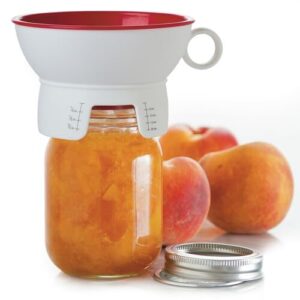
Ever eyeball a headspace gap and guess wrong? This funnel ends that guessing game.
With a proper canning funnel keeping headspace consistent, you’ll set up jars for success using these summer harvest preserving techniques every single time.
The double-wall design has an outer edge that rests on your counter while the inner wall sits right on the jar rim, so spills stay put. Built-in markings show headspace in both inches and millimeters—no separate ruler needed.
At 5 inches wide and 3 tall, it fits wide and regular mouth jars alike. High-heat polypropylene experiences hot jam without warping, and it’s dishwasher safe.
| Best For | Home canners and food preservers who want accurate, mess-free jar filling for both small batches and large-scale canning projects. |
|---|---|
| Material | PP Plastic |
| Dishwasher Safe | Not specified |
| Primary Use | Filling Jars |
| Weight | 0.29 lbs |
| Home Kitchen Use | Yes |
| Care Instructions | Wipe clean |
| Additional Features |
|
- Printed headspace measurements on the base eliminate the need for a separate ruler
- Fits both wide and regular mouth jars for versatile use
- Raised collar and outer edge design keep countertops clean and funnel elevated
- Made of plastic, which may have limits on high-heat exposure
- Only one funnel included per package
- Lightweight plastic construction may feel less durable than metal alternatives
6. Progressive International Canning Scoop Red
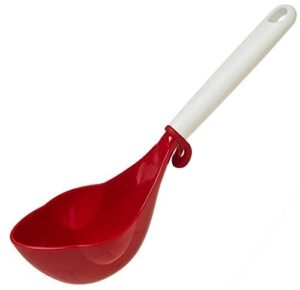
Digging sauce out of a deep pot’s corners with a regular spoon? Good luck.
This red scoop’s angled front edge hugs pot corners and scrapes bottoms clean, so nothing gets left behind. One scoop fills a half-pint jar—no more guessing, no more topping off. Dual-sided pouring means it doesn’t matter if you’re left or right-handed.
Nylon construction can take heat up to 400°F, and a built-in clip keeps it from sliding into your pot mid-stir. Dishwasher safe, too.
| Best For | Home cooks and canning enthusiasts who want precise half-pint jar fills and easy scraping when working with deep stock pots or sauces. |
|---|---|
| Material | Nylon Plastic |
| Dishwasher Safe | Yes |
| Primary Use | Scooping/Filling |
| Weight | 4.16 oz |
| Home Kitchen Use | Yes |
| Care Instructions | Dishwasher safe |
| Additional Features |
|
- Angled edge reaches corners and scrapes pot bottoms clean
- Fills a half-pint jar in a single scoop, taking the guesswork out of canning
- Works comfortably for both left- and right-handed users
- Only one scoop included per package
- Not heat-safe above 400°F
- Made of plastic rather than metal, which some users may prefer for durability
7. Aifeier ET canning tools kit
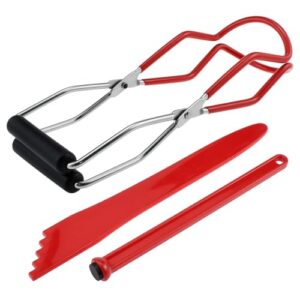
Three tools, one job: keep your hands off hot metal. This kit bundles a bubble popper, magnetic lid lifter, and stainless canning tongs—everything a beginner needs for small-batch jars.
The magnetic lid lifter grabs lids straight from boiling water, no fumbling required. Serrated tongs grip rings firmly, while the curved bubble popper reaches jar bottoms to release trapped air.
Stainless steel resists rust, grips are heat-coated, and everything’s dishwasher safe. Budget-friendly and drawer-sized—perfect for apartment shelves.
| Best For | This kit is best for home cooks and beginner canners who make small batches of jams, sauces, or preserves and want an affordable, easy-to-use set of tools. |
|---|---|
| Material | Plastic/Steel |
| Dishwasher Safe | Not specified |
| Primary Use | Canning Kit |
| Weight | Not specified |
| Home Kitchen Use | Yes |
| Care Instructions | Hand wash recommended |
| Additional Features |
|
- Magnetic lid lifter keeps hands and dust away from jar lids for safer, contamination-free handling
- Vinyl-coated jar lifter handle offers a secure grip while protecting hands from boiling-water heat
- Bubble popper helps remove trapped air, supporting a proper seal on your preserves
- Includes plastic components, which may feel less durable than an all-metal set
- Using the bubble popper can lower liquid levels, sometimes requiring you to top off jars afterward
- Built for home canning, so it’s not suited to heavy or industrial-scale preservation work
8. Stainless Steel Fine Mesh Strainer Set
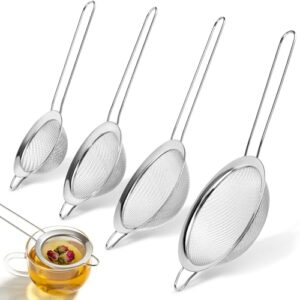
Skip the wobbly plastic strainer from your college days. A 304 stainless steel set—usually three sizes like 3.3", 5.5", and 8"—works for everything from clarifying jelly to rinsing quinoa.
Mesh openings run 70 to 140 microns, fine enough to catch pulp without slowing your flow. Welded joints mean no gaps, no tearing, and rolled edges keep things rigid.
Best part? They’re dishwasher safe and dry fast thanks to the open weave. No clogging, no rust, no drama.
| Best For | Home cooks who want one reliable strainer set for everything from sifting flour to rinsing rice to straining fresh juice. |
|---|---|
| Material | Stainless Steel |
| Dishwasher Safe | Yes |
| Primary Use | Straining/Sifting |
| Weight | Not specified |
| Home Kitchen Use | Yes |
| Care Instructions | Rinse or dishwasher |
| Additional Features |
|
- Durable 304 stainless steel construction that resists rust and won’t warp over time
- Four sizes (2.8" to 4.7") cover everything from fine sifting to straining larger batches
- Dishwasher safe with hanging loops, so cleanup and storage are both hassle-free
- Four separate pieces take up more storage space than a single all-in-one strainer
- Requires hand rinsing between uses if you’re not running the dishwasher right away
- Reinforced frame helps prevent food trapping, but tiny bits can still lodge in the fine mesh
9. Presto 01781 Pressure Canner and Cooker, 23 qt, Silver
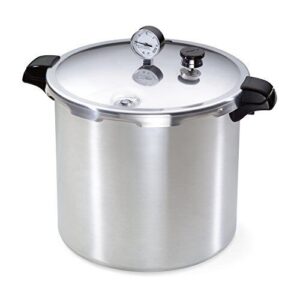
Green beans, carrots, chicken stock—if it’s low-acid, this pot is non-negotiable. The Presto 01781 hits 23 quarts, enough for 7 quarts or 20 pints in one load.
Its dial gauge tracks exact PSI, which is really important if your apartment sits above sea level. An overpressure plug and air vent lock keep things safe until pressure drops.
Aluminum construction heats evenly on any range, electric included. At 12 pounds, it’s manageable solo—no wrestling required for weeknight canning sessions.
| Best For | Home cooks and gardeners who preserve large batches of low-acid foods like meats, poultry, and vegetables and want one pot that also doubles as a water-bath canner and everyday pressure cooker. |
|---|---|
| Material | Aluminum |
| Dishwasher Safe | No, hand wash |
| Primary Use | Pressure Canning |
| Weight | 12 lbs |
| Home Kitchen Use | Yes |
| Care Instructions | Nonabrasive cleansers |
| Additional Features |
|
- Large 23-quart capacity fits 7 quarts, 20 pints, or 26 half-pints in a single load
- Precise dial gauge makes it easy to maintain safe pressure even at higher altitudes
- Safety features like the overpressure plug and air vent lock add peace of mind during use
- Lid can’t be submerged in water, so cleaning takes a bit more care
- Sealing ring needs to be removed and cleaned after every use
- Delicate dial gauge requires gentle handling to avoid damage
10. Bonsenkitchen immersion hand blender
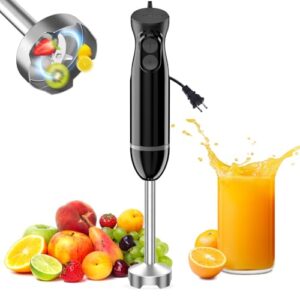
Once your jars are sealed and cooling, what turns garden gluts into actual meals? This 500-watt blender, with 20 speeds plus turbo, purees soups and sauces right in the pot. The stainless steel blade and detachable wand mean quick cleanup—no separate bowl to scrub.
It comes with a 24 oz beaker, chopping bowl, and whisk, so one gadget preps marinades, purees, and dressings before canning day even starts. Compact enough for tiny kitchens.
| Best For | Home cooks who want a compact, easy-to-clean tool for whipping up smoothies, soups, sauces, and baby food in small batches. |
|---|---|
| Material | Stainless Steel |
| Dishwasher Safe | Blades only |
| Primary Use | Blending |
| Weight | Not specified |
| Home Kitchen Use | Yes |
| Care Instructions | Do not immerse body |
| Additional Features |
|
- Two adjustable speeds make it easy to switch between light blending and tougher tasks
- Detachable design with dishwasher-safe blades keeps cleanup quick and simple
- Ergonomic handle offers comfortable, steady control during use
- Limited to under a minute of continuous use before needing a break
- Not built for hard, frozen, or fibrous ingredients like ice or whole spices
- Handheld body can’t be submerged in water, so it needs careful hand-washing
Choose Apartment-Friendly Canning Methods
Not every canning method fits a tiny kitchen, and that’s okay—you just need to know which ones do. Some need serious counter space and hours of babysitting a pot, while others work fine on a single apartment burner. Here’s how to match your space to the right method.
Water Bath Canning
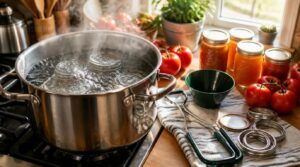
Water bath canning is your apartment’s best friend for high-acid foods—jams, pickles, tomatoes with added acid. Submerge jars 1-2 inches underwater, boil rolling, time only after that boil starts.
- Canning jars, lids, rings
- Jar lifter (no burns!)
- Canning funnel
- Tested recipe with proper acidification
Always remember to use new canning lids for every session to keep things safe.
Altitude over 1,000 feet? Add time. Check seals—lids should sit concave, not flex.
Pressure Canning Needs
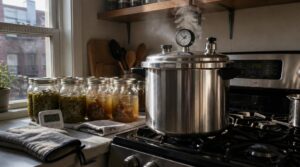
Now for the low-acid stuff—beans, meat, broth—boiling water just won’t cut it. You need a pressure canner hitting 10-15 PSI to kill botulism spores.
Vent 10 minutes before pressurizing. Check your gauge yearly for accuracy. Let pressure drop naturally after processing; never force it.
Above 1,000 feet? Bump your PSI up.
Steam Canning Benefits
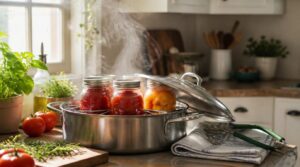
Skip the pressure gauge headaches—for high-acid foods, steam canning is the apartment dweller’s shortcut. It needs just 2-3 quarts of water instead of 16+, meaning less water conservation guilt and lower energy bills.
You’ll notice faster processing (10-25 minutes) and way less kitchen heat—your cabinets won’t sweat. Lighter canning kit pieces mean safer handling, fewer splash burns near your canning jars.
Fermentation for Small Kitchens
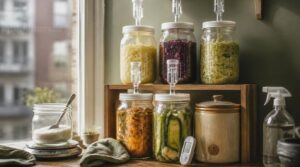
Ready for something that skips heat entirely? Fermentation turns your countertop into a probiotic factory using just salt, water, and time.
A compact station setup—18×24 inches—fits a fermentation kit with airlocks or ceramic crocks. Keep small batch brine at 2-3% salt, jars between 60-75°F for temperature stability. Sanitize everything first; fermentation hygiene prevents mold. Stack jars vertically to reclaim counter space.
Dehydrating Garden Harvests
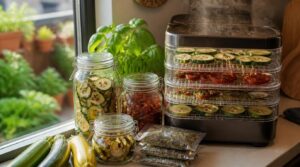
Turning your zucchini glut into shelf-stable snacks doesn’t need a canner at all—just a food dehydrator.
Run fruits at 130-140°F, veggies at 125-135°F, herbs at 95-115°F. Blanch veggies first for better color.
Moisture content testing: dried right means brittle or pliable, never soft. Vacuum sealing then stretches shelf life to 6-12 months.
Match Supplies to Garden Crops
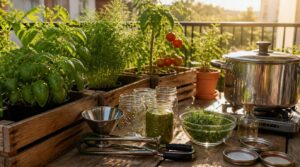
Not every crop needs the same setup, so matching your tools to your harvest saves you money and headaches. A jar of basil pesto and a batch of dill pickles call for completely different gear. Here’s what to grab based on what’s actually growing on your balcony.
Herbs and Small Batches
That windowsill basil doesn’t need a 21-quart canner—grab half-pint jars instead.
Harvest herbs at peak flavor, dry gently (skip heat, it kills essential oils) within 6-24 hours. Track batch traceability with harvest-date labels. Moisture target: 8-12%. Weigh portions (±2 grams) for consistency.
Small batch canning rewards patience, not equipment size—your spice rack will thank you.
Tomatoes and Sauces
Twenty-eight ounces of crushed tomatoes, one onion, three garlic cloves—that’s your baseline for a pot big enough for canning jars you’ll actually use.
San Marzano varieties run lower-acid, so plain sauce needs bottled lemon juice to hit pH 4.6 for safe water bath canning. Add meat? That’s pressure canning territory. Roasting first deepens flavor before it ever hits the jar.
Jams and Jellies
Sweet spreads live and die by gel point—220 to 222°F, no guessing. Grab a candy thermometer.
Natural pectin works for high-pectin fruit; low-pectin batches need added pectin and lemon juice for acid balance. Water bath canning seals both in wide-mouth jars with fresh lids and rings. Skim foam for clarity, and let flavor profiles shine—strawberry-rhubarb, jalapeño-berry, whatever your garden grew.
Pickles and Peppers
Peppers on your patio? Time to pickle them.
Pack jalapeño, banana, or Hungarian wax into jars with 5% acidity vinegar brine—that’s non-negotiable for safety.
- Wash and trim peppers
- Slice or leave whole
- Pack jars snug
- Add garlic, dill, peppercorns
- Process in water bath canner
Botulism prevention means hitting pH 4.6 or below. Use your jar lifter, fresh lids, and rings every time.
Low-acid Vegetables
Zucchini, broccoli, spinach—your garden’s low-acid crops all sit above pH 4.6, meaning pressure canning isn’t optional. A Presto 23-quart pressure canner is perfect for this.
| Vegetable | Prep Tip | Processing Note |
|---|---|---|
| Carrots | Root vegetable brining | Firm texture |
| Broccoli | Cruciferous texture tips | Avoid darkening |
| Spinach | Leafy green processing | Pack minimal liquid |
| Zucchini | Squash canning methods | Slice evenly |
Skip water bath here—it won’t kill botulism spores in low-acid foods.
Save Space While Canning
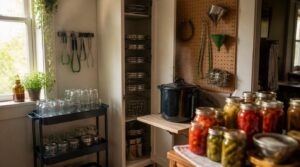
Small kitchens don’t have room for canning clutter—every drawer and shelf has to earn its keep. The good news? A few smart storage tricks can turn cramped cabinets into an organized canning headquarters. Here are five space-saving moves worth stealing.
Compact Tool Storage
Ten canning tools scattered across your counter is a recipe for chaos. Drawer Divider Systems hold up to 12 compartments for lifters and funnels. Try these instead:
- Magnetic Tool Rails for metal gadgets
- Vertical Pegboard Layouts for hooks
- Modular Bin Organization for loose accessories
Snag a protective tool case—your canning kit stays organized, period.
Stackable Jar Organization
Interlocking jar shoulders let you stack canning jars two to four high without them sliding off-kilter—game changer for tight cabinets. Uniform lid profiles keep towers steady on 3-4 inch shelf increments, and clear glass gives you instant inventory visibility without unstacking a thing.
Match jar sizes for shelf density maximization, and your pantry essentials stay organized, accessible, stable—no more Jenga-style jar collapses.
Countertop Appliance Planning
Once your jars are stacked, turn to the appliances doing the actual work. Outlet placement matters most—dedicate 15-20 amp circuits for your food dehydrator or digital pressure canner, and never pair them on one GFCI outlet. Leave 2 inches of ventilation clearance behind heat-producing units like an electric water bath canner.
Group kitchen appliances into workflow zones: prep, cook, seal (vacuum sealers included) for smoother canning days.
Vertical Pantry Storage
Once outlets are sorted, look up. Empty pantry space above eye level is prime real estate for canning jars you don’t grab daily.
Adjustable shelf spacing in 1-2 inch increments fits odd-sized jars. Add ceiling rack lighting so labels stay readable, under shelf risers double your layers, and door pocket inventory keeps lids visible without digging through boxes.
Multi-use Kitchen Tools
Five gadgets or one? Skip the drawer clutter and grab kitchen tools that pull double, triple, even quadruple duty.
Interchangeable blade systems turn one base into a chopper, slicer, and grater—no extra gadgets needed. Look for ergonomic handle design so your wrists survive tomato season, plus multiuse pot versatility for steaming, braising, and simmering in one stockpot. Space-saving nesting and easy cleaning keep your setup lean.
Buy Safely and Budget Wisely
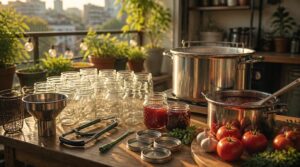
Canning gear can get expensive fast, so knowing where to spend and where to skip matters. Safety isn’t optional here—a bad lid seal can ruin more than your jam. Here’s how to shop smart without cutting corners that count.
Essential Beginner Supplies
Starter kit value beats buying piecemeal every time. Grab a jar lifter, funnel, tongs, and a wide pot—that’s your foundation.
Choosing jar sizes matters too: 8 oz and 12 oz jars suit small-batch experiments perfectly.
Basic canning safety starts here, folks. Skip a lifter, risk a burn. This is canning supplies for beginners done right—simple, safe, and ready for real home canning methods.
Nice-to-have Upgrades
Once you’ve mastered the basics, a few upgrades make canning feel a breeze instead of fussy.
- Digital thermometer probe for exact bath temps
- Bluetooth data logger to track cycles
- Silicone grip mats for slip-free handling
- Color-coded lid bands for quick sorting
- Vacuum sealer for shelf-stable extras
An electric water bath canner frees up stovetop space—worth it if your kitchen’s tight.
Lid Safety Checks
Before every canning session, run your fingers over the lid’s gasket, checking for cracks or hardening. Metal lids are single-use only; never reuse them.
After processing, press each lid’s center—no pop-back means a good seal. Store spares dry, unstacked, to prevent corrosion. Replace annually, no exceptions.
Jar Size Selection
Right size, right jar—every time. For apartment kitchens, three sizes cover 90% of your needs:
- 4 oz jars – gift jams
- Pint jars – sauces
- Quart jars – soups
Widemouth mason jars simplify mouth size compatibility and chunky fills. Watch the right amount of headspace—¼ to ½ inch prevents spoilage. Match size to batch size planning and pantry space optimization.
Cost Per Harvest Batch
What does a jar of tomato sauce actually cost you? More than the tomatoes.
A jar of tomato sauce always costs more than the tomatoes themselves
Batch size scaling matters most: bigger batches spread labor and depreciation thin.
| Cost Factor | Impact |
|---|---|
| Labor per shift | Fixed, regardless of size |
| Equipment depreciation | Lower per jar at scale |
| Utilities | Rises with longer processing |
| Jars/lids | Direct, per-batch expense |
Reduce consumable waste and your shelf-stable food gets cheaper, batch after batch.
Frequently Asked Questions (FAQs)
What is the 70 30 rule in gardening?
Sounds like just another garden gimmick, right? It’s not — it’s 70% perennial backbone plants for structure and low maintenance, 30% seasonal experiments for variety, cutting labor while keeping your container garden productive for harvesting and preserving.
What is the best canning kit for beginners?
Look for a 7 to 9 piece stainless steel set with wide mouth funnel, jar lifter, and bubble remover. The Granite Ware enamel kit adds a 5-quart pot—solid beginner kit value for tackling your first tomato harvest.
What is something every gardener needs?
A sturdy trowel with an ergonomic handle beats a flimsy one every harvest season. Add sharp pruning shears, gloves for hand protection, and a cultivator for soil aeration—then you’re set to fill those canning jars and water bath canners with real garden results.
What is the 5 4 3 2 1 method for gardening?
Five herbs, four leaves, three roots, two flowers, one fruit — that’s the 5 4 3 2 1 layout, packing pest deterrence, pollinator attraction, and staggered harvests into a single container. Small space, big yield: exactly what your future canning jars will thank you for.
Can I can food using an induction stovetop apartment setup?
Yes, but only with magnetic base compatibility — your canner needs a ferrous bottom. Stainless steel or cast iron works great; glass or aluminum won’t heat. Check labels before buying, and enjoy precise temperature maintenance for safer, steadier canning batches.
How do weighted gauges differ from dial pressure gauges?
Weighted gauges offer automatic pressure regulation—no watching required.
Dial gauges show exact PSI readings, needing manual heat adjustments and yearly calibration.
Altitude adjustments differ too: weights change size, dials need recalculated numbers.
Choose based on hands-off ease versus precision control.
Can fermentation crocks be used in tiny kitchens?
Think of a crock as a tiny brine apartment—cozy but efficient.
Compact crock sizing (1-2 gallon) fits tight counters easily. Water-sealed lid benefits keep odors contained.
No room? Mason jar alternatives with airlocks work great for tiny kitchens.
Whats the difference between Weck jars and Ball jars?
Mason jars use metal lids and a vacuum seal for canning jars.
Weck’s European style relies on a gasket vs vacuum system—rubber gaskets and clamps.
Ball needs fresh lids each batch; Weck’s thicker glass and gaskets often get reused.
Conclusion
The smallest kitchens often can the biggest harvests — that’s the paradox every apartment gardener learns fast.
Six pounds of zucchini isn’t a crisis once your garden canning supplies for apartment gardeners are stacked, sized, and ready to go. A jar lifter, a good pot, a few smart tools — that’s it.
You’re not building a farmhouse pantry. You’re building confidence, jar by jar, one August at a time.
That’s a harvest worth keeping.
- https://www.foodandwine.com/best-canning-products-6827161
- https://www.pressurecooker-outlet.com/Ball-Electric-Water-Bath-Canner-and-Multicooker.htm
- https://www.simplycanning.com/water-bath-canner
- https://www.lifewithlessmess.com/ideas-with-mason-jars
- https://www.katheats.com/empty-mason-jar-storage-ideas