
This site is supported by our readers. We may earn a commission, at no cost to you, if you purchase through links.

Blueberries are one of the few crops that genuinely thrive where most plants struggle — in soil acidic enough to make a gardener nervous. The secret isn’t luck. It’s chemistry.
Soil pH controls which nutrients your plants can actually absorb. Drop below 4.0, and soluble aluminum accumulates to toxic levels, shredding root hairs before your bushes ever hit their stride. Creep above 5.8, and iron, manganese, and zinc lock up in the soil — present but completely unavailable, leaving plants starving in plain sight.
Growing blueberries in acidic soil isn’t complicated, but it demands precision. Get the pH window right — 4.5 to 5.5 — and blueberries reward you with vigorous growth and heavy harvests. Miss it, and no amount of watering or fertilizing will save them. The steps ahead show you exactly how to hit that target and keep it there.
Table Of Contents
- Key Takeaways
- Test and Target Blueberry Soil PH
- Prepare Acidic Soil Before Planting
- Plant Blueberries for Strong Roots
- Maintain Acidity With Mulch and Fertilizer
- Monitor PH and Prevent Nutrient Problems
- Frequently Asked Questions (FAQs)
- What berry bushes like acidic soil?
- Can blueberries grow in containers or pots?
- What blueberry varieties tolerate different soil conditions?
- How do seasons affect blueberry soil requirements?
- Do companion plants help acidify blueberry soil?
- Can rainwater collection benefit blueberry soil health?
- Can blueberries grow well in containers or raised beds?
- Which blueberry varieties thrive in warmer climates?
- How do you protect blueberry plants from birds and pests?
- When is the best time to harvest blueberries?
- Conclusion
Key Takeaways
- Keeping soil pH between 4.5 and 5.5 is the single most critical factor for blueberry success, since even slight deviations lock out essential nutrients or introduce toxic aluminum.
- Elemental sulfur is your primary pH-lowering tool, but it works slowly — start amending four to six months before planting, and split applications to avoid root burn.
- Pine needle mulch and ammonium-based fertilizers do double duty, maintaining soil acidity over time while feeding the plants through each growing season.
- Test your soil every spring and fall to catch pH drift early, and treat iron chlorosis with chelated iron sprays the moment yellowing appears between leaf veins.
Test and Target Blueberry Soil PH
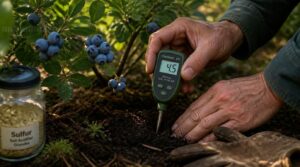
Blueberries are picky about one thing above all else: soil pH. Get this wrong and your plants will struggle no matter how well you water or fertilize them. Here’s what you need to know to test your soil and hit the right target before you plant.
Most blueberry growers are surprised to learn that even shade and light conditions affect how well your soil holds acidity, making site selection just as critical as that pH reading.
Ideal 4.5–5.5 PH Range
Blueberries are picky about where they put down roots — and soil pH between 4.5 and 5.5 is non‑negotiable. Inside that window, iron, manganese, and zinc stay soluble and available.
Drop below 4.0, and soluble aluminum rises to toxic levels, damaging root hairs directly. Push above 5.8, and micronutrient availability collapses, starving your plants despite healthy‑looking soil.
Below pH 4.0, toxic aluminum attacks roots; above 5.8, micronutrients vanish — soil pH is everything
For best fruit production, aim for the optimal blueberry pH range of 4.0–5.0.
When to Test Soil
Timing your tests matters as much as knowing your target pH.
Test at three key points:
- Several months before planting to guide soil amendments
- Early spring to catch winter pH drift and plan corrections
- 2–8 weeks post-amendment to confirm sulfur adjustments worked
Avoid testing right after heavy rainfall — saturated soil skews your readings.
Digital Meter Vs Lab Test
Once you know when to test, you need to pick how.
A digital pH meter gives results in minutes — handy for quick decisions. But accuracy sits around ±0.5 pH units, and drift happens without regular calibration.
A professional lab test costs more and takes days, yet delivers ±0.1 unit accuracy plus nutrient data. For first-time planting, that depth is worth it.
Signs PH is Too High
Your meter or lab test will confirm what your plants may already be showing you. When soil pH climbs above 5.8, iron becomes chemically unavailable — even if it’s physically present in the soil.
The result is iron chlorosis: yellowing between the leaf veins on young leaves, while the veins themselves stay green. That pattern is a reliable early warning.
Prepare Acidic Soil Before Planting
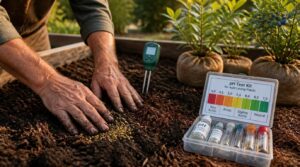
Getting the soil right before you plant is the most important step you’ll take. Blueberries won’t forgive bad chemistry, so preparation needs to start months before your first bush goes in the ground. Here’s exactly what to do.
Amend Several Months Ahead
Soil doesn’t change overnight. Start amending four to six months before planting so elemental sulfur has time to oxidize and actually shift your pH.
Meanwhile, getting your blueberry growing conditions right from seed to harvest means pairing that acidic soil prep with the six-plus hours of daily sun these plants genuinely need.
Log every application — date, amount, and current pH reading. Retest after each round to measure drift. This record keeps you from guessing and lets you plan seasonal adjustments with real data behind them.
Elemental Sulfur Application Rates
A single pound of elemental sulfur per 50 square feet drops pH by roughly one point — but oxidation takes months, not days. Finer, micronized particles work faster than coarse granules because more surface area means faster microbial conversion. Dry conditions stall that process entirely.
Split applications two to three months apart deliver steadier results and protect roots from sulfur burn.
Sandy Vs Clay Soil
Your soil type changes how much sulfur you actually need.
- Sandy soil needs only 0.8 lbs per 100 sq ft to drop pH one point
- Clay soil needs roughly three times that amount
- Clay also drains poorly, risking waterlogged roots after heavy rain
Sandy soils leach nutrients faster and dry out quickly. Clay holds moisture longer but warms slowly and compacts under pressure, making it harder to work.
Peat Moss Soil Blends
Think of sphagnum peat moss as your pH anchor — it naturally pulls soil acidity down to 3.0–4.0. Mix it at 50% volume into your bed. Pair it with perlite or pumice to keep roots breathing and aeration balanced.
| Component | Role |
|---|---|
| Sphagnum peat moss | Lowers pH; retains moisture |
| Perlite or pumice | Adds aeration |
| Composted bark | Feeds microbes |
| Elemental sulfur | Accelerates acidification |
Avoid Planting Hole Mistakes
The hole sets the stage for everything. Dig it 2–3 times wider than the root ball — but no deeper than its height.
- Rough up the sides to prevent root circling
- Skip narrow, deep holes — the bathtub effect drowns roots
- Backfill using native soil, not rich potting mix
- Position the root flare just above ground level
- Tamp gently, then water in to settle the soil interface
Plant Blueberries for Strong Roots
Healthy roots start long before the first berry appears — they begin the moment you put the plant in the ground. How you dig, position, and water your blueberries in those first hours sets the foundation for years of growth. Here’s what to get right from the start.
Full Sun Site Selection

Blueberries need at least six hours of direct sunlight daily — less than that and fruit production drops noticeably.
Pick a south-facing spot in your garden plot, away from buildings or tall trees that cast long shadows. Full sun sites warm up faster in spring, encouraging earlier growth.
Watch for heat stress in mid-summer; keep irrigation consistent, since sunny plots lose moisture quickly.
Wide, Shallow Planting Holes

Once you’ve chosen your sunny spot, how you dig matters as much as where you dig.
Make your hole 2–3 times wider than the root ball but no deeper than it. Wide holes encourage lateral root spread and prevent root girdling. They also improve drainage and aeration around the root zone. Keep edges jagged — roots exit irregular walls far more readily than smooth ones.
Set Root Ball High
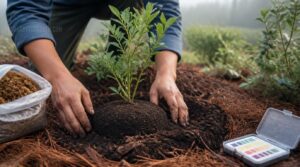
Once the hole is ready, set the root ball so it sits slightly above grade — roughly an inch higher than the surrounding soil. Soil settles after watering, and planting high accounts for that shift.
Keep the root collar visible at or just above the surface. Burying it invites trunk rot. Press soil gently around the sides to close air pockets without compacting.
Ensure 18-Inch Soil Depth
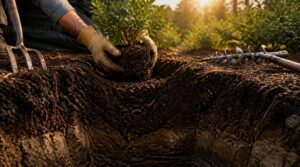
Roots need room to spread — and blueberries want at least 18 inches of loose, workable soil beneath them. Compact or shallow ground forces roots to crowd near the surface, where they dry out fast and lose access to stable moisture.
Before planting, break up any hardpan layer. Deep soil preparation keeps the root zone open, well-drained, and ready for long-term growth.
Water Without Waterlogging

Deep roots need consistent moisture — but standing water is their enemy. Drip irrigation delivers water directly to the root zone without saturating surrounding soil. Keep moisture steady, not excessive.
- Use soil moisture sensors at 6–12 inches to guide watering
- Plant in raised beds to promote natural drainage
- Watch for yellowing leaves — early signs of root rot
Maintain Acidity With Mulch and Fertilizer

Once your blueberries are in the ground, keeping that soil acidic is an ongoing job — not a one-time fix. The right mulch and fertilizer choices do a lot of the heavy lifting for you. Here’s what to reach for.
Pine Needle Mulch
Pine needles are one of the best mulches for blueberries. Spread a 4–6 inch layer around each plant, keeping it clear of the stem.
As they decompose slowly, they release organic acids that aid soil acidification and feed beneficial microbes. They also lock in moisture and insulate roots from summer heat and winter cold.
Pine Bark and Sawdust
Bark and sawdust work differently than pine needles. Pine bark decomposes slowly — its high lignin content means it stays put longer, releasing organic acids gradually while supporting beneficial fungi that improve soil structure.
Apply a 2–3 inch layer only. Fresh sawdust ties up nitrogen as it breaks down, so always use composted sawdust and pair it with an acid-loving fertilizer to compensate.
Acid-Loving Fertilizers
Not all fertilizers suit blueberries. Choose products labeled for acid-loving plants — these use ammonium-based nitrogen rather than nitrate-based forms, releasing hydrogen ions that nudge pH lower over time.
Espoma Holly-tone is a reliable option. Elemental sulfur and iron sulfate in the mix support micronutrient solubility, keeping iron, manganese, and zinc accessible where blueberries need them most.
Ammonium Sulfate Use
Ammonium sulfate delivers a 21% nitrogen, 24% sulfur combination that feeds blueberries while gently pushing pH downward. Apply it to the top 1–2 inches of soil — don’t dig it in — to drop surface pH by 0.1–0.2 points annually.
Keep rates conservative. Excess applications leach nitrogen past the root zone, wasting money and stressing plants.
Seasonal Feeding Schedule
Timing matters as much as what you apply.
- Spring and post-bloom: apply acidic fertilizer as growth resumes, then again after flowers drop.
- Summer: shift feeding to early morning and increase water availability by 20–40% on hot days.
- Fall: introduce complex carbohydrates and boost protein slightly to sustain steady energy as days shorten.
Avoid late-fall feeding — new growth won’t harden before frost hits.
Monitor PH and Prevent Nutrient Problems

Getting your soil right doesn’t stop after planting — it’s an ongoing process. pH can drift quietly over time, and when it does, your blueberries will start showing it through yellowing leaves and stunted growth. Here’s what to watch for and how to stay ahead of it.
Annual Spring and Fall Testing
Blueberries keep no secrets — your soil reveals everything twice a year. Test every spring to confirm nutrients are available before shoot growth begins, and test again each fall to prevent leaching over winter.
A digital meter gives quick readings, but a lab test delivers cation exchange capacity and salinity data.
Track results consistently to spot long-term pH drift.
Prevent Iron Chlorosis
Yellowing between leaf veins on young growth signals iron chlorosis — your soil pH is likely above 5.5. At that point, iron binds to soil particles and roots can’t absorb it, even when iron is physically present.
Keep pH in the 4.5–5.5 range and soil microbes do the work, cycling iron naturally to roots. Avoid high-phosphate fertilizers, which block uptake directly.
Quick Chelated Iron Fixes
When chlorosis strikes, chelated iron acts fast. Mix a foliar spray at 0.1–0.5% concentration, add a non-ionic surfactant to improve leaf coating, and spray until runoff. Target new growth first — leaves green up within 48–72 hours.
- Spray early morning or late afternoon
- Use surfactant for better absorption
- Target young, chlorotic leaves first
- Apply soil chelates at 1–3 lbs per 100 sq ft
- Reapply every 2–4 weeks until color returns
Avoid Lime and Wood Ash
Once your chelated iron restores leaf color, don’t undo that work with the wrong amendment.
Garden lime and wood ash both push pH well above 5.5, locking out iron, manganese, and zinc almost immediately. Wood ash also carries trace metals like cadmium and lead that accumulate in soil over time.
Keep both products far from your blueberry beds — permanently.
Adjust Sulfur Carefully
Sulfur won’t fix pH overnight. Microbial oxidation converts elemental sulfur to sulfuric acid over weeks or months — sandy soils move faster, clay soils lag behind.
Apply small doses, retest after 6–8 weeks, and adjust from there. Never exceed moderate annual rates on established plants; too much risks root burn and throws off nutrient balance permanently.
Frequently Asked Questions (FAQs)
What berry bushes like acidic soil?
Blueberries, cranberries, lingonberries, huckleberries, and raspberries all thrive in acidic soil pH between 5 and Strawberries tolerate slightly higher pH, around 5–5, making them the least demanding of the group.
Can blueberries grow in containers or pots?
Yes, blueberries thrive in containers. You’ll have full control over soil pH, drainage, and moisture — exactly what these plants need. Choose a pot with at least 12–16 inches of depth and drainage holes.
What blueberry varieties tolerate different soil conditions?
Pick the right tool for the job. Rabbiteye varieties like Brightwell handle drought and adapt to wider soil types. Sunshine Blue suits borderline pH well. Patriot grips heavier soils; cold-hardy Northblue excels in peat mixes.
How do seasons affect blueberry soil requirements?
Each season pulls your soil chemistry in a different direction. Spring rain leaches sulfate and raises pH. Summer drought concentrates soil acids, naturally supporting acidity. Fall is the prime window for targeted sulfur amendments.
Do companion plants help acidify blueberry soil?
Ironically, your blueberry’s best allies aren’t always amendments — they’re neighbors. Acid-loving companions like azaleas and pine trees drop organic litter that slowly lowers pH, while mycorrhizal root networks keep the rhizosphere naturally acidic.
Can rainwater collection benefit blueberry soil health?
Rainwater sits around pH 6–5 — closer to blueberries’ preferred range than most tap water. It carries no chlorine or lime additives, reducing salt buildup and supporting mycorrhizal fungal activity that drives phosphorus uptake in acidic soil.
Can blueberries grow well in containers or raised beds?
Yes, blueberries thrive in containers and raised beds. Use an acidic potting mix (pH 5–5), provide adequate drainage, and choose pots with at least 18 inches of depth for healthy root development.
Which blueberry varieties thrive in warmer climates?
Warm gardens call for smart cultivar choices. Southern Highbush varieties like Misty and O’Neal handle heat well. Rabbiteye types — Climax and Brightwell — tolerate long hot summers with fewer chill hours needed.
How do you protect blueberry plants from birds and pests?
Fine mesh netting is your best defense. Put it up before fruit sets and keep it secured at ground level. Harvest ripe berries promptly — waiting invites birds straight to the patch.
When is the best time to harvest blueberries?
How do you know when a blueberry is truly ready? Wait until berries are fully blue with a dusty bloom and detach with a gentle twist — no pulling needed.
Conclusion
Blueberries demand hostile ground to produce something impressive — that’s the paradox. Growing blueberries in acidic soil means learning to work with chemistry, not against it.
Test annually. Keep sulfur and pine mulch doing their quiet work between seasons.
When the pH holds steady between 4.5 and 5.5, your bushes stop fighting and start thriving. Precision isn’t optional here — it’s the whole game. Get the chemistry right, and the harvest takes care of itself.
- https://en.wikipedia.org/wiki/Soil_pH
- https://www.canr.msu.edu/uploads/files/Lowering_Soil_pH_with_Sulfur.pdf
- https://farmonaut.com/blogs/blueberry-soil-ph-leaf-spot-rust-disease-guide-2025
- https://gardenerspath.com/plants/fruit/blueberry-soil-ph/
- https://extension.oregonstate.edu/catalog/pub/em-8918-nutrient-management-blueberries-oregon