
This site is supported by our readers. We may earn a commission, at no cost to you, if you purchase through links.

A single strawberry plant grown in a 3-gallon pot can produce fruit for three seasons straight—no garden bed required. Day-neutral varieties like Albion and Seascape don’t wait for a specific day length to flower, so they fruit continuously from late spring through fall. That steady rhythm makes container growing surprisingly productive, even on a tenth-floor balcony.
The real challenge isn’t space—it’s understanding how pot size, soil composition, and watering habits interact to either make or break your harvest. Get those three things right, and you’ll be picking ripe strawberries weeks before your neighbors pull theirs from the ground.
Table Of Contents
- Key Takeaways
- Choose Container-Friendly Strawberry Varieties
- Pick The Right Strawberry Container
- Prepare a Well-Draining Potting Mix
- Plant Strawberries at The Correct Depth
- Give Strawberries Enough Sunlight
- Water Potted Strawberries Consistently
- Fertilize for Flowers and Fruit
- Manage Runners, Flowers, and Pollination
- Prevent Pests and Strawberry Diseases
- Harvest and Overwinter Container Strawberries
- Frequently Asked Questions (FAQs)
- Do strawberries grow well in containers?
- What is the trick to growing strawberries?
- What not to do when growing strawberries?
- Do strawberries like full sun or shade?
- What do coffee grounds do for strawberry plants?
- What is the best container for growing strawberries?
- How to grow a strawberry plant in a container?
- How to grow strawberries in containers?
- How do you grow strawberries in a pot?
- Should you water strawberries every day?
- Conclusion
Key Takeaways
- Day-neutral varieties like Albion and Seascape outperform June-bearing types in containers because they fruit continuously from late spring through fall, not just once.
- A light-colored pot at least 12 inches wide filled with coco coir, perlite, and compost mix keeps roots cool, well-aerated, and productive through the hottest months.
- Pinching runners weekly and removing first-year flowers redirects the plant’s energy into fruit, boosting berry size and total yield by up to 37%.
- Consistent morning watering, a pH of 5.5–6.5, and switching from nitrogen to high-potassium feed when buds appear are the three habits that turn a leafy plant into a heavy producer.
Choose Container-Friendly Strawberry Varieties

Not every strawberry variety thrives in a pot — some spread too aggressively, fruit only once, and exhaust themselves fast.
The good news is that several compact cultivars were practically made for container life. Here are the best ones to explore.
If you want a deeper dive into which varieties thrive in pots, growing blueberries in containers walks you through the top picks with practical tips.
Best Day-neutral Varieties: Albion, Seascape, Cabrillo
Three day-neutral cultivars stand out when selecting the right strawberry cultivar for containers: Albion, Seascape, and Cabrillo.
- Albion delivers outstanding flavor consistency, impressive berry firmness, and strong heat tolerance — plus disease resistance to Verticillium wilt and crown rot
- Seascape offers heavy yields with glossy, large berries and an extended harvest window
- Cabrillo matches Albion’s fruit size with steady, reliable production in moderate climates
- All three fruit continuously across warm seasons as true day-neutral cultivars
Best Everbearing Varieties: Ozark Beauty, Quinault
If everbearing cultivars like Ozark Beauty and Quinault aren’t your style, they’re worth a close look. Both offer strong disease resistance and impressive harvest consistency, making them reliable container strawberries season after season. Ozark Beauty thrives with cold tolerance and delivers two generous harvests—early and late summer—with firm, juicy fruit texture. Quinault’s compact growth suits smaller pots perfectly.
Ozark Beauty is hardy in zones 3‑9, ensuring suitability for a wide range of climates.
Alpine Strawberries for Baskets and Window Boxes
Alpine strawberries (Fragaria vesca) are a perfect fit for hanging baskets and window boxes. They stay compact — just 3 to 9 inches tall — and offer intensely aromatic fruit through a nearly year-round harvest.
Their low-light tolerance makes shaded balconies workable, and the decorative foliage adds genuine miniature garden design charm.
- Thrive in a well-draining potting mix with partial shade
- Produce small, fragrant berries continuously without crowding runners
- Suit any window box or basket that gets 4–6 hours of full sunlight
Why June-bearing Strawberries Are Less Ideal
June-bearing strawberries fruit once — a two-to-four-week window that demands everything from you all at once. For container strawberries, that’s a tough trade-off.
| Problem | What It Means | Why It Matters |
|---|---|---|
| Short Fruiting Period | One-season productivity only | Minimal return for your effort |
| Cold Damage Vulnerability | Spring frosts kill buds | Entire harvest can disappear overnight |
| Higher Maintenance | Runners crowd pots fast | More work and inconsistent sweetness |
Everbearing and day-neutral types simply reward you longer.
Choosing Varieties by Flavor, Yield, and Space
Every variety brings something different to the table — so match your pick to what matters most to you.
- Flavor Consistency: Albion and Seascape deliver balanced sweetness across every flush
- Yield Density: Cabrillo packs high berry counts into compact growth with minimal fuss
- Space Efficiency: Alpine strawberries thrive in baskets where room is tight
- Temperature Tolerance: Quinault stays sweet even when heat climbs
- Compact Growth: Select day-neutral strawberry varieties for containers, which outperform everbearing and June-bearing types for steady, manageable harvests
Pick The Right Strawberry Container
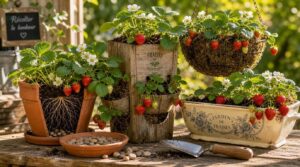
The container you pick matters more than most people expect — it shapes how well your roots breathe, how cool the soil stays, and ultimately how many berries you harvest.
Not every pot, basket, or trough works equally well for strawberries. Here’s what to look for before you buy.
Minimum Pot Size and Depth
Think of your container as a home — cramped roots mean stressed plants. For a single strawberry, you need at least 2–3 gallons and a container depth of 8–10 inches to support healthy root zone volume.
Multi-plant setups require 8–12 gallons total.
| Pot Diameter Guidelines | Pot Size Plant Count |
|---|---|
| 12 inches | 3–4 plants |
| 8 inches | 1 plant |
Best Containers for Balconies and Patios
For balconies and patios, fiberglass planters and polyresin options are hard to beat — they weigh just 1.5 to 4.5 pounds empty, resist UV damage, and won’t crack through freeze cycles. Light cool-tone finishes keep root zones noticeably cooler than dark pots.
Self-watering systems cut daily maintenance, while modular stackables maximize tight spaces.
Terracotta pots work too, but they’re heavier and dry out faster.
Hanging Baskets, Grow Bags, and Troughs
Fabric grow bags naturally air-prune roots, keeping them healthy and productive—just plan for daily watering in heat. Troughs at least 24 inches long distribute weight evenly across railings. Coco-coir lined hanging baskets offer solid material durability but need drip irrigation.
Lightweight options ensure smooth location swapping between spots.
Why Wide Containers Improve Yields
Width matters more than you’d think. A wider pot gives roots room to expand, creating a deeper nutrient reservoir and better moisture buffering between waterings — both critical during fruiting.
Container size selection directly affects strawberry yield: more soil volume means improved aeration efficiency, temperature moderation, and stable drainage.
Avoid overcrowding by determining ideal pot size and plant density before you plant.
Light-colored Pots for Cooler Roots
Pot color quietly shapes root health more than most gardeners realize. A light-colored plastic pot reflects sunlight, cutting root zone temperature by up to 22 percent during peak heat — a straightforward form of temperature stress mitigation that preserves moisture and keeps roots working efficiently.
- Choose white or pale thick-walled pots for reliable root zone cooling
- Light-colored plastic pot surfaces act as a reflective surface, slowing heat absorption
- Cooler soil reduces moisture conservation losses, cutting watering by 1–2 cycles weekly
- Monitor root zone temperature with a soil thermometer to catch heat stress early
- Pair light pots with afternoon shade above 85°F for full temperature monitoring control
Drainage Holes and Saucer Setup
Good drainage picks up right where cool roots leave off.
Drill or check for holes sized between ¼ and ½ inch — that’s your hole size guideline sweet spot. Space them evenly so soil drains adequately across the whole base.
Pair your pot with a detachable water catchment tray, empty it within 30 minutes, and raise the container slightly for real drainage clearance.
Prepare a Well-Draining Potting Mix

The soil you use matters just as much as the pot you choose. Strawberries are picky about drainage, and the wrong mix leads to soggy roots and very few berries.
Here’s exactly what to put in your container to give them the best start.
Ideal Container Mix Ingredients
Think of your potting mix as a recipe — get the ratios right, and your strawberries will thrive. A well-draining potting mix balances moisture retention with airflow.
Here’s what to include:
- Coco coir or peat moss (40–50%): Your base layer; the Coconut Coir Ratio keeps roots evenly moist without drowning them
- Perlite (25–30%): The key Aeration Additive Mix component that prevents compaction and improves drainage
- Vermiculite (20–30%): Vermiculite Inclusion adds cation exchange sites, releasing nutrients gradually into the root zone
- Compost (10–20%): Your Organic Nutrient Sources — feeds microbial life and delivers slow-release nutrition
- Worm castings or bone meal (5–10%): Manages Mineral Amendment Balance, supplying phosphorus for strong roots and flowers
Peat-free and Coco-coir Options
Coco coir is your best peat-free base for container strawberries. It offers impressive coir’s pH stability — naturally sitting around 5.5–6.5 — making potting mix formulation for strawberries straightforward. A reusable coir mix holds five to seven times its weight in water while draining cleanly.
Simple rehydration of coir blocks is achieved by adding hot water, which causes them to expand into a ready-to-use, uniform medium.
Adding Compost, Worm Castings, and Perlite
Once your coir base is ready, build real nutrition into the mix. Blend in 20% finished compost for organic matter and improved soil structure.
Add 10–15% worm castings for a steady nutrient release and microbial boost that feeds roots gently over weeks.
Round it out with 20% perlite for aeration balance — your potting mix composition will drain beautifully without drying too fast.
Best Soil PH for Strawberries
Soil pH is the quiet control dial behind every nutrient your strawberries can actually use. Target a soil pH between 5.5 and 7.0, with 6.0–6.2 as your sweet spot — that’s where micronutrient availability peaks, and iron remains soluble.
Use pH testing methods like simple test kits monthly to monitor levels.
Lime amendment timing matters before planting; sulfur pH correction works similarly to lower acidity. Apply these amendments strategically to achieve the desired range.
Organic matter and pH buffers in coir-based mixes naturally stabilize the balance, reducing drastic fluctuations and supporting consistent nutrient uptake.
Preventing Soggy Soil and Root Rot
Root rot is the silent killer of container strawberries — and soggy soil is almost always to blame. Your well-draining potting mix is your first defense, but pair it with proper drainage holes and solid water management for container-grown strawberries.
Aeration techniques like adding perlite help enormously.
Soil moisture sensors take the guesswork out of watering, so roots stay healthy, never waterlogged.
Flushing Salts From Container Soil
Even the best potting mix becomes a salt trap over time — fertilizers and tap water minerals accumulate faster than you’d think. Flush your containers monthly using two to four times the pot’s volume in distilled or rainwater, letting it drain adequately each time.
Salt Buildup Detection and Leaching Checklist:
- Watch for white crust on soil — classic salt buildup
- Check runoff EC or TDS monthly during peak feeding
- Use distilled water to avoid adding new minerals during flushing
- Apply leaching water volume generously — never a quick rinse
- Resume post-flush fertilization only after soil dries slightly to prevent nutrient leaching shock
Plant Strawberries at The Correct Depth
Getting your strawberries in the ground — or rather, into the pot — is where the real fun begins. Planting depth and timing matter more than most people expect, and a few small decisions here can make or break your harvest.
Here’s what you need to get right from the start.
Best Time to Plant Strawberries

Timing is everything with strawberries. Wait until daytime soil temperature hits 45–50°F (7–10°C) — that’s your green light. In colder zones, that usually means early spring after the last frost.
If you’re in USDA zones 7–10, fall planting works beautifully, letting roots settle during cooler months before fruiting next spring. Your regional climate window shapes your whole seasonal planting calendar.
Bare-root Plants Versus Nursery Starts
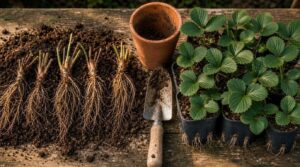
When sourcing container strawberries, you have two solid options: bare-root plants or nursery starts. Each presents distinct trade-offs worth considering.
- Cost comparison: Bare-root wins, as their lighter shipping weight means lower prices and a wider variety selection.
- Planting window: Bare-root plants require precise timing; nursery starts offer year-round flexibility.
- Root health and establishment speed: Nursery starts reduce transplant shock, although bare-root plants develop stronger roots when handled carefully.
Setting The Crown Above The Soil
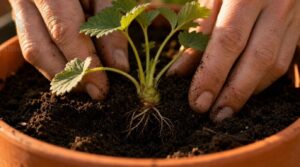
The crown is the heart of your strawberry plant—treat it like one. Set it right at soil level, never buried, never too high. Burying it even a centimeter invites rot; lifting it too far invites drought stress.
Crown-level uniformity across your pot promotes even crown sunlight exposure, healthy crown airflow, and consistent root rot prevention through reliable soil drainage.
Proper Spacing in Pots and Troughs
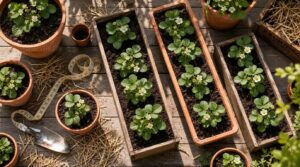
Once the crown sits level, spacing is your next call. Measure center spacing at 8 inches between plants — not edge to edge, but center to center.
A diagonal arrangement fits more plants and opens airflow corridors between foliage.
In troughs, grid planning keeps canopy clearance consistent, preventing shading.
Tight spacing is tempting, but avoid overcrowding; compressed roots underperform every time.
How Many Plants Per Container
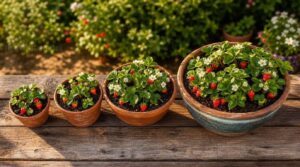
With spacing dialed in, plant count becomes your next decision — and it directly shapes your yield efficiency ratio. Determining ideal pot size and plant density prevents overcrowding and protects fruit size.
- 12-inch pot — 3 plants maximum plant load
- 16-inch pot — 4 plants, balanced root zone crowding
- 20-inch pot — up to 6 plants, strong airflow impact
- 24-inch trough — 6–8 plants, ideal water demand scaling
Watering After Planting
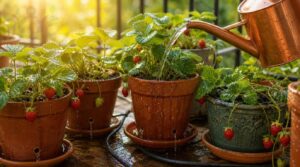
Once your plants are in place, give them an initial deep soak — water slowly at the base until steady drips confirm drainage verification. For the first two weeks, follow a daily establishment moisture schedule in warm weather, then ease into every two to three days.
An irrigation timer with a drip/soaker line simplifies temperature-adjusted watering, keeping watering frequency and soil moisture management effortlessly consistent.
Give Strawberries Enough Sunlight

Strawberries are sun-lovers, plain and simple — shortchange them on light and you’ll get leafy plants with disappointing fruit. Getting the sunlight balance right involves more than just picking a sunny spot.
Here’s what you need to know to keep your plants thriving from spring through fall.
Minimum Daily Sunlight Requirements
Strawberries are sun lovers — full sunlight is non-negotiable. Your light duration threshold sits at six hours of direct sun daily, but eight is where the real magic happens.
Morning sun emphasis matters here: early light dries dew fast, reducing disease risk.
As seasons shift, track your container’s exposure. Reflective surfaces like white walls or light-colored paving can boost available light when your spot falls short.
Why Eight Hours Improves Fruit Sweetness
Those extra two hours of full sunlight aren’t just a bonus — they’re the engine behind sweeter berries. A longer photosynthetic window drives sugar metabolism into high gear, loading more sucrose directly into developing fruit.
Temperature balance and water stress mitigation during that eight-hour period keep the process steady. This ensures consistent sugar accumulation without disruptions from heat or drought.
Strong canopy vigor improves light requirements efficiency, translating consistent sunlight into noticeably richer flavor. The plant’s robust structure maximizes energy conversion, directly enhancing the fruit’s taste profile.
Managing Heat Above 85°F
Once temperatures climb past 85°F, your strawberries shift from thriving to surviving. Summer heat stress hits hard—slowing fruit set, softening berries, and risking fruit sunscald on exposed fruit.
Fight back with reflective mulch on the soil surface to bounce heat away, cooling trays beneath pots for evaporative cooling, and ventilation fans to break stagnant air.
Microclimate modification keeps your plants productive when the heat gets serious.
Using Afternoon Shade in Hot Climates
Light afternoon shade becomes your best tool against summer heat stress when the afternoon sun turns brutal. Effective shade structure types—such as a shade cloth, pergola with climbing vines, or reflective overhangs—block the harshest western rays while enhancing ventilation.
Add companion shade plants nearby, monitor pot temperatures, and combine mitigating heat stress through shade and mulching to keep roots cool without sacrificing sunlight requirements.
Outdoor Versus Indoor Container Placement
Where you place your container shapes almost every outcome. Outdoors, natural pollinators, rainfall, and full-spectrum light provide plants with a significant edge, but temperature fluctuations, pest pressure differences, and airflow management become daily considerations. Indoor vs. outdoor container strawberry cultivation presents distinct trade-offs, balancing environmental control against natural advantages.
Key factors influencing cultivation choices include:
- Outdoor spots fulfill sunlight requirements naturally.
- Indoors, light source options like grow lights fill gaps.
- Mobility constraints favor lightweight pots indoors.
- Microclimate management on balconies buffers temperature extremes.
- Indoor settings reduce pest pressure noticeably.
Rotating Pots for Even Growth
Think of your strawberry pot like a rotisserie — every side deserves equal time in the heat. Turning your container a quarter turn weekly delivers uniform light exposure, encourages balanced root growth, and promotes microclimate equalization across the canopy.
This simple rotation routine also improves structural stability, keeping stems upright rather than leaning.
Pairing rotations with your regular watering checks ensures seamless consistency.
Water Potted Strawberries Consistently
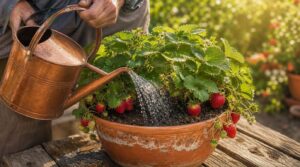
Strawberries in containers dry out faster than you’d expect — sometimes within a day in hot weather. Getting your watering routine right is one of the biggest factors between a healthy harvest and a stressed, wilting plant.
Here’s what you need to know to keep moisture levels just right.
How Often to Water Container Strawberries
Watering container strawberries isn’t a fixed schedule — it’s a conversation with your plants. During hot, dry spells, check soil moisture daily; your irrigation scheduling should shift to every one to two days. In cooler periods, every three days works.
Container evaporation rates climb fast in wind and heat, so always water at the base, targeting about 1 to 1.5 inches weekly.
Morning Watering for Healthier Plants
Dawn irrigation timing makes a real difference. Watering early lets moisture sink into the root zone before heat pulls it away, ensuring consistent moisture and cut disease pressure — wet leaves dry completely before nightfall, reducing gray mold risk.
A drip-soaker system set for 15–30 minutes manages water conservation automatically. Moisture sensors eliminate guesswork entirely, triggering your watering schedule only when the root zone actually needs it.
Checking Moisture Below The Surface
Surface dryness can fool you. Your finger is actually a decent first tool — push it 2–3 inches deep and feel for consistent moisture, not just a dry crust on top. That surface-subsurface contrast tells the real story.
For precise soil moisture control, consider these options:
- Tensiometer readings reveal root-zone water potential in centibars
- TDR moisture profiling gives exact volumetric water content via probe depth placement
- Capillary moisture movement means that deeper layers stay damp longer than the surface suggests
Watering Hanging Baskets and Grow Bags
Hanging baskets and fabric grow bags lose moisture faster than standard pots — sometimes shockingly fast on a breezy afternoon. To address this, reservoir basket designs or self-watering setups can help maintain consistent moisture levels.
A drip soaker line simplifies water management for container-grown strawberries, making it nearly effortless.
| Watering Target | Recommendation |
|---|---|
| Frequency (cool days) | Every 1–2 days |
| Frequency (hot/windy) | Daily or twice daily |
| Moisture sensor use | Check 2–3 inches deep |
| Capillary matting | Line basket base |
| Even moisture distribution | Use a reservoir basket design |
Mulching Pots to Conserve Moisture
Once the watering rhythm is established, a thin layer of organic mulch acts like a slow-release moisture shield. Straw is the classic pick—a lightweight, breathable mulch that won’t mat or block drainage.
Aim for 1–2 inches, keeping it clear of the plant’s crown. Mulch color choice matters too: lighter materials reflect heat, protecting roots on sunny patios.
Refresh your mulch seasonally when it breaks down.
Avoiding Overwatering and Crown Rot
Overwatering is the quiet killer of container strawberries. A perched water table in shallow pots keeps moisture trapped right at the crown, inviting rot quickly. To prevent this, maintain crown elevation slightly above the soil line, promote airflow around the crown, and use ventilated self-watering pots carefully.
A moisture sensor removes the guesswork—check 2 inches deep before adding more water. Always ensure drainage holes remain clear to prevent waterlogging.
Fertilize for Flowers and Fruit

Feeding container strawberries isn’t complicated, but timing and nutrient type make a real difference between scraggly leaves and a bowl full of berries.
Think of fertilizing in two stages — one to build the plant, one to build the fruit. Here’s what to know at each step.
Slow-release Fertilizer at Planting
Think of slow-release fertilizer as a time-locked nutrient bank built into your potting mix formulation for strawberries. At planting, mix granules 2–3 inches deep into the soil — polymer or sulfur coatings control release timing over 3–9 months.
Warmer temperatures speed breakdown, so factor that into your fertilization schedule.
This single application delivers balanced nitrogen, phosphorus, and potassium without burning young roots.
Early-season Feeding for Leafy Growth
Once true leaves fill out and soil temperature climbs above 50°F, your plants are ready for their first real meal. A gentle nitrogen pulse every two to three weeks fuels that lush early canopy — the foundation for everything that follows.
To support this growth phase:
- Apply a phosphorus starter at planting for strong root establishment
- Use organic liquid boost like seaweed or fish fertilizer biweekly
- Introduce micronutrient chelates (iron, magnesium) to prevent pale, yellowing leaves
- Follow soil temperature cues — feeding below 50°F wastes nutrients
- Build your fertilization schedule around plant cues, not the calendar
Switching to Potassium When Buds Appear
Once buds push through, nitrogen steps aside — potassium timing becomes your priority. Implementing a fertilization plan with high-potash feed now directs energy straight into flower development and fruit sweetness rather than leafy bulk.
| Stage | Action | K Source Options |
|---|---|---|
| Buds visible | Start high-potash liquid feed weekly | Potassium sulfate solution |
| Early flowering | Maintain K, integrate phosphorus | Kelp-based liquid feed |
| Mid-flowering | Monitor deficiency indicators (leaf edge browning) | Compost tea blend |
| Late flowering | Check magnesium balance; adjust if needed | Epsom salt supplement |
| Pre-harvest | Pause nitrogen; continue K feeding | Tomato fertilizer formula |
Watch for toxicity management cues too — marginal leaf burn signals you’ve pushed too hard. Fertilization and nutrient management for potted strawberries stays balanced when potassium rises gradually, not all at once.
Organic Fertilizer Options
Nature’s own pantry holds everything your container strawberries need. Organic fertilizer options provide steady, gentle nutrition without the salt buildup that synthetic blends risk in confined pots.
- Fish fertilizer and seaweed extract deliver quick nitrogen and micronutrients
- Alfalfa meal feeds leafy growth slowly and steadily
- Blood meal boosts nitrogen fast — use sparingly
- Bone meal and kelp meal support flowering and fruit
- Compost or decomposed manure builds long-term soil reserves
Signs of Nutrient Deficiency
Your plants will tell you when something’s off — you just need to know the language.
Nitrogen deficiency shows up as pale, yellowing older leaves with stunted new growth. Iron chlorosis turns young leaves yellow between the veins. Potassium deficiency scorches leaf edges brown. Calcium deficiency distorts new growth, while magnesium deficiency mottles older leaves.
Soil pH adjustment often resolves poor nutrient uptake before adding more organic fertilizer.
When to Reduce Nitrogen Feeding
Once buds appear, it’s time to shift your nitrogen reduction schedule. Excess nitrogen during fruit set prioritizes leafy growth over berry development. Watch your leaf color cues—leaves transitioning from dark to lighter green signal the shift from vegetative to fruit production.
Day-neutral and everbearing cultivars require cultivar-specific timing, so reduce nitrogen by 20–40% and transition to a high-potash liquid feed. This adjustment supports fruit development while minimizing vegetative excess.
Manage Runners, Flowers, and Pollination

Once your plants are flowering, a few simple habits can make the difference between a handful of berries and a genuinely impressive harvest. Managing runners, blooms, and pollination doesn’t require expert knowledge — just knowing what to do and when.
Here’s what to focus on to keep your container strawberries productive all season.
Removing Runners for Bigger Harvests
Every runner your strawberries send out is fundamentally a small energy heist — stealing carbohydrates meant for fruit. Prune off all runners weekly, and you redirect that fuel straight into crown development and root system balance.
Pruning strawberry runners weekly redirects stolen energy back into fruit where it belongs
Ontario trials demonstrated that day-neutral plants gained up to 37% more berry weight with consistent runner pruning frequency.
Runner Control Checklist:
- Check plants every 5–7 days during peak season for yield boost timing.
- Pinch most runners at the base using clean scissors.
- Prioritize removal on ‘Albion’ and ‘Seascape’ for the biggest energy allocation gains.
- Keep container spacing at 8 inches to maintain airflow after pruning.
- Manage runner growth and pruning in container strawberries consistently throughout summer.
When to Keep Runners for Propagation
Sometimes, though, keeping a runner makes sense — especially when you want free plants. Wait until you spot visible root development at the node, at least 1–2 inches of roots, before severing it. Pin it into moist soil during a mild weather window, with ideal soil temperatures between 60–75°F.
Runner pinning timing and seasonal propagation strategies make runner management in strawberry pots genuinely rewarding.
Should You Remove First Flowers?
Early bloom pinching feels counterintuitive, but it’s one of the smartest moves you can make with young container plants. Redirecting energy toward root growth instead of fruit set builds a stronger crown before the real fruiting cycle begins.
For day-neutral varieties especially, this small sacrifice boosts increased fruit size and total season yield noticeably.
Hand-pollinating Indoor Strawberries
When bees aren’t around, your indoor container strawberries need a little help. Morning brushing with a soft makeup brush transfers pollen between fully open flowers—mimicking natural pollinator activity precisely when stigma receptivity peaks.
- Use a clean, soft-bristled brush daily
- Brush sanitation between plants prevents disease spread
- Target humidity levels of 60–70% for better pollen release
- Consistent pollination frequency reduces misshapen berries
Cross-cultivar mixing can even improve sweetness.
Attracting Pollinators Outdoors
If your containers live outdoors, you’ve got nature working in your favor. Native flowering plants nearby — such as borage, lavender, or phacelia — create habitat corridors and seasonal bloom succession, drawing bees directly to your strawberries.
These plants establish a natural rhythm that supports pollinators year-round. Nectar-rich flowers grouped in clusters act as vivid landing signals, guiding bees efficiently. Adding shallow water sources nearby further enhances this ecosystem, making pollinator attraction for increased strawberry yields nearly self-sustaining.
Keeping Plants Productive in Small Spaces
Vertical stacking lets you layer pots and maximize every square foot on a balcony. Pair this with companion planting—such as placing borage or thyme nearby—to create natural microclimate control.
Staying consistent with pruning methods and managing runner growth prevents energy drain. Use season extension tricks, like repositioning pots toward reflected warmth, to further optimize conditions.
Productivity stems from discipline.
Prevent Pests and Strawberry Diseases

Strawberries in containers are mostly low-maintenance, but a few pests and diseases can quietly set you back if you’re not watching.
The good news is that most problems are easy to catch early and even easier to prevent with the right habits.
Here’s what to keep an eye on.
Preventing Gray Mold in Containers
Gray mold — caused by Botrytis cinerea — can quietly devastate a container strawberry crop. To combat this, prioritize smart Ventilation Management, maintaining humidity below 85% with 12–16 air exchanges per hour.
Water plants in the morning and avoid overhead irrigation. Implement rigorous Sanitation Practices: promptly remove dead leaves and sanitize tools between plants to eliminate spore spread.
Enhance protection using Bacillus subtilis-based Biocontrol Applications. Pair this with Humidity Monitoring daily to stay proactive against outbreaks.
Avoiding Root Rot With Drainage
Root rot is basically a slow suffocation — soggy soil squeezes out the oxygen your plants need. Aim for a coarse aeration mix that maintains 35–45% air-filled porosity at field capacity.
Skip the bottom gravel avoidance trap; that layer creates perched water, not drainage.
Use a well-draining potting mix, clear drainage holes, and elevated pot placement to keep roots breathing freely.
Spider Mites on Balcony Strawberries
Spider mites are the sneaky freeloaders of urban balcony gardening — tiny, fast-breeding, and destructive.
For Mite Monitoring, check leaf undersides weekly with a 10x lens; five mites per leaflet signal action.
Cultural Prevention like consistent watering and good airflow discourages outbreaks. Try Biological Controls first — release Phytoseiulus persimilis before reaching for Chemical Treatments.
Post-treatment Reinfestation Management matters too: humidity control around 40–60% slows their comeback on container strawberries.
Vine Weevils in Potted Plants
While mites attack from above, vine weevils strike from below. These nocturnal beetles leave notched leaf edges as calling cards, but their creamy white larvae quietly destroy roots in your container strawberries.
Use inspection techniques like lifting pots and checking compost for grubs. Apply beneficial nematodes to moist soil, set physical barriers around pots, and follow quarantine practices with new plants — Fresh soil sterilization prevents most infestations.
Removing Dead or Diseased Leaves
Vine weevils hide underground, but dead and diseased leaves create problems right at eye level. Leaf inspection every week catches trouble early — brown, crispy tissue or spots with yellow halos signal it’s time to act.
- Use sharp, sanitized shears — tool sanitation stops pathogen transfer between cuts
- Cut at the base for clean removal timing
- Bag clippings immediately — disposal practices prevent Botrytis and powdery mildew spores from spreading
- Space plants to optimize airflow improvement, slows gray mold and Botrytis
- Disinfect tools with 70% alcohol after every session for consistent disease prevention and disease control
Organic Pest-control Options
Neem oil spray manages aphids and mites on contact. Insecticidal soap works on soft-bodied insects without harming pollinators.
Beneficial nematodes target vine weevil larvae beneath the soil. Companion planting with marigolds draws in helpful predators.
Sticky barriers around pot rims catch crawlers.
Organic mulching and using organic amendments improve potting mix, rounding out a solid pest management strategy.
Harvest and Overwinter Container Strawberries

You’ve put in the work all season, and now comes the best part — picking ripe berries and setting your plants up for next year.
Knowing when to harvest and how to protect your containers through winter makes all the difference between thriving plants and ones that struggle to recover.
Here’s exactly what to do from first fruit to final frost.
How to Tell Strawberries Are Ripe
Your nose knows before your eyes do — a strong, sweet aroma rising from the berry is your first green light. This sensory cue, combined with the following three checks, ensures confident harvest timing and yield expectations for container strawberries:
- Uniform color: Deep crimson from tip to stem, no white patches
- Firm texture: Yields slightly to gentle pressure, never mushy
- Easy detachment: A light twist means it’s ready
Harvest at full color every morning — morning harvest captures peak sugars before heat builds. Harvest regularly; fruit ripening won’t wait.
Best Harvesting Technique for Potted Plants
Once your berry passes the ripeness check, technique is everything. Use sanitized scissors and aim for a stem cut length of about ¼ inch above the fruit. Never pull — tugging damages nearby buds.
Batch picking every one to three days keeps harvesting and continuous fruit production in containers on track.
Place berries in a single shallow layer for bruise-free handling, then refrigerate immediately for rapid cooling.
Encouraging Repeat Fruiting
Repeat fruiting doesn’t happen by accident — it’s earned through consistent management. After each harvest wave, these three steps keep production cycling:
- Flower Thinning – Remove crowded blooms to focus energy on fewer, stronger fruits.
- Bud Induction – Switch to high-potassium feed and use Microclimate Cooling with light-colored pots to trigger fresh bud set.
- Day Length Extension – Position containers in full sun, rotating pots for even exposure.
Cut nitrogen, maintain moisture, and harvesting and continuous fruit production in containers becomes second nature.
Late-season Plant Care
End-Season Pruning: Snip spent runners, remove yellowing growth, and clear fallen fruit for Leaf Debris Removal.
Apply 2–3 inches of straw for Winter Mulch Application, keeping it off the crown.
Scale back watering and stop nitrogen feeds; Dormancy Nutrient Management means a gentle, balanced compost tea instead.
Overwintering Pots in Cold Climates
Cold climates don’t have to mean dead plants. Move pots into an unheated garage once dormancy begins—that is your simplest overwintering technique for container-grown strawberries.
For Insulation Strategies, wrap containers in burlap or bubble wrap insulation. Additionally, practice Microclimate Grouping by clustering pots together to enhance warmth retention.
Elevated Pot Placement prevents freeze-thaw water-logging, while Winter Moisture Management requires watering only when the top inch of soil dries out.
Cold-Frame Use extends protection effectively outdoors, offering additional safeguards against harsh winter conditions.
Replacing Tired Plants for Better Yields
Even the most productive plants wear out. After two to three years, yields drop noticeably — that’s your replant schedule signal.
Swap tired plants for fresh Albion or Seascape starts, rinse the container, and rebuild with a new potting mix formulation for strawberries.
This root rejuvenation resets plant lifespan, prevents overcrowding in strawberry pots, and keeps your harvest climbing season after season.
Frequently Asked Questions (FAQs)
Do strawberries grow well in containers?
Yes, strawberries thrive in containers. Their root zone stays shallow — mostly within the top 6 to 8 inches — making pots a natural fit. You’ll deal with fewer soil diseases too.
What is the trick to growing strawberries?
The real trick is balance — sun, water, and the right roots. Give strawberries 6–8 hours of light, steady moisture, and a pH of 5–5, and they’ll reward you generously.
What not to do when growing strawberries?
Don’t plant in the shade, plant too deep, overwater regularly, or skip mulching. Ignore pest signs, and you’ll lose your crop fast.
These mistakes cause root rot, salt buildup, and overcrowding before you know it.
Do strawberries like full sun or shade?
Strawberries love full sun — aim for six to eight hours daily. That sunlight intensity drives sugar production, giving you sweeter berries.
In heat above 85°F, light afternoon shade prevents leaf scorch and sunburn.
What do coffee grounds do for strawberry plants?
Coffee grounds give strawberry plants a gentle nutrient boost — slow-release nitrogen, potassium, and phosphorus — while supporting soil acidification to keep pH near that sweet 5–5 window your berries love.
What is the best container for growing strawberries?
A light-colored plastic pot — at least 12 inches wide and 8 inches deep — hits the sweet spot for most growers: affordable, durable, and kind to roots on hot days.
How to grow a strawberry plant in a container?
Growing strawberries in a container starts with choosing appropriate container size and type — at least 12 inches wide and 8 inches deep.
Fill it with a well-draining mix and select a compact day-neutral variety like Albion or Cabrillo.
How to grow strawberries in containers?
Container strawberry planting guide success starts with choosing appropriate container size and type, managing soil pH and organic matter, watering and drainage strategies, and runner management — all covered step by step below.
How do you grow strawberries in a pot?
You don’t need a garden bed — just the right pot, a quality peat-free mix, smart irrigation automation, and a sunny spot.
Pick a day-neutral variety, water consistently, and you’ll harvest fresh strawberries all season.
Should you water strawberries every day?
Not necessarily. Water every day only when it’s hot and dry. Check the soil first — if it’s still damp 3 inches down, skip it. Consistent moisture beats a rigid daily schedule.
Conclusion
The irony of learning how to grow strawberries in containers is that the smallest setup often outperforms a full garden bed. Strip away the excess soil, control every variable, and your plants respond with focus—directing energy straight into fruit rather than sprawling roots.
You’ve already done the hard thinking: right variety, right pot, right soil, right rhythm. Now the only thing left is finding a bowl large enough for the harvest.
- https://yardandgarden.extension.iastate.edu/how-to/how-grow-strawberries-containers
- https://www.growveg.com/guides/growing-strawberries-in-pots/
- https://growingfruit.org/t/strawberry-plant-container-growing-tips/72745
- https://www.gardenersworld.com/plants/the-best-containers-for-strawberries/?srsltid=AfmBOopj77DkO99FhSyGXQXgDV-dhMAUpgEYVC-g45P1SADUrEoRBQCj
- https://www.epicgardening.com/container-strawberries/