This site is supported by our readers. We may earn a commission, at no cost to you, if you purchase through links.
single yellowing leaf rarely signals trouble, but by the time brown lesions spread across half your canopy, the window for easy intervention has already closed. Plant pathogens move fast—some fungal spores can colonize new tissue within hours of landing, and bacterial infections exploit the smallest wound or water droplet to establish a foothold.
What separates a gardener who saves their plants from one who loses them isn’t luck; it’s knowing precisely what to look for before minor symptoms become irreversible damage. Accurate diagnosis starts with learning to read the specific language plants use to describe their distress.
Table Of Contents
- Key Takeaways
- Early Plant Disease Clues
- Check Leaves, Stems, and Roots
- Separate Disease From Plant Stress
- Diagnose Problems Step by Step
- Top 6 Plant Disease Guides
- Frequently Asked Questions (FAQs)
- What is the free app that identifies plant diseases?
- What are three ways to identify plant diseases?
- What are the 5 plant diseases?
- What are the top 10 viral diseases in plants?
- Can plant diseases spread between different species?
- How long do plant diseases take to show?
- Which seasons see the most plant diseases?
- Do indoor plants get the same diseases?
- Can you cure diseases once plants show symptoms?
- How can I prevent misdiagnosing plant diseases?
- Conclusion
Key Takeaways
- Early symptoms like water-soaked patches, angular lesions, or one-sided wilting are your diagnostic window — once they spread across half the plant, you’ve already lost the easy fight.
- Wilting in moist soil, spots with defined borders, and distorted new growth, each point to distinct pathogen classes, so matching symptom pattern to cause before treating is what separates a correct fix from a wasted one.
- Not every struggling plant has a disease — abiotic stress from overwatering, drought, or nutrient deficiency can mirror fungal and bacterial symptoms almost exactly, so ruling out environmental causes first saves you from misdiagnosis.
- A reliable diagnosis follows a sequence: whole-plant observation, symptom location mapping, photo documentation, and lab confirmation when field assessment hits its limit.
Early Plant Disease Clues
Your plant is trying to tell you something — you just have to know what to look for.
Once you learn to read those signals, something like watering techniques for indoor herb gardens becomes less of a chore and more of a conversation.
Most diseases leave behind visible clues long before serious damage sets in.
Here are the early warning signs worth paying attention to.
Spots, Blotches, and Unusual Discoloration
Spots and discoloration are your first diagnostic window.
Fungal spot morphology usually shows round or irregular lesions with tan, brown, or black centers — sometimes surrounded by darker edges.
Bacterial halo indicators appear as angular, water-soaked patches rimmed with yellow.
Viral mosaic patterns produce mottled yellow-green streaking, while nutrient chlorosis signs and abiotic discoloration causes tend to spread uniformly rather than in isolated lesions — a critical distinction in plant disease identification.
According to research, most plant diseases are fungal, accounting for roughly 85% of cases.
Wilting Despite Proper Watering
Wilting despite regular watering is one of the most misread signals in plant disease scouting. When roots lose access to oxygen — Root Oxygen Deficiency from Soil Aeration Issues — or vascular tissue gets blocked by pathogens like Fusarium or Phytophthora, water simply cannot move upward. Heat-Induced Wilting causing Midday Leaf Droop differs from persistent wilt; the latter demands serious symptom assessment and diagnostic testing procedures. Fusarium oxysporum forms host‑specific formae speciales that target particular cucurbit species.
Three diagnostic clues that point beyond simple drought:
- Wilting of leaves that continues after watering, with soil already moist
- Vascular Blockage symptoms starting on one side or branch before spreading
- Wilting that worsens progressively rather than recovering overnight
Yellowing, Curling, and Leaf Drop
Yellowing that starts at older leaves and moves upward often signals nitrogen deficiency or Age-Related Yellowing, not disease.
But when Salt Buildup Stress, Soil pH Fluctuations, or Spider Mite Damage enter the picture, leaf curl and leaf fall follow quickly.
Heat Scorch Curling looks remarkably similar to pathogen-induced symptoms — so during plant disease scouting, don’t skip symptom assessment or identification of plant diseases using leaf images.
Stunted Growth and Distorted New Leaves
When new leaves emerge twisted, undersized, or puckered, that’s your plant sending a distress signal worth decoding immediately. Stunted growth rarely has a single cause — Hormonal Disruption from herbicide drift, Micronutrient Imbalance like iron or zinc deficiency, Viral Mosaic Patterns, Overfertilization Toxicity, or Waterlogging Stress can all produce nearly identical symptoms.
For accurate plant disease identification, examine these five indicators:
- Twisted or cupped new leaves that won’t unfurl
- Interveinal chlorosis on young growth only
- Shortened internodes between new shoots
- Mosaic or puckered patterning on first‑flush leaves
- Stunted buds forming clusters of malformed foliage
Use a diagnostic app for identifying plant diseases using leaf images for rapid plant symptom analysis — especially when crop disease monitoring across multiple specimens shows the same pattern spreading outward.
Soft Rot, Cankers, and Sunken Lesions
Three distinct damage types — soft rot, cankers, and sunken lesions — each signals a different pathogen class requiring targeted response.
| Symptom | Likely Cause | Action |
|---|---|---|
| Mushy, water-soaked tissue | Bacterial soft rot | Moisture Control, remove infected material |
| Sunken bark patches | Fungal/bacterial canker | Wound Sanitization, prune beyond margin |
| Elongated wood depressions | Secondary fungal entry | Airflow Enhancement, monitor spread |
| Brown watery lesions | Soft rot bacteria | Sanitation Practices, destroy debris |
| Gum or resin oozing | Perennial canker stress | Fungal Spore Monitoring, diagnostic app |
Use symptom analysis and crop disease monitoring together — plant disease identification depends on catching these patterns before pathogen identification becomes a post‑mortem exercise.
Check Leaves, Stems, and Roots
Once you spot something off, the real detective work begins at the plant itself.
A thorough inspection—leaves, stems, and roots—gives you the clearest picture of what’s actually going on.
Here’s where to look and what to watch for.
Inspect Both Sides of Leaves

Most gardeners inspect only the top surface of a leaf — a habit that guarantees missed diagnoses.
Flip each leaf using the Leaf Flip Technique, supporting the petiole to avoid tearing, and you’ll expose critical Underside Pest Signs: aphid colonies, spider mite eggs clustered along veins, and downy mildew’s gray-purple spore masses.
Vein Pattern Inspection, ideally with a 10x magnifier for Stomatal Spotting, sharpens your plant disease ID considerably.
Look for Powdery, Fuzzy, or Rusty Growth

Surface growth tells you a lot. Dusty White Patches and a Surface Powdery Coating signal powdery mildew spores colonizing leaf tissue, while Gray Fuzzy Molds on undersides point toward downy mildew.
Orange Pustule Clusters and varied Rust Spot Coloration indicate rust — check both surfaces.
Leaf pictures and tools that support Identification of plant diseases using leaf images help you identify sick plants by leaf pictures quickly and accurately.
Examine Stems for Cracks, Galls, and Dark Tissue
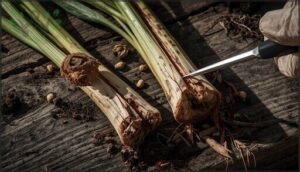
Stems reveal what leaves often hide. Split any suspect stem lengthwise to expose Internal Browning Inspection opportunities — Verticillium wilt and Phytophthora both leave diagnostic Vascular Discoloration Patterns inside.
- Examine Node Lesion Shape: reddish-brown cankers usually originate at petiole bases
- Assess Stem Girth Swelling for crown gall — hard, cracked, tumor-like masses
- Evaluate Surface Crack Morphology: longitudinal cracks signal tissue death
- Note elongated shallow lesions distinguishing pod blight from deeper cankers
Check Crowns and Roots for Rot
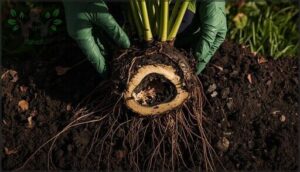
Pull back the soil at the base of any struggling plant and you’ll find where many diseases truly begin.
Soil Line Browning and Stem Collar Girdling are early rot indicators — wash the root ball to expose Feeder Root Mushiness or dark, hollow tissue.
Cut into the crown: Crown Necrosis Patches and Dark Interior Decay confirm infection.
When symptom pattern analysis remains inconclusive, submit samples to a diagnostic laboratory.
Note Flower and Fruit Damage Patterns
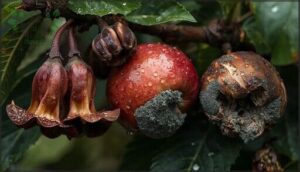
Flowers and fruit are often the clearest diagnostic windows you have.
Blossom Blight causes wilted, water-soaked flowers that quickly darken and cling to spurs — cankers follow at twig bases.
Fruit Rot produces tan circular Spot Lesions that develop ash-gray spore masses in humidity.
Gray Mold blasts young blossoms brown, while Distortion Damage from thrips leaves scarred petals and misshapen fruit — classic flower disease and fruit disease red flags.
Separate Disease From Plant Stress
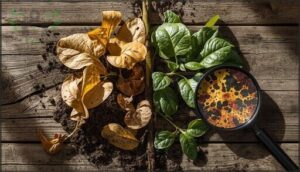
Not every struggling plant has a disease — sometimes the culprit is stress from its environment, not a pathogen. Telling the two apart early saves you from misdiagnosing the problem and applying the wrong fix.
Here’s what to look for when separating true disease from stress-related damage.
Biotic Vs. Abiotic Symptom Patterns
Distinguishing biotic from abiotic disease causes comes down to reading the language your plant is speaking. Biotic infections show Margin Definition — spots with clear borders, Spore Presence on leaf surfaces, and Temporal Progression as lesions spread outward. Abiotic stress shows Pattern Uniformity across large tissue areas with Environmental Correlation to heat or drought events.
Biotic disease spreads in patterns; abiotic stress speaks in uniformity — learn the difference
- Biotic: Discrete spots, fungal growth, spreading lesions
- Abiotic: Uniform browning, tip scorch, no pathogen signs
- Key tool: Symptom pattern analysis for field diagnosis confirms which disease triangle arm is active
Damage on One Plant or Many Plants
Once you’ve assessed whether symptoms look biotic or abiotic, ask yourself: Is this damage on one plant or many? Isolation Patterns—a single wilted stem, one cankered branch—often point to localized infection or a chance wound.
But Cluster Distribution and Spread Mechanisms across a row signal contagious disease.
Species Specificity matters too: if only tomatoes suffer while nearby herbs stay healthy, you’re dealing with a host-targeted pathogen.
Effects of Overwatering, Drought, and Poor Drainage
Water management mistakes mimic disease — and that’s where many diagnoses go wrong.
Overwatering triggers Root Oxygen Depletion, Stem Softening Symptoms, and Crown Rot Development as saturated soil suffocates roots. Drought stress causes leaf curl and crisp brown margins.
Watch for:
- Leaf Edema Formation: blistered, water-soaked lesions from cellular rupture
- Yellowing lower leaves signaling poor nutrient uptake
- Nutrient Leaching Effects from excess soil moisture
- Wilting despite wet soil — classic root rot indicator
Nutrient Deficiencies Vs. Pathogen Symptoms
Once you’ve ruled out water stress, nutrient deficiencies become the next likely suspect — and they can look deceptively similar to pathogen symptoms. The key is Leaf Age Patterns: nitrogen or potassium shortages show first on older leaves, while calcium deficiency hits new growth.
Pathogen Sign Presence — rust pustules, fuzzy mold, bacterial ooze — confirms disease.
Symptom Uniformity across many plants suggests nutrient imbalance; patchy spread signals infection.
Light, Temperature, and Humidity Clues
Environmental conditions are easy to misread as disease — but the clues are distinct once you know what to look for.
Low Light Symptoms include pale leaves and leggy, stretched stems.
Heat Stress Indicators show up as scorched edges and aborted flowers.
Cold Damage Signs appear as blackened, water-soaked tissue.
High Humidity Effects, paired with poor Airflow Wetness, accelerate fungal outbreaks, making environmental condition assessment essential before assuming pathogen involvement.
Diagnose Problems Step by Step

Getting to the root of a plant problem takes more than a quick glance — it takes a clear, repeatable process. Working through your diagnosis in the right order saves time and keeps you from chasing the wrong cause.
Here’s how to move from first observation to confident identification.
Start With Whole-plant Observation
Before you zero in on individual lesions, step back and read the whole plant. Your Silhouette Profile and Canopy Uniformity tell you more than any single spot can.
- Compare Branch Density against a healthy reference of the same species.
- Assess Root‑Shoot Balance by noting whether top growth outpaces visible rooting vigor.
- Conduct a Vigor Assessment by counting active shoot tips and new flushes.
- Document overall form before touching anything.
Record Symptom Location and Spread
Once you’ve scanned the whole plant, anchor every observation to a specific location. Map your infection zone by noting whether symptoms appear at the low, mid, or upper canopy — canopy level logging reveals a great deal about pathogen movement.
Build a symptom progression timeline by dating each new development. Track spread direction vectors along vein networks or outward from lesions, and tally affected branches systematically.
Compare Signs and Symptoms Carefully
Distinguishing signs from symptoms is where diagnostic confidence levels are made or broken. Symptoms — yellowing, wilting, leaf spots — represent the plant’s response; signs are the pathogen itself, like fungal spores or bacterial ooze.
Viral diseases show symptoms with zero visible pathogen indicators, so don’t expect both.
Tracking temporal symptom patterns alongside host-pathogen interaction clues sharpens your field symptom analysis considerably.
Use Photos, Guides, and Identification Apps
Your camera is your first diagnostic instrument. Capture four to six photos per plant — leaf undersides, stem lesions, and whole-plant habit — because photo quality directly affects app confidence scores.
Upload to AI-based mobile applications for plant disease diagnosis and management, then cross‑reference guide symptom matching against regional field guides.
Metadata tagging by date and location, combined with community validation, strengthens identification of plant diseases using leaf images considerably.
Collect Samples for Lab Confirmation
When field diagnosis hits its limit, the lab becomes your ground truth. Collect tissue using Sterile Container Use practices — separate bags per tissue type follow the Tissue Segregation Protocol that preserves distinct pathogen profiles. Accurate Labeling with GPS coordinates, symptom stage, and collection date is non‑negotiable.
- Use Cool Transport Methods (insulated bag, shade, 24–48 hr delivery)
- Document Chain of Custody to verify sample integrity on arrival
- Follow the sample collection protocol for collecting and shipping whole plant samples for laboratory diagnosis
- Note identifying fungal and oomycete structures such as spores and sclerotia before sealing
When to Contact an Extension Clinic
Once you’ve sealed your samples, don’t sit on a puzzling result. Extension clinics exist precisely for situations that are hard to diagnose — rapid spread, unclear symptoms, or whole-plant decline that started below ground.
| Situation | Why It Matters | Who to Contact |
|---|---|---|
| Rapid spread across planting | Disease can overtake a field in 24 hours | Plant diagnostic clinic |
| Unclear symptoms or mixed causes | Visual guesswork leads to wrong treatments | Extension specialist |
| High-value plants declining | Protects costly crops and ornamentals | Extension services |
Top 6 Plant Disease Guides
Having the right reference in your hands makes all the difference when you’re trying to pin down what’s wrong with your plants. These six guides cover everything from common garden diseases to pest management and tree care.
Here’s what’s worth keeping on your shelf.
1. Tree And Shrub Disease Guide

If you work with trees and shrubs, this guide belongs on your shelf.
Published by Comstock Publishing Associates, this 680-page second edition packs over 2,200 digitally optimized color images across 261 full-color plates — organized by disease-causing agent so you can actually find what you’re looking for.
It covers fungi, bacteria, viruses, and more, with symptom descriptions, disease cycles, and microscopic detail.
Whether you’re an arborist, horticulturist, or extension agent, it’s a reliable diagnostic reference for woody ornamentals across the U.S. and Canada.
| Best For | Arborists, horticulturists, foresters, and plant health professionals who need a thorough diagnostic reference for woody ornamental diseases across the U.S. and Canada. |
|---|---|
| Format | Hardcover book |
| Price Range | Premium |
| Visual Aids | 2,200+ color images |
| Target User | Professionals |
| Searchability | No digital search |
| Scope | Woody ornamentals |
| Additional Features |
|
- Over 2,200 color images make it easy to visually ID diseases in the field or classroom
- Organized by disease-causing agent, so finding what you need is actually straightforward
- Covers fungi, bacteria, viruses, and more — all in one comprehensive 680-page resource
- At 5 lbs and over a foot tall, it’s not exactly easy to haul out to a job site
- Published in 2005, so it may be missing newer disease reports or updated taxonomy
- No digital version means no keyword searching — you’re flipping pages the old-fashioned way
2. Rose Disease Identification Guidebook

Roses bring their own set of headaches, and a focused reference makes all the difference. The Rose Disease Identification Guidebook, published by the American Phytopathological Society, is a compact 50-page quarto paperback built for quick field use.
It covers the classics — black spot, powdery mildew, rust, and rose rosette — with line drawings and color photographs showing feathery-edged lesions, orange pustules, and distorted new growth. At under $10, it’s a practical addition for any rose grower who wants confident answers without guesswork.
| Best For | Rose growers of any experience level who want a quick, no-fuss way to diagnose common rose diseases right in the garden. |
|---|---|
| Format | Paperback book |
| Price Range | Budget |
| Visual Aids | Line drawings & photos |
| Target User | Rose growers |
| Searchability | No digital search |
| Scope | Roses only |
| Additional Features |
|
- At under $10 and just 50 pages, it’s easy to carry around and won’t break the bank.
- Line drawings and color photos make it simple to match what you’re seeing to a real diagnosis.
- Works just as well for a backyard hobbyist as it does for nursery staff or extension agents.
- Published in 1983, so it may be behind on newer disease variants and current treatment recommendations.
- Mostly black-and-white illustrations — the color photos are limited, which can make spotting subtle symptoms trickier.
- Only covers roses, and the short page count means complex diseases don’t get much depth.
3. Plant Disease Reference Handbook

When you’re dealing with something beyond roses — think orchard trees, cover crops, or greenhouse cucumbers — you need a reference that scales with you. The Compendium of Plant Diseases, published by Springer, covers fungi, bacteria, viruses, viroids, and nematodes across nearly every plant category imaginable, from turf grasses to native wildflowers.
At 848 pages, it’s not a field pocket guide, but it’s the kind of authoritative desk reference that plant pathologists, extension agents, and serious growers trust when a diagnosis genuinely matters.
| Best For | Plant pathologists, agronomists, extension agents, and serious growers who need a comprehensive, authoritative reference for diagnosing and managing plant diseases across a wide range of species and ecosystems. |
|---|---|
| Format | Hardcover book |
| Price Range | Premium |
| Visual Aids | Illustrations included |
| Target User | Professionals |
| Searchability | No digital search |
| Scope | All plant types |
| Additional Features |
|
- Covers an impressive range of plant types — trees, grasses, fruits, vegetables, greenhouse plants, and more — all in one place
- Goes deep on causal agents (fungi, bacteria, viruses, viroids, nematodes) with illustrations and control strategies
- Trusted by professionals and used in academic plant pathology programs
- Published in 2013, so some information on newer or emerging diseases may be out of date
- No digital version means you can’t search it — you’re flipping through 848 pages the old-fashioned way
- At $336 for a used copy, it’s a significant investment that won’t make sense for casual gardeners
4. Easy Plant Problem Solver Guide

Not every gardener needs an 848-page desk reference — sometimes you just need a clear answer, fast. The Easy Plant Problem Solver Guide from Timber Press does exactly that, walking you through illustrated flow-charts that use simple yes/no questions to narrow down problems across more than 400 diseases, pests, and disorders. No Latin required.
At $24.95 for a used hardcover copy, it’s a practical shelf staple for home gardeners, nursery staff, and landscapers who want reliable, organic treatment recommendations without the guesswork.
| Best For | Home gardeners, landscapers, and nursery staff who want a no-fuss, visual way to diagnose plant problems and treat them organically — no botanical expertise needed. |
|---|---|
| Format | Hardcover book |
| Price Range | Budget |
| Visual Aids | Flowchart diagrams |
| Target User | Home gardeners |
| Searchability | No digital search |
| Scope | 400+ problems |
| Additional Features |
|
- Covers 400 plant diseases, pests, and disorders using simple yes/no flowcharts anyone can follow
- All treatment recommendations are organic, making it a natural fit for eco-conscious growers
- Compact hardcover format holds up well in a shed or workshop for years of hands-on use
- At 452 pages with a flowchart layout, flipping between sections can get frustrating fast
- No digital version means no quick searching — you’re doing it the old-fashioned way
- Coverage of specific vegetable crops is thinner than some growers might hope for
5. Beneficial Nematodes Pest Control Solution
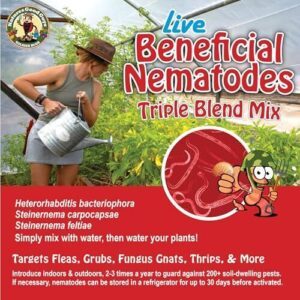
Sometimes the pest problem isn’t in the leaves at all — it’s underground.
NaturesGoodGuys Beneficial Nematodes deliver three species in one packet: Heterorhabditis bacteriophora, Steinernema carpocapsae, and Steinernema feltiae, each targeting different soil-dwelling larvae including fungus gnats, grubs, and cutworms.
You simply dilute the powder in water and apply it to moist soil.
At $17.25, it’s a non-chemical, residue-free option that fits cleanly into any integrated pest management approach — no sticky traps, no synthetic inputs.
| Best For | Gardeners and indoor growers who want a chemical-free way to tackle soil-dwelling pests like fungus gnats, grubs, and cutworms without reaching for synthetic pesticides. |
|---|---|
| Format | Powder packet |
| Price Range | Budget |
| Visual Aids | None |
| Target User | Gardeners |
| Searchability | N/A |
| Scope | Soil pests only |
| Additional Features |
|
- Three nematode species in one packet means broader pest coverage without buying multiple products.
- Safe to use around edible plants — no residues, no odor, no chemical runoff to worry about.
- Works in both indoor setups (like hydroponic grow bags) and outdoor garden beds for a lot of flexibility.
- Results aren’t instant — you’re looking at a week or more before you notice a real difference.
- Efficacy can be hit or miss depending on species match, soil moisture, and timing, so some pests may need repeat treatments.
- The cooling pack can arrive melted, which puts nematode viability at risk if you’re not ready to refrigerate right away.
6. Tree And Shrub Pest Guide
When diagnosing pests on woody plants, you need a resource built specifically for trees and shrubs — and the Pests of Landscape Trees and Shrubs guide from UC Agriculture and Natural Resources delivers exactly that. At 504 pages and packed with hundreds of color photographs, it walks you through insects, diseases, and abiotic disorders side by side.
Its IPM-focused framework helps you separate borer damage from fungal cankers before you reach for any treatment.
At $45.41, it’s a legitimate field and classroom reference.
| Best For | Landscapers, arborists, and horticulture students who need a thorough, photo-rich reference for diagnosing and managing pests on trees and shrubs. |
|---|---|
| Format | Paperback book |
| Price Range | Mid-range |
| Visual Aids | Hundreds of color photos |
| Target User | Professionals & hobbyists |
| Searchability | No digital search |
| Scope | Trees & shrubs |
| Additional Features |
|
- Hundreds of color photos make it genuinely useful for field identification — you can flip to a picture and match what you’re seeing.
- The IPM approach guides you toward smart, environmentally responsible decisions before jumping to chemical treatments.
- At $45.41 for 504 pages, it covers insects, diseases, and abiotic disorders in one book instead of three.
- Written for California’s climate, so gardeners in other regions may find some recommendations don’t quite fit their pest reality.
- Published in 1994, meaning newer invasive pests and modern treatment options aren’t covered.
- It’s a big, heavy book — not something you’ll easily tuck into a back pocket for quick field use.
Frequently Asked Questions (FAQs)
What is the free app that identifies plant diseases?
Plantix is a free app that diagnoses plant diseases from a photo in seconds. It covers 780+ plant damages across 30 major crops and is available in 19 languages with over 10 million downloads.
What are three ways to identify plant diseases?
You can identify plant diseases through visual symptom inspection, root and stem examination, and lab-based sample testing. Each method builds on the last, giving you a clearer, more confident diagnosis.
What are the 5 plant diseases?
The five most impactful plant diseases you’ll encounter are powdery mildew, late blight, bacterial wilt, Fusarium wilt, and rust disease — each caused by distinct pathogens and requiring targeted management strategies.
What are the top 10 viral diseases in plants?
Viral diseases leave a distinctive fingerprint: mosaic patterns, leaf curl, stunting, and distorted growth.
The top 10 include Tobacco Mosaic, Cucumber Mosaic, Tomato Yellow Leaf Curl, Papaya Ringspot, Wheat Streak Mosaic, Cassava Mosaic, Rice Tungro, Maize Dwarf Mosaic, Bean Common Mosaic, and Tomato Spotted Wilt.
Can plant diseases spread between different species?
Yes, plant diseases absolutely can spread between species. Botrytis cinerea, for instance, infects over 200 plant types, while bacterial wilt (Ralstonia solanacearum) attacks nearly 200 species across 50 botanical families.
How long do plant diseases take to show?
Plant diseases don’t follow a fixed clock.
Depending on the pathogen, visible symptoms can appear anywhere from a few days to several weeks — or even longer — after infection first takes hold.
Which seasons see the most plant diseases?
Spring and early summer bring the heaviest disease pressure when warm, humid conditions fuel fungal and foliar pathogens.
Cool, wet springs also trigger damping off and root rots in young seedlings.
Do indoor plants get the same diseases?
Indoor plants aren’t immune — they face the same fungal, bacterial, and viral threats as outdoor plants. Cramped pots, wet soil, and poor airflow actually make disease easier to develop indoors.
Can you cure diseases once plants show symptoms?
Once symptoms appear, most plant diseases can’t be fully cured — only managed. You can slow the spread, protect healthy tissue, and support recovery, but affected areas rarely return to normal.
How can I prevent misdiagnosing plant diseases?
Avoid misdiagnosis by inspecting all plant parts, noting symptom patterns and progression, and distinguishing signs from symptoms.
Use guides, comparison photos, and diagnostic apps, and collect fresh samples for lab confirmation when the cause remains uncertain or ambiguous.
Conclusion
Over 80% of plant diseases become unmanageable within 48 hours of visible symptoms spreading—yet this guide enables you to act decisively.
Mastery of how to identify plant diseases hinges on systematic observation: inspecting leaves for powdery mildew, stems for cankers, and roots for rot while distinguishing pathogens from drought stress or nutrient deficiencies.
The diagnostic process—recording spread patterns, consulting guides, and using lab resources—transforms uncertainty into precision.
Your vigilance now prevents epidemics later, turning gardens from vulnerable targets into resilient ecosystems through evidence‑based care.
- https://docs.google.com/forms/d/1GAQr3Kn1cURCVHUA82hAga1Wv8DCH0IuqDLRUrOpN7M/viewform?ts=63f4f653&entry.1515682415=https://www.merriam-webster.com/dictionary%2Fidentify
- https://unabridged.merriam-webster.com/check-redirect-premium?utm_source=mw&utm_medium=inline-def&utm_campaign=evergreen&headword=identify
- http://blogs.cornell.edu/livegpath/gallery/
- https://www.npdn.org/home
- https://basil.agpestmonitor.org/