This site is supported by our readers. We may earn a commission, at no cost to you, if you purchase through links.
reach for a spray bottle the moment they spot trouble—but by then, the disease has already won half the battle.
Plant pathogens are patient. Fungi wait for humid mornings. Bacteria hitchhike on dirty pruners. Viruses travel with the aphids you haven’t noticed yet.
Organic disease control isn’t about reacting faster; it’s about building a garden that makes pathogens work harder to get a foothold. From soil biology to spray timing, every decision either invites disease or shuts the door on it.
The tips ahead will help you do the latter.
Table Of Contents
- Key Takeaways
- Organic Disease Control Basics
- Choose Organic Fungicide Types
- Apply Organic Controls Safely
- Build Disease-Resistant Garden Systems
- Top 10 Organic Disease Control Items
- 1. Microbial Biopesticides Formulation Guide
- 2. Black Kow Compost Manure Fertilizer
- 3. Espoma Organic Rock Phosphate Fertilizer
- 4. Great White Mycorrhizal Root Booster
- 5. Companion Planting Guide for Beginners
- 6. Live Edible Herb Assortment Plants
- 7. Cherokee Purple Heirloom Tomato Seeds
- 8. Black Duck Assorted Vegetable Herb Seeds
- 9. Back to the Roots Organic Heirloom Seed Mix
- 10. OXO POP Airtight Food Storage Container
- Frequently Asked Questions (FAQs)
- Is vinegar a good fungicide?
- Can I use dish soap as a fungicide?
- Is apple cider vinegar a fungicide?
- How to control plant diseases organically?
- Is cinnamon a natural fungicide for plants?
- What is an example of an organic fungicide?
- What is organic disease management?
- What are the 5 principles of plant disease control?
- What is an organic fungicide?
- How much do organic treatments cost?
- Conclusion
Key Takeaways
- Prevention beats reaction every time — healthy soil, smart watering, and good airflow make it genuinely hard for pathogens to gain a foothold.
- Matching your treatment to the actual threat matters: fungal, bacterial, and viral diseases each spread differently and need a different fix.
- Organic sprays like neem oil, copper, and biological fungicides work best when applied early, timed to weather, and rotated to prevent resistance.
- Building long-term disease resistance means layering your defenses — rotate crops, add compost, choose resistant varieties, and clean up infected debris every season.
Organic Disease Control Basics
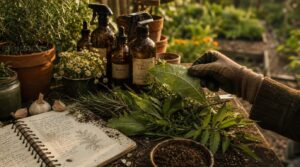
Keeping your garden healthy starts long before you ever reach for a spray bottle.
Building good habits early—like soil care, crop rotation, and smart watering—is the foundation of safe pest control for edible gardens that actually lasts.
Knowing what you’re dealing with — whether it’s a fungal problem, a bacterial issue, or something lurking in your soil — makes all the difference in choosing the right fix.
Here’s what every organic gardener needs to understand first.
Prevention-first Garden Care
Before disease ever shows up, your best defense is a system that makes plants hard to infect. Start with healthy transplants, sterilize tools between plants, and use smart watering techniques like drip irrigation to keep foliage dry.
Airflow enhancement through proper spacing and preventive pruning reduces humidity in the canopy.
Strong soil health improvement and biological controls round out a solid organic disease control foundation.
Fungal Vs Bacterial Diseases
Knowing what you’re up against changes everything.
Fungal disease spreads through airborne spores and thrives in humid, damp conditions — think powdery coatings or rust-colored pustules.
Plant bacterial diseases move differently, traveling via water, insects, or tools, leaving water-soaked lesions and angular spots.
Each has distinct pathogen structures and symptom patterns, so your organic disease control approach — whether biological control, Neem oil, or copper spray — needs to match the actual threat.
Understanding the cell wall composition differences helps target treatments effectively.
Viral Disease Warning Signs
Viruses in plants are sneakier than fungi or bacteria — no visible spores, no water-soaked spots.
Sucking insects like aphids carry them straight into your plants.
Watch for these warning signs during disease scouting:
- Leaf Mosaic Patterns — blotchy light and dark patches
- Leaf Curl Symptoms — twisted or cupped leaves
- Plant Stunting Signs — compact, slow growth
- Ring Spot Identification — circular tan or brown lesions
- Fruit Abnormalities — misshapen or mottled harvests
Vector management and building plant immunity start with catching these early.
Soil-borne Disease Risks
Some threats hide right beneath your feet. Soilborne diseases don’t announce themselves — they build quietly through pathogen dormancy, waiting for wet conditions or stressed roots to strike.
| Risk Factor | What It Means |
|---|---|
| Moisture Impact | Waterlogged soil fuels root and soilborne fungi |
| Soil Structure | Clay texture sustains humid pockets near roots |
| Subsoil Risks | Deep propagules infect roots as they grow down |
| Salinity Effects | Salt stress shifts root chemistry, inviting soilborne pathogens |
Soilborne pathogen management starts with understanding your soil health and microbiome — because what lives underground shapes everything above it.
When Organic Sprays Help
Organic sprays earn their place when conditions stack against you — high humidity, post‑rain disease prevention windows, or seedling protective sprays during vulnerable early growth. Timing matters most.
- Apply preventive application timing before symptoms spread.
- Use neem oil-based fungicides at first leaf signs.
- Rotate botanical oil-based sprays for organic spray rotation.
- Respect harvest-safe intervals on every natural fungicide label.
Choose Organic Fungicide Types
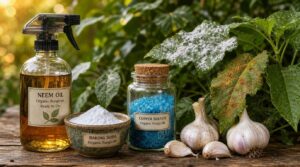
Not all organic fungicides work the same way, and picking the right one can make a real difference in your garden. Each type has its own strengths depending on the disease you’re dealing with and the plants you’re protecting.
Here’s a look at your main options.
Neem Oil Uses
Neem oil is one of those rare garden allies that pulls double duty — fighting both pests and disease in one spray.
Through pest hormone disruption, it blocks insect molting and feeding cycles at the source.
As a neem oil-based fungicide, it builds foliar fungal barriers against powdery mildew, rust, and black spot.
| Use | Method | Benefit |
|---|---|---|
| DIY Neem Formulations | Mix 1 tsp per liter with surfactant | Affordable, customizable coverage |
| Soil Drench Benefits | Apply to root zone | Targets soil-dwelling pests systemically |
| Seedling Protection Coats | Spray young transplants early | Shields vulnerable new growth |
Sulfur and Copper Sprays
When chemical-free isn’t cutting it, sulfur and copper sprays are your mineral-based fungicides that actually work.
Their spray mechanisms are straightforward — elemental sulfur blocks spore germination while copper fungicides release ions that disrupt fungal cell walls. Bordeaux mixture does both.
Rotate them for resistance prevention, watch soil microbe effects with cumulative use, and match each to your crop compatibility needs for smart residue management.
Biological Fungicide Options
Living microbes are your garden’s undercover defense team.
Biological fungicides work through microbial antagonists that outcompete pathogens before they gain ground.
Bacillus subtilis colonizes leaf surfaces preventatively, while Trichoderma harzianum targets root-colonizing fungi and soilborne threats.
Soil actinomycetes like Streptomyces lydicus protect the root zone naturally.
Microbe application timing matters — apply early.
Hyperparasite fungicides like Ampelomyces quisqualis even attack powdery mildew directly.
Botanical Extract Treatments
Plants have their own pharmacy — and botanical extracts tap right into it.
Garlic extract benefits your garden through allicin, which disrupts fungal and bacterial cell membranes fast. Citrus oil applications handle soft rots and leaf spots preventively. Capsaicin pest control deters insects while suppressing some fungi.
These herbal extract blends make powerful natural fungicides and organic fungicides for plants. Extract storage tips: keep them cool and dark.
Pollinator-friendly Spray Choices
Your bees deserve a seat at the table too. Choosing OMRI-listed, USDA Organic certified sprays with solvent-free options keeps nectar and pollen clean.
Bloom‑stage timing — evening or afternoon applications — reduces direct pollinator contact. Neem oil-based fungicides and botanical oil‑based sprays dry fast and leave no harmful residues.
drift reduction techniques with microbial compatibility in mind, and your garden stays both disease‑free and pollinator‑friendly.
Apply Organic Controls Safely
Even the best organic spray won’t do much good if you use it wrong. Timing, coverage, and basic safety habits make a real difference in whether your treatment actually works.
Here’s what to keep in mind before you reach for the bottle.
Spray at First Symptoms
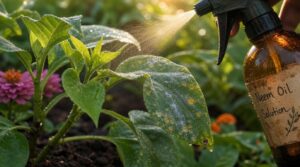
The moment you spot early symptoms—white fuzz, yellowing spots, or tiny lesions—your symptom spotting guide instinct should kick in. That’s your cue to act.
Apply natural fungicides or neem oil-based fungicides right away, targeting new growth first, using lesion targeting techniques. Cool-weather application during morning hours improves coverage, helps prevent secondary infections, and keeps your organic fungicide for plants working effectively.
Follow Label Reapplication Intervals
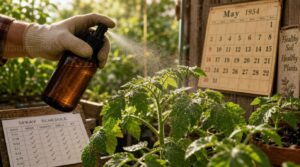
Once you’ve sprayed, don’t assume one application does the job.
Label reapplication intervals are your spray schedule tracking system — most organic products call for retreatment every 7–10 days, especially under humid conditions. Rain within 48 hours? Reapply sooner.
Respecting these intervals enhances fungicide resistance management, prevents phytotoxicity, and keeps you aligned with organic certification standards.
Cover Leaf Surfaces Fully
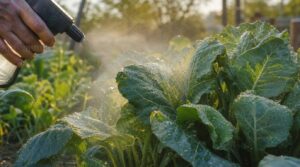
After setting your spray schedule, aim for full leaf surface coverage.
Pick the right spray nozzle selection—fine mist nozzles help Botanical oil-based Sprays reach tricky undersides.
Leaf surface challenges like waxiness or rough texture demand coverage assessment methods and use adhesion enhancers.
Weather impact factors matter; foliar application works best on dry leaves.
Proper organic spray formulations boost your preventive spray programs.
Avoid Heat and Wind
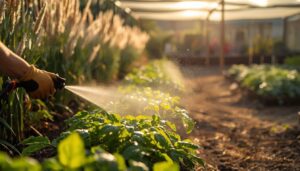
Good coverage means nothing if you spray at the wrong time. High heat and windy conditions break down organic fungicides before they even dry. Weather-dependent spraying is non‑negotiable for proper fungicide application.
- Use shade structures during peak afternoon hours
- Plant windbreak plants on exposed garden edges
- Apply mulching techniques to cool root zones
- Increase plant spacing to improve airflow
- Use evaporative cooling in enclosed growing areas
Wear Gloves and Goggles
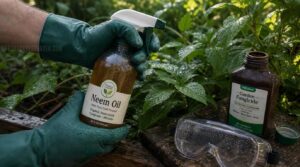
Before reaching for any organic sprays or neem oil-based fungicides, suit up properly. Nitrile or neoprene gloves — your first pick for glove material selection — hold up well against horticultural oils and botanical oil-based sprays.
Check for tears before each session; pre‑use glove checks take seconds but save your skin.
Pair them with splash goggles featuring anti‑fog tech and adjustable straps for goggles fit adjustments.
Rinse both after use — simple PPE cleaning methods protect your personal protective equipment and you.
Build Disease-Resistant Garden Systems
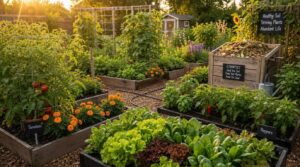
Sprays and treatments are only part of the picture—your garden’s long-term health depends on the systems you build around it. Think of it as playing defense: the stronger your foundation, the less you’ll need to fight off problems later.
Five practices that help your garden resist disease from the ground up.
Rotate Crops Yearly
Crop rotation is one of the oldest tricks in sustainable agriculture — and it still works. Moving crops to different beds each year disrupts pest cycles, improves soil structure, and enhances microbe diversity through varied residues. A simple three-year crop sequencing plan balances nutrient cycling naturally, cutting disease pressure dramatically.
Think of it as resetting the board so pathogens never get comfortable.
Improve Soil With Compost
Compost is your soil’s best defense — and its most loyal ally.
Working organic matter into your top 6 to 8 inches improves soil structure, boosts water retention, and kick-starts natural nutrient release over weeks. Better drainage means fewer fungal hot spots. Stronger aggregates mean less erosion.
And that microbial boost from composting? It quietly suppresses pathogens, making disease prevention in gardens far less of a battle.
Composting’s microbial boost quietly suppresses pathogens, making garden disease prevention far less of a battle
Add Beneficial Microbes
Think of beneficial microbes as a living shield around your plants. Microbial inoculant types — including Bacillus, Pseudomonas, and mycorrhizal fungi — form symbiotic relationships with plants that boost nutrient uptake and induce systemic resistance naturally.
Biocontrol agents colonize roots, crowd out pathogens, and even improve iron absorption. Seed treatment methods deliver soil microbes right at germination, giving your garden’s microbial biocontrol system the strongest possible head start.
Remove Infected Plant Debris
Leaving infected plant debris in your garden is like handing pathogens a free hotel room. Strong sanitation practices stop pathogen buildup before it spirals.
Here’s your cleanup timing checklist for smart crop residue management:
- Remove debris in dry weather to prevent spread
- Bag diseased material — composting risks are real at home
- Sanitize tools with 10% bleach after each pass
- Dispose via municipal green waste for proper debris disposal
- Repeat seasonally to support long-term plant disease prevention
Choose Resistant Varieties
Your best defense starts before seeds even hit the soil. Resistant plant selection takes the fight to pathogens before symptoms appear.
Look for disease resistance codes like VFNT on tomato varieties — those letters signal pathogen-specific traits bred right into the plant.
Prioritize local cultivar adaptation by checking regional extension guides and always choose seed source reliability over price.
Resistant cultivars simply make organic gardening easier.
Top 10 Organic Disease Control Items
Good systems need good tools, and the right products can make all the difference between a struggling garden and a thriving one.
These ten items cover everything from soil health to seed selection, giving you a solid foundation for organic disease control.
Here’s what’s worth adding to your toolkit.
1. Microbial Biopesticides Formulation Guide
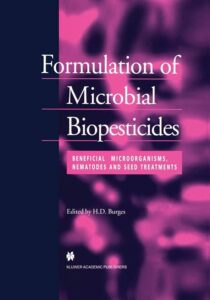
Understanding how biopesticides are built helps you choose products that actually work in the field. This Springer reference breaks down formulation science across five focused sections — covering wettable powders, oil dispersions, and seed treatments.
It’s written for researchers and agronomists, but the practical guidance on keeping microbes viable during storage and application translates directly to real garden decisions. At $254.21, it’s a serious investment, though invaluable if you’re developing or deeply evaluating microbial disease control programs.
| Best For | Researchers, agronomists, and microbiologists who are actively developing or rigorously evaluating microbial biopesticide programs in academic or commercial settings. |
|---|---|
| Price | $254.21 |
| Format | Hardcover book |
| Organic Certified | No |
| Beginner Friendly | No |
| Primary Use | Research reference |
| Reusable/Multi-Season | Yes |
| Additional Features |
|
- Covers formulation science in real depth — wettable powders, oil dispersions, seed treatments — all in one place.
- Written by recognized experts, so the guidance is grounded and credible.
- Three appendices (additives, spray criteria, terminology) make it genuinely useful as a go-to reference.
- Published in 2012, so it may be behind on current regulations and recent science.
- At $254.21, it’s a tough sell for individuals or smaller institutions.
- No digital version mentioned, which makes searching and referencing on the fly harder than it should be.
2. Black Kow Compost Manure Fertilizer
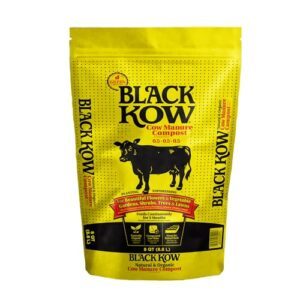
Not every disease solution comes in a spray bottle. Black Kow Compost Manure Fertilizer works from the ground up — literally.
Its granular cow manure feeds millions of beneficial bacteria that convert nutrients into plant-available forms, quietly building the kind of soil that pathogens struggle to colonize. Better drainage means fewer waterlogged roots, and fewer fungal problems down the line.
At 6 lbs a bag, it’s best suited for garden beds and rose plots rather than large acreage.
| Best For | Home gardeners and rose growers looking to build healthier soil from the ground up without risking root burn. |
|---|---|
| Price | $19.00 |
| Format | Granular bag |
| Organic Certified | Yes |
| Beginner Friendly | Yes |
| Primary Use | Soil enrichment |
| Reusable/Multi-Season | No |
| Additional Features |
|
- Slow-release nutrients feed plants steadily without the risk of burning tender roots
- Beneficial bacteria help convert nutrients into forms plants can actually use
- Works double duty — improves drainage in clay soils and moisture retention in sandy ones
- At around $19 for just 6 lbs, it gets pricey fast if you’re covering a large area
- Small bag size means multiple trips to the store for bigger projects
- Some buyers have received bags that weren’t properly sealed, which is annoying to deal with
3. Espoma Organic Rock Phosphate Fertilizer
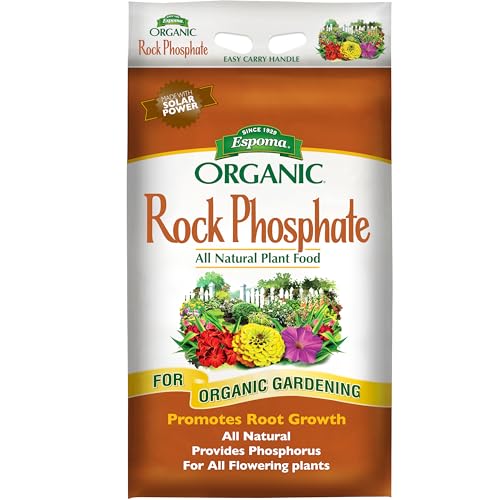
Strong roots are your first line of defense — and that’s where Espoma Organic Rock Phosphate earns its place. This 28‑lb bag of pelletized phosphorus feeds root development slowly and steadily, releasing nutrients for up to a decade in acidic soils.
It’s clean, certified organic, and free from synthetic fillers.
Mix it into new beds before planting or work it around established plants.
Just remember: it supplies phosphorus only, so pair it with a nitrogen source for balanced feeding.
| Best For | Organic gardeners growing root vegetables, tomatoes, bulbs, or dahlias in acidic soil who want a long-lasting phosphorus boost without synthetic inputs. |
|---|---|
| Price | $28.00 |
| Format | Pellet bag |
| Organic Certified | Yes |
| Beginner Friendly | Yes |
| Primary Use | Root nutrition |
| Reusable/Multi-Season | Yes |
| Additional Features |
|
- Slow-release formula can feed your soil for up to 10 years, so you’re not out there re-applying every season.
- 100% organic and certified safe for people, pets, and the environment — no sketchy fillers.
- Pelletized form makes it easy to spread evenly with minimal dust.
- Barely works in neutral or alkaline soil — phosphorus just won’t break down and become available to plants.
- Phosphorus only, so you’ll need to grab a separate nitrogen and potassium source to round out your feeding.
- Releases slowly, which means heavy feeders might need extra supplemental fertilizer during peak growing season.
4. Great White Mycorrhizal Root Booster
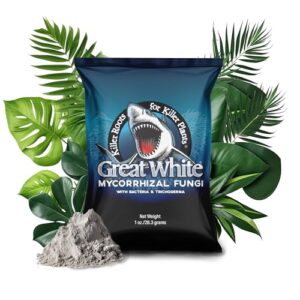
Once your roots have a strong phosphorus foundation, give them a living upgrade. Great White Mycorrhizal Root Booster adds multiple fungi strains and beneficial bacteria that colonize your root zone fast. That means wider nutrient reach, better drought tolerance, and stronger transplants with less shock.
Mix roughly half a teaspoon per gallon and apply as a drench or root dust — it works in soil, coco, and hydroponics. At $15.49 for 4 oz, it punches well above its weight.
| Best For | Home gardeners and hydroponic growers who want faster root development and stronger transplants without overhauling their current feeding setup. |
|---|---|
| Price | $15.49 |
| Format | Powder pouch |
| Organic Certified | No |
| Beginner Friendly | Yes |
| Primary Use | Root inoculation |
| Reusable/Multi-Season | No |
| Additional Features |
|
- Works across soil, coco, and hydro systems, so you don’t need a different product for different grows
- Combines multiple fungi strains with beneficial bacteria for broader root colonization and better nutrient reach
- Boosts drought tolerance and cuts transplant shock, which can make a real difference in early growth stages
- At $15.49 for just 4 oz, it gets pricey fast if you’re running a large-scale operation
- The bag seals poorly, so you’ll want a separate airtight container to keep it fresh
- Easy to overdo it — especially around flowering, where too much can actually work against you
5. Companion Planting Guide for Beginners
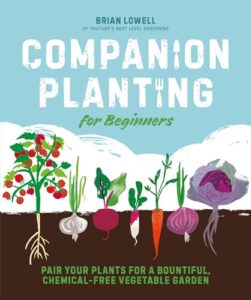
Think of this book as your garden’s cheat sheet. The Companion Planting Guide for Beginners, by expert organic gardener Brian Lowell, maps out over 100 plant pairings — alphabetically organized so you’re not digging through fluff.
Pair tomatoes with basil to repel thrips, or let marigolds fight off soil-dwelling pests naturally.
At $10.46 for 176 full-color pages, it’s beginner-friendly without being dumbed down. Whether you’re working a raised bed or containers, this guide helps you build a system where plants protect each other.
| Best For | New gardeners who want a simple, affordable way to grow more food without reaching for chemicals. |
|---|---|
| Price | $10.46 |
| Format | Paperback book |
| Organic Certified | No |
| Beginner Friendly | Yes |
| Primary Use | Planting guide |
| Reusable/Multi-Season | Yes |
| Additional Features |
|
- Over 100 plant pairings, organized alphabetically — easy to look something up without reading the whole thing
- Full-color photos and layouts make it genuinely easy to visualize your garden before you dig
- At $10.46, it’s a low-risk buy that covers pest control, soil health, and crop rotation in one place
- Sticks mostly to common vegetables, so if you’re growing anything unusual, you may hit some gaps
- Built around temperate-zone conditions, so results can vary if your climate runs hot, cold, or weird
- A few tips (like neem-oil timing) conflict with standard advice, so it’s worth double-checking those
6. Live Edible Herb Assortment Plants

Six ready-to-plant herbs for just $29.99 — that’s a pretty solid head start on a kitchen garden that actually works with your disease control plan.
The Three Company’s Live Edible Herb Assortment lands basil, cilantro, parsley, chives, and dill at your door, grown without synthetic pesticides and ready for transplanting.
Space them 6 to 8 inches apart for good airflow, and you’ll naturally cut down on fungal pressure before it even starts.
| Best For | Beginner gardeners who want a low-effort way to start growing fresh culinary herbs indoors or outdoors. |
|---|---|
| Price | $29.99 |
| Format | Live plants |
| Organic Certified | Yes |
| Beginner Friendly | Yes |
| Primary Use | Culinary herbs |
| Reusable/Multi-Season | No |
| Additional Features |
|
- Six fully rooted plants for $29.99 is solid value — you’re basically skipping the seedling stage entirely.
- Ready to transplant right away, so there’s almost no learning curve for new gardeners.
- Great variety of culinary herbs that pull double duty in the kitchen and as a windowsill display.
- You don’t get to pick your herbs — the mix rotates weekly, so what shows up is a bit of a surprise.
- Shipping can be rough on live plants; some buyers have reported wilting, mites, or root rot on arrival.
- Plants may be smaller than the photos suggest, and the packaging doesn’t always allow enough airflow.
7. Cherokee Purple Heirloom Tomato Seeds
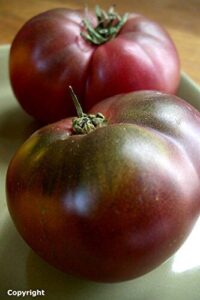
Cherokee Purple heirloom tomato seeds give you something hybrids can’t — real flavor and full seed-saving control season after season. At $4.29 for 75 seeds, you’re getting open-pollinated, non-GMO genetics that stay true to type.
These indeterminate vines need sturdy support and at least 6 hours of sun daily, plus well-drained soil to avoid disease pressure. They’re more susceptible to soil-borne problems than hybrids, so pair them with crop rotation and beneficial microbes to keep them thriving.
| Best For | Home gardeners and seed-saving enthusiasts who want old-school flavor and don’t mind putting in a little extra care. |
|---|---|
| Price | $4.29 |
| Format | Seed packet |
| Organic Certified | Yes |
| Beginner Friendly | No |
| Primary Use | Heirloom tomatoes |
| Reusable/Multi-Season | Yes |
| Additional Features |
|
- Rich, sweet-winey flavor that most hybrid tomatoes just can’t match — great fresh or cooked
- Open-pollinated seeds mean you can save and replant them every season, paying $4.29 once and growing from there
- Compact enough for small gardens or containers, with 75 seeds per packet giving you plenty to work with
- More disease-prone than hybrids, so you’ll need to stay on top of crop rotation and soil health
- Germination rates are unpredictable — anywhere from 25% to nearly 100% depending on how you handle the seeds
- Hot, humid climates can hurt fruit set, and you may need to hand-pollinate if pollinators are scarce in your area
8. Black Duck Assorted Vegetable Herb Seeds
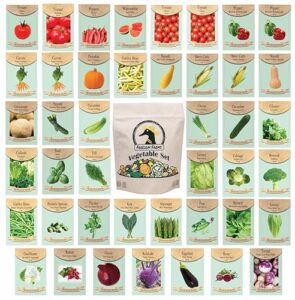
Want variety without the guesswork? Black Duck Assorted Vegetable Herb Seeds pack delivers 43 heirloom, non‑GMO varieties in one $9.99 bundle — roughly 10,000 seeds total.
That’s serious garden diversity on a shoestring budget. Each packet includes planting directions, so you’re never left guessing about depth or spacing.
The included Mylar bag keeps seeds viable for future seasons when stored cool and dry. Just note that about 30% of packets may be duplicate varieties.
| Best For | Home gardeners who want to grow a wide variety of vegetables and herbs without spending a lot or buying a dozen separate seed packs. |
|---|---|
| Price | $9.99 |
| Format | Seed bundle |
| Organic Certified | Yes |
| Beginner Friendly | Yes |
| Primary Use | Garden variety |
| Reusable/Multi-Season | Yes |
| Additional Features |
|
- 43 heirloom, non-GMO varieties for just $9.99 — hard to beat that value
- Each packet has planting instructions right on the back, great for beginners
- Comes with a Mylar bag to keep seeds fresh for future growing seasons
- About 30% of packets are duplicate varieties, so true diversity takes a hit
- Seeds are measured in milligrams, not count, which makes it tricky to know exactly how much you’re planting
- Some users found date info on packets hard to read or missing entirely
9. Back to the Roots Organic Heirloom Seed Mix
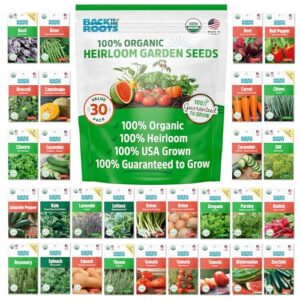
Back to the Roots Organic Heirloom Seed Mix gives you 30 seed packets — herbs, vegetables, fruits, and edible flowers — all certified organic and non-GMO, for just $29.99. Each variety is germination-tested, and the brand backs that up with a zero-risk replacement guarantee.
You also get a "Grow One Give One" program that donates a kit to a classroom when you share a photo. It’s a solid, community-minded starter kit for any organic garden.
| Best For | Beginner and experienced gardeners who want a broad, organic seed selection and like the idea of giving back to their community. |
|---|---|
| Price | $29.99 |
| Format | Seed kit |
| Organic Certified | Yes |
| Beginner Friendly | Yes |
| Primary Use | Seed collection |
| Reusable/Multi-Season | Yes |
| Additional Features |
|
- 30 certified organic, non-GMO heirloom seed packets for just $29.99 — solid value for the variety you get
- Germination-tested with a zero-risk replacement guarantee, so you’re not left hanging if something doesn’t sprout
- "Grow One Give One" program donates a kit to a classroom when you share a photo — easy way to do some good
- Exact seed varieties can vary between orders, and some items (like cosmos seeds) have been reported missing
- Packaging isn’t always what you’d expect — some customers got a plain brown bag instead of a decorative sleeve
- The replacement guarantee requires you to reach out to the seller, so it’s not completely hands-off
10. OXO POP Airtight Food Storage Container
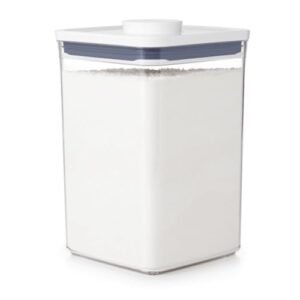
Storing your organic seeds, amendments, and dry inputs properly is part of disease prevention, too.
The OXO POP Airtight Food Storage Container keeps moisture and pests out of your flour, rice, or garden seed stash — and at $21.95 for a 4.4 qt container, it’s a practical addition to any organized growing space. The push-button lid seals with a satisfying click, and it’s dishwasher-safe and BPA-free. Stack a few in your pantry or potting shed, and you’re set.
| Best For | Home gardeners and kitchen organizers who want a clean, stackable way to store dry pantry staples or garden inputs like seeds and amendments. |
|---|---|
| Price | $21.95 |
| Format | Plastic container |
| Organic Certified | No |
| Beginner Friendly | Yes |
| Primary Use | Food storage |
| Reusable/Multi-Season | Yes |
| Additional Features |
|
- The push-button lid seals one-handed and doubles as a handle — genuinely useful when your other hand’s full.
- Stackable square shape makes the most of shelf or cabinet space, and the curved corners help ingredients flow out cleanly.
- Dishwasher-safe and BPA-free, so cleanup is easy and you’re not dealing with sketchy materials near your food.
- It’s not a true hermetic seal — if you need long-term freshness for something like specialty flour or sensitive seeds, you may notice a difference over time.
- Don’t store it upside down; the lid can pop off, which is a problem if you’re moving it around.
- Accessories like measuring cups and labels are sold separately, so the sticker price can creep up if you want the full setup.
Frequently Asked Questions (FAQs)
Is vinegar a good fungicide?
Got vinegar in your pantry? It can inhibit some fungal growth on contact, but it’s not a reliable fix. Stronger concentrations burn leaves, and it won’t protect your garden long-term.
Can I use dish soap as a fungicide?
Dish soap isn’t a registered fungicide, so it won’t reliably protect your plants from disease. It may knock off a few spores, but it can’t stop infections already taking hold.
Is apple cider vinegar a fungicide?
Apple cider vinegar isn’t a true fungicide — it’s diluted acetic acid that can knock back some fungal spores on contact, but it won’t protect your plants long-term.
How to control plant diseases organically?
Controlling plant diseases organically starts with prevention — remove infected debris, space plants for airflow, and rotate crops yearly.
Use neem oil, biological fungicides, or copper sprays at first symptoms for best results.
Is cinnamon a natural fungicide for plants?
Cinnamon is a mild natural fungicide, not a cure-all. Its active compound, cinnamaldehyde, can slow some fungal growth, but it works best as a preventative, especially against damping-off in seedlings.
What is an example of an organic fungicide?
Neem oil is a go-to organic fungicide that disrupts fungal lipid membranes within 24 to 48 hours. Sulfur sprays and copper-based options also work well for broad-spectrum disease control.
What is organic disease management?
Think of your garden like a neighborhood watch — organic disease management keeps the whole ecosystem on alert, using prevention, soil health, and smart plant choices to stop problems before they start.
What are the 5 principles of plant disease control?
There are five core principles: exclusion, prevention, host resistance, cultural control, and biological solutions. Together, they build a layered defense that keeps diseases from taking hold in the first place.
What is an organic fungicide?
An organic fungicide comes from natural sources — plant extracts, minerals, or beneficial microbes — and fights fungal disease without synthetic chemicals.
It’s approved for organic use and works both as a preventive shield and an active treatment.
How much do organic treatments cost?
Costs vary widely — neem oil runs $10–$25 per bottle, sulfur sprays $8–$25 per pound, and copper products $15–$40 per pint. Biological fungicides cost more but often cover larger areas.
Conclusion
A gardener in Vermont once lost her entire tomato crop to late blight—then rebuilt her beds with compost, resistant varieties, and copper spray on a consistent schedule. The following season, her plants barely flinched.
That’s what organic disease control actually looks like in practice: not a single miracle product, but a layered system working quietly in your favor. Build the right foundation, stay consistent, and pathogens simply won’t find the opening they’re looking for.