This site is supported by our readers. We may earn a commission, at no cost to you, if you purchase through links.

Gardening doesn’t stop at the wheelchair—but the wrong bed design will. A standard ground-level plot puts most work out of reach, turns a rewarding hobby into a frustrating stretch, and leaves you with soil you can barely touch.
The fix isn’t complicated, but it requires careful planning: dimensions, approach angles, and materials must align with how wheelchair users sit, reach, and move. Raised beds for accessibility aren’t merely taller boxes—they demand intentional design.
Get it right, and the garden works with you instead of against you.
Table Of Contents
Key Takeaways
- Bed height between 28–34 inches and a 60-inch turning radius isn’t suggestions—they’re the baseline for a garden you can actually use from a wheelchair.
- The approach angle matters as much as the height: parallel beds let you roll up alongside, while forward-approach and U-shaped designs give you front-facing access without repositioning.
- Materials like composite lumber, galvanized metal, and HDPE plastic outlast wood with far less upkeep, making them the smarter long-term pick for accessible builds.
- Drip irrigation, self-watering planters, and non-slip paths aren’t extras—they’re what keep a well-designed bed from becoming a daily frustration.
What Makes Raised Beds Accessible?
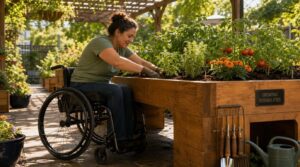
Not every raised bed works for wheelchair users—the design details matter more than most people realize. Height, approach angle, and clearance all play a role in whether a garden actually feels usable or just looks accessible. Here’s what to look for.
Getting the details right from the start makes all the difference, and these wheelchair-accessible raised bed design guidelines lay out exactly what height, clearance, and approach space to plan for.
Parallel Approach Beds
With a parallel approach bed, your wheelchair rolls right up alongside the planting zone — no awkward repositioning needed. Dual Aisle Access means you can work both sides comfortably. Here’s what makes this design click:
- Uniform Trough Spacing at 24 inches wide fits standard wheelchair legroom
- Adjustable Rail Height from 28–34 inches matches your chair
- Rounded Edge Safety prevents skin snags mid-reach
- Integrated Tool Hooks keep everything within arm’s reach
- ADA compliance is built into every measurement
Forward Approach Beds
Forward approach beds flip the script entirely. Instead of rolling alongside, you pull straight up to the front edge. A Low Front Rail and Front Edge Lip keep soil in place while giving your hands a clear path forward.
The Tapered Back Shape fits snugly against walls, ensuring stability and space efficiency. Built-in Seating Pad plus Integrated Tool Shelf make every reach easy, eliminating strain during gardening tasks.
This design embodies true universal design, prioritizing accessibility for wheelchair users in raised garden beds.
Comfortable Reach Zones
Once you’re positioned at the bed, reach zones matter more than most people expect. Your Primary Reach sits within 6–18 inches—tools should stay here. Secondary Reach extends to about 40 inches for less-used items. Tertiary Reach pushes beyond that, so keep it minimal.
Vertical Comfort means staying between knee and chest height, and ergonomic height-adjustable beds make that possible. According to ergonomic research, the maximum reach zone guidelines suggest limiting frequent tasks to within 40–70 cm to reduce strain.
Wheelchair Clearance Space
Reach zones set your planting range — but clearance space determines accessibility. Your wheelchair needs a full 60-inch turning circle to rotate comfortably.
A standard wheelchair-friendly design clears 60 L x 27 H x 19 D inches beneath the bed, ensuring generous knee clearance.
Maintain threshold height flush, firm floor texture, and an obstacle buffer around each bed to meet ADA standards.
Pathway Width Guidelines
Getting the path right changes everything. For single-file movement, ADA standards require a minimum path width of 36 inches—but this must be increased to 60 inches for two-way access and comfortable passing.
A 60-inch diameter turning radius is essential to allow wheelchairs to maneuver without backing up.
Ensure surface grip remains firm, maintain slopes under 5 percent, and prioritize uniform lighting throughout the design for a fully accessible garden.
Best Dimensions for Wheelchair Gardeners
Getting the dimensions right is where everything clicks into place. A bed that’s the wrong height or too wide to reach across can turn a good idea into a frustrating one fast.
The same logic applies to container depth and spacing—these small-space sustainable gardening ideas show how a little planning upfront saves a lot of headache later.
Here are the key measurements that make the real difference.
Ideal Bed Height

For wheelchair users, Transfer Height Alignment is crucial. Your raised bed should sit between 28 and 34 inches tall, matching where your hands naturally land when seated. This ensures Ergonomic Seat Matching, eliminating awkward reaching or hunching.
If using height-adjustable beds, target an Adjustable Bed Range of 24 to 34 inches. This flexibility accommodates varying mobility needs while maintaining accessibility.
Always account for Mattress Thickness Consideration and Height Stability Factors to preserve consistent wheelchair clearance. These elements prevent instability and ensure long-term safety.
Accessible Bed Width
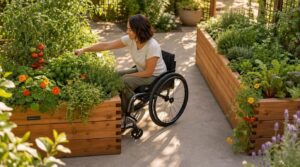
Width is where many accessible garden beds get it wrong. For wheelchair-friendly design, keep frame width to a maximum of 30 inches, with side rail clearance leaving at least 2 feet of open space beside the user. Aisle spacing between paired beds requires a minimum of 36 inches. Bed side clearance adheres closely to accessible width standards, ensuring the standard wheelchair clearance of 60 L x 27 H x 19 D keeps everything within comfortable reach.
Recessed Legroom Needs
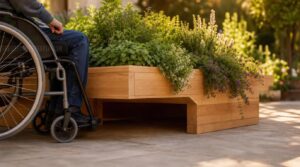
Recessed beds are the secret weapon of accessible garden design. A properly built recess maintains Knee Clearance Height at 12–15 cm, with Toe Clearance Space of at least 6 cm to prevent feet from dragging.
Front Edge Chamfer reduces knee impact, while Recess Bracing Integrity and Rounded Corner Safety ensure protection during transfers. Standard wheelchair clearance (60 L x 27 H x 19 D) accommodates mobility needs seamlessly.
Turning Radius Space

Think of your garden layout like a choreographed dance — every move needs room. Standard wheelchairs require a Turn Diameter of at least 60 inches, while power chairs demand up to 72 inches.
A wheelchair garden needs choreography: at least 60 inches of turning space, or 72 for power chairs
That full Obstacle-Free Zone, including your Wheelchair Swing Path, must remain clear of planters, tools, and edges. Build your Maneuvering Corridor with Pivot Clearance in mind, and you’ll move freely every time.
Seated Planting Depth
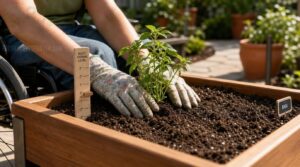
Depth matters more than most gardeners realize. In wheelchair accessible raised garden beds, you want your hands to reach the base of each plant without straining.
Keep root balls at nursery depth — crown alignment at soil level prevents rot. Account for soil settling by planting slightly high.
Depth gauges help maintain consistency, and smart moisture management keeps root ball harmony intact throughout the season.
Wheelchair-Friendly Raised Bed Designs

Not every garden bed works the same way, and that’s actually a good thing.
Wheelchair-friendly designs come in several shapes and setups, each built around how you naturally move and reach. Here are the ones worth knowing about.
Tabletop Garden Beds
A tabletop garden bed is one of the smartest moves in accessible garden design. Set at waist height, it provides clear knee and toe space below—real wheelchair-accessible garden clearance—while an edge lip keeps your soil mix contained. Optional side trays handle tool storage without stretching, ensuring essentials remain within easy reach.
Whether you’re growing seasonal crops or herbs, these ergonomic designs prioritize convenience. Features like height-adjustable beds position the work directly in front of you, eliminating unnecessary strain. This thoughtful layout transforms gardening into an inclusive, efficient activity for all.
Recessed Raised Beds
Want full front-facing access without repositioning your chair? Recessed raised beds roll right up to you. With wheelchair clearance of 60 L x 27 H x 19 D inches, corner cutouts, and edge coping lowered for easy reach, this accessible raised garden bed puts control in your hands.
Integrated drainage, soil grading, and a seating coffer make it a genuinely ADA compliant gardening setup.
U-Shaped Garden Beds
A U-shaped bed puts every planting zone within arm’s reach — no repositioning, no straining. The open center lets your wheelchair roll straight in, giving you stable access on three sides.
You can organize companion planting zones by season, apply seasonal crop rotation with labeled sections, and even add modular expansion options as your accessible garden planning grows. It’s ADA-compliant gardening built around how you actually move.
L-Shaped Garden Beds
Where the U-shape wraps around you, an L-shaped bed tucks into corners — a smart move for smaller yards. This wheelchair accessible garden design gives you dual path access along both legs, so you’re never locked into one spot. Reinforced brackets keep corner joints solid under heavy soil loads.
Add seating rails, modular extensions, and built-in drip lines, and your ADA compliant, L-shaped raised garden bed accommodates everything.
Rotating Lazy Susan Beds
A lazy susan garden bed spins the whole planting surface around a central axis, enabling easy access to every section without repositioning a wheelchair. This embodies space efficiency in action. Most models include safety locking to stabilize the bed during planting, motorized controls for hands-free rotation, and adjustable height settings.
Regular bearing maintenance ensures smooth operation—a minor effort for a wheelchair-friendly design that meets ADA-friendly, accessible gardening standards.
Durable Materials and Easy Maintenance
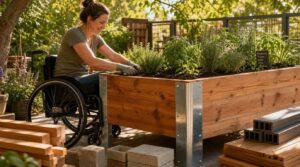
The material you build with affects everything—how long your bed lasts, how much upkeep it needs, and whether it holds up through rain, frost, and daily use. Some options need almost no attention after setup, while others ask for a little more care in exchange for a lower price tag.
Here are five materials worth knowing before you decide.
Cedar and Redwood
Cedar’s lighter weight makes it easier to handle during setup, and its natural oils fight off rot and insects without chemical treatments.
Redwood is denser and stronger, lasting 20–30 years with minimal upkeep.
Both woods age beautifully, shifting color over time, and come with sustainable sourcing options for raised garden beds.
Composite Lumber Beds
Composite lumber hits a sweet spot for wheelchair accessible garden builds. These boards blend recycled plastic content with wood fiber, giving you raised garden beds that won’t rot, warp, or splinter over time.
UV‑stable pigments keep the color locked in for years, while snap‑together joints make assembly straightforward.
Many options carry a 10‑year warranty, low‑VOC certification, and support height‑adjustable, ADA compliant configurations.
Galvanized Metal Beds
Galvanized metal raised beds are built to last — we’re talking up to 15 years of corrosion resistance without much fuss. They’re a smart pick for wheelchair-friendly design because they stay structural without constant upkeep.
- Assembly Simplicity — Interlocking panels and pre-drilled holes mean no special tools required.
- Edge Safety — Hemmed and rolled edges protect you during planting and maintenance.
- Drainage Integration — Perforated base plates push water away from roots consistently.
- Modular Expansion — Add panels to extend your ADA compliant raised garden beds as your space grows.
- Non-slip feet — Rubberized pads keep height-adjustable beds stable on smooth wheelchair paths.
HDPE Garden Beds
HDPE plastic might just be the toughest material in the raised bed world. It withstands temperatures from -20 to 120°F without warping, ensuring your wheelchair-friendly raised planters remain solid through every season.
The non-porous surface resists mold, while UV stability keeps colors sharp for years. These features ensure long-term durability and aesthetic appeal.
These ADA-friendly raised garden planters combine impact resistance with recyclable construction — making modular garden design and height-adjustable beds genuinely low-maintenance.
Concrete Block Frames
Concrete block frames bring serious staying power to accessible garden design. These brick, stone, and concrete raised beds are built on masonry reinforcement, giving you a raised garden bed that won’t budge through freeze-thaw cycles.
- Thermal mass regulates soil temperature naturally
- Fire resistance suits community and institutional settings
- Modular construction allows integrated utilities like irrigation conduits
ADA-friendly design principles meet real durability here.
Watering, Pathways, and Planting Tips
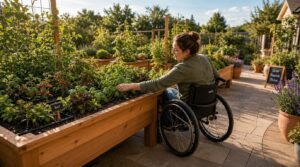
Getting your garden set up is one thing—keeping it running smoothly is another. The right watering system, safe pathways, and smart crop choices can make all the difference between a garden that frustrates you and one you actually enjoy.
Here’s what to focus on: prioritize efficient systems and thoughtful design to ensure long-term success and enjoyment.
Drip Irrigation Systems
A well-designed drip irrigation system takes the daily watering grind completely off your plate.
Emitter spacing of 6 to 12 inches delivers consistent moisture directly to roots.
Pressure regulation between 15 and 30 psi keeps flow even across your wheelchair-accessible raised garden beds.
Zoned scheduling lets different bed sections run independently.
Subsurface drip paired with regular filtration maintenance makes this genuinely low-maintenance irrigation.
Self-Watering Planters
Self-watering planters take things a step further than drip systems. A built-in reservoir manages moisture automatically through wicking materials like cotton or synthetic fibers, feeding roots steadily without daily input.
Look for fill indicators so you are never guessing. Pair them with a loose, airy soil mix for best results.
Most wheelchair-friendly raised planters require reservoir cleaning every six to twelve months—simple upkeep, serious payoff.
Wheelchair-Height Controls
Reservoir systems handle the water—but you still need controls within reach. Seat height adjustment and armrest positioning both affect how far you can comfortably stretch toward valves or timers. Controls should be mounted between 15–18 inches from elbow height to optimize accessibility.
Height-adjustable beds with wheelchair clearance (60 L x 27 H x 19 D) pair well with tray height integration for tools, ensuring ergonomic workflow.
Safety lock mechanisms keep everything stable during use, preventing unintended movement or accidents.
Non-Slip Garden Paths
Once your controls are dialed in, the path to your bed matters just as much. Wet grass and loose gravel can work against you fast. Textured Pavers and Grooved Timber boards channel water away, keeping accessible pathways grippy through rain. Anti-Slip Mats with drainage perforations add another layer of security on tricky spots.
- Gravel Stabilization grids keep pea gravel firm underfoot without blocking drainage
- Ground Cover Walks work well on gentle slopes with dense, short turf
- Smooth, firm surfaces paired with ADA barrier-free design principles create truly wheelchair-friendly outdoor areas
Easy-Reach Edible Crops
Leafy greens like lettuce and Swiss chard are your best starting point — they’re shallow-rooted, fast-growing, and perfectly suited to wheelchair-accessible raised garden planters at comfortable arm height. Fast-growing root crops like radishes mature in under 30 days.
Include herb microgreens, edible flower varieties, and compact berry plants to round things out. These additions maximize diversity and yield in limited space.
Well-designed raised beds and height-adjustable beds make garden ergonomics work for you, not against you. Prioritize dimensions and adjustability to ensure accessibility and comfort.
Frequently Asked Questions (FAQs)
Can raised beds work on sloped or uneven ground?
Yes, they absolutely can. With terrace stabilization, retaining wall integration, and a graded subbase beneath each bed, even a hillside becomes workable.
Adaptive gardening on slopes is less about fighting the terrain and more about designing with it.
What tools help wheelchair users garden more easily?
Ergonomic Tool Grips, Lightweight Aluminum Tools, and Long-Reach Pruners let you work comfortably from your chair. These tools prioritize ease of use and reduce strain during gardening tasks.
Magnetic Tool Connectors, Extendable Garden Tools, and a long-reach watering wand round out your mobility aid toolkit, enhancing accessibility for hard-to-reach areas.
How do you protect raised beds during winter months?
Winter hits hard, but a little prep keeps your beds ready for spring. Spread 3–6 inches of straw mulch insulation over the soil, and add cold frame covers to trap heat from the sun.
Check your frame integrity before the freeze sets in.
Can wheelchair gardeners grow fruit trees or shrubs?
Absolutely — dwarf varieties, espalier training, and long-handled pruning tools make fruit trees and shrubs completely manageable from a wheelchair, especially with accessible irrigation and companion shrubs planted within easy reach.
Conclusion
Like Capability Brown reshaping English landscapes to work with nature instead of against it, the best raised garden beds for wheelchair users don’t fight your body—they meet it exactly where you are. Height, width, clearance, materials—every detail is designed for one purpose: putting the soil back in your hands.
You don’t need a perfect garden. You need one built for you. That’s not accommodation. That’s good design.
- https://landguardgarden.com/blogs/gardening-tips-and-tricks/wheelchair-accessible-raised-garden-beds-inclusive-gardening-solutions?srsltid=AfmBOooPu_OiveN_E_rseZC0kqCfL1PyITwU9EgMu8n_gcQ3p_9DN9RD
- https://glplanters.com/blog/best-height-for-raised-garden-beds/
- https://gronomics.com/blogs/news/how-high-should-a-raised-or-elevated-garden-bed-be?srsltid=AfmBOoqv2zD2s5zSp--eABaADY0sYUlmPoQeQe0BMtexADpV5Mcv6fa3
- https://ambucs.org/a-complete-guide-to-building-a-wheel-chair-accessible-garden-bed/
- https://placerrcd.org/programs/accessibleraisedbed/