
This site is supported by our readers. We may earn a commission, at no cost to you, if you purchase through links.

A dull blade at harvest time doesn’t just slow you down—it costs you. Crop damage from improper cutting tools can waste up to 15% of a yield before it ever reaches storage, a margin no serious grower can afford to ignore. The difference between a clean cut and a crushed stem often determines whether your produce sells or rots.
Choosing the tools needed for successful harvesting isn’t about buying the most expensive equipment—it’s about matching the right tool to the right crop, scale, and condition. A scythe that works beautifully in a meadow becomes a liability in a root vegetable plot. What follows breaks down exactly which tools earn their place in your operation, from hand-held precision instruments to mechanized workhorses built for volume.
Table Of Contents
- Key Takeaways
- Essential Hand Tools for Harvesting Success
- Mechanical and Electrical Harvesting Equipment
- Top 6 Tools for Successful Harvesting
- Choosing The Right Harvesting Tools
- Maintenance and Safety for Harvesting Tools
- Frequently Asked Questions (FAQs)
- What tools will you need for harvesting?
- What factors contribute to a successful harvest?
- What are the 4 steps of harvesting?
- How often should harvesting tools be replaced?
- Can harvesting tools be rented instead of purchased?
- What are the best brands for harvesting equipment?
- How do weather conditions affect harvesting tool performance?
- Are there certification requirements for operating mechanical harvesters?
- What role do drones play in modern harvesting?
- How can robotics increase harvesting efficiency on farms?
- Conclusion
Key Takeaways
- Matching your tool to the specific crop—whether that’s reaping hook for corn or bypass-blade shears for fruit—can cut harvest damage by 15–20% compared to using the wrong equipment.
- Mechanical options like combine harvesters and flail machines become genuinely cost-effective only at scale, with hand tools remaining the smarter choice for plots under 2 hectares.
- Blade hardness between 56–60 HRC, food-grade stainless steel, and proper daily maintenance aren’t optional extras—they’re what keep your tools performing season after season.
- Ergonomic design (contoured grips, adjustable heights, vibration-dampening systems) directly reduces injury risk and fatigue, which means you stay productive through the full harvest window.
Essential Hand Tools for Harvesting Success
Before any tractor or combine enters the picture, hand tools are where real harvesting control begins. The right one in your grip can mean the difference between a clean cut and a damaged crop.
Knowing how to use harvesting tools properly for each crop keeps both your yield and your produce intact.
Here are the essential hand tools every serious grower should know.
Sickle – Best for Grains and Pasture

The sickle is one of those agricultural tools that has been earning its keep for centuries — and for good reason. Its crescent-shaped blade curvature catches and gathers grain bunches efficiently, while the serrated edge grips silica‑rich wheat and rice stems for clean, precise cuts every swing.
Here’s why harvest sickles still dominate small‑scale crop management:
- Serrated blades outperform smooth edges on mature cereals
- Blade widths reach 40 mm on heavier grain models
- Short 10–20 cm grips support one‑handed bunching
- Offset design prevents knuckles from hitting the ground
- Grip ergonomics reduce fatigue during extended cutting sessions
For terraced or waterlogged plots where larger agricultural equipment simply can’t maneuver, your sickle delivers unparalleled pasture efficiency and cutting technique control.
Scythe – Efficient Grass Cutting

Where the sickle ends its reach, the scythe takes over. Grass scythe blades run 90–100 centimeters, built from tensioned steel to sweep wide arcs across meadows without clogging on thick vegetation.
Snath ergonomics — those S‑curved grips reaching 170 centimeters — let you mow upright, which dramatically cuts back strain.
Before each session, peening and sharpening with 150 overlapping hammer blows keeps that edge tissue‑thin and frictionless.
Your mowing stance matters too: feet 50–80 centimeters apart, torso rotating through each stroke.
Efficiency benefits stack quickly — skilled operators clear half an acre per season with zero engine noise.
Harvesting Knives – Versatile for Vegetables
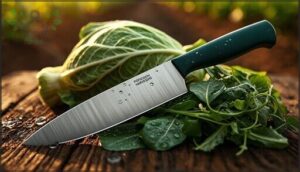
While a scythe covers open fields, harvest knives give you surgical control over vegetables. Blade geometry matters here — curved edges measuring 10–20 cm, paired with edge serration cut cabbage and leafy greens using 20–30% less force than straight blades.
Material selection counts too; food-grade stainless resists corrosion across seasons. These agricultural tools reward smart investment through grip ergonomics and cutting efficiency:
- Serrated edges slice spinach and arugula without bruising
- ErgoTec soft grips reduce hand fatigue during long shifts
- Stainless construction prevents flavor transfer on edible produce
- Clean cuts minimize microbial spoilage post-harvest
Reaping Hook – Precision for Corn and Millet
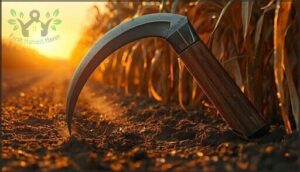
Where harvest knives offer surgical vegetable control, the reaping hook delivers blade momentum purpose‑built for corn and millet. Its C-shaped blade — roughly 18 inches long and 40 mm wide — pairs crop-specific angle with ergonomic handle design to slash arm loads in a single swipe.
| Feature | Reaping Hook | Traditional Sickle |
|---|---|---|
| Blade width | 40 mm | 20–25 mm |
| Harvest speed (corn/acre) | ~1 day | 3–4 days |
| Selective precision | High | Low |
Reaping hooks handle flattened crops where agricultural equipment and technology can’t reach, supporting precision agriculture goals without heavy investment.
Garden Shears – Fruit and Vegetable Harvesting

Garden shears are among the most indispensable harvesting tools in your toolkit. Bypass blade design generates 30% less crushing damage than anvil models, keeping fruiting stems intact.
Curved blade benefits shine in tight spaces — think grapes, citrus, and peppers. Ergonomic handle features on models like Fiskars reduce grip fatigue during long sessions, while stainless steel durability resists rust through sap‑heavy harvests. That yield‑boosting precision adds up to 15–20% less fruit damage per season.
Mechanical and Electrical Harvesting Equipment
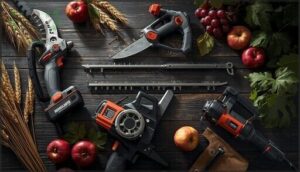
When hand tools aren’t enough, mechanical and electrical equipment steps in to handle the heavy lifting. These machines are built for scale, speed, and precision — turning days of labor into hours.
Here are four key pieces of equipment worth knowing.
Combine Harvesters – All-in-One Grain Solution
Think of a combine harvester as a full harvest crew packed into one machine. It reaps, threshes, and winnows in a single pass — that’s the power of modern agricultural machinery. The Header System cuts at widths up to 6 meters, the Threshing Drum spins at 500–1200 rpm, and the Cleaning Shoe hits 95% impurity removal. The Grain Tank stores up to 14,100 liters, while the Unloading Auger empties it in under two minutes.
Here’s what sets combines apart:
- Harvesting Automation reduces operator guesswork through integrated yield monitors
- Precision Agriculture sensors fine‑tune drum speed to minimize grain loss
- Farm Machinery and Automation cuts labor costs substantially within a few seasons
- Combine units range from $100,000–$800,000 — a serious but justifiable investment
Tractors – Large-Scale Crop Collection
For broad-acre operations, tractors are the backbone of modern farm machinery — delivering 200–400 horsepower through high‑power engines built for heavy machinery demands.
Precision guidance systems keep tracks within 2–3 cm, while PTO systems drive large‑scale implements like balers and forage harvesters.
Operator comfort features — climate‑controlled cabs, air‑ride seats — support 12‑hour harvest days.
Harvesting automation and agricultural machinery advances have cut labor by up to 100%.
| Feature | Specification | Benefit |
|---|---|---|
| Engine Power | 200–400 HP | Pulls wide-row implements efficiently |
| RTK Guidance | ±2–3 cm accuracy | Reduces field overlap and compaction |
| PTO Speed | 540 or 1,000 rpm | Drives combines and harvest attachments |
| Grain Wagon Capacity | 10–20 tonnes | Minimizes combine downtime |
| Cab Climate Control | Standard on modern models | Sustains operator comfort all day |
Flails – Root Crop Harvesting
When lifting potatoes or sugar beet at scale, flail harvesters are indispensable mechanical harvesters that clear foliage fast.
Flail blade materials range from steel for tough haulm to rubber for delicate beet heads, each engineered for root crop harvesting without bruising yield.
Pneumatic height control and adjustable cutting height let you follow field contours precisely, while working width optimization across two- to four-row configurations — paired with 90–135 hp power requirements — delivers 0.8–1.5 hectares per hour.
Rechargeable Garden Shears – Powered Efficiency
rechargeable garden shears cuts hand strain dramatically — and your wrists will thank you by lunch.
These electric harvest assistants run up to 80 minutes on lithium-ion battery runtime, making them reliable power tools for orchard detail work.
Blade swapping between a 3.5-inch grass blade and 6.7-inch shrub blade takes seconds.
ergonomic grip, built-in safety lock, and simple maintenance routine round out these sustainable gardening tools for serious growers.
Top 6 Tools for Successful Harvesting
Not all harvesting tools are created equal — the right one can mean the difference between a harvesting tools are created equal and a frustrating afternoon in the field.
Whether you’re snipping herbs or pulling nuts from the ground, having purpose-built equipment makes the job faster and easier on your body.
Here are six tools worth keeping in your kit.
1. Fiskars Herb Garden Snips with Sheath
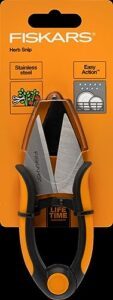
Precision tools don’t need to be large to be indispensable.
The Fiskars Herb Garden Snips (Model 310020-1001) pack serious performance into a 5‑inch frame, featuring fully hardened, precision‑ground stainless steel blades with pointed tips that reach cleanly into tight spots without disturbing surrounding stems.
What separates these from standard scissors is the Easy Action spring mechanism — it automatically reopens the blades after each cut, giving your hand a real break during extended harvesting sessions.
The NSF‑certified, dishwasher‑safe blades maintain hygiene from garden to kitchen, while the SoftGrip handle accommodates both left‑ and right‑handed users.
An included protective sheath rounds out a tool built for serious herb gardeners who won’t compromise on control.
| Best For | Home gardeners who want lightweight, precise snips for harvesting herbs and trimming small plants without hand fatigue. |
|---|---|
| Primary Use | Herb trimming |
| Material | Stainless steel |
| User Fatigue | Reduced via spring |
| Ease of Use | High |
| Maintenance | Dishwasher safe |
| Scale of Use | Home/small garden |
| Additional Features |
|
- The Easy Action spring reopens the blades automatically after every cut — your hand actually gets to rest during longer sessions.
- Pointed stainless steel tips get into tight spots cleanly, so you’re snipping exactly what you mean to without disturbing everything around it.
- Dishwasher-safe blades and a lifetime warranty mean you’re not babying this tool — it’s built to stick around.
- These are strictly small-scale snips — thick stems or heavy pruning are out of the question.
- The plastic build feels light, which might make you wonder how it holds up after a few seasons of regular use.
- The blades do need occasional sharpening — skip the upkeep and you’ll notice the difference pretty fast.
2. DonSail Adjustable Fruit Picker Pole
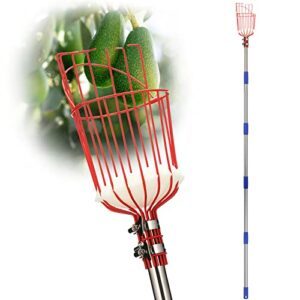
When herb snips handle what’s at eye level, you still need reliable reach for what’s up in the canopy. That’s where the DonSail Adjustable Fruit Picker Pole earns its place in your toolkit.
It extends from 35 to 65 inches, letting you pull apples, oranges, and mangoes from mid‑height branches without touching a ladder. At just one pound, the stainless steel build won’t tire your arms during long picking sessions. The claw‑shaped basket dislodges fruit cleanly, while the foam‑cushioned base absorbs impact — keeping delicate pears and avocados bruise‑free on the way down. Sections screw together in under five minutes, no tools needed.
| Best For | Gardeners, farmers, and homeowners who want to harvest fruit from tall trees without ever dragging out a ladder. |
|---|---|
| Primary Use | Fruit picking |
| Material | Stainless steel |
| User Fatigue | Reduced via lightweight |
| Ease of Use | Medium |
| Maintenance | Rinse clean |
| Scale of Use | Home/orchard |
| Additional Features |
|
- Adjustable length (35–65") gives you solid reach into the canopy without needing a ladder
- Lightweight stainless steel means you can pick for a while without your arms giving out
- Foam-cushioned basket keeps delicate fruit like pears and avocados bruise-free on the way down
- The prongs can puncture softer fruits, so you may need to tweak your technique or the head itself
- Not great for very large or heavy fruits — it does have its limits
- Instructions can be a bit unclear, so first-time assembly might take some trial and error
3. Heavy Duty Peanut Sheller Machine
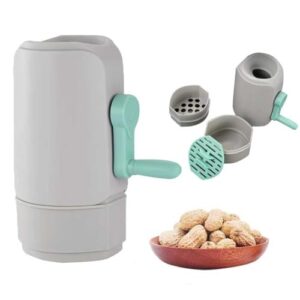
Once your fruit is down from the canopy, the next challenge waiting in the field is often peanuts — and hand-shelling at 7–10 kg a day will wear you out fast.
A heavy-duty peanut sheller machine changes that completely.
These units process 200–800 kg per hour with 98–99% shelling efficiency, keeping kernel breakage below 4%.
Running on 2–5 kW of three‑phase power, they’re built from mild or stainless steel for long‑term durability in demanding conditions.
The real win? Labor costs can drop up to 70%, and most commercial operations recover the investment within a single season.
Just suit up — ear protection and a dust mask aren’t optional here.
| Best For | Commercial farmers and field operations who need to process large volumes of peanuts fast without burning through labor costs. |
|---|---|
| Primary Use | Peanut shelling |
| Material | Mild/stainless steel |
| User Fatigue | High for manual use |
| Ease of Use | Medium |
| Maintenance | Periodic cleaning |
| Scale of Use | Commercial/bulk |
| Additional Features |
|
- Processes 200–800 kg per hour, so what used to take days gets done before lunch
- Shelling efficiency of 98–99% means almost no wasted product and kernel breakage stays under 4%
- Cuts labor costs by up to 70%, with most operations breaking even within a single season
- Requires three-phase power, which isn’t always easy to access in remote field locations
- Ear protection and a dust mask are a must — the work environment gets loud and dusty fast
- Upfront cost may be a hurdle for smaller operations, even with a quick ROI timeline
4. Zenport Clementine Citrus Apple Fruit Clippers
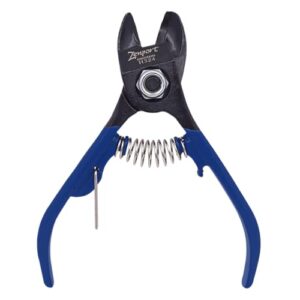
After tackling bulk shelling, orchard work calls for an entirely different kind of precision — and that’s where the Zenport H324 Clementine Citrus Apple Fruit Clippers earn their place in your kit.
At just 4.5 inches and 3.2 ounces, these clippers won’t slow you down between trees. Forged chromoly steel blades hold a sharp edge through thousands of daily cuts on oranges, clementines, and apples, while the spring-loaded action automatically reopens the blades after each snip — a small detail that saves your hand over a long picking shift.
Curved ergonomic grips keep your wrist neutral, and the rounded blade tips slide cleanly around stems without puncturing adjacent fruit, protecting your harvest before it ever hits the bin.
| Best For | Fruit growers and orchard workers who need a reliable, comfortable clipper for harvesting large volumes of citrus and other fruits throughout long picking days. |
|---|---|
| Primary Use | Citrus harvesting |
| Material | Chromoly steel |
| User Fatigue | Reduced via spring |
| Ease of Use | High |
| Maintenance | Blade sharpening |
| Scale of Use | Orchard/commercial |
| Additional Features |
|
- Spring-loaded blades pop back open automatically, saving serious hand fatigue over hours of picking
- Rounded blade tips let you cut cleanly around stems without nicking nearby fruit
- At 3.2 ounces and 4.5 inches, they’re light and compact enough to use all day without slowing you down
- Manual operation can still wear your hand out during really long harvesting sessions
- Not built for thicker branches — stick to fruit stems and light pruning
- Only comes in one size, so it may not be the best fit for everyone’s grip
5. Zenport Grape Razor Fork Harvest Tool
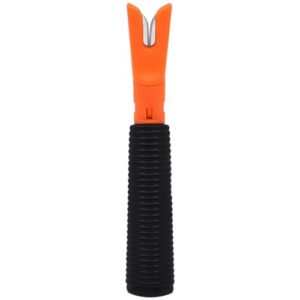
Orchard clippers handle stems with clean precision, but grape clusters require a completely different approach — and that’s where the Zenport H335 Grape Razor Fork steps in.
At just 0.2 pounds and 9.5 inches long, this tool feels almost weightless during long vineyard shifts. Its forked guide cradles each bunch while the enclosed razor blade slices through stems up to 0.5 inches in diameter, keeping your fingers safely away from the cutting edge.
That guarded design markedly reduces hand injuries during high-volume harvests. The adjustable cutting head angle lets you match different trellis systems without awkward wrist angles.
When the blade dulls, replaceable H335-1 heads swap in quickly, extending the same handle across multiple seasons.
| Best For | Home winemakers and small vineyard owners who harvest by hand and want to protect their fingers from repetitive strain or accidental cuts. |
|---|---|
| Primary Use | Grape harvesting |
| Material | Steel with razor blade |
| User Fatigue | Reduced via lightweight |
| Ease of Use | High |
| Maintenance | Replaceable blades |
| Scale of Use | Vineyard/small farm |
| Additional Features |
|
- The forked, guarded design keeps your fingers away from the blade — a real plus during long harvest days
- Adjustable cutting head means you’re not fighting awkward angles on different trellis setups
- Lightweight at 0.2 lbs, so your hand won’t fatigue as fast as it would with traditional pruners
- The blade dulls quickly, and at $14 a replacement head, those costs add up fast
- Some users reported the piece holding the head in place can break, which is a pretty critical failure point
- Not a great fit for large commercial operations — the scale just isn’t there
6. Roasted Hazelnuts Natural Unsalted AZNUT Brand

Snacking might seem far removed from field equipment, but what happens after harvest matters just as much as the tools you use to gather crops. AZNUT’s roasted hazelnuts show exactly what thoughtful post-harvest handling looks like in practice.
Sourced from Azerbaijan and Turkey, then double dry roasted at a Florida facility, these hazelnuts contain zero added oils, salt, or preservatives. One ounce delivers 180 calories — roughly 82% from healthy fats — with 4 grams of protein and 3 grams of dietary fiber. They’re Non-GMO certified, gluten-free, and kosher, covering a wide range of dietary needs.
Store them in a cool, dry place to preserve that rich, buttery flavor. Resealable packaging makes portioning straightforward whether you’re snacking on-site or baking at home.
| Best For | Anyone who wants a clean, versatile snack — especially home bakers, health-conscious eaters, or anyone watching their sodium intake. |
|---|---|
| Primary Use | Snacking/baking |
| Material | Roasted hazelnut kernels |
| User Fatigue | Not applicable |
| Ease of Use | High |
| Maintenance | Resealable bag |
| Scale of Use | Home/personal |
| Additional Features |
|
- Double dry roasted with no oil or salt, so you get pure hazelnut flavor without the extras
- Certified Non-GMO, gluten-free, and kosher — works for a wide range of diets
- Super versatile: great for snacking, baking, or tossing on a salad
- Pricier than some competing brands, which adds up if you’re buying regularly
- Limited sizing options — no bulk packs for those who go through them fast
- Quality control has slipped for some buyers, with at least one report of a stale or rancid batch
Choosing The Right Harvesting Tools
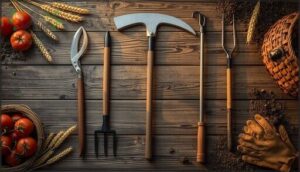
Picking the right harvesting tool isn’t just about grabbing what’s nearby — it’s about matching the right equipment to your specific crop, land, and budget. A poor choice can cost you time, money, and yield, while the right one makes the whole operation run smoothly.
Here’s what to think about before you commit to any tool.
Matching Tools to Crop Type
Every crop speaks a different language — and your tools need to listen.
Grain‑Specific Harvesters, like combine harvesters, cut, thresh, and clean wheat in a single pass, protecting Crop Yield and Quality without added steps.
Root‑Crop Extractors lift tubers with minimal bruising, keeping cassava damage under 15%.
Tree‑Fruit Pickers and Leafy‑Green Cutters match the delicacy each crop demands, while Nut‑Harvest Shakers strip almond trees efficiently.
Aligning Harvesting Techniques with crop biology isn’t just Agricultural Best Practices — it’s how you protect yield from field to market.
Considering Land Size and Scale
Your farm size drives every Farm Size Matching decision you’ll make about Scale Equipment Choice. Holdings under 2 hectares work well with hand-held Harvest Tools, while mechanization becomes economical around 33 hectares.
Above 100 hectares, combine harvesters become indispensable for Harvest Window Planning.
- Field Fragmentation Impact slows Labor Allocation and raises fuel costs
- Scattered plots limit which Farm Equipment can safely maneuver
- Compact land blocks support efficient Harvesting Techniques and straight passes
- Sustainable Farming through Agricultural Innovation starts with right-sized machinery
Budget and Investment Considerations
Budget isn’t just the sticker price — your Cost‑Benefit Analysis must account for ownership expenses averaging 41% of total Farm Equipment costs, plus fuel, repairs, and labor.
Targeting around $650 per acre keeps ROI Timeline realistic.
Explore Financing Options like agricultural loans or leasing to reduce upfront pressure, and check Subsidy Eligibility, since government programs can cover up to 60% on qualifying Harvest Tools.
Depreciation Impact hits hardest in year one, so buying used Harvesting Tools cuts that loss substantially.
Smart Agricultural Innovation and Sustainable Agriculture Practices depend on disciplined spending from the start.
Ergonomic Features for User Comfort
The right tool should feel like an extension of your hand — not a source of pain. Ergonomics in harvesting tools isn’t just comfort; it’s Farm Safety and Ergonomics working together to protect your body across long harvest days.
Ergonomic harvesting tools don’t just reduce pain — they protect your body so every long harvest day stays productive
- Contoured Grip handles matched to 3.8 cm diameter reduce grip force and forearm fatigue during repetitive cuts
- Adjustable Height mechanisms set at elbow-minus-elevation keep your spine neutral, while Angled Blade designs cut lower back flexion by 30 percent
- Vibration Reduction systems in powered Garden Tools and Harvesting Tools — like the SawX reciprocating saw — slash hand-arm vibration by up to 90 percent
Balanced Weight distribution, achieved through hollow aluminum shafts, cuts tool mass by 20 percent without sacrificing blade strength. Combined, these features directly drive Labor Efficiency and support long-term Agricultural Safety and Maintenance.
Tool Durability and Material Quality
Material quality is your best insurance policy against early tool failure. Blade Hardness between 56 and 60 HRC balances sharp edge retention with toughness — critical for Hand Tools like sickles and harvest knives.
Stainless steel’s Corrosion Resistance, reinforced by chromium oxide film, extends tool lifespan in wet fields without constant maintenance.
Chrome powder Coating Technologies protect frames, while fiberglass grips deliver Handle Longevity that wood can’t match.
Smart Material Cost‑Benefit analysis here pays dividends across seasons.
Maintenance and Safety for Harvesting Tools
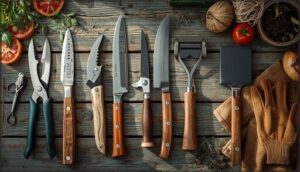
Good tools don’t last without good habits behind them.
Maintenance and safety aren’t afterthoughts — they’re what keep your equipment sharp, your yields consistent, and your body out of harm’s way.
Here’s what every serious harvester needs to know.
Cleaning and Sharpening Techniques
Keeping your harvesting tools sharp and clean isn’t optional — it’s what separates productive seasons from frustrating ones. Consistent blade sanitization and edge honing preserve tool performance and prevent crop contamination. Follow this practical maintenance routine:
- Clean daily — wipe sickle blades with a damp cloth, then rinse knives under running water to remove soil and sap.
- Stone sharpening — hold sickles at 20–30 degrees against a whetstone; scrub garden shears with a 200–400 grit stone along the beveled edge.
- Bleach disinfection — apply a 50–150 ppm chlorine solution, soak blades for ten minutes, then rinse thoroughly with potable water.
File restoration works well on dull sickles when whetstones aren’t available — steady strokes matching the factory bevel restore a clean, functional edge without compromising sustainable gardening practices or your tool’s longevity.
Rust Prevention and Storage Best Practices
Once blades are clean, winning the rust battle comes down to storage discipline.
Keep humidity between 35–40% in your shed — steel corrodes rapidly above 45%.
Hang farm tools on wall racks to improve airflow, and wipe harvesting tools down with light machine oil before storing.
Silica gel desiccant packs in closed toolboxes add reliable backup protection.
Residue removal before storage isn’t optional — trapped sap and soil accelerate corrosion quickly.
Personal Protective Equipment Essentials
Good storage habits protect your tools — but protecting yourself is a different layer entirely. When sharp harvesting knives, heavy farm equipment and tools, and chemical-laden crops are in play, PPE isn’t optional.
- Eye Shielding: Polycarbonate goggles block debris from grain threshing and chemical splashes in treated fields.
- Hearing Protection: Earmuffs rated NRR 30 dB reduce tractor noise to safer levels.
- Cut-resistant Gloves: Leather-reinforced crop handling gloves and gardening gloves protect against blade contact during harvesting tools operation.
- Steel-toed Boots: Rubber-soled, waterproof boots prevent slips on muddy terrain while shielding feet from falling equipment.
UV sun hats add critical protection during long daylight harvests.
Safe Handling and Operation Tips
Your grip technique sets the tone before a single stalk gets cut. Run pre‑operation checks on fluid levels, guards, and sensors — then follow strict machine shutdown procedures: disengage the PTO, kill the engine, remove the key.
Ergonomic positioning keeps your back straight and wrists neutral throughout. For entanglement prevention, wear fitted clothing and never step over rotating shafts.
Identifying and Managing Potential Hazards
Spotting hazards before they find you is what separates a productive harvest from a preventable accident. Pre‑harvest assessment reveals animal tracks, contamination sources, and equipment leakage sites that compromise both safety and yield. Machinery guard checks confirm shields cover PTO shafts, belt pulleys, and knife reels. Slip‑fall prevention demands three‑point contact on ladders and debris‑free platforms. Fatigue risk controls — critical during peak seasons — mean rotating tasks and staying hydrated.
- Contamination source scans – Flag feces, manure runoff, or hydraulic leaks immediately.
- Guard inspections – Never tape safety switches; keep covers closed.
- Fatigue monitoring – Under 6 hours of sleep signals dangerous impairment around machinery.
Frequently Asked Questions (FAQs)
What tools will you need for harvesting?
Your harvest tools lineup depends on crop type, scale, and budget.
From hand tools to precision ag equipment, the right agricultural technology choices directly shape your labor efficiency metrics and overall yield outcomes.
What factors contribute to a successful harvest?
successful harvest as a puzzle — soil fertility, timing optimization, pest management, and irrigation efficiency are the pieces.
Get them right, and your harvesting tools and agricultural technology do the rest.
What are the 4 steps of harvesting?
Successful harvesting follows four core steps: reaping, threshing, winnowing, and hauling.
Each stage relies on specific harvesting tools and techniques to protect yield quality and support overall agricultural productivity from field to storage.
How often should harvesting tools be replaced?
Replacement timing depends on how hard you push your tools. Quality hand pruners generally last 10–15 years with proper care, though heavy daily use often cuts that to 5–7 years.
Can harvesting tools be rented instead of purchased?
Renting rather than purchasing makes real financial sense. Combine harvesters run $180–$225 per hour to rent, dodging $400,000 ownership costs — smart risk mitigation for seasonal equipment access on flexible lease terms.
What are the best brands for harvesting equipment?
John Deere leads global market share, while New Holland earns 3 percent of farmer trust votes for brand reliability.
Claas, Fendt, and Kubota round out the field with strong technological innovation and after-sales service.
How do weather conditions affect harvesting tool performance?
Weather doesn’t play fair.
Rain‑Induced Slippage cuts tractor traction sharply, Humidity‑Driven Fire Risk spikes above 27°C, and Moisture Content Adjustment becomes critical when grain exceeds 6%—directly stalling your harvesting tools and overall Labor Efficiency in Farming.
Are there certification requirements for operating mechanical harvesters?
Yes — licensing regulations vary by region.
In the US, operating combines over 26,001 lbs requires a Class A CDL.
Australia uses competency verification through FBPVIT3008 training standards, while the EU mandates a Category F license for mechanical harvesters exceeding 40 kph.
What role do drones play in modern harvesting?
Drones have completely transformed how you monitor and manage crops. From drone crop mapping to real-time field monitoring, a single flight covers hundreds of hectares, supporting smarter yield forecasting and precision spraying before harvest day arrives.
The multispectral imaging system provides detailed crop health insights.
How can robotics increase harvesting efficiency on farms?
Robotics cut labor costs by 30–60% through 24/7 operation, precision vision for ripeness detection, gentle handling that reduces damage by 40%, and data‑driven scheduling that optimizes every harvest window automatically.
The rise of autonomous weeding robots(https://www.agritecture.com/blog/exploring-the-future-of-agriculture-a-deep-dive-into-robots) showcases AI‑driven precision in weed control.
Conclusion
The harvest doesn’t lie—your tools tell the story before the first crop ever reaches your hands.
Every blade sharpened, every grip chosen with intention, reflects the grower you’ve decided to be.
Selecting the right tools needed for successful harvesting isn’t just practical preparation; it’s a commitment to protecting what you’ve worked all season to grow.
Match your tools to your crop, your scale, and your standards—and the field will answer back with exactly what you gave it.