
This site is supported by our readers. We may earn a commission, at no cost to you, if you purchase through links.
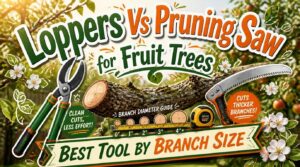
Grab the wrong tool, and you’ll crush a branch instead of cutting it. That torn wound invites rot and pests right into your fruit tree. Most home orchardists reach for whatever’s hanging in the garage, never realizing the choice between loppers vs pruning saw fruit trees decisions actually shapes how well that tree heals.
Branch diameter tells you almost everything. Loppers shear cleanly through live wood up to two inches, while saws handle anything thicker without splintering the bark.
Get this match right, and every cut becomes a step toward a healthier, more productive tree.
Table Of Contents
- Key Takeaways
- Loppers Vs Pruning Saws: Key Differences
- Choose Tools by Branch Diameter
- Top 10 Fruit Tree Pruning Tools
- 1. Corona 32 Inch Compound Action Anvil Lopper
- 2. Ymachray Heavy Duty Anvil Lopping Shears
- 3. Fiskars 24 Inch Bypass Lopper Softgrip Handles
- 4. Silky GomBoy Professional Folding Saw 240mm
- 5. ARS LA-160ZR203 Telescoping Pruner
- 6. Felco Folding Saw F600 Red
- 7. Corona WL 6470 ClassicCUT Bypass Lopper
- 8. Bahco 45mm Aluminium Handle Bypass Lopper
- 9. Silky Zubat Hand Saw 330mm
- 10. Wolf Garten ZMV3 Telescopic Handle 170-300cm
- Compare Reach, Comfort, and Safety
- Maintain Tools for Cleaner Cuts
- Frequently Asked Questions (FAQs)
- What is the best tool for pruning fruit trees?
- Are pruning saws better than loppers?
- What are the common mistakes when pruning fruit trees?
- What is the best technique for pruning fruit trees?
- How often should I replace my pruning tools?
- Can I use loppers on dead branches too?
- Do compound loppers really cut faster than saws?
- How do I know if a branch is diseased?
- Conclusion
Key Takeaways
- Branch size is your best guide: use shears under an inch, loppers for one to two inches, and a pruning saw once limbs get thicker than that.
- Bypass blades slice live wood cleanly for fast healing, while anvil blades crush and work better on dead or dry branches.
- Forcing a tool past its cutting capacity crushes or tears the wound instead of slicing it, which invites rot and pests into the tree.
- Keeping blades sharp, clean, and lubricated (and matching handle length to the job) makes cuts easier and helps tools last for years.
Loppers Vs Pruning Saws: Key Differences
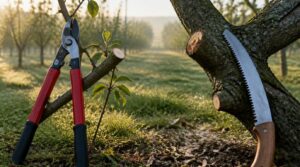
Loppers and pruning saws might look like they do the same job, but they don’t. Each tool cuts differently, and that difference affects your tree’s health, your effort, and your wallet. Here’s what sets them apart.
Loppers work well for thinner, flexible branches, while a pruning saw handles thicker limbs—if you’re tending berry bushes, this berry plant pruning guide breaks down which tool fits each cut.
Cutting Mechanisms Compared
Grab a branch and picture the tool meeting it. Bypass action slices with two blades passing like scissors. Anvil loppers press wood against a flat edge instead.
| Mechanism | Cutting Stroke | Best Use |
|---|---|---|
| Bypass | Slicing | Live wood |
| Anvil | Crushing press | Dead wood |
| Saw | Push-pull ripping | Thick limbs |
Compound designs multiply force, easing tough cuts. For a broader perspective on material separation, explore laser cutting technology.
Clean Cuts and Tree Health
That slicing action matters for more than convenience. A clean precise cut heals faster, since the tree can start callus formation right away.
| Cut Type | Wound Response | Healing Speed |
|---|---|---|
| Bypass slice | Smooth margin | Fast |
| Anvil crush | Bruised tissue | Slow |
| Ragged tear | Torn fibers | Slowest |
Preserving the branch collar and sanitizing blades between cuts protects plant health and speeds recovery.
Speed, Control, and Effort
A clean cut heals fast, but speed while you work matters too. Bypass loppers shear through branches up to 1.5 inches with quick, low-effort cycles, thanks to handle power near the pivot. Pruning saws move slower but rip through thicker wood in fewer passes.
| Tool | Best Speed Range |
|---|---|
| Bypass lopper | Under 1.5 in |
| Compound lopper | Up to 2 in |
| Pruning saw | 1.5 in and up |
| Folding saw | Tight spaces |
| Pole saw | Overhead reach |
Sharp blades and soft grips keep control steady without draining your arms.
Live Versus Dead Wood
Speed only matters once you know what you’re cutting. Live branches bend before they break, so try a quick branch flexibility test first.
Dead wood snaps flat, shows no green cambium, and skips buds entirely.
| Wood Type | Best Tool |
|---|---|
| Live, thin | Bypass Loppers |
| Live, thick | Pruning Saw |
| Dead, dry | Anvil Loppers |
| Dead, brittle | Pruning Saw |
Cost and Long-term Value
A cheap lopper looks like a bargain until the blade dulls by cut thirty. Tool investment matters less than sharpening habits and part availability.
| Tool | Upfront Cost | Long-term Value |
|---|---|---|
| Loppers | Low | Moderate |
| Pruning Saw | Moderate | High |
| Compound Lopper | Higher | High |
Hardened blades outlast cheap steel, and replaceable parts beat buying new every season.
Choose Tools by Branch Diameter
Branch size tells you almost everything about which tool to grab. Get it wrong, and you risk crushed wood or a struggle you didn’t need. Here’s how to match your tool to the cut in front of you.
Shears for Under One Inch
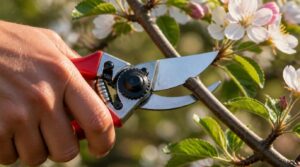
Think of pruning shears as your scalpel for anything pencil-thin. They handle branch diameter under one inch, using a bypass blade design for clean shearing on live shoots.
Their soft ergonomic grips make trimming comfortable through longer sessions, so you can stay focused on planting and caring for your vegetables without hand fatigue slowing you down.
Look for corrosion resistance, precision cutting angles, and lightweight material selection. Blade sharpness maintenance matters here more than cutting capacity, since thin tissue bruises easily under a dull edge.
Loppers for One-inch Branches
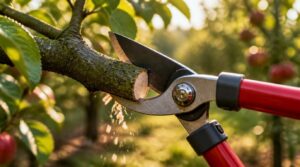
One-inch branches are the lopper’s sweet spot on fruit trees. Bypass blade design slices live wood cleanly, using mechanical advantage so you’re not muscling through anything.
Check three things before buying:
- Blade sharpness for clean shearing
- Handle grip comfort for repeat cuts
- Pivot maintenance ease for smooth action
Wood type matters too — green wood cuts easier than seasoned branches, so match your cutting technique accordingly.
Saws for Thicker Limbs
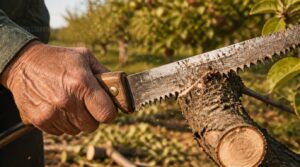
Past two inches, loppers crush more than they cut. That’s where a pruning saw takes over, slicing tree limbs with aggressive carbide teeth and sharp blade tooth geometry.
| Saw Type | Best Use |
|---|---|
| Folding saw | Compact folding design, 3" limbs |
| Bow saw | Fast, straight cuts |
| Fixed-blade | Pull stroke efficiency, thick wood |
Resin buildup prevention keeps blade sharpness longer.
Wood Density Considerations
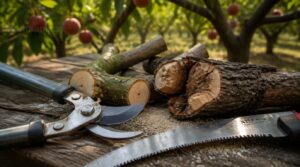
Not all branches of the same size cut the same way. Wood density varies by species, so a two-inch peach limb slices easier than oak.
Moisture content matters too. Green, sappy wood resists blades differently than dry branches, changing your blade sharpness needs and overall cutting effort at each diameter you tackle.
Avoiding Crushed Pruning Wounds
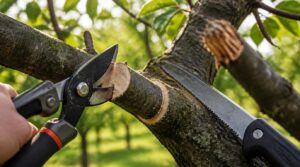
A crushed wound never heals clean, it just invites rot. Forcing dull loppers through thick limbs tears fibers instead of slicing them.
A crushed wound never heals clean; forcing dull blades through wood tears fibers instead of slicing them
Keep blades sharp, cut at the right angle, and protect the branch collar. Smaller, cleaner wounds close faster, so prune during proper seasonal timing for best results.
Good gardening safety and technique protect your tree’s long-term health.
Top 10 Fruit Tree Pruning Tools
Knowing which tool fits which branch is only half the job. You still need gear that holds up in your hands, season after season. Here are ten solid picks worth adding to your pruning kit.
1. Corona 32 Inch Compound Action Anvil Lopper
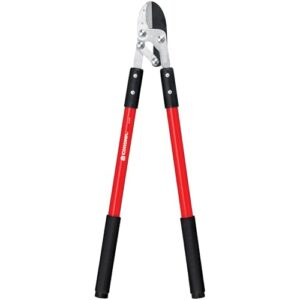
Dead wood on old fruit trees fights back, and that’s where this lopper earns its keep. The four-bar compound linkage triples your cutting power, so a single squeeze grips branches up to 1½ inches of dry wood.
Those 32-inch fiberglass grips give you real reach and control, while the PTFE-coated anvil blade sheds sap easily. At 2.7 pounds, it’s manageable overhead, though the anvil bolts may loosen and need occasional tightening.
| Best For | homeowners and professionals who need to cut through thick, dry, or dead branches during tree trimming, shrub pruning, and general yard cleanup. |
|---|---|
| Type | Lopper |
| Blade Material | Steel |
| Weight | 2.7 lbs |
| Cutting Capacity | Thick/Hard Wood |
| Handle Length | 32 inches |
| Primary Use | Dead/Dry Wood |
| Additional Features |
|
- Compound action mechanism multiplies cutting force, making it easier to slice through thick, tough branches
- 32-inch fiberglass handles offer extended reach and leverage for hard-to-reach limbs
- Anvil blade design works especially well on dry, dead, or hard wood
- Foam handle sleeves may slide or tear with heavy, repeated use
- Anvil bolts can loosen over time and may need thread lock or periodic tightening
- Handles stay apart at rest, which takes up more storage space and can snag on other tools
2. Ymachray Heavy Duty Anvil Lopping Shears
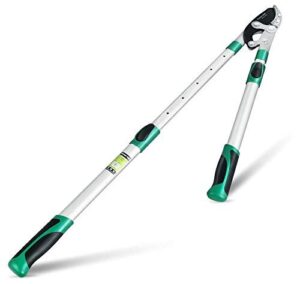
If the Corona’s compound action feels like more machine than you need, the Ymachray keeps things simple. Its anvil blade closes against a flat edge, built for crushing dry or dead wood cleanly.
High-carbon steel holds an edge through repeated cuts, and a black oxide coating fights rust and sap buildup.
Telescoping grips stretch from 26 to 41 inches, so you get power without buying a longer tool. Rated for branches up to 2 inches, it grips most stubborn deadwood jobs without strain.
| Best For | homeowners and landscapers who want a straightforward, no-frills lopper for cleanly crushing through dry or dead wood branches up to 2 inches thick. |
|---|---|
| Type | Lopper |
| Blade Material | SK-5 High-Carbon Steel |
| Weight | 3.6 lbs |
| Cutting Capacity | 2 inches |
| Handle Length | 26-41 inches |
| Primary Use | Hedges & Shrubs |
| Additional Features |
|
- High-carbon steel blade holds its edge through repeated, heavy-duty cuts
- Black oxide coating helps resist rust and sap buildup for easy maintenance
- Telescoping handles (26–41 inches) give you extra reach and leverage without needing a bigger tool
- Anvil-style blade is best suited for dry or dead wood, not ideal for green or living branches
- Limited to branches up to 2 inches in diameter, so thicker limbs are out of scope
- Simpler design means less cutting assistance compared to compound-action loppers
3. Fiskars 24 Inch Bypass Lopper Softgrip Handles
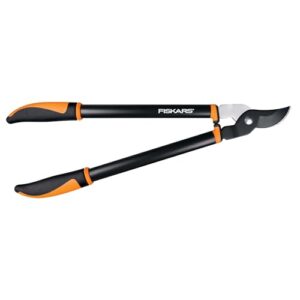
Switch gears to live wood, and the Fiskars fits right in. Its bypass blade slices through green growth instead of crushing it, cutting cleanly up to 1.5 inches.
At just 1.01 kg, it’s easy to handle for extended sessions. Softgrip grips with shock-absorbing bumpers ease hand fatigue, while the low-friction coating resists rust and sap.
The 24-inch length trades reach for control, perfect for tight-angle cuts on live branches and shrubs.
| Best For | Home gardeners with light to medium pruning needs who want clean cuts on live branches without straining their hands. |
|---|---|
| Type | Lopper |
| Blade Material | Steel |
| Weight | 2.23 lbs |
| Cutting Capacity | 1.5 inches |
| Handle Length | 24 inches |
| Primary Use | Live Branches |
| Additional Features |
|
- Bypass blade delivers clean, healthy cuts on green growth up to 1.5 inches thick
- Lightweight 1.01 kg build with softgrip handles reduces hand fatigue during long sessions
- Low-friction, rust-resistant coating keeps the blade smooth and sap-free
- Not built for dead or dry wood over 1.5 inches
- Shorter 24-inch length can make high or hard-to-reach branches tougher to cut
- Not designed for professional arborist or heavy commercial use
4. Silky GomBoy Professional Folding Saw 240mm
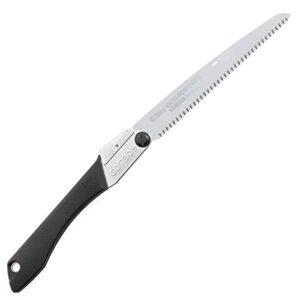
Once branches outgrow your lopper’s reach, the Silky GomBoy takes over. Its 240mm impulse-hardened blade controls cuts up to 4.7 inches, pulling through dry or green limbs with ease.
At 12.8 ounces, it folds compact for backpacks or tool belts. The chrome-plated blade locks in two settings, resisting sap and rust while keeping teeth sharp longer than standard carbon steel saws.
| Best For | Gardeners, campers, and landscapers who need a compact, powerful folding saw for pruning and trimming branches up to 4.7 inches thick. |
|---|---|
| Type | Folding Saw |
| Blade Material | Chrome-Plated Steel |
| Weight | 12.8 oz |
| Cutting Capacity | 4.7 inches |
| Handle Length | 19.8 inches folded |
| Primary Use | Camping & Trimming |
| Additional Features |
|
- Impulse-hardened teeth deliver clean, smooth cuts with minimal effort on the pull stroke
- Lightweight (12.8 oz) and compact when folded, making it easy to pack for camping or backpacking
- Chrome-plated blade resists rust and resin buildup, keeping teeth sharp over long-term use
- Not designed for wood over 5 inches in diameter, risking blade binding
- Blade can bend or snap under excessive force, especially on the push stroke
- Replacement blades are sold separately and can be pricey
5. ARS LA-160ZR203 Telescoping Pruner
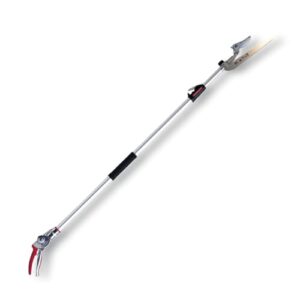
When high, thin growth is the problem, not thick limbs, the ARS LA-160ZR203 shines. It telescopes from 4 to 7 feet, so you skip the ladder entirely for shrub and tree touch-ups.
Its Cut and Hold blades grip cuttings after the snip, keeping them from dropping into flower beds below.
Just know its limits: cutting capacity tops out around 3/8 inch. This tool’s for precision, not power—save thicker limbs for your loppers or saw.
| Best For | homeowners who need to prune high, thin branches on trees and shrubs without hauling out a ladder. |
|---|---|
| Type | Pole Pruner |
| Blade Material | Drop-Forged Steel |
| Weight | 2.3 lbs |
| Cutting Capacity | 0.375 inch |
| Handle Length | 4-7 feet |
| Primary Use | High Pruning |
| Additional Features |
|
- Telescopes from 4 to 7 feet, giving you extended reach for high growth
- Cut and Hold blades grip cuttings after each snip, so they don’t fall into beds below
- Lightweight at 2.3 lbs with a balanced design that eases arm fatigue during longer sessions
- Cutting capacity maxes out around 3/8 inch, so it can’t handle thicker limbs
- The hold feature only works if you orient the jaws correctly, which takes a little practice
- Some users report the safety lever can jam and need adjusting right out of the box
6. Felco Folding Saw F600 Red
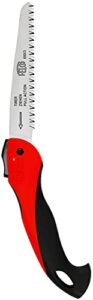
A red handle stands out for a reason: you can actually find it in leaf litter after you set it down. The Felco F600 packs a 6.3-inch chrome-plated blade with impulse-hardened teeth, cutting branches up to 4 inches thick.
Its conical blade shape resists sap binding, and the pull-stroke action means less wrist strain. Everything folds down small, locks securely, and the parts are replaceable when they wear out.
| Best For | Arborists, landscapers, and gardeners who need a compact, portable pruning saw for cutting branches up to 4 inches thick in tight spaces. |
|---|---|
| Type | Folding Saw |
| Blade Material | Chromium-Coated Steel |
| Weight | 5.5-6.4 oz |
| Cutting Capacity | 4 inches |
| Handle Length | 14 inches open |
| Primary Use | Portable Field Cuts |
| Additional Features |
|
- Pull-stroke action reduces wrist strain and delivers clean, precise cuts
- Conical blade design resists sap buildup, keeping cuts smooth and clog-free
- Folds down to just 8 inches, making it easy to carry in a pocket or backpack
- Blade can bend or wobble if used improperly, so cutting only on the pull stroke is essential
- Performance drops on branches over 2.5 inches, requiring more effort for thicker cuts
- Not built for regular use on very hard or dense wood
7. Corona WL 6470 ClassicCUT Bypass Lopper
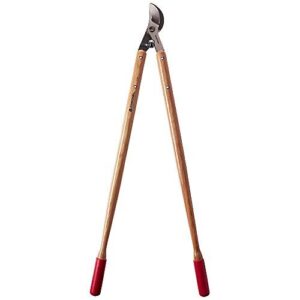
When a lopper needs to last for years, not seasons, the ClassicCUT earns its keep. Its forged Radial Arc bypass blade controls a 2 1/4-inch cutting capacity, and it’s fully resharpenable instead of disposable.
The self-aligning bolt keeps the pivot tight, while a Shock Stop bumper cuts down on vibration hitting your shoulder. A sap groove in the hook fights buildup mid-cut.
At 36 inches with hickory or aluminum grips, it’s built for orchard work that demands consistency.
| Best For | Professional landscapers and dedicated gardeners who want a durable, long-lasting lopper for regular pruning of live branches up to 2.25 inches thick. |
|---|---|
| Type | Lopper |
| Blade Material | Heat-Treated Steel Alloy |
| Weight | 3.3 lbs |
| Cutting Capacity | 2.25 inches |
| Handle Length | 30.5 inches |
| Primary Use | Orchard Pruning |
| Additional Features |
|
- Forged Radial Arc bypass blade is resharpenable, so it’s built to last rather than be replaced
- 30-1/2-inch tapered hickory handles offer strong leverage and control for cleaner cuts
- Fully heat-treated steel alloy blade delivers durable, high-performance cutting power
- Cutting dense or dead wood takes noticeably more physical effort
- Hickory handles can warp or suffer weather damage without proper upkeep
- At 3.3 pounds, it’s heavier than aluminum-handled models, which may lead to quicker fatigue
8. Bahco 45mm Aluminium Handle Bypass Lopper
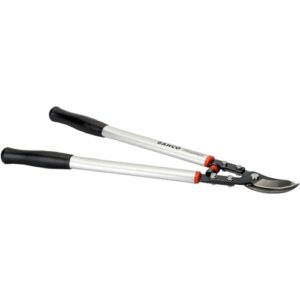
Overhead cuts wear you out fast, and that’s where this Bahco shines. At 750 mm long with aluminium grips, it weighs just 2.7 kg, so your shoulders stay fresh through a full day of orchard work.
The narrow forged blade pairs with a hooked counter blade for slicing cuts up to 45 mm. A center bolt keeps everything locked tight, no wobble, no wasted effort.
| Best For | professional orchard workers and landscapers who need to make clean overhead cuts on thick lower branches without tiring their arms and shoulders. |
|---|---|
| Type | Lopper |
| Blade Material | Forged Steel |
| Weight | 5.95 lbs |
| Cutting Capacity | Thick Lower Branches |
| Handle Length | 750 mm |
| Primary Use | Orchard Pruning |
| Additional Features |
|
- Lightweight aluminium handles make extended overhead cutting far less tiring
- Forged narrow blade and center bolt locking system deliver smooth, precise, wobble-free cuts
- Balanced design and replaceable parts make it a durable, long-term choice for regular use
- Not suited for cutting dry hardwood or metal materials
- Aluminium handles are less impact-resistant than steel alternatives
- The long overall length can be awkward to maneuver in tight spaces
9. Silky Zubat Hand Saw 330mm
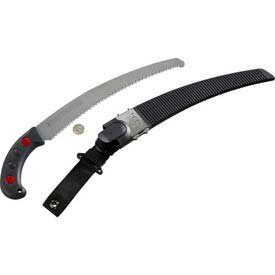
Think of this saw as your go-to for branches too thick for loppers. The curved 330mm blade uses a pull-stroke design, cutting fast with less arm effort.
Impulse-hardened teeth stay sharp through resinous or wet wood without binding. At roughly 465-495 grams, it’s light enough for extended pruning sessions.
The molded rubber handle keeps your grip steady, even in humid orchard conditions. This saw earns its keep on live limbs where loppers just can’t compete.
| Best For | Arborists, orchard owners, and trail crews who need a reliable pull-stroke saw for cutting live, green, or wet branches without binding. |
|---|---|
| Type | Folding Saw |
| Blade Material | High-Carbon Steel |
| Weight | 13.4 oz |
| Cutting Capacity | Live Branches |
| Handle Length | N/A |
| Primary Use | Forestry/Brush |
| Additional Features |
|
- Aggressive, large-tooth design powers through green wood with ease
- Curved 330mm blade and pull-stroke action deliver fast cuts with less arm fatigue
- Impulse-hardened, high-carbon steel teeth resist dulling in wet or resinous wood
- Not suited for dry hardwood lumber or metal cutting
- Blade isn’t replaceable, so the whole saw needs replacing once it dulls
- Needs regular cleaning to keep resin from building up on the teeth
10. Wolf Garten ZMV3 Telescopic Handle 170-300cm
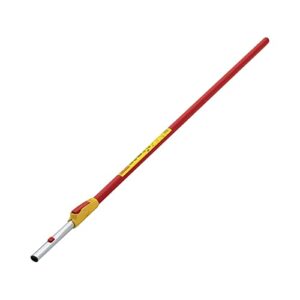
This isn’t a cutting tool at all, but it might save your shoulders more than any blade on this list. The ZMV3 extends from 170 to 300cm in five locking stages, turning any lopper or saw head into a high-reach tool.
It clicks into Wolf Garten’s Multi-Change system, swapping heads in seconds. At under a kilogram, it stays balanced overhead, keeping your feet on the ground where they belong.
| Best For | gardeners who need to reach tall trees and hedges safely from the ground without hauling out a ladder. |
|---|---|
| Type | Pole Tool |
| Blade Material | N/A |
| Weight | 1.65 lbs |
| Cutting Capacity | N/A |
| Handle Length | 170-300 cm |
| Primary Use | High Reach Tasks |
| Additional Features |
|
- Extends from 170 to 300cm, giving serious reach for high branches
- Clicks into the Multi-Change system, so one handle works with 50 different tool heads
- Lightweight aluminum build (0.75 kg) keeps it manageable even at full extension
- At full length, the extra leverage makes it harder to keep steady control
- No 4-meter version available through Amazon if you need even more reach
- Angled tool heads can be tricky to see clearly when working in thick foliage
Compare Reach, Comfort, and Safety
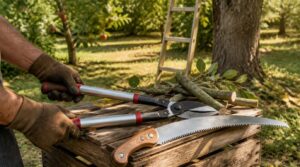
Picking the right tool is only half the job. How it feels in your hands, and how far it reaches, matters just as much. Here’s what to check before you make the cut.
Handle Length and Leverage
That extra foot of handle isn’t just for reach, it’s free cutting force. Longer grips give you more mechanical advantage, so a wider pivot spacing cuts thick limbs without extra effort.
Shorter grips trade power for control, better for precise cuts near trunk junctions. Match handle length to branch diameter, and let power do the heavy lifting.
Telescoping Tools for High Branches
When branches sit too high for grips alone, a telescopic handle solves the problem. These poles extend 12 to 27 feet using aluminum or fiberglass, with lever or twist extension locks keeping each section secure.
Detachable heads swap between bypass, anvil, or saw options, matching cutting capacity to branch diameter for real fruit tree pruning control up high.
Grip Comfort During Pruning
A pole extends your reach, but comfort still starts in your hands. Handle grip design matters most during long sessions—look for cushioned foam or rubber that absorbs shock.
Wider grips spread pressure evenly, and shock-absorbing bumpers ease impact. Ergonomic grips support neutral wrist angles, while good finger placement and balanced weight keep fatigue low, even after hours of pruning.
Tight-canopy Cutting Control
Good grip means nothing if you can’t reach the right limb. Working inside a dense canopy calls for tight-canopy cutting control—short strokes, narrow heads, and a bypass blade that slices without tearing bark.
Adjustable pivots give you branch access precision for inward-facing limbs. Low-angle cutting protects nearby shoots, while a sharp blade keeps cuts clean and canopy maneuverability easy.
Safe Overhead Pruning
Once you’re cutting overhead, safety comes first. Wear a helmet and eye protection, check weather conditions, and set up drop zone management with a helper below.
Use the three-cut method on bigger limbs to stop bark from tearing. Match tool to branch diameter and cutting capacity, then clear debris right away to avoid trip hazards underfoot.
Maintain Tools for Cleaner Cuts
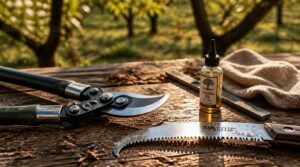
A sharp, clean tool makes a better cut than any amount of muscle. Good maintenance keeps your loppers and saw ready to work, season after season. Here’s what to check and clean before your next trip into the orchard.
Remove Sap After Pruning
That sticky residue on your blades isn’t just messy, it’s a tool killer. Wipe your lopper and pruning saw clean right after each cut, before sap buildup hardens.
For bleeding branches, a soft cloth removes surface sap fast. This helps natural wound healing and keeps your post-prune tree care simple, without dressings or sealants slowing things down.
Sharpen Lopper Blades Regularly
Rarely does a dull blade make a clean cut. Sharpen loppers every 2 to 4 pruning sessions, or once you feel drag on wood.
Use a flat stone or file for a consistent bevel. Remove nicks first, then oil the blade after sharpening.
Test on a small twig, if it slices smooth without tearing, your blade’s ready.
Care for Saw Teeth
Saw teeth need less babying than blades, but sap still gums up the works. Wipe teeth dry after each cut, then brush out debris caught between them.
- Remove pitch with a soft brush or citrus solvent
- File nicks with a single-point file, matching tooth angle
- Check tooth set for even alignment
- Oil lightly before dry storage
Sharpness retention stays high when you skip harsh solvents.
Lubricate Pivots and Joints
A stiff pivot slows every cut, so keep it moving with regular grease.
Wipe off old grease first, then apply a fresh coat to your lopper pivot and pruning saw joint. Use water-resistant grease for outdoor tool maintenance.
Check for wear each time. Re-lubricate every few sessions, or sooner if squeaking starts. Store lubricants sealed, away from heat, for safety.
Store Blades Safely and Dry
A wet blade rusts fast, so drying matters as much as cleaning.
Air dry blades for 15 minutes before storage. Wipe with a lint-free cloth, then store in a dry, sheathed pouch with desiccant packets. Keep tools off concrete, away from humidity, to maintain blade sharpness, cutting capacity, and long-term tool maintenance.
Frequently Asked Questions (FAQs)
What is the best tool for pruning fruit trees?
Is there really one perfect tool? Not quite. Match the tool to branch diameter: hand pruners under an inch, loppers for one to two inches, and a pruning saw once limbs exceed two inches.
Are pruning saws better than loppers?
Neither tool wins outright. Pruning saws beat loppers past 2 inches, preserving wood fibers with clean strokes. Loppers stay faster and less fatiguing on smaller branches, thanks to bypass blades and geared advantage on live wood.
What are the common mistakes when pruning fruit trees?
One grower topped her tree hard every winter, then wondered why fruit vanished. That’s over-pruning: cutting too much, at the wrong time, with dull tools, ignoring growth patterns, wrong cuts, and poor tool ergonomics.
What is the best technique for pruning fruit trees?
Match branch diameter to sharp, well-maintained blades: thinning cuts at the origin for structure, three-step cuts on heavy limbs, dormant-season timing, matching tool capacity to wood size for clean, fast-healing wounds.
How often should I replace my pruning tools?
Wondering if that lopper still has some life left? Run a quick blade sharpness check each season. Replace pruners every 1–3 years, loppers and saws every 2–5, or sooner if you spot rust, nicks, or cutting efficiency decline.
Can I use loppers on dead branches too?
Yes, loppers handle dead branches fine, though cuts come out rougher. Anvil loppers work best here, crushing slightly but severing cleanly. Keep blades sharp, wear gloves, and inspect for hidden decay before cutting dry, brittle wood.
Do compound loppers really cut faster than saws?
A single squeeze through a two-inch limb beats ten saw strokes any day. That’s force multiplication at work. On green wood under two inches, compound loppers win on speed and fatigue—saws only pull ahead once diameter and wood density climb.
How do I know if a branch is diseased?
Look for dieback starting at branch tips, sunken cankers oozing sap, leaf discoloration or curling, and crumbly brown wood underneath the bark. Fungal fruiting bodies or brittle, weak limbs signal deeper decay worth removing promptly.
Conclusion
Small cuts deserve shears. Medium branches deserve loppers. Thick limbs deserve saws.
That’s the whole story behind loppers vs pruning saw fruit trees choices, and it’s simpler than most gardeners think. Match the tool to the branch, and you’ll leave a clean wound that heals fast, not a torn scar that invites disease.
Your tree doesn’t care how sharp your tools look. It cares whether every cut helps it grow stronger, season after season.