This site is supported by our readers. We may earn a commission, at no cost to you, if you purchase through links.
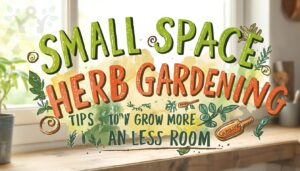
A six-inch pot of basil sitting on a sunny windowsill can outperform a grocery store bunch every single time—harvested within minutes; the essential oils haven’t had a chance to fade.
Most people assume growing herbs requires a sprawling garden, but a balcony railing, a kitchen shelf, or a south-facing sill holds everything you need.
The real secret isn’t space—it’s placement, container choice, and knowing which herbs genuinely thrive when their roots are confined. Small space herb gardening rewards precision over acreage, and once you understand a few core principles, even the most compact apartment kitchen can stay stocked with fresh rosemary, thyme, and basil year‑round.
Table Of Contents
- Key Takeaways
- Why Small Space Herbs Thrive
- Best Herbs for Tight Spaces
- Choose Containers and Soil
- Maximize Light and Water
- Design, Prune, and Harvest
- Frequently Asked Questions (FAQs)
- How can I grow herbs in a small space?
- What herbs should never be planted together?
- How to grow lots of herbs in a small space?
- What to grow in a small herb garden?
- How to grow herbs in a small space?
- What herbs are good for small gardens?
- What herbs should not grow together?
- What is the best layout for an herb garden?
- How much space does each herb need?
- Can I grow herbs from supermarket cuttings and scraps?
- Conclusion
Key Takeaways
- You don’t need a yard — sunny windowsill or balcony rail gives herbs everything they need to outperform store-bought bunches.
- Match each herb to its light conditions and group pots by water needs, and you’ll spend less time fussing and more time harvesting.
- Drainage holes, the right pot depth, and a light fast-draining mix are the real difference between herbs that thrive and ones that slowly drown.
- Pinch and harvest often — frequent, light trimming is what keeps basil bushy, woody herbs productive, and your whole container garden going strong.
Why Small Space Herbs Thrive
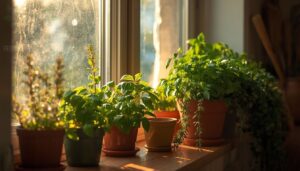
Small-space herb gardening works better than most people expect — and for reasons that go beyond just saving room. A few smart choices make all the difference, whether you’re working with a sunny windowsill or a narrow balcony.
Grouping compatible herbs in wider containers is one of those small shifts that pays off fast, as this guide to herb gardening in pots shows beautifully.
Here’s why herbs are actually built for tight spaces.
Fresh Harvests Close to The Kitchen
When your herb garden sits steps from the stove, everything changes. No wilted bunches from the fridge — just Rapid Leaf Picking and Instant Flavor Access, exactly when you need it.
Here’s what that proximity gives you daily:
- Daily Herb Supply — snip what you need, when you need it
- Kitchen Aroma Boost — fresh basil and thyme perfume your cooking space
- Freshness Retention Time — leaves harvested minutes before use hold peak oils
- Smarter harvest timing — your sunny windowsill or balcony herb garden rewards consistent, light pruning
Choosing an optimal garden location with full sun maximizes herb growth.
Lower Cost, Less Waste, More Flavor
Growing your own cuts grocery bills fast. Frequent small harvests mean almost zero spoilage — you pick what you need, nothing rots in the fridge.
Compost recycling turns kitchen scraps into free fertilizer, while rainwater harvesting slashes water costs.
Self-watering planters and capillary mats make watering strategies for herbs nearly simple.
Herb waste reduction happens naturally — and harvesting herbs for flavor at peak ripeness means every leaf punches harder.
Balconies, Windowsills, and Patios Work Well
Saving money on herbs is satisfying — and your balcony, windowsill, or patio makes it even easier.
Small-space herb gardening works beautifully in outdoor spots with:
- Slim rail planters along balcony edges
- Weather-resistant furniture paired with reflective surfaces for brighter light
- Privacy screens and solar lighting for evening harvests
Container gardening fits naturally into any corner you already have.
Easy to Start for Beginners
Starting out doesn’t have to feel overwhelming. Pick one beginner-friendly herb — basil, chives, or mint — and a 6 to 8-inch starter pot with a simple soil mix.
Label each pot and follow a basic harvest schedule: trim every week or two.
Small-space herb gardening rewards consistency over complexity. Avoid the most common beginner mistake — overwatering — and your container herb gardening journey builds confidence fast.
Best Herbs for Tight Spaces
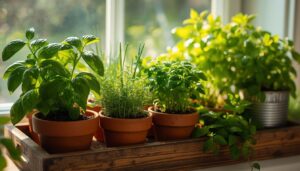
Not every herb belongs in every corner — and that’s actually good news for small-space growers. Matching the right plant to the right spot makes the difference between a thriving little garden and a struggling one.
Here are the best herbs to reach for, organized by how they grow and what they need.
Sun-loving Herbs for Bright Spots
A sun-drenched balcony or south-facing windowsill is prime real estate for sunloving drought-tolerant herbs. These heat-tolerant varieties ask for little — just bright light and space to breathe.
Harvest them every few weeks to keep growth coming — these tips on steady leaf yield and healthy regrowth apply just as well to sun-loving herbs.
- Rosemary thrives in a container with gritty soil and full sun
- Basil delivers peak Sun herb nutrition with six-plus hours daily
- Thyme suits vertical gardens and edging beautifully
- Oregano manages Pest control full sun conditions naturally
- Sage rewards Seasonal harvest timing with bold, aromatic leaves
Mulch moisture retention keeps roots happy between waterings.
Shade-tolerant Herbs for Partial Light
Not every herb needs a sun-drenched ledge to deliver. Shade-tolerant herbs — mint, chives, parsley, and lemon balm — thrive in partial shade with just 3–4 hours of light. Their leaf texture stays lush, aroma retention remains strong, and growth speed surprises most beginners.
Shade-tolerant herbs like mint and parsley thrive on just three to four hours of light — and still deliver
In small spaces, these indoor-friendly workhorses keep your herb garden productive through every season, with natural pest resilience built right in.
Best Indoor Herbs for Windowsills
Your windowsill is prime real estate.
Basil, sage, and cilantro — all indoor-friendly herbs — thrive in bright indirect light with compact growth that fits even the tightest small spaces.
Their aromatic foliage fills your kitchen with flavor intensity you won’t get from a grocery bag.
Low‑maintenance herbs by nature, they tolerate typical indoor temperature swings well and quietly improve air purification too.
Annuals, Perennials, and Dwarf Varieties
Not all herbs play by the same rules — and that’s actually a good thing for small-space herb gardening.
Annuals like basil and cilantro reward high harvest frequency but need replanting each season.
Perennials like thyme return year after year with minimal fuss.
Dwarf herbs and compact herbs fit tight containers perfectly, maximizing space efficiency through smart lifecycle timing, growth habit awareness, and seasonal rotation planning.
Group Herbs by Similar Water Needs
Grouping by water need clusters is the secret to a low-fuss container garden. Think of it as moisture compatibility in action — no more guessing who’s thirsty.
- Dry soil lovers — thyme, oregano, rosemary — water once a week
- Moist-soil herbs — basil, parsley, cilantro — water when the top inch dries
- Always-damp herbs — mint — keep consistently moist
- Hydration scheduling tip — separate watering zones prevent overwatering mistakes
Choose Containers and Soil
The right container makes all the difference between herbs that struggle and herbs that thrive.
Before you grab the nearest pot, there are a few simple things worth getting right — starting with drainage, depth, and soil mix. Here’s what to look for.
Pick Pots With Drainage Holes
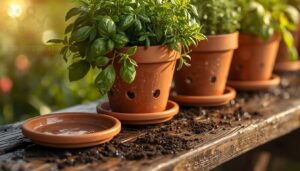
Drainage holes are non‑negotiable — they’re what separates a thriving herb from a drowning one. Choosing containers with drainage means excess water escapes freely, keeping roots healthy.
Look for even flow placement across the base, with holes at least 6mm wide. Clear blocked holes regularly. Pair functional containers with saucers to protect surfaces.
Material drainage traits matter too — terracotta breathes faster than plastic.
Use The Right Pot Depth
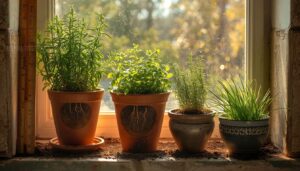
Once drainage is sorted, depth is your next call. Most herbs need 6–8 inches for healthy root zone expansion — enough room for roots to spread without circling. Deeper pots also help with moisture retention and temperature regulation, buffering hot window sills. They slow salt build-up too.
Shallow pots? Fine for chives. Thyme or oregano, go deeper.
Select a Light, Fast-draining Mix
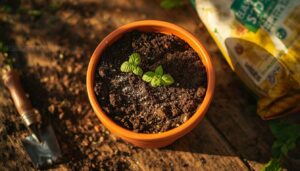
Depth sorted — now the mix matters just as much. Think of your soil like a sponge that knows when to let go. A good organic soil mix uses Base Material Choices like peat moss or coconut coir for Nutrient Retention Balance, while Aeration Additives keep roots breathing. Follow Mix Ratio Guidelines — roughly equal parts — and watch dry soil cycles stay healthy.
- Lightweight blends prevent compaction and support soil drainage naturally
- pH Adjustment keeps herbs near neutral — most culinary varieties thrive there
- A quality soil amendment improves both structure and moisture release
Improve Soil With Perlite or Grit
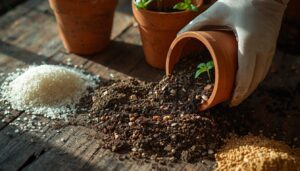
Once you’ve got the right mix, perlite and grit take it further. Perlite moisture control works by creating tiny air pockets — roots breathe, excess water escapes.
Grit soil structure prevents compaction, keeping things loose and workable. A combined grit-perlite blend balances drainage and moisture beautifully in small-space herb gardening.
Stir either into your potting mix — your herbs will notice immediately.
Avoid Compacted Garden Soil
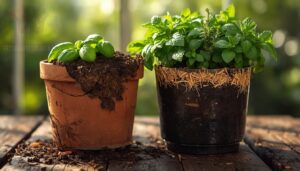
Garden soil looks tempting — it’s free and right there. But it compacts fast in pots, cutting off Soil Aeration and suffocating roots.
Bulk density climbs, water pools, and your herbs struggle.
Use raised beds when possible, keep Foot Traffic off planting zones, and add Organic Matter or a thin Mulch Layer to maintain soil quality and healthy soil moisture management.
Maximize Light and Water
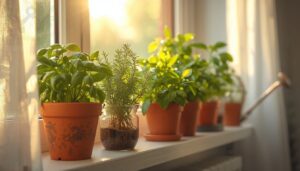
Getting light and water right makes all the difference between herbs that thrive and ones that just survive. Every herb has its own preferences — and once you know them, keeping your plants happy gets a lot easier.
Here’s what to focus on.
Match Herbs to Sun or Shade
Think of your balcony or windowsill as a Light Intensity Map — some corners get blazing full sun, others stay cool and dim.
Sun-loving herbs like rosemary, oregano, and basil need six-plus hours of direct light.
Shade-tolerant picks — mint, parsley, chives — thrive in partial shade with just three to four hours.
Use a simple Sun Shade Pairing approach: match each herb to its ideal microclimate spot.
Use Grow Lights in Dim Spaces
Not every windowsill catches enough sun — that’s where indoor grow lights become your best ally in small-space herb gardening.
Managing sunlight and using grow lights together keeps your herbs thriving year-round. Full-spectrum LEDs handle all the light requirements without overheating your space.
- Spectrum Tuning: Blue light builds leafy, compact growth; red light boosts oils.
- Light Height: Keep fixtures 6–12 inches above mature herbs.
- Timer Scheduling: Run lights 12–16 hours daily for consistent indoor herb growing techniques.
- Energy Efficiency: Choose high-output LEDs — 40–80 watts cover a compact tray.
- Reflective Surfaces: Line shelves with Mylar to spread light evenly across every pot.
Water Only After Soil Begins Drying
Before you reach for the watering can, do a quick Surface Dry Test — press a finger 2–3 inches into the soil. Still damp? Wait.
A Moisture Meter use check removes all guesswork.
When the soil signals readiness, try the Deep Soak Technique: water slowly from the bottom — Bottom Watering Benefits include even root absorption.
Stick to a Morning Watering Routine for best uptake.
Prevent Root Rot by Avoiding Overwatering
Root rot is the silent killer of herb gardens — and overwatering is almost always the culprit.
Good root rot prevention starts with smart habits:
- Check soil moisture monitoring before every watering.
- Stick to a morning watering routine for drier foliage.
- Use the pot elevation technique to clear drainage holes.
- Apply mulch moisture control to slow surface evaporation.
Soggy roots suffocate. Let the soil breathe.
Rotate Pots for Even Growth
Your herbs are quietly leaning toward the light — and you might not notice until one side looks sparse.
Simple rotation fixes that. Turn each pot 90 degrees every one to two weeks. This builds Light Angle Balance, promotes Growth Symmetry, and encourages Stem Straightening across your container gardening setup.
| Rotation Schedule | Herb Type | Benefit |
|---|---|---|
| Every 7 days | Basil, parsley | Even leaf size |
| Every 10 days | Mint, cilantro | Upright, balanced growth |
| Every 14 days | Thyme, oregano | Reduces wall-leaning |
| Every 14 days | Sun-loving rosemary | Root Uniformity |
| Every 7 days | Indoor-friendly sage | Consistent stem strength |
Mark pots with a small dot — rotate on the same day weekly. Your watering strategies for herbs pair perfectly here: check soil moisture at each turn. Small spaces reward this kind of quiet discipline.
Design, Prune, and Harvest
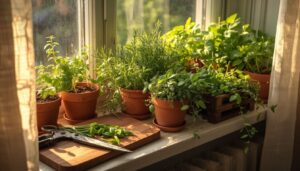
A smart layout does more than look good — it shapes how much you actually grow. Once your herbs are placed well, pruning and harvesting regularly keep everything productive and within reach.
Here are the best ways to design, tend, and collect from your small-space garden.
Use Vertical Planters and Hanging Baskets
Think of walls and railings as untapped garden real estate. A modular stacking system lets you layer multiple herbs vertically — turning a bare balcony wall into a vertical kitchen herb garden overnight.
Decorative hanging baskets work beautifully near windows, while wall-mounted planters with an integrated wicking reservoir keep moisture consistent without daily checking.
Vertical panel grids offer even more small-space herb gardening flexibility.
Try Tiered Stands and Railing Planters
Tiered stands take vertical growing even further. A tiered shelving unit stacks your container herb garden upward — adjustable shelf heights let you fit pots of any size without guessing.
Metal frames with powder-coated weatherproofing handle rain and humidity without rusting.
Railing planters clip onto your balcony rail via rail clamp security, freeing floor space entirely.
Modular expansion options mean you can add tiers as your small-space herb gardening grows — and smart weight distribution tips prevent top-heavy wobbles.
Companion Plant Herbs With Similar Needs
Grouping herbs by similar needs is one of the smartest moves in small-space herb gardening.
- Pair sun-loving, drought-tolerant herbs like rosemary, thyme, and oregano for Growth Habit Harmony and easy watering
- Shade-tolerant kitchen herbs — mint, chives, parsley — share a pot without competing
- Basil and thyme offer Flavor Synergy plus natural Pest Repellent Pairings
- Match Soil pH Balance by keeping Mediterranean herbs together in gritty, low-fertility mix
- Plan Seasonal Succession Timing so low-maintenance container herbs fill gaps year-round
Pinch Basil and Harvest Often
Basil rewards frequent attention. Pinch just above a leaf node every 7–14 days — that’s your Growth Stimulation sweet spot — and two new shoots replace every stem you remove.
This simple Harvest Frequency habit delivers a real Leaf Yield Boost, up to 40 percent more leaves per season.
Pick in the morning for peak Flavor Intensification. Smart Pinch Timing keeps small-space herb gardening productive all summer.
Trim Woody Herbs to Stay Productive
Woody herbs like rosemary, thyme, and sage need a different approach than basil.
Follow a Seasonal Pruning Schedule — trim every 3–4 weeks with Sharp Bypass Pruners, making 45° Angle Cuts just above outward-facing buds. Leave Collar Wood at the base.
After cutting, apply Post‑Prune Mulch to support recovery. Smart herb pruning keeps your container herb gardening productive all season long.
Succession Sow Fast-bolting Herbs for Continuity
Cilantro bolts fast — sometimes within two to three weeks in warm weather. That’s why Staggered Planting is your best friend here.
Use Biweekly Seed Sowing to keep a Rapid Harvest Cycle going all season:
- Sow cilantro and basil every 14 days
- Bolting Delay Strategies like partial shade at peak heat
- Follow a Seasonal Sow Rotation for small‑space herb gardening
- succession planting and interplanting methods into your Herb Garden Layout Plans
Frequently Asked Questions (FAQs)
How can I grow herbs in a small space?
You don’t need a big yard. A sunny windowsill or compact balcony corner is enough.
Smart container choices, vertical planters, and matching herbs to your light conditions make small-space herb gardening surprisingly simple.
What herbs should never be planted together?
Some herbs are bad neighbors. Mint incompatibility is real — it crowds everything.
Keep fennel vs basil apart.
The sage‑rosemary clash, dill‑basil conflict, and cilantro‑mint competition all hurt yields quickly.
How to grow lots of herbs in a small space?
Group pots together — that’s your secret weapon. Shared microclimates cut water loss fast. Stack vertical planters, match herbs by need, and you’ll harvest more than you ever expected.
What to grow in a small herb garden?
What works best? Think culinary flavor boosters like basil, thyme, and chives — aromatic kitchen herbs that punch above their weight.
Add mint, parsley, and compact herb mixes for seasonal harvest rotations and medicinal mini herbs year-round.
How to grow herbs in a small space?
Pick the right pot, match each herb to its light, and water only when the top inch dries out. Small spaces reward smart choices — not more room.
What herbs are good for small gardens?
Basil, chives, mint, and parsley top the list for small spaces. These compact herbs deliver big flavor, resist common pests, and thrive in container herb gardening setups with minimal fuss.
What herbs should not grow together?
Some herbs simply don’t get along. Mint invades everything near it. Fennel poisons basil, cilantro, and parsley. Keep troublemakers isolated — your herb garden design for small spaces depends on it.
What is the best layout for an herb garden?
Group by water needs first. Sun lovers like rosemary and thyme share one zone — mint gets its own pot.
A Rail-mounted Herb Rack or Adjustable Height Stand keeps everything reachable and organized.
How much space does each herb need?
Every herb claims its own territory — root spread, canopy width, container volume. Basil needs 12 inches. Mint wants Thyme and oregano share Rosemary stretches
Can I grow herbs from supermarket cuttings and scraps?
Yes — supermarket cuttings root surprisingly well. Trim basil or mint stems to 4–6 inches, strip lower leaves, and set them in water. Roots appear within 7–14 days.
Conclusion
pot of basil on your windowsill is more than a plant—it’s proof that roots don’t need room to run deep. Small space herb gardening strips away everything unnecessary and leaves only what matters: the right light, a well-drained pot, and herbs that actually suit your conditions.
Start with three varieties. Learn their rhythms. Harvest often. Your kitchen won’t just smell better—it’ll feel like somewhere a capable, attentive grower actually lives.