This site is supported by our readers. We may earn a commission, at no cost to you, if you purchase through links.
Most gardeners think they need more land. They don’t—they need more wall.
A single 4×8 fence panel planted with pole beans, cucumbers, and lettuce can outproduce a traditional bed twice its footprint, and that’s before you factor in the back-breaking harvests you’ll skip because everything grows at arm’s reach.
Vertical gardening for vegetables flips the whole math of a kitchen garden on its head. Less ground, better airflow, fewer pests, and crops that practically present themselves to you. Whether you’re working with a tiny balcony or a full backyard fence, growing up is the smartest move you’ll make this season.
Table Of Contents
- Key Takeaways
- What is Vertical Gardening for Vegetables
- Choosing The Best Vegetables for Vertical Gardens
- Planning Your Vertical Vegetable Garden Layout
- Essential Vertical Garden Support Structures
- Step-by-Step Guide to Setting Up Your Vertical Garden
- Growing Climbing Beans and Peas Vertically
- Cultivating Leafy Greens in Wall and Tiered Planters
- Watering, Mulching, and Fertilizing Vertical Crops
- Top 4 Products for Vertical Vegetable Gardening
- Space-Saving Vertical Gardening Tips for Small Gardens
- Frequently Asked Questions (FAQs)
- What are the disadvantages of vertical gardening?
- What vegetables are best for vertical farming?
- What vegetables grow well vertically?
- What grows best in a vertical garden?
- What vegetables do not grow well in raised beds?
- Are vertical gardens hard to maintain?
- What is a vertical vegetable garden?
- Can you grow vegetables vertically?
- What are the benefits of a vertical vegetable garden?
- What is the best plant for vertical vegetable gardening?
- Conclusion
Key Takeaways
- A single 4×8 fence panel planted with pole beans, cucumbers, and lettuce can outproduce a traditional ground bed twice its size — less space, bigger harvest.
- Vertical systems cut fungal disease pressure by nearly 30% and reduce pests naturally, because crops stay off the soil and air moves freely around the foliage.
- Match your plants to the right depth: leafy greens thrive in just 6–8 inches, while root crops like carrots need 25–30 cm to develop properly.
- Drip irrigation isn’t optional in a vertical setup — containers dry out faster than ground beds, so consistent, targeted watering is what keeps everything alive and productive.
What is Vertical Gardening for Vegetables
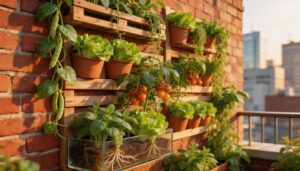
Vertical gardening is exactly what it sounds like — growing your vegetables up instead of out. It’s a smart way to turn a blank wall, fence, or balcony into a productive growing space.
Whether you’re working with a tiny balcony or a bare fence, these garden planning ideas for small and vertical spaces can help you map out a setup that actually works.
Here’s how it works, why growers love it, and where it fits best.
How Vertical Gardening Works
Vertical gardening shifts plant growth upward using vertical garden support structures and trellises — think walls, arches, or freestanding frames built with load bearing capacity to handle soil, plants, and wind load management.
Drip lines handle vertical garden irrigation while moisture sensor integration fine-tunes watering by level.
Light angle optimization ensures every tier catches sun, and nutrient flow dynamics keep roots fed consistently.
Key Benefits for Vegetable Growers
Once your structure is in place, the real payoff begins. Space efficiency alone is a key innovation — vertical systems use up to 60% less ground space for the same yield. And that’s just the start:
- Air flow improves around foliage, cutting fungal disease pressure by nearly 30%
- Labor savings add up fast — harvests stay chest-height, no crouching required
- Pest reduction happens naturally when crops stay off the soil
Urban agriculture has never looked better.
Ideal Spaces for Vertical Vegetable Gardens
South-facing walls are your best friend here — they capture midday sun and warm up faster, which fruiting crops love. Balcony railings, patio fences, rooftop terraces, and even urban alleyways all become productive ground with the right setup.
Small space gardening thrives when you think vertically.
Most people don’t realize a single fence panel can yield a surprising harvest.
Choosing The Best Vegetables for Vertical Gardens
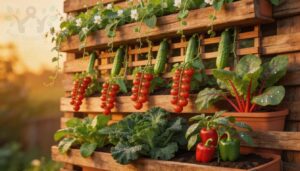
Not every vegetable belongs in a vertical garden — but more do than you’d think. The right picks make the difference between a thriving wall of food and a frustrating tangle of stems.
Here are the best vegetables to grow vertically, sorted by type so you can plan with confidence.
Best Leafy Greens and Herbs for Vertical Growth
Leafy greens and herbs are basically built for vertical gardens. Their shallow roots make root depth control simple — wall planters just 6–8 inches deep handle lettuce, spinach, and arugula comfortably.
Shade-tolerant herbs like parsley and chives tuck into lower tiers, while basil claims the sunny spots.
Use nutrient-dense mixes, stay consistent with watering and soil management, and leaf turnover stays steady all season.
Vertical gardening also increases planting density by utilizing vertical space.
Top Climbing and Vining Vegetables
Some vegetables practically beg to grow up — and climbing vines are your fastest path to a productive vertical garden.
- Bean Variety Selection: Pole beans like Kentucky Wonder hit 6–8 feet on vertical garden support structures and trellises.
- Pea Seasonality: Cultivating climbing beans and peas vertically works best in cool soil around 45–70°F.
- Cucumber Airflow: Vertical systems cut fruit rot dramatically.
- Squash Fruit Support: Use slings for heavy vines; Gourd Trellis Design needs 6–8 feet minimum.
Root and Compact Vegetables for Vertical Systems
Most people don’t realize roots can thrive vertically — you just need the right depth.
Carrots and parsnips need deep, well-drained pots (25–30 cm) for proper Taproot Depth Management, while radishes shine in Shallow Pocket Planting at just 5–15 cm.
Use 40% compost for Nutrient Balancing, practice Root Crop Rotation yearly, and nail Harvest Timing Precision — pull radishes at 2–3 cm for peak crispness.
Unique and Colorful Vertical Vegetable Options
Growing color into your vertical garden is easier than you think.
Rainbow carrots, purple pod beans, and variegated lettuce turn a trellis into living art. Try bicolored tomatoes on vertical strings, or let edible flower vines like nasturtium cascade downward.
Yardlong beans, Malabar spinach, luffa loofah gourds, and Egyptian walking onions add bold structure — beautiful and genuinely useful.
Planning Your Vertical Vegetable Garden Layout
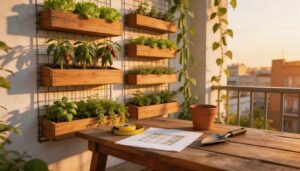
Before your first seed goes in the ground, your layout does the heavy lifting. A little planning now saves a lot of frustration later — from blocked sunlight to cramped roots.
Here’s what you need to think through to set your vertical garden up right.
Designing Your Garden Layout and Structure
Think of your vertical garden like a well-run kitchen — everything needs a place. Space tiers 15 to 24 inches apart for airflow zoning, and keep access paths at least 18 inches wide for easy reach.
Use modular frame design so you can expand without starting over. Aesthetic color coding by sun and water needs makes routine care faster and surprisingly effortless.
Selecting The Right Location and Sun Exposure
Location is everything. A south-facing orientation gives your vertical garden the longest, strongest light across the day.
Most fruiting crops need full sun — that’s 6 to 8 hours minimum. Leafy greens handle partial sunlight well, around 3 to 4 hours.
Use shade mapping to track where shadows fall, and don’t forget seasonal sun angles shift. Morning sun advantage keeps plants cool and productive without afternoon heat stress.
Companion Planting Strategies for Vertical Beds
Companion planting turns your vertical beds into a working ecosystem. Basil near tomato trellises deters aphids, while nasturtium draws them away from beans — classic pest repellents doing double duty.
Marigolds repel nematodes around pepper stakes, and dill attracts beneficial insects that protect cucumber vines.
These herb pairings and pollinator-friendly choices boost productivity without chemicals, creating root zone synergy throughout your vertical garden support structures.
Soil, Drainage, and Container Considerations
Your soil does the quiet heavy lifting here. Aim for a mineral mix ratio of 40–60% in your potting blend, then layer in organic matter and worm casting enrichment for slow-release nutrition.
Follow the drainage test procedure — water should clear within 30 minutes.
Container depth guidelines suggest 20–25 cm for greens, 30–40 cm for roots.
Lightweight plastic planters keep wall planters manageable without sacrificing well-drained soil performance.
Essential Vertical Garden Support Structures
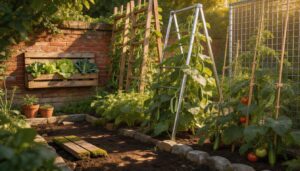
The right support structure can make or break your vertical garden — pick the wrong one and your plants will fight you all season. There’s no one-size-fits-all answer here, since different crops need different types of backing.
Here’s a look at the main options worth knowing about.
Trellises, Arches, and Pergolas for Climbing Crops
Your climbing crops need a backbone — and the right structure changes everything.
Metal cattle panels bend into sturdy arches for around – each, giving vines like cucumbers and pole beans an 18-foot runway.
Steel arch designs resist rust, while treated timber pergolas anchor heavier crops with serious staying power.
A-frame trellises and iron support frames round out your vertical garden toolkit beautifully.
Wire Cages, Netting, and Bamboo Supports
Beyond arches and panels, three workhorses handle most vertical garden support needs:
- Wire cages — galvanized steel with 14–16 gauge wire distributes weight evenly for tomatoes and peppers; zinc coating manages Cage Rust Prevention across multiple seasons.
- Netting — polypropylene mesh with smart Mesh Size Selection (¼ to 1 inch) keeps fruit off the ground.
- Bamboo sticks — Bamboo Pole Treatment through curing prevents rot; bury poles 2–3 feet deep using Anchor Stake Techniques for stability.
Combine all three with Hybrid Frame Designs for flexible DIY trellis construction.
Wall-Mounted Planters and Pocket Systems
Wall-mounted planters take your vertical garden off the ground and onto any solid surface.
Pocket systems use UV-Resistant Fabrics and Modular Pocket Design — usually three to nine pockets per panel — so you can swap plants seasonally without rebuilding anything.
Follow Weight Capacity Guidelines (usually 30–50 lb per panel), add Integrated Irrigation via a drip line, and Material Durability takes care of the rest year‑round.
Freestanding Frames and DIY Trellis Options
Freestanding frames give you total flexibility — no fence, no wall, no problem. A-frame Design stands on its own two legs and resists tipping better than a flat panel.
For Teepee Construction, drive six to eight bamboo poles in a circle and bind them at the top. Smart Anchoring Techniques, like sinking posts into compacted gravel, keep DIY vertical garden structures steady when vines fill out.
Step-by-Step Guide to Setting Up Your Vertical Garden
Getting your vertical garden up and running comes down to a handful of key habits done consistently right. From the way you guide vines upward to how often you harvest, each step builds on the last.
Here’s exactly what you need to do to keep everything growing strong.
Training and Supporting Vegetable Vines Upward
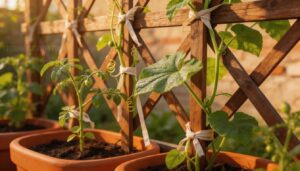
Vines don’t just climb — they need direction. Start with soft tie materials like Velcro or fabric strips to secure stems without cutting into tender tissue.
Use staggered vine training to weave growth evenly across your vertical garden support structures and trellises — this prevents shadowing and boosts airflow.
Trellis angle optimization matters too: a slight lean reduces wind stress.
Time your vine pruning timing weekly for best results.
Efficient Watering and Drip Irrigation Solutions
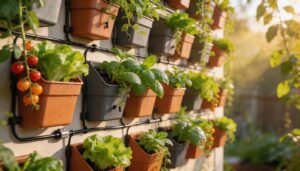
Most people don’t realize vertical gardens dry out faster than ground beds — so drip irrigation isn’t optional; it’s essential. Use zone-based watering to target only active planters, and set pressure regulation tips at 10–25 psi for even flow. Smart emitter placement strategies and sensor-driven automation keep moisture consistent without waste.
Vertical gardens dry out faster than ground beds, making drip irrigation not optional but essential
- Place emitters 15–30 cm from stems
- Schedule fertigation timing at early morning
- Mulch containers to boost soil moisture retention
Managing Plant Nutrition and Soil Health
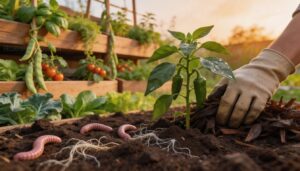
Think of your vertical planters as a living system — what goes into the soil determines what ends up on your plate. Start with nutrient-rich compost for organic matter integration and pH optimization between 6.0 and 7.0.
Use microbial inoculants to energize soil fertility, apply split nutrient application every 4–6 weeks, and lean on mulching for soil moisture retention.
Pruning, Maintenance, and Harvesting Best Practices
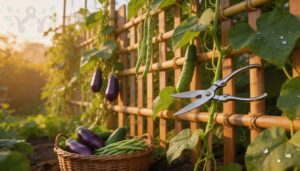
Small habits keep a vertical garden thriving. Regular pruning removes crowded leaves so light and air reach every stem — that’s your Airflow Management working quietly in the background. Stick to consistent Pruning Schedules before plants tangle.
- Sanitize tools between plants — Tool Sanitation stops disease, cold
- Check structures weekly — Support Inspection catches weak ties early
- Time harvests at the morning — Harvest Timing locks in peak flavor
- Pick beans and cucumbers often — continuous picking triggers more flowers
Growing Climbing Beans and Peas Vertically
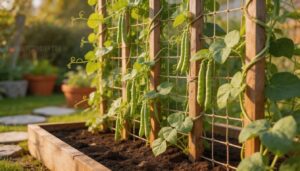
Beans and peas are some of the easiest crops to grow vertically, and they reward you fast.
The key is matching the right variety and setup to your space before you plant a single seed.
Here’s what you need to know to get it right from the start.
Best Pole Bean and Pea Varieties for Trellises
Not all pole beans are created equal. Kentucky Wonder delivers long, tender pods on sturdy vines.
Fortex pods stay slender and crisp — great for fresh eating. Jackson Wonder climbs reliably on standard vertical garden support structures and trellises.
Adams’ resistance to mosaic viruses keeps plants healthy. Scarlet Emperor adds real color.
Want a showstopper? Peas and pole beans both reward smart trellising methods for vining plants.
Building a Bean Teepee Step by Step
A bean teepee is one of the smartest DIY trellis construction projects for home gardeners.
Start with pole length selection — use 8 to 10-foot poles, driven 18 to 24 inches deep, using a solid base anchoring technique. Position the top wind orientation away from prevailing winds.
Wrap your twine lattice pattern every 6 to 8 inches, then follow a simple seed spacing plan: two to three inches apart at the base.
Spacing, Soil, and Sunlight Requirements
Now that your teepee is up, get the growing conditions right.
- Plant Spacing Guidelines: space seeds 3 inches apart at the base.
- Air Gap Optimization: leave 12 inches behind climbing rows.
- Soil Organic Content: aim for 40–60% compost in your mix.
- Drainage Capacity: make sure soil drains 2–3x the root depth.
- Sunlight Orientation: south-facing gives beans their needed 6–8 hours.
Harvesting Techniques to Maximize Pod Production
Once your spacing and sunlight are dialed in, your harvest rhythm matters just as much. Stick to a Harvest Timing Schedule — pole beans are ready around day 60–70, then pick every 3–5 days after that.
Frequent Picking keeps new pods coming.
Use Clean Pruning with scissors, follow a Dry Harvest Routine, and watch Pod Maturity Indicators: firm, snap-ready pods mean peak flavor.
Cultivating Leafy Greens in Wall and Tiered Planters
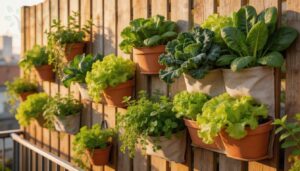
Leafy greens are some of the easiest crops to grow vertically, and they don’t need much space to thrive. Wall planters and tiered containers give you a surprising amount of growing room — even on a narrow balcony or fence.
Here’s what works best for getting a steady supply of fresh greens going upward.
Spinach, Lettuce, and Kale in Stacked Containers
Stacked containers are one of the smartest moves you can make for leafy greens. Spinach, lettuce, and kale thrive in 4-to-6-tier setups, each tier about 6 to 8 inches deep — just enough root space optimization for shallow-rooted crops.
Use a balanced soil mix ratio of compost and light potting blend, keep light balance at 4 to 6 hours daily, and moisture monitoring consistent.
Temperature buffering matters too — these greens prefer 60 to 75°F.
Swiss Chard, Bok Choy, and Arugula Vertically
Most people don’t realize that Swiss chard, bok choy, and arugula are some of the compact leafy mixes for wall planters. These shade‑tolerant greens thrive in rack or column setups, delivering rapid growth cycles and a nutrient-rich harvest in 30 to 50 days. Aim for pH 6.0 to 7.0 and choose bolt‑resistant varieties for consistency.
- Swiss chard stems blazing red, yellow, and white against a vertical wall
- Bok choy heads nestled snugly in tiered columns, dense and ready to pick
- Arugula filling shallow pockets with peppery, self‑supporting growth
- Growing leafy greens in wall planters keeps roots moist and harvests within arm’s reach
Managing Cool-Season Crops in Wall Planters
Cool-season crops in wall planters actually benefit from smart microclimate management.
Thermal mass effects from shaded walls keep daytime temperatures between 15–20°C, while cold air drainage along vertical seams can slow growth if drainage isn’t maintained.
Watch humidity regulation closely — poor airflow invites disease fast.
Amend your mix with perlite, apply slow-release fertilizer monthly, and time light exposure to morning sun for best results.
Continuous Harvest Strategies for Leafy Greens
Cut-and-come-again harvesting is your best friend in a vertical setup. Snip outer leaves of leaf lettuce and spinach when they hit 4–6 inches, leaving the crown intact.
Leaf rotation spreads stress so no single plant gets hammered. Pair that with succession sowing every 1–2 weeks, and your wall planters stay productive all season.
Harvest timing matters — pick early, pick often.
Watering, Mulching, and Fertilizing Vertical Crops
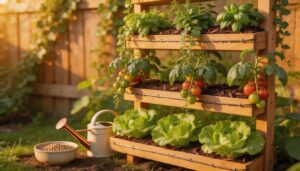
Keeping vertical crops healthy comes down to three things: water, moisture retention, and food. Most people don’t realize how quickly containers dry out compared to ground beds — and vertical systems are even thirstier.
Here’s what you need to know to keep your plants thriving all season.
Drip and Micro-Irrigation for Vertical Systems
Vertical gardens dry out fast — drip irrigation fixes that. Place pressure-compensating emitters at each plant’s root zone for even flow regardless of height.
Run short, frequent cycles and let smart controllers adjust for heat and light shifts.
Use 150–300 micron inline filters to prevent clogging, and inject nutrients directly through the line.
Clean emitters monthly. That’s water efficiency working for you.
Mulching to Retain Moisture in Vertical Planters
Most people don’t realize mulching works just as hard as irrigation in vertical planters. A 2-inch layer cuts evaporation by up to 50%. Here’s what to choose:
- Straw mulch – top pick for straw mulch benefits and water efficiency
- Pine bark – slow pine bark decomposition feeds soil over months
- Wood chips – improve wood chip aeration around roots
Cocoa shell adds cocoa shell aesthetics, while compost delivers a real compost nutrient boost.
Fertilization Schedule for Continuous Vegetable Growth
Think of feeding your vertical garden like pacing a marathon. Start with a balanced 10-10-10 fertilizer at planting, then shift your Nutrient Timing as plants grow — a weekly Nitrogen Taper after week six keeps leafy crops from going wild.
When flowers appear, apply a Phosphorus Boost to drive fruit set.
A quick Soil Test Integration guides your soil amendment and fertilization for vertical gardens, ensuring your Pre-Harvest Feed stays light for clean, ready-to-eat produce.
Pest and Disease Management in Vertical Gardens
Good nutrition sets your plants up — but pests can still knock them down. Airflow Optimization matters here: space plants 2–3 inches apart so leaves dry fast.
Choose Resistant Varieties, practice IPM Monitoring twice weekly, and let Beneficial Insects do the heavy lifting. Drip Sanitation — flushing emitters regularly — cuts disease prevention issues fast.
Smart pest and disease management in vertical gardens keeps your harvest clean.
Top 4 Products for Vertical Vegetable Gardening
The right tools can make or break your vertical garden before you even plant a seed. A few standout products have earned their spot in small-space growing setups — tested, trusted, and genuinely useful.
Here are four worth adding to your setup.
1. Plow Hearth Metal Garden Arbor
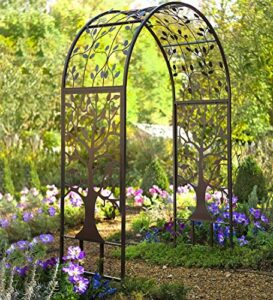
The Plow & Hearth Metal Garden Arbor (model 50513) earns its place in any serious vertical garden. At roughly 83 inches tall and 52.5 inches wide, it gives climbing crops like cucumbers, beans, and flowering vines real room to run.
The powder-coated black frame with its burnished bronze Tree of Life panel looks sharp too — functional and ornamental at once.
Just anchor it well; the ground stakes alone won’t hold in heavy wind.
Priced at $329.99, it’s a solid long-term investment.
| Best For | Gardeners who want a good-looking, functional arch for climbing plants and don’t mind doing a little extra work to anchor it properly. |
|---|---|
| Price | $329.99 |
| Brand | Plow & Hearth |
| Vertical Use | Climbing plant support |
| Non-GMO | N/A |
| Outdoor Use | Yes |
| Durability | Long-term, powder-coated |
| Additional Features |
|
- The Tree of Life design looks great — ornamental enough to be a focal point, sturdy enough to hold heavy vines
- Plenty of clearance at 83 inches tall, so it works for serious vertical growing like cucumbers, beans, and roses
- Comes with all the hardware you need and goes together with basic hand tools
- The ground stakes are short, so you’ll likely need rebar, concrete, or lag screws to keep it solid in wind
- A few buyers have reported minor paint chips and the occasional missing bolt right out of the box
- No gate included, so if you want one, that’s an extra purchase on top of the $329.99
2. Irrigation Mart Tomato Twine
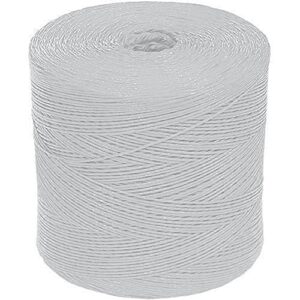
Once your arbor is up, you need train those vines. That’s where Irrigation Mart’s Tomato Twine earns its keep.
One 3 lb box gives you 6,300 feet of UV-resistant poly-twine — enough to cover dozens of plants without a mid-season restock run.
It’s soft on stems, easy to cut, and the belt-loop box means you can dispense it hands-free while you work. At $17.98, it’s honestly one of the best-value tools in your vertical garden setup.
| Best For | Home gardeners and greenhouse growers who need a reliable, budget-friendly way to trellis tomatoes, peppers, and other climbing plants through a full growing season. |
|---|---|
| Price | $17.98 |
| Brand | Irrigation Mart |
| Vertical Use | Vine training & trellising |
| Non-GMO | N/A |
| Outdoor Use | Yes |
| Durability | Single season only |
| Additional Features |
|
- 6,300 feet of twine in one box — plenty for dozens of plants without running out mid-season
- Soft on stems and easy to cut, so you’re not wrestling with it while you work
- The belt-loop box lets you dispense hands-free, which is a small thing that makes a big difference
- Single-season use only — it degrades after weathering, so don’t expect it to last year over year
- Can fray at the ends or mid-section, which means occasional trimming and some untangling
- Price has crept up from its original $13–$14 range, so the value isn’t quite what it used to be
3. Sow Right Sugar Pumpkin Seeds
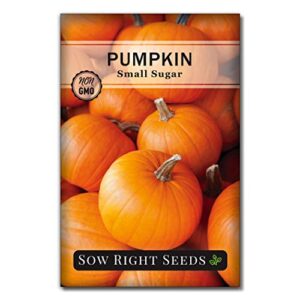
Now, for the pumpkin lover in your garden — Sow Right Seeds’ Small Sugar Pumpkin variety is a solid pick for vertical setups.
Each packet carries around 45 non-GMO heirloom seeds at just $4.94.
These compact plants top out at 10–18 inches tall, but the vines stretch 10–12 feet, so a sturdy trellis keeps them off the ground.
Fruits hit 6–8 pounds and store for months.
Sweet, dense flesh makes them perfect for pies or fall décor.
| Best For | Home gardeners who want a dual-purpose pumpkin — great for cooking and fall decorating — especially those with limited space or kids who’d love watching something grow. |
|---|---|
| Price | $4.94 |
| Brand | Sow Right Seeds |
| Vertical Use | Trellis-compatible vines |
| Non-GMO | Yes, heirloom |
| Outdoor Use | Yes |
| Durability | 95–100 day season |
| Additional Features |
|
- Sweet, fine-grained flesh that’s perfect for pies, soups, and breads — and the seeds are great roasted too
- Non-GMO heirloom variety with a germination guarantee, so you’re not flying blind if a batch doesn’t sprout
- Compact plants work well in smaller gardens or containers, and they’re fun for kids to grow
- Some buyers have reported uneven germination, so seed quality can be hit or miss
- Plants are prone to powdery mildew in humid weather, which can be a real headache
- They need a long growing season (95–100 days), so a late start or early frost can leave you with underdeveloped fruit
4. Luffa Gourd Seeds For Planting
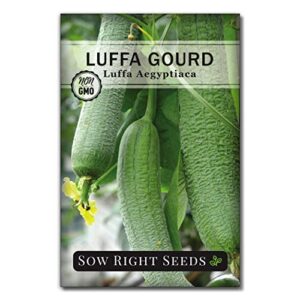
Most people don’t realize luffa grows right in your backyard — and it’s a natural fit for vertical setups.
Sow Right Seeds’ Luffa aegyptiaca packet gives you around 30 non-GMO heirloom seeds for just $4.69.
Vines stretch 8–12 feet, so run them up a sturdy trellis.
Germination takes 7–10 days at 70–85°F.
Young gourds are edible; leave mature ones to dry into natural sponges.
Plan for a long season — fruit needs 150–200 days to fully develop.
| Best For | Home gardeners in warm climates who want to grow their own natural loofahs, eat fresh young gourds, or add a fast-climbing vine to a trellis setup. |
|---|---|
| Price | $4.69 |
| Brand | Sow Right Seeds |
| Vertical Use | Climbing trellis vine |
| Non-GMO | Yes, heirloom |
| Outdoor Use | Yes |
| Durability | 5–7 month season |
| Additional Features |
|
- Heirloom, non-GMO seeds at a solid price — about $4.69 for ~30 seeds with good germination rates (7–10 days in warm soil)
- Dual-purpose plant: eat the young gourds or let them dry into plastic-free, natural bath sponges
- Beautiful climbing vine that fills a trellis fast and supports seed-saving for future seasons
- Long growing season (150–200 days) means it’s a tough fit if you don’t have 5–6 frost-free months ahead
- Only about 10% of flowers are female, so fruit set can be low and pollination hit-or-miss
- Harvested sponges need consistent drying and swapping out every 3–4 weeks or bacteria can build up
Space-Saving Vertical Gardening Tips for Small Gardens
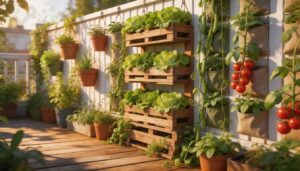
Small gardens don’t have to mean small harvests.
With the right approach, even a narrow balcony or blank fence can become a productive growing space.
Here are some practical tips to help you squeeze more out of every square foot.
Maximizing Balcony and Urban Garden Space
Balconies aren’t limitations — they’re vertical opportunities waiting to happen. With modular planter systems and vertical shelf stacking, you can layer compact container choices along every inch of railing. Multi-use railings double as growing frames for herbs and greens.
South-facing setups get roughly 20% more light, which matters.
Vertical gardening for small spaces and urban gardening thrive when rooftop garden integration and space-saving gardening thinking replace the old "I don’t have room" excuse.
Using Fence and Wall Space for Food Production
Most people don’t realize how much growing space is hiding right behind them. Your fence and walls are untapped real estate.
A fence-mounted trellis design accommodates climbing beans and cucumbers up to eight feet high, while wall-mounted planters hold leafy greens with modular pot spacing every six inches.
Add rainwater capture integration and vertical pollinator habitats, and your vertical garden becomes a fully productive food system.
Seasonal Crop Rotation in Vertical Systems
Rotating crops in your vertical beds isn’t just smart — it’s how you stay ahead of pests and soil depletion. Family Rotation Planning means grouping brassicas, legumes, and roots by plant family, then moving each group forward each season.
Cool-Season Scheduling fills spring and fall slots with spinach and kale. Warm-Season Swaps bring in tomatoes and cucumbers.
Nutrient Reset Strategies and Pest Cycle Disruption keep your containers productive all year.
Cost-Effective DIY Vertical Garden Projects
You don’t need to spend much to build a productive DIY vertical garden. Repurposing pallets for garden planters gives you instant Pallet Frame Construction at nearly zero cost.
Add Upcycled Gutter Channels for herbs, a Budget Wire Grid for climbing beans, and Recycled Bottle Planters along any sunny fence.
A simple DIY Drip Reservoir manages watering. These cost-effective methods for building vertical gardens prove that sustainable DIY vertical garden projects are totally within reach.
Frequently Asked Questions (FAQs)
What are the disadvantages of vertical gardening?
Vertical gardening looks easy on Pinterest, but the reality bites back.
High cost, uneven water distribution, pest spread between tiers, and serious structural strain make maintenance labor a real daily commitment.
What vegetables are best for vertical farming?
Leafy greens, climbing beans, pole beans, vining tomatoes, and cucumbers top the list.
They’re fast‑growth champions, low‑maintenance, and deliver high yield varieties, perfect for choosing vegetables for vertical gardening.
What vegetables grow well vertically?
Think of your fence as a ladder — some vegetables are born ready to climb it. Pole beans, cucumbers, vining tomatoes, and peas all thrive when given vertical support.
What grows best in a vertical garden?
Climbing vines, pole beans, and vining tomatoes top the list. Leafy greens, compact nightshades, and microgreen varieties also thrive. These are genuinely the best crops for vertical vegetable gardens.
What vegetables do not grow well in raised beds?
Some vegetables just don’t play nice with raised beds.
Deep Root Crops like potatoes, parsnips, and sweet potatoes need more soil depth than most beds offer.
Spreading Vines, Tall Heavy Crops, Slow Perennial Crops, and crops with heavy Brassica Space Needs — like winter squash, corn, and asparagus — quickly overwhelm compact spaces.
Are vertical gardens hard to maintain?
Not really — most people don’t realize how manageable it is once you’re set up.
With drip irrigation, regular filter cleaning, and media top-ups each season, your routine stays simple and steady.
What is a vertical vegetable garden?
A vertical vegetable garden grows your plants upward on trellises, walls, or towers instead of outward. You get more food from less ground — a smart move for any tight space.
Can you grow vegetables vertically?
Yes, you can — and it works surprisingly well.
Pole beans, cucumbers, peas, and compact tomatoes all thrive on trellises and vertical gardening support systems, turning any fence or wall into a productive food garden.
What are the benefits of a vertical vegetable garden?
Like a skyscraper beating a bungalow for space, vertical gardens pack serious punch.
You get reduced soil use, improved airflow, pest reduction, and lower water consumption — all while turning bare walls into thriving harvests.
What is the best plant for vertical vegetable gardening?
Pole beans top the list. They climb on their own, deliver strong yield per foot, and reward you with high harvest frequency all summer long — making them the best crops for vertical vegetable gardens.
Conclusion
Imagine stepping into a lush oasis, where vibrant vegetables burst from every available inch. With vertical gardening for vegetables, this vision becomes your reality.
By embracing this space-saving technique, you’ll reveal a world of abundance, effortlessly harvesting fresh produce from your very own backyard or balcony.
As you start your vertical gardening journey, remember that every vine, every leaf, and every fruit are proof of your creativity and dedication.
Grow upwards, and savor the rewards.
- https://cals.cornell.edu/school-integrative-plant-science/school-sections/horticulture-section/outreach-and-extension/pandemic-vegetable-gardening/pandemic-vegetable-gardening-2020-archive/sunlight-key-great-vegetables
- https://www.tiktok.com/
- https://extension.psu.edu/planting-in-sun-or-shade
- https://kellogggarden.com/blog/gardening/best-way-to-plant-a-vertical-garden/
- https://www.garden-products.co.uk/news/assembly-and-usage/north-south-east-or-west-facing-gardens-the-complete-guide/