This site is supported by our readers. We may earn a commission, at no cost to you, if you purchase through links.
A single 5-gallon bucket on a fire escape once produced enough cherry tomatoes to stock a neighbor’s kitchen for three weeks straight. No yard, no raised bed, no elaborate setup—just the right plant, the right pot, and a south-facing wall.
That’s the quiet revolution happening on balconies, rooftops, and windowsills across every major city.
Most people assume container gardening means compromising on yield. The reality runs opposite: matched to the correct container depth and variety, vegetables like ‘Micro Tom’ tomatoes, 30-day radishes, and cut-and-come-again lettuce outperform garden beds in controlled conditions.
The best vegetables to grow in containers reward you with harvests measured in weeks, not seasons.
Table Of Contents
- Key Takeaways
- Best Vegetables to Grow in Containers
- Choosing The Right Containers and Soil
- Essential Tips for Growing Vegetables in Pots
- Top 5 Products for Container Vegetable Gardening
- Frequently Asked Questions (FAQs)
- What can you grow in a container garden?
- Can you grow vegetables in containers?
- What vegetables grow well in containers?
- What vegetables grow well in pots & window boxes?
- What vegetables grow well in a container?
- Which vegetable is the king of all vegetables?
- What vegetables grow well in 5 gallon buckets?
- What vegetable is best to grow in pots?
- What is the easiest vegetable to grow in pots?
- What are the best low maintenance plants in pots?
- Conclusion
Key Takeaways
- Matching container depth to your crop—6 inches for lettuce, 12–16 inches for tomatoes—directly controls yield, so getting this wrong from the start costs you the harvest before you even plant.
- Compact and dwarf varieties like ‘Micro Tom’ tomatoes and ‘Spacemaster’ cucumbers are bred for pots, outperforming standard varieties in containers when paired with the right soil mix of equal parts compost, coco coir, and perlite.
- Going vertical with a trellis at least 6 feet tall lets vining crops like cucumbers and beans climb instead of sprawling, which frees up floor space and improves airflow to reduce disease risk.
- Harvesting often—every 2–3 days for cut-and-come-again greens—signals the plant to keep producing, so the more you pick, the more you get all season long.
Best Vegetables to Grow in Containers
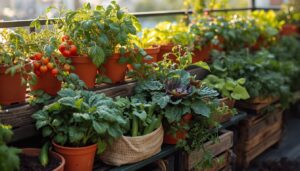
Not every vegetable plays well in a pot — but more do than you’d think. The key is knowing which ones actually thrive when their roots are contained.
A good guide to growing vegetables in containers can save you a lot of trial and error with the wrong picks.
Here are the best picks to get you started.
Leafy Greens (Lettuce, Spinach, Kale, Arugula)
Leafy greens are your fastest win in container gardening.
Lettuce and arugula deliver harvests in as little as 30 days — and their flavor profiles range from mild and buttery to bold and peppery.
Kale punches above its weight on nutrient density, while spinach stays tender and quick-cooking.
All four resist common diseases well and thrive in shallow pots with partial shade.
Their high antioxidant density further boosts cellular protection.
Root Vegetables (Carrots, Beets, Radishes, Turnips)
Root vegetables grown in pots reward patience — and a little planning.
Carrots need at least 12 inches of depth and loose, stone‑free soil to develop smooth, uniform roots. Beets and turnips mature in 40–60 days with consistent moisture. Radishes move fastest, ready in under 30 days.
Rotate varieties each season for smart seasonal variety rotation and natural pest prevention strategies.
Nightshades (Tomatoes, Peppers, Eggplant)
Nightshades are the heavy hitters of container gardening for small spaces — and they deliver big when you get the setup right.
Tomatoes, peppers, and eggplant all belong to the Solanaceae family and share similar needs: full sun, steady moisture, and consistent Nutrient Balancing through regular feeding.
- Tomatoes: Dwarf varieties like ‘Micro Tom’ or ‘Patio Princess’ thrive in 10-gallon pots; stake early for clean Fruit Ripening
- Peppers: ‘Shishito’ and ‘Jalapeño’ grow well in 3–5 gallon containers; watch calcium levels to prevent blossom end rot
- Eggplant: Miniature types like ‘Patio Baby’ need at least 12-inch depth and benefit from consistent watering for Pest Control against flea beetles
- Pollination Strategies: Gently shake flowering stems on calm days — these crops are self-fertile but respond well to a little help
- Disease Management: Space containers apart for airflow; crowded nightshades invite blight fast
Vining Crops (Cucumbers, Green Beans, Summer Squash)
If nightshades are the headliners, vining crops are the workhorses. Cucumbers (Cucumis sativus), bush beans (Phaseolus vulgaris), and summer squash (Cucurbita pepo) all produce heavily in pots — especially compact varieties like ‘Spacemaster’ or ‘Little Marvel’. Use vertical trellising for vining crops to save floor space.
Vining crops like cucumbers, beans, and squash are the workhorses of container gardening, producing heavily when trained vertically
Mulch moisture retention keeps roots cool, and soil temperature control above 70°F locks in fruit set.
Herbs (Basil, Chives, Scallions, Parsley)
Don’t overlook herbs — they’re the easiest wins in container gardening. Basil, chives, scallions, and parsley all thrive in small pots and deliver outsized flavor pairings in the kitchen.
- Pruning techniques matter: Pinch basil tops weekly to keep plants bushy and productive.
- Pest repellent bonus: Chives naturally deter aphids when placed near other containers.
- Indoor growing works: Parsley and scallions handle low light surprisingly well on a windowsill.
Compact and Dwarf Varieties for Small Spaces
When space is tight, variety selection becomes your most powerful tool. Dwarf and compact vegetable varieties are primarily bred for small space agriculture — think ‘Micro Tom’ tomatoes in a 5-gallon pot or ‘Spacemaster’ cucumbers trellised on a balcony rail.
These space-saving designs also tend toward pest-resistant types, and with smart seasonal timing, you can rotate crops and keep containers producing all season long.
Pairing pest-resistant varieties with reusable frost netting—which handles light freezes down to −2°C—keeps containers thriving longer, as covered in these seasonal frost damage prevention tips for container gardens.
Choosing The Right Containers and Soil
The container you choose can make or break your harvest — it’s that important. Getting the size, material, and soil right from the start saves you a lot of frustration later.
Here’s what you need to know before you buy a single pot.
Minimum Container Size by Vegetable
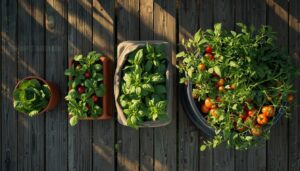
Size up your containers before you size up your ambitions. Minimum container size isn’t a suggestion — it directly controls plant density, root room, and yield.
Lettuce works in 1-gallon shallows; tomatoes need 10 gallons minimum.
Volume benchmarks shift by growth stage size too: seedlings forgive small pots, fruiting plants won’t.
Smart container size selection means matching soil drainage capacity to what each crop actually demands.
Matching Container Depth to Root Systems
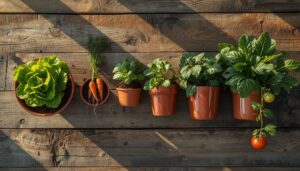
Depth is what separates thriving roots from stunted ones. Root depth considerations for container vegetables aren’t complicated — but skipping them costs you yield.
- Lettuce and spinach need just 6–8 inches; deeper pots cause waterlogging
- Tomatoes demand 12–16 inches for root zone moisture and stability
- Carrots need 8–12 inches for proper taproot development
- Peppers perform best at 10–12 inches depth
Best Container Materials for Vegetables
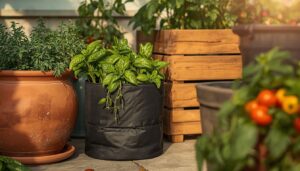
Your container material shapes everything from moisture retention to root health.
Here’s a quick comparison to guide your pick:
| Material | Best For |
|---|---|
| Food-grade Plastic | Moisture-retentive potting mix setups |
| Breathable Fabric Bags | Air-pruned, heat-tolerant root zones |
| Porous Terracotta Pots | Herbs and crops prone to overwatering |
Insulated wooden planters stabilize soil temps; powder-coated metal looks sharp but heats fast. Grow bags win for flexibility.
Ensuring Proper Drainage and Support
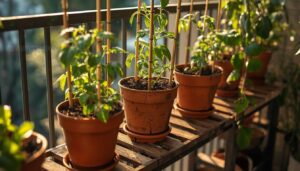
Poor drainage kills more container gardens than anything else. Think of it as your plant’s exit strategy for excess water.
- Layer your Drainage Layer Design with 1–2 inches of coarse gravel or perlite at the bottom
- Use Perforated Base Inserts to keep well-draining soil from clogging drainage holes
- Try Elevated Pot Racking to boost airflow and prevent pooling beneath containers
- Add Flexible Trellis Systems matched to your container size and pot depth for vertical trellising support
- Use Moisture Monitoring Sensors to catch soggy zones before root rot sets in
Ideal Potting Mix and Compost Blends
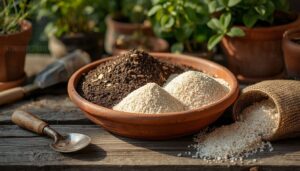
Good drainage got the water out—now let’s make sure what stays behind actually feeds your plants.
Your potting mix is the engine. Aim for equal parts compost and coco coir for Water Retention, plus one part perlite as your Aeration Media. That combo manages Nutrient Balance and pH Adjustment (target 6.0–6.5) naturally.
| Component | Role | Ratio |
|---|---|---|
| Compost | Organic Amendments + nutrients | 1 part |
| Coco coir | Water Retention + structure | 1 part |
| Perlite | Aeration Media + drainage | 1 part |
Toss in slow-release balanced organic fertilizer at planting—it feeds steadily for 3–4 months.
Essential Tips for Growing Vegetables in Pots
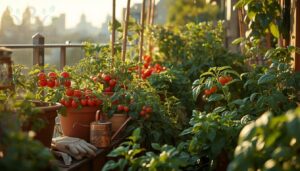
Getting your container setup right is only half the battle. How care for those plants day-to-day is what actually drives the harvest.
Here are the key practices that make the biggest difference.
Sunlight and Placement Requirements
Light is everything in container gardening. Most nightshades demand full sun exposure — at least six hours daily — while leafy greens manage fine with partial shade.
For Morning Sun Orientation, angle tomatoes and peppers slightly east. Use the North‑South Axis to prevent taller pots from shading shorter ones.
Seasonal Sun Adjustments matter too: shift containers as shadows change. Shade Cloth Usage curbs midday heat stress, and Wall Proximity Tips help reflect extra light onto your balcony garden.
Watering and Fertilizing Best Practices
Once you’ve nailed your light setup, water and nutrients become your next levers.
Get these right:
- Soil Moisture Timing — water early morning when the top inch feels dry
- Drip Irrigation Setup — delivers steady moisture without wetting leaves
- Fertilizer Scheduling — balanced fertilizer every 2–4 weeks during active growth
- Mulch Moisture Retention — a thin compost layer slows evaporation quickly
Nutrient balance matters. Flush containers monthly to prevent salt buildup.
Maximizing Yield With Vertical Supports
Going vertical changes everything. With the right Trellis Height Optimization — at least 6 feet tall — tomatoes and cucumbers climb instead of sprawling, freeing up precious floor space on any balcony.
| Technique | What It Does |
|---|---|
| Stake Placement Strategy | Anchors stems, prevents tipping |
| Clip Tie Techniques | Guides vines without bruising |
| Adjustable Support Systems | Adapts as fruit load grows |
| Airflow Channel Management | Keeps 12–18 inches open between canopies |
Tie vines every 6–12 inches and prune suckers regularly.
Succession and Companion Planting in Containers
Staggered Planting keeps your containers producing all season — sow radishes or leaf lettuce every 7 to 14 days for a steady, rolling harvest. Layer in companion planting by tucking basil near tomatoes or chives beside peppers for natural Intercropping Pest Control.
Seasonal Crop Rotation rebuilds Nutrient Cycling between rounds. Even a small-space gardening setup becomes a Beneficial Insect Habitat when you mix marigolds into the rotation.
Regular Harvesting for Continuous Production
Pick often, and your plants will keep giving. With cut and come again harvesting, you remove outer leaves every 2 to 3 days while the center keeps pushing new growth — that’s continuous harvest working in your favor.
Nail your harvest timing before leaves bolt or fruit overripens. Pair this with regular nutrient top-ups and steady moisture management, and your containers won’t slow down.
Top 5 Products for Container Vegetable Gardening
The right gear makes a real difference in container gardening — not just for convenience, but for how well your plants actually grow.
A few key products consistently show up in successful urban gardens, from fabric bags to full growing systems. Here are five worth considering.
1. Container Gardening For Beginners Guide
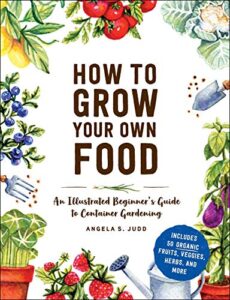
If you’re just starting out, this guide is worth keeping on your shelf.
The Container Gardening For Beginners handbook covers 50 edible plants — vegetables, fruits, and herbs — with clear care instructions and illustrations throughout.
At 144 pages, it doesn’t overwhelm you. You get container size guidance, watering schedules, feeding tips, and harvest timing, all in one place.
It’s priced at $16.29 and works well as a quick reference even after you’ve moved past the beginner stage.
| Best For | Beginners who want to grow their own food in small spaces like apartments, patios, or balconies. |
|---|---|
| Product Type | Handbook/Guide |
| Price Range | $16.29 |
| Beginner Friendly | Yes |
| Reusable | N/A |
| Space Saving | Yes |
| Drainage Support | Guidance provided |
| Additional Features |
|
- Covers 50 edible plants with clear care instructions, so you’re not left guessing what your tomatoes actually need.
- Walks you through the practical stuff — container sizing, watering, feeding, and when to harvest — all in one compact book.
- At $16.29, it’s a solid pick as a gift for a new gardener or a handy shelf reference for anyone expanding into containers.
- Skips pruning techniques and doesn’t cover every edible plant out there, so the plant variety feels limited to some readers.
- Stays pretty surface-level, which might leave experienced growers wanting more depth on the horticultural side.
- A few readers found certain vegetables tricky to grow in containers and felt the book didn’t fully address those challenges.
2. Heavy Duty Grow Bags Set
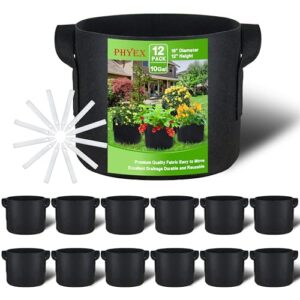
Twelve bags, one set — that’s a lot of growing room. This Heavy Duty Grow Bags Set gives you BPA-free, 300 g polyester felt construction that breathes well, drains fast, and won’t trap water around your roots.
Each bag holds about 5 gallons, which is plenty for peppers, dwarf tomatoes, or herbs.
The double-stitched grips mean you can actually move a fully loaded bag without it falling apart.
Included plant-label tags keep your crop rotation organized from day one.
| Best For | Balcony and patio gardeners who want a flexible, reusable setup for growing vegetables, herbs, or flowers without committing to bulky plastic pots. |
|---|---|
| Product Type | Grow Bags (12-pack) |
| Price Range | Budget-friendly |
| Beginner Friendly | Yes |
| Reusable | Yes |
| Space Saving | Yes |
| Drainage Support | Fast-draining felt |
| Additional Features |
|
- Breathable felt fabric keeps roots aerated and draining well, so root rot is much less of a worry
- Double-stitched handles make it easy to move fully loaded bags — handy when a storm rolls in
- Comes with 12 bags and plant-label tags, so you can get a full garden going right out of the box
- Dries out fast in heat or wind, so you may need to water two or three times a day in summer
- Liquid fertilizers leach out quickly, especially after heavy rain, so you’ll go through nutrients faster
- Not ideal for deep-rooted plants — if you’re growing something that needs serious depth, a rigid pot will serve you better
3. Indoor Tomato Growing System Tower
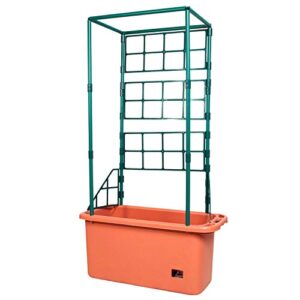
If balcony space is your biggest obstacle, the Hydrofarm GCTR might just change the game.
This 10-gallon planter comes with a built-in self-watering reservoir — so you’re checking moisture maybe once a week instead of every day.
The snap-together trellis extends past 4 feet, giving tomatoes, cucumbers, and beans real room to climb. Two rear wheels make repositioning easy.
At just 6.5 pounds empty and under $52, it’s one of the smarter investments for small-space growers.
| Best For | Apartment dwellers, balcony gardeners, and busy folks who want to grow tomatoes or vining veggies without a yard or a daily watering routine. |
|---|---|
| Product Type | Self-Watering Planter |
| Price Range | Under $52 |
| Beginner Friendly | Yes |
| Reusable | Yes |
| Space Saving | Yes |
| Drainage Support | Built-in reservoir |
| Additional Features |
|
- Self-watering reservoir means you’re only topping it off about once a week — huge time saver.
- The snap-together trellis grows past 4 feet, so tomatoes, cucumbers, and beans actually have room to do their thing.
- Two rear wheels make it easy to chase the sun or drag it inside when the weather turns.
- The plastic trellis connectors are on the flimsy side — prolonged sun or heavy vines can cause breakage, and there are no replacement parts available.
- Once you fill it with soil, those wheels become more of a suggestion — it gets heavy fast.
- The reservoir can become a mosquito hangout if you’re not keeping an eye on standing water.
4. Heavy Duty Grow Plant Bags
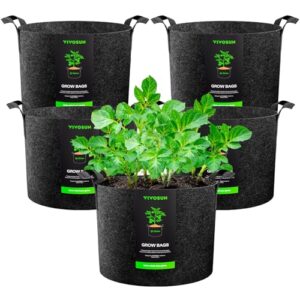
The VIVOSUN ABCD grow bags are the kind of tool that quietly does a lot of heavy lifting.
Made from 300 g non-woven fabric, they drain well without drying out too fast — a balance most rigid pots can’t pull off.
Roots air-prune naturally, so you get denser, healthier root systems without circling.
Reinforced serger-stitched grips hold a full bag of soil without complaint.
You get five bags per pack, they fold flat off-season, and they’re reusable for several growing seasons.
| Best For | Gardeners who want healthier root systems without the mess of rigid pots — whether you’re growing tomatoes on a balcony, running a greenhouse, or just need something easy to store off-season. |
|---|---|
| Product Type | Grow Bags (5-pack) |
| Price Range | Mid-range |
| Beginner Friendly | Yes |
| Reusable | Yes |
| Space Saving | Yes |
| Drainage Support | Balanced drainage |
| Additional Features |
|
- 300 g fabric drains well but holds enough moisture, so your plants aren’t sitting in soggy soil or drying out too fast
- Roots air-prune on their own, which means denser, stronger root systems and less risk of root rot
- Folds flat when empty and reusable for several seasons — way more practical than tossing plastic pots every year
- Handles are single-layer, so they feel a bit less sturdy than competitors with reinforced internal patches
- Fabric stays damp after watering, which can lead to algae if you’re not drying them out properly between uses
- Big sizes (like 25 gal) get seriously heavy when wet — you’ll probably want a second pair of hands or a rolling base
5. Heavy Duty Garden Grow Bags
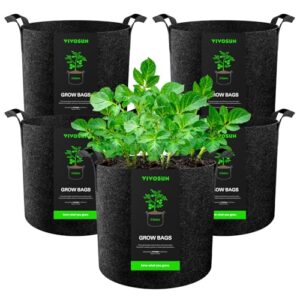
If you need something a step up in durability, these heavy-duty garden grow bags are worth the look.
Built from thick woven fabric rated 100–150 gsm, with double-stitched seams and reinforced rim edges, they’re engineered to handle full soil loads and frequent moves without giving out.
UV-resistant finishes mean they hold up through multiple seasons. Wide opening tops make transplanting easy, and sizes from 5 to 20 gallons cover everything from peppers to tomatoes.
Solid bags. Serious results.
| Best For | Gardeners who want a reliable, portable growing solution for vegetables, herbs, or flowers across multiple seasons. |
|---|---|
| Product Type | Grow Bags (5-pack) |
| Price Range | Mid-range |
| Beginner Friendly | Yes |
| Reusable | Yes |
| Space Saving | Yes |
| Drainage Support | Excellent drainage |
| Additional Features |
|
- Thick 300 g non-woven fabric gives solid drainage while holding enough moisture to keep roots happy.
- Reinforced handles make it easy to move plants around for better light or to bring them in before a frost.
- Folds flat when empty, so off-season storage is a breeze.
- Handles are single-layer attachments, which may not be as tough as bags with internal reinforcement patches.
- Moisture sitting in the fabric over time can lead to algae buildup — plan on occasional cleaning.
- Very large bags filled with wet soil can get seriously heavy, so you might need a second pair of hands.
Frequently Asked Questions (FAQs)
What can you grow in a container garden?
Think of your container as a private plot — herbs, greens, roots, nightshades, even vining crops, all fit.
If grows in the ground, chances are it grows just as well in a pot.
Can you grow vegetables in containers?
Yes, you can grow vegetables in containers — and do it well.
With the right pot, soil, and sunlight, you can raise tomatoes, greens, herbs, and more on a balcony or patio.
What vegetables grow well in containers?
Quite a few, actually. Leafy greens, root vegetables, tomatoes, peppers, cucumbers, and herbs all do well in pots — as long as you match the container size to what you’re growing.
What vegetables grow well in pots & window boxes?
Leafy greens, herbs, radishes, and compact tomato varieties all do well in pots and window boxes. Even carrots and peppers fit with the right depth — usually 8 to 12 inches minimum.
What vegetables grow well in a container?
Even a small balcony can become a working kitchen garden. Lettuce, radishes, peppers, tomatoes, cucumbers, and herbs all thrive in pots — harvest-ready, compact, and surprisingly productive with the right setup.
Which vegetable is the king of all vegetables?
Cauliflower earns the crown. It’s endlessly adaptable — roasted, riced, raw, or steamed — and packs serious vitamin C and K into every serving.
No wonder cooks worldwide call it the king of vegetables.
What vegetables grow well in 5 gallon buckets?
A 5-gallon bucket holds more than you’d think. Tomatoes, peppers, lettuce, kale, carrots, radishes, cucumbers, and eggplant all thrive in one — just match the variety to the space.
What vegetable is best to grow in pots?
Lettuce is hard to beat. It grows in a 6-inch pot, matures fast, and keeps producing when you harvest regularly.
It’s genuinely the easiest win for any container gardener starting out.
What is the easiest vegetable to grow in pots?
Radishes are the easiest — they mature in just 25 days and need only a 4-inch pot. Drop in seeds, water consistently, and you’re harvesting before most plants even sprout.
What are the best low maintenance plants in pots?
Herbs win hands down. Chives, parsley, and scallions practically grow themselves — minimal feeding, forgiving of missed waterings, and they keep producing for weeks without much fuss from you.
Conclusion
Space isn’t shrinking your garden—it’s sharpening it. When you focus on the best vegetables to grow in containers, every square foot earns its place.
well-matched pot and the right variety don’t just compensate for missing ground; they cut the wasted space that open beds hide so well.
Start with one container, one crop. Watch how quickly "not enough room" stops feeling like a limitation and starts feeling like the most productive constraint you never planned for.