This site is supported by our readers. We may earn a commission, at no cost to you, if you purchase through links.
Winter doesn’t have to mean the end of fresh food from your own hands. While most gardeners pack up their tools in November, a surprising number are quietly harvesting arugula, radishes, and crisp lettuce straight from their living rooms—sometimes weeks before spring even hints at arriving. Growing vegetables indoors during winter is less about fighting the season and more about working around it with the right setup.
A good grow light, a few well-chosen containers, and a handful of cold-hardy varieties can keep your kitchen stocked from December through March. This approach transforms the challenge of winter into an opportunity for year-round harvests.
This guide walks you through every step, from picking your first seeds to pulling your last winter harvest. By focusing on practical strategies and adaptable techniques, it empowers even novice gardeners to thrive during the coldest months.
Table Of Contents
- Key Takeaways
- Choose Winter Indoor Vegetables
- Gather Indoor Gardening Supplies
- Set Up Your Growing Space
- Plant and Care for Crops
- Harvest All Winter Long
- Frequently Asked Questions (FAQs)
- What vegetables can I grow inside over winter?
- What can I plant indoors in October?
- Is October too late to plant plants?
- What vegetables can I grow indoors with a grow light?
- What vegetables can you grow indoors in the winter?
- How many winter vegetables can you grow indoors?
- Can you grow vegetables indoors?
- Can you grow vegetables in winter?
- How do you grow a green plant in winter?
- Can you grow vegetables in cold weather?
- Conclusion
Key Takeaways
- A full-spectrum LED grow light, a few containers suited to root depth, and cold-hardy varieties like arugula, spinach, and radishes are all you need to harvest fresh food all winter long.
- Leafy greens are your fastest wins—arugula is ready in 20–30 days, and cutting the outer leaves instead of the whole plant keeps your harvest going for weeks.
- Getting your setup right before you sow—south-facing windows or lights hung 18–24 inches above plants, temperatures between 65–75°F, and humidity at 40–60%—makes everything else easier.
- Staggering your sowings every 5–7 days and feeding greens every one to two weeks with a balanced fertilizer keeps fresh food on your counter from December straight through March.
Choose Winter Indoor Vegetables
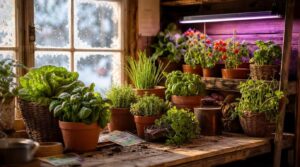
Not every vegetable belongs indoors in winter, but the right ones can thrive with surprisingly little fuss.
A winter vegetable gardening calendar can help you plan exactly what to plant and when, so nothing goes to waste.
The key is picking crops that actually match your space, your light, and how quickly you want to eat.
Here are five categories worth starting with.
Fast Leafy Greens
Few crops reward you faster than leafy greens — and that seedling speed is exactly what makes them perfect for winter indoor gardening.
Arugula hits harvest cycle in just 20–30 days, spinach in 25–40, and loose-leaf lettuce close behind. Consistent grow lights drive real growth acceleration and better flavor development.
For an ultra‑fast option, garden cress can be harvested in as little as 7‑14 days.
- Baby spinach leaves stay tender with steady moisture and cooler temps
- Cut outer arugula leaves above the rosette for impressive leaf turnover
- Stagger sowings every week for non‑stop winter indoor produce
Compact Root Crops
Roots don’t have to mean a garden bed. Compact Root Varieties like Carrots Carnival Blend, Beets Gourmet Beet Blend, Radish French Breakfast, and Turnip Market Express all thrive in containers.
Pot Size Selection matters — radishes need just 4–6 inches, while carrots want 10 inches deep.
Maintain Soil pH Management between 6.0 and 6.8, and prioritize Harvest Timing to prevent roots from toughening.
Cold-Hardy Brassicas
Cold-hardy crops like kale, collards, and winter cabbages thrive in cool temperatures, with frost sweetening improving their flavor. These resilient plants offer a rewarding winter harvest, adapting beautifully to indoor conditions.
Broccoli Burgundy and Cauliflower Romanesco demonstrate strong varietal hardiness, making them excellent choices for cold-season growth. Their robust nature ensures reliable yields despite lower temperatures.
Maintain soil pH around 6.5 and prioritize precise nutrient timing to support healthy development. With proper care, bolting prevention becomes simple, allowing these crops to flourish indoors throughout winter.
Herbs and Microgreens
Herbs and microgreens bring serious flavor profiles and nutrient density to your indoor garden without demanding much space. Culinary herbs like basil, cilantro, and chives grow well under LED grow lights, with light requirements that most windowsills can meet.
For faster results, try DIY tray systems for microgreen cultivation — ready in 10–14 days, offering culinary versatility and sanitation routines integrated into your workflow.
Fruiting Crops With Lights
LED grow lights are your best friend if you want tomatoes or peppers in winter. Dwarf tomato varieties like Tiny Tim thrive under spectrum-tuned LEDs, delivering 600–900 µmol·m⁻²·s⁻¹.
Smart photoperiod management—16 hours for vegetative growth, then 12 for fruiting—makes a real difference. This timed approach ensures plants receive optimal light cycles to support their developmental stages.
The red-blue spectrum drives fruit set, while far-red flowering signals help trigger blooms. These spectrum-specific effects directly influence plant physiology, enhancing productivity.
Supplemental lighting and tuned grow light spectrum keep indoor tomato production going strong all season, ensuring consistent yields even in low-light conditions.
Gather Indoor Gardening Supplies
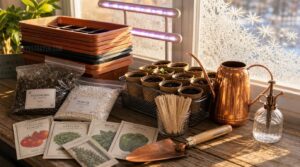
Before you sow a single seed, you’ll want to make sure you have the right supplies on hand. The good news is you don’t need anything fancy — just a few key items that do real work.
Here’s what to gather before you get started.
Containers by Root Depth
Shallow pots (4 to 6 inches) are ideal for lettuce and spinach, while medium-depth pots (8 to 12 inches) suit radishes and compact root vegetables. Deep pots (10 to 18 inches) are essential for carrots and beets, ensuring adequate root development.
Fabric air-pruning pots offer adjustable depths and promote healthier roots, especially during winter, providing a versatile alternative for year-round gardening.
Well-Draining Potting Mix
Your potting mix can make or break an indoor garden. A sandy potting mix with proper perlite proportions—around 20% perlite, 30% coarse sand, and 50% quality base mix—gives roots the air they need.
Sand integration adds stability, while organic matter balance from compost or worm castings feeds plants slowly.
For drainage testing, press a handful: it should crumble, not clump.
Full-Spectrum Grow Lights
Winter days are short — that’s where a good LED grow light changes everything. Full-spectrum LEDs, covering 380 to 780 nanometers, balance blue light for leafy growth and red light for fruiting crops, while UV enhancement boosts overall plant health. These features ensure robust development even in low-light conditions.
Smart DLI (Daily Light Integral) Management and photoperiod management systems keep crops on track by mimicking natural sunlight cycles. This precision control allows growers to optimize growth stages and maximize yields year-round.
When selecting fixtures, prioritize models with:
- Spectral tuning to adjust light spectrum output by growth stage
- 200–400 µmol·m⁻²·s⁻¹ light intensity for most vegetables
- Efficient heat dissipation through aluminum heat sinks
- Low energy consumption rated for 50,000+ hours
These indoor lighting solutions provide unparalleled control during winter months, ensuring healthy, productive plants regardless of outdoor conditions.
Watering Trays and Saucers
A good tray does more than catch drips — it’s your first line of defense in soil moisture management. Material choice matters: HDPE and silicone handle humidity well, while ceramic coordinate with your décor.
Stick to size matching within 5 mm of your pot’s base for stability. This ensures proper alignment and prevents wobbling, maintaining both aesthetics and functionality.
Dual-purpose trays support indoor garden moisture management through bottom watering, promoting healthier root systems. A simple cleaning routine keeps algae from taking hold, preserving hygiene and tray longevity.
Fertilizer for Edible Crops
Think of fertilizer as your plants’ weekly paycheck — skip it, and productivity drops fast. Getting the nutrient requirements right makes the difference between pale, struggling leaves and nutrient-rich indoor produce.
Fertilizer is your plants’ weekly paycheck — miss it, and your harvest pays the price
To maintain optimal growth, consider these essential strategies:
- Nitrogen timing — Feed leafy greens every two weeks with a balanced houseplant fertilizer to keep growth steady.
- Phosphorus root support — Apply bone meal at planting for stronger root development in carrots and brassicas.
- Micronutrient chelation — Choose an organic blend basic mix with chelated iron and zinc to prevent pale, yellowing leaves.
- Synthetic boost schedule — Follow your organic soil mix with a targeted synthetic boost during peak growth for best results.
Set Up Your Growing Space
Getting your space right makes everything else easier. A few simple decisions about light, temperature, and layout can mean the difference between scraggly seedlings and a thriving winter garden.
Set up these elements before your first seeds go in to ensure optimal conditions for growth.
Bright Windows and Shelves
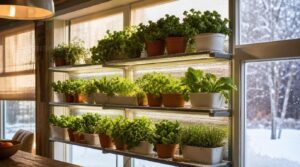
Your best starting point is a south-facing window that delivers six to eight hours of bright sunlight daily. Install shelves six to eight inches below the glass to catch low winter light, and line them with reflective linings to bounce extra light onto leaves.
Choose powder-coated metal or treated bamboo for material durability, and leave gaps between levels for airflow design.
Manage glare with light-filtering shades.
Grow Light Placement
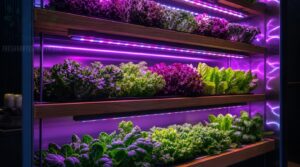
Once your shelves are set, placing your grow light correctly makes all the difference. Start with these five placement rules:
- Hang LED lamps 18–24 inches above the canopy height for leafy greens
- Drop light distance to 12–18 inches for fruiting crops needing higher intensity
- Space fixtures for full coverage uniformity across every plant row
- Use reflective positioning on side walls to boost light by up to 30%
- Clean lenses regularly to maintain strong LED light spectrum output
Temperature and Humidity Targets
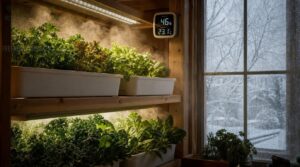
With your lights dialed in, temperature and humidity become your next levers. Keep your daytime temperature range between 65–75°F and your nighttime temperature minimum above 55°F. Cool temperatures 60–70°F suit most leafy greens perfectly.
Target a relative humidity band of 40–60%, using thermostat hysteresis to avoid wild swings. Place microclimate sensors near canopy level for smart air humidity control and steady indoor temperature maintenance.
Air Circulation Basics
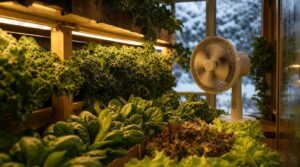
Once your humidity is steady, air circulation keeps everything in balance.
Convection currents naturally push warm air up and cool air down, but that’s rarely enough. A small oscillating fan running on low speed creates the pressure differential your plants need, improving air exchange and indoor garden air quality without wind burn.
- Run fans continuously at low speed
- Place fans to avoid direct blasts on leaves
- Target 40–60% humidity with steady airflow
- Check canopy-level sensors for temperature control indoors
Space-Saving Vertical Setups
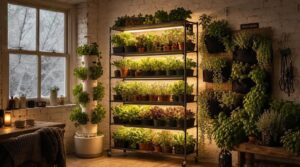
When floor space runs out, going vertical is your best move. Vertical Planter Towers stack multiple pots into one small footprint, while Wall-Mounted Racks keep crops off your counters entirely.
Free-Standing Racks reach six feet high with four to six levels, offering ample vertical storage. Hanging Pocket Gardens hold lettuce or basil flat against any wall, maximizing unused spaces.
Tiered Shelving rounds out your space optimization options, providing structured solutions without requiring complex DIY indoor farm setups.
Plant and Care for Crops
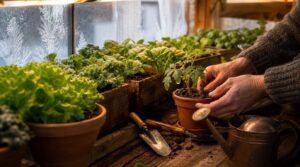
Getting your seeds in the ground is just the beginning. How you care for them day-to-day makes all the difference between a scraggly plant and a thriving one.
Here’s what you need to know to keep your indoor crops healthy all winter long.
Seed Spacing and Thinning
Crowding your seeds is one of the most common mistakes new indoor growers make. Start with the right seed spacing: small leafy greens need 1 to 2 inches, carrots 2 to 3 inches, and radishes about 1 inch apart. Thinning timing matters too—wait for true leaves, then use scissor-cutting at soil level.
To avoid overcrowding and ensure healthy growth:
- Use the seed tape method for even tray density from the start
- Follow plant spacing guidelines on your seed packet before sowing
- Begin seed starting in shallow trays with proper seed sowing depth
- Monitor seed germination closely so thinning happens at the right moment
- Cut, don’t pull—proper spacing saves neighboring roots from damage
Bottom Watering Techniques
Once you nail seed spacing, watering becomes your next big win. Bottom watering uses capillary action to pull moisture upward through well-draining soil, giving roots exactly what they need without soggy tops.
| Technique | Tray Soak Timing |
|---|---|
| Tray Soak Method | 10–30 minutes |
| Sink Soak Method | Until surface darkens |
| Self-Watering Pot Care | Check reservoir weekly |
Always water when the top inch is dry, and empty trays after soaking to avoid overwatering. Moisture monitoring keeps your container drainage working perfectly.
Feeding Leafy Greens
Your leafy greens are hungry — and feeding them right makes all the difference. Think of nitrogen timing as the engine behind fast, lush growth. Feed every one to two weeks with a balanced fertilizer, and you’ll see steady results.
- Use a 3-1-2 NPK ratio for strong leaf production
- Add calcium supplementation to prevent tip burn and weak cell walls
- Watch micronutrient balance — calcium and magnesium work together
- Adjust feeding frequency based on light intensity and growth speed
- Skip foliar sprays on dense crops to reduce fungal risk
A smart fertilizer schedule keeps your nutrient-rich indoor produce thriving all winter.
Pollinating Indoor Fruiting Plants
Without bees, your tomatoes and peppers won’t fruit — so you’ll need to hand pollinate flowers yourself.
Grab a soft paintbrush or cotton swab and gently brush each bloom in the morning, when pollen is freshest. Maintain your indoor garden at 70–75°F and humidity around 40–60% for optimal results.
Check blooms daily and use hand pollination tools consistently to improve fruit set.
Pruning for Better Growth
Think of pruning as a conversation with your plants — you guide, they respond. For Crown Health, remove dead or damaged stems at the base to keep disease out. Trim regularly and snip stems above the leaves to boost Light Penetration and support Hormone Balance.
Pinch off flower buds on greens to delay bolting. This technique encourages leafy growth and extends harvest periods.
The cut-and-come-again approach is your best tool for Fruit Optimization all winter, with Seasonal Timing keeping everything on track. Regular harvesting prompts renewed growth, ensuring sustained yields.
Harvest All Winter Long
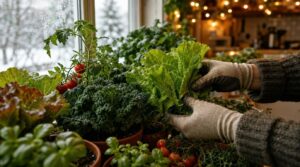
Getting your first harvest is honestly the best part of indoor winter gardening. Once your plants are established, keeping that momentum going is mostly about knowing when and how to pick.
Here’s what to focus on to keep fresh food coming all season.
Cut-And-Come-Again Greens
Cut-and-come-again harvesting is your best friend for keeping greens on the table all winter. Wait until leaves hit 4 to 6 inches — that’s the leaf size threshold — then harvest outer leaves only, leaving the crown intact for regrowth.
Most plants give 3 to 5 rounds this way. After a few cuts, refresh with balanced fertilizer to maintain momentum.
Picking Root Vegetables
Root vegetables play by different rules. Check radishes at 30 days—they’re done at 1 to 3 inches. Scarlet Nantes carrots require 60–70 days and deep pots (at least 10 inches) for proper development.
Follow these Root Size Guidelines for a clean pull:
- Radishes: harvest at 1–3 inches wide
- Carrots: ready at 6–8 inches long
- Beets: pick at 2–3 inches diameter
- Loosen soil first with a hand fork to protect roots
- Store in a cool drawer after brushing off soil
Good variety selection and well-draining soil make all the difference for Harvest Timing and Storage Preparation.
Microgreen Succession Sowing
Microgreens keep your indoor garden producing all winter when you master batch rotation. Sow small trays every 5 to 7 days — this is your ideal sowing interval.
Try microgreens cilantro or kale first, and maintain consistent seed density across batches. This ensures you’ll perfect germination timing and harvest scheduling without gaps.
Staggering light intensity requirements across your shelf guarantees fresh greens never stop coming.
Preventing Indoor Pests
Fresh greens invite uninvited guests. Keeping your indoor garden pest-free starts with Entry Point Sealing — caulk gaps near windows and pipes before trouble moves in.
Pair this with Moisture Management, Food Storage Hygiene, and Monitoring Traps for effective Integrated Pest Management.
- Seal cracks and vents with foam or copper mesh
- Keep humidity between 40–60% to discourage fungal pests
- Store fertilizers and seeds in airtight containers
- Place monitoring traps along walls to catch activity early
Garden-To-Table Winter Meals
Your winter indoor harvest feeds more than just hunger — it feeds the whole meal plan. Toss cold-hardy greens into One-Pot Stews, blend Soup Boosters like arugula and kale into broths, or build Grain-Legume Bowls with barley and lentils.
Root Roasts bring out natural sweetness from beets and carrots.
Try Herb Drying for thyme and rosemary, and you’ll have seasonal cooking with herbs ready all winter.
Frequently Asked Questions (FAQs)
What vegetables can I grow inside over winter?
You’d be surprised how much food fits on a windowsill. Low-Light Greens like spinach, kale, and arugula thrive inside.
Add lettuce, cold-hardy vegetables, Nutrient-Dense Roots, and Space-Efficient Crops for variety all season.
What can I plant indoors in October?
October is the perfect time to start cold-hardy crops like Eruca Astro arugula, Red Giant mustard, Gourmet Beet Blend, Carnival carrot mix, and French Breakfast radish indoors under good light.
Is October too late to plant plants?
Not at all. Frost timing and climate zones determine your window, but cool-hardy crops like arugula and spinach thrive with October’s seasonal light and soil warmth still intact.
What vegetables can I grow indoors with a grow light?
You can grow lettuce, kale, radishes, herbs, and even cherry tomatoes indoors with a grow light. Most leafy greens thrive under 12–16 hours of full-spectrum light daily.
What vegetables can you grow indoors in the winter?
You can grow plenty of nutrient-dense picks like leaf lettuce, kale, and spinach indoors all winter. Low-light performers and cold hardy vegetables thrive in edible container ideas with minimal fuss.
How many winter vegetables can you grow indoors?
You might be surprised — the variety count is bigger than most people expect. More than 20 cold-hardy crops thrive indoors, from quick greens to root vegetables, herbs, and even fruiting plants.
Can you grow vegetables indoors?
Yes, you can absolutely grow vegetables indoors. With container gardening, a decent grow light, and basic temperature control, fresh greens, herbs, and even radishes thrive inside your home year-round.
Can you grow vegetables in winter?
Absolutely — winter is no barrier when you grow vegetables indoors in winter.
Cold-hardy crops like spinach and kale thrive with the right light duration, stable temperatures, and a healthy soil microbiome supporting every root.
How do you grow a green plant in winter?
You can keep cold-hardy greens thriving all winter with the right grow light, temperature control for indoor plants, and Root Zone Aeration.
Daylength Extension and Mold Prevention make all the difference.
Can you grow vegetables in cold weather?
You can grow vegetables in cold weather using frost protection, cold frames, and insulated containers.
Cold-hardy crops like kale and spinach handle cold temperatures well, and nighttime heating keeps frost‑tolerant crops thriving through winter planting.
Conclusion
Picture your kitchen window in January—frost tracing patterns on the glass outside, while a tray of bright arugula pushes up just inches away. That contrast is exactly what growing vegetables indoors during winter makes possible. Winter stops being a gap in your garden and becomes the season you finally grew something worth eating.
You don’t need a greenhouse or a green thumb honed over decades. You need the right light, a few good containers, and a willingness to start. This transforms winter from a dormant period into an opportunity to cultivate fresh, edible delights.
- https://www.gardeners.com/blogs/fruit-vegetable-articles/growing-vegetables-indoors-9196
- https://local.newsbreak.com/lovely-garden-roots-361928332/4605213577757-home-gardening-is-moving-indoors-with-led-grow-lights-and-even-winter-crops-are-starting-to-become-normal
- https://www.quictents.com/blogs/gardening/mastering-grow-lights-to-indoor-winter-gardening?srsltid=AfmBOoqvhC5lpPWbCe6QG3X2HOH6jn9rj-hR4KZ8P2q63CES-63QbYIO
- https://www.gorillagrowtent.com/blogs/news/growing-vegetables-indoors-with-lights?srsltid=AfmBOoqGnytrd79lGUMTdHFF9w52KsB4BpQnGj7lIIQm_ZT1AaBHkpNi
- https://www.vegogarden.com/blogs/academy/choosing-the-right-plants-for-indoor-garden-under-led-grow-lights?srsltid=AfmBOopY9Sga_sQfyLfxfZMy-gOIgM9DC_fSeoZxLipn6_zS_BGiiB3P