This site is supported by our readers. We may earn a commission, at no cost to you, if you purchase through links.

Half the fresh herbs you buy at the grocery store never make it to your plate. They sit in the fridge, slowly turning yellow, until you toss them out with the receipt still in the bag. A $4 bunch of cilantro for one taco night feels fine until you realize you’ve spent $200 on wilted greens over the course of a year.
Growing your own herbs indoors flips that math completely — one basil plant on your windowsill can yield cuttings for months, not days. The best part is you don’t need a garden, a greenhouse, or even a particularly green thumb.
These indoor herb garden ideas work in apartments, small kitchens, and rooms that barely see the sun.
Table Of Contents
- Key Takeaways
- Why Grow Herbs Indoors
- Indoor Herb Garden Setup Essentials
- Best Herbs for Indoor Growing
- Creative Indoor Herb Garden Ideas
- Mason Jar Herb Gardens on Windowsills
- Wall-mounted Wooden Pallet Planters
- Tiered Hanging Baskets for Corners
- Floating Shelf Herb Gardens Above Sinks
- Magnetic Spice Tins on The Fridge
- Wooden Crate Vertical Planter Walls
- Pegboard Wall Herb Displays
- Portable Utensil Caddy Herb Garden
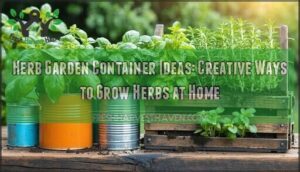
- Recycled Tea Tin Herb Containers
- Macrame Plant Hangers for Herbs
- Top 4 Smart Herb Gardens
- Frequently Asked Questions (FAQs)
- How to make a simple indoor herb garden?
- How to grow herbs indoors?
- How do you make an indoor herb garden?
- What is the best indoor herb garden?
- Which herbs grow well indoors?
- How do I make an indoor herb garden?
- Can you have an indoor herb garden all year round?
- What herbs should not be grown indoors?
- How do you make a simple indoor herb garden?
- What herbs should not be potted together?
- Conclusion
Key Takeaways
- Growing herbs indoors from a single plant saves you real money — one basil plant on your windowsill keeps producing for months, compared to a $3–$5 store bunch that wilts in days.
- Light and drainage are the two things you can’t fake: most herbs need 6–8 hours of sun (or a full-spectrum LED running 12–16 hours), and every pot must have drainage holes or roots will rot.
- Matching the herb to your conditions matters — basil craves a south-facing window, parsley handles low light just fine, and mint needs its own pot or it’ll crowd everything else out.
- If you want fresh herbs without any guesswork, a smart hydroponic kit like the AeroGarden Harvest handles light, watering reminders, and timing automatically — no soil, no sunlight required.
Why Grow Herbs Indoors
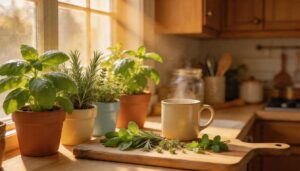
Growing herbs indoors is one of those small changes that quietly makes your whole kitchen feel better.
Fresh basil, rosemary, and thyme on your windowsill can genuinely transform weeknight dinners—check out these practical tips for growing herbs at home to get started on the right foot.
You save money, skip the grocery store herb aisle, and actually enjoy a bit of greenery without needing a backyard. Here’s why so many people are making the switch.
Year-round Harvests in Any Season
Unlike outdoor gardening, where winter shuts everything down, an indoor herb setup keeps producing straight through December. Using full‑spectrum LED lights ensures consistent illumination throughout winter. Succession planting is the real secret — stagger your sowing every few weeks, and you’ll never hit a gap in supply.
Here’s what keeps the harvest rotation going strong year‑round:
- Start new basil or cilantro seeds every 2–3 weeks
- Follow a consistent light scheduling of 12–16 hours daily
- Cut herbs above a leaf node to trigger new branching
- Practice seasonal harvest planning by rotating older plants out
- Keep perennials like thyme trimmed lightly, annuals more aggressively
Lower Grocery Costs With Fresh Herbs
Think about how much you spend on fresh herbs weekly. A small bundle of basil or cilantro runs $2–$5 at most stores — and half usually wilts before you use it.
Your DIY indoor herb garden flips that math fast. One kitchen herb garden plant keeps producing for months, making cost-effective harvest scheduling and zero-waste herb use genuinely simple.
| Herb | Avg. Store Cost |
|---|---|
| Basil | $3–$5/bunch |
| Cilantro | $2–$4/bunch |
Decorative Greenery for Kitchens and Windowsills
Beyond the savings, there’s something genuinely satisfying about a kitchen windowsill lined with terracotta pots and mason jars filled with living herbs. Colorful herb labels, minimalist pot pairings, and aromatic kitchen accents turn a bare ledge into living wall art.
Seasonal herb swaps keep things fresh year-round.
Add magnetic pots to your fridge or a small vertical herb garden — functional and beautiful.
Low-maintenance Gardening for Beginners
Herbs are honestly one of the easiest things you can grow indoors — no garden beds, no complicated tools. A few compact herb kits, some minimalist soil blends, and you’re set.
- Self-watering containers take the guesswork out of watering
- Automated watering timers handle consistency on busy days
- Shade-friendly herbs like parsley thrive without perfect light
- DIY upcycling turns old tins into budget-friendly gardening wins
Kid-friendly and Mindful Home Activity
Gardening with kids turns a windowsill into a classroom.
Herb Scent Breathing, where children inhale mint or lemon balm deeply, mirrors belly-buddy breathing exercises — simple, calming, and genuinely fun.
Sensory Herb Exploration and Mindful Harvest Play build curiosity about food origins while Calm Corner Gardening teaches emotional regulation.
DIY Aroma Craft projects using upcycled tins make kid-friendly indoor gardening activities feel creative and purposeful.
| Activity | Herb Used | Mindfulness Benefit |
|---|---|---|
| Herb Scent Breathing | Mint, Lemon Balm | Emotional regulation |
| Sensory Herb Exploration | Basil, Thyme | Present-moment awareness |
| Mindful Harvest Play | Chives, Parsley | Focus and patience |
| Calm Corner Gardening | Rosemary, Sage | Stress relief |
| DIY Aroma Craft | Any fragrant herb | Creative expression |
Indoor Herb Garden Setup Essentials
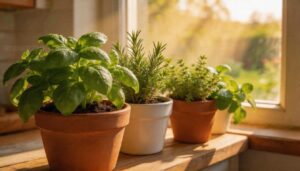
Getting your setup right from the start makes everything else easier. A few containers, soil, light, and water determine whether your herbs thrive or just survive.
Here’s what you actually need to get it right.
Choosing Pots With Proper Drainage
The right pot is your first real decision — and drainage holes aren’t optional. Roots sitting in standing water develop rot fast.
Here’s what actually matters:
- Drainage hole configuration — multiple small holes outperform one large hole
- Pot size matching — match the container to the root ball, not the ambition
- Pot elevation techniques — lift pots so water escapes freely underneath
- Drainage performance testing — after watering, confirm water flows out within minutes
Don’t skip the saucer check.
Best Potting Mix for Indoor Herbs
Think of your potting soil as the foundation that everything else depends on. A sterile mix prevents pests and disease from the start.
This matters even more when you’re working with compact setups like herb walls and kitchen hanging planters, where poor soil in a small container can spell trouble fast.
Blend 2 parts compost with coco coir, perlite, and vermiculite for solid moisture retention and well-draining soil. Perlite keeps roots breathing; vermiculite buffers dryness.
Add organic amendments like worm castings for nutrient balance and check pH — most herbs thrive between 6 and 7.
Using Gravel, Filters, and Saucers
Most gardeners assume gravel inside the pot improves drainage — it doesn’t. That’s one of the most stubborn drainage layer myths around. Water actually perches above aquarium gravel in finer soil, keeping roots wetter longer.
Gravel inside your pot doesn’t improve drainage — it actually keeps roots wetter longer
Here’s what actually works:
- Place gravel in the saucer for smarter gravel saucer placement and humidity benefits
- Use a coffee filter as a filter barrier to keep soil from escaping drainage holes
- Practice double potting techniques — inner pot drains freely inside a decorative outer container
- Empty saucers after watering for proper saucers water management
South- or West-facing Window Placement
Your south facing window is the prime real estate of any indoor herb setup. It delivers consistent full sun year‑round, with seasonal light shifts actually working in your favor — winter sun sits lower, pushing light deeper indoors.
West windows bring intense afternoon light intensity but more heat. Watch pot distance from the glass; sill insulation matters for heat mitigation on tender herbs.
LED Grow Lights for Low-light Rooms
Not every kitchen gets six hours of sun — that’s exactly where an LED grow light earns its place. Modern LEDs deliver the Blue Red Spectrum herbs actually use, hitting PPFD Targets between 400–800 µmol/m²/s without scorching leaves. Heat Management is built in through heat sinks, making Mounting Height adjustments simple and safe.
- Position your LED grow light 6–12 inches above the canopy
- Run lights 12–16 hours daily to meet lighting requirements and solutions for indoor herbs
- Choose full-spectrum LEDs for Energy Efficiency — up to 50,000 hours of life
- Add a DIY grow light timer automation to maintain consistent light intensity
- Move lights closer if stems get leggy
Watering When The Top Inch Dries
Lighting covers the energy side — water covers everything else. The Finger Moisture Test is simple: push your finger 1–2 inches into the soil. Dry? Water thoroughly using the Deep Watering Technique until it drains freely. That’s Drainage Management working as intended.
| Signal | Action |
|---|---|
| Top inch dry | Water fully |
| Soggy soil | Skip watering |
| Winter slowdown | Seasonal Watering Adjustments needed |
| Full saucer | Saucer Emptying Routine immediately |
Your watering schedule isn’t fixed — it shifts with conditions. Consistent soil moisture monitoring prevents overwatering, protects soil drainage, and keeps humidity control steady.
Monthly Organic Feeding for Steady Growth
Water keeps your herbs alive — food keeps them thriving.
Feed container herbs every two to four weeks using a diluted organic liquid fertilizer like fish emulsion or kelp. That’s your Feeding Frequency sweet spot.
Mind your Fertilizer Dilution — half-strength prevents salt leaching issues and leaf burn.
Organic Feed Types naturally support Micronutrient Balance, giving herbs the plant nutrition and soil amendment support, synthetic options often miss.
Humidity Boosts With Pebble Trays and Grouping
Once your feeding routine is locked in, humidity management is the next lever to pull. Dry indoor air stresses herbs quickly — especially basil, which thrives between 40 and 60 percent humidity.
Here’s what actually works:
- Pebble Tray Placement: Fill a shallow tray with rinsed gravel, add water halfway up the stones, and set pots on top — Evaporation Rate Control happens passively.
- Grouped Pot Arrangement: Cluster four to six herbs together to trap transpired moisture, creating a Microclimate Humidity zone extending about 10 to 30 centimeters around your plants.
- Hygrometer Monitoring: Clip one near your seedling trays to keep readings between 45 and 60 percent — guesswork out, precision in.
Best Herbs for Indoor Growing
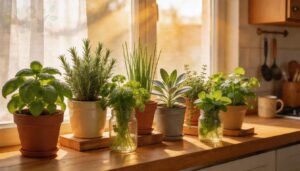
Not every herb will thrive in your living room — but a surprising number will, and they’re probably already on your grocery list. The secret is matching the right plant to the light and space you actually have.
Here are eight herbs that do especially well indoors.
Basil for Sunny Kitchen Gardens
Basil is the crown jewel of any kitchen herb garden — and it earns that spot by being rewarding when you get the conditions right. Set your basil plant near a south-facing window where it gets 6–8 hours of direct light. Good sunny window placement keeps stems compact.
In container gardening, pair it with companion planting neighbors like chives for natural pest prevention, and pinch flower buds early for better harvest timing.
Parsley for Bright, Lower-light Spots
Unlike basil, parsley is one of the more forgiving shade‑tolerant varieties you can grow indoors. It thrives with just 4–6 hours of light near an east‑facing windowsill or under a grow light running 12–14 hours daily.
Keep these four things consistent:
- Pot depth: 6–8 inches covers the root zone
- Soil mix and drainage: loose, moisture-retaining mix with perlite
- Watering consistency: water when the top inch dries
- Temperature sweet spot: 60–70°F slows bolting
Watch leaf color cues — pale, thin growth signals that it needs more light.
Mint for Fast-growing Container Gardens
Mint is possibly the most rewarding herb for container gardening — but it’s a sprinter, not a stroller. Its runners spread fast, so root expansion needs a dedicated 10–12 inch pot to keep growth pacing manageable.
Prune shoot tips every week or two; pruning frequency directly controls flavor intensity.
For mint growth indoors, a south-facing windowsill and consistently moist soil is all it really needs.
Chives for Compact Indoor Planters
Chives are the quiet overachiever of small-space gardening. Their shallow root system means a 6–8 inch wide pot is all you need.
Follow these four steps for a thriving indoor herb garden setup:
- Space clumps 4–6 inches apart for healthy growth
- well-draining soil to protect shallow root containers
- Snip near the base weekly for harvest frequency and flavor preservation
- division techniques every two years to refresh crowded pots
Thyme and Oregano for Small Spaces
Thyme and oregano are a natural match for small-space gardening — same sun needs, same dry-soil preference, easy companion pairings in one window spot. Both do well in 6–8 inch terracotta containers, which handle aroma retention better by keeping roots from sitting wet.
Trim tips regularly for growth habit control and seasonal pruning.
Both adapt nicely to vertical and magnetic pot planting techniques too.
Rosemary and Sage for Sunny Windows
Rosemary and sage are the heavyweights of your indoor herb garden setup and supplies list — both demand a truly sunny window with 6–8 hours of direct light daily.
A south-facing spot nails their lighting requirements best.
Use well-draining cactus mix around pH 6.5, a 6-inch container, and prune regularly to boost air circulation and keep growth compact.
Cilantro for Quick Harvest Cycles
Cilantro is the sprinter of your indoor herb garden setup and supplies — it goes from seed to plate faster than almost anything else. Fast-growing varieties like Confetti can be ready in 28 days.
Use a seed starting mix, position your grow light 6–12 inches above, and harvest outer leaves regularly. A succession planting schedule every few weeks keeps the cutting going continuously.
Lemon Balm for Fragrant Indoor Displays
Unlike cilantro’s rapid cycle, lemon balm plays the long game — and rewards you with fragrance retention that fills a whole room. Brush a leaf, and you’ll smell why it earns its spot in any indoor herb garden setup and supplies list.
- Place it in a south-facing window for 6–8 hours of light and peak pot aroma management
- Pinch flower buds regularly to support seasonal scent variation and bushier growth
- Good air circulation boost prevents fungal issues in tight display corners
Creative Indoor Herb Garden Ideas
You don’t need a big backyard or fancy setup to grow herbs at home — just a little creativity with the space you already have. From windowsills to blank wall space, there are surprisingly clever ways to keep fresh herbs within arm’s reach.
Here are ten indoor herb garden ideas worth trying.
Mason Jar Herb Gardens on Windowsills
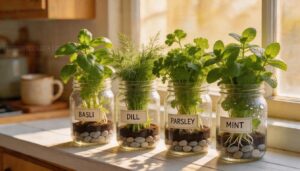
Mason jars might be the simplest DIY indoor herb garden ideas you’ll actually stick with.
Grab a few wide-mouth 22 oz jars, add a DIY charcoal layer above your drainage rocks, fill with organic potting mix, and you’re set.
A jar labeling system keeps everything organized; Mason jar aesthetics look great on any window sill; and seasonal herb rotation keeps your garden productive year‑round.
Wall-mounted Wooden Pallet Planters
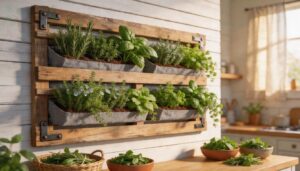
If mason jars feel too small, a wooden pallet planter offers a beautifully scaled-up solution.
Before building, prioritize safety: verify Pallet Safety Standards by checking for the HT stamp (avoid MB-marked pallets).
For structural integrity, implement Smart Weight Load Planning by mounting into studs and using solid Mounting Bracket Options like L-brackets.
Follow Pocket Depth Guidelines and line pockets with breathable Liner Material Selection, such as landscape fabric, to create an optimal vertical herb garden setup.
Tiered Hanging Baskets for Corners
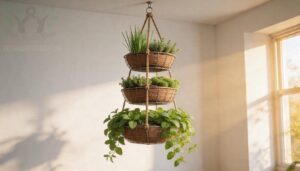
Pallets give you scale — but corners? They give you dead space back.
A tiered hanging basket turns that forgotten room corner into a vertical and wall-mounted herb garden idea that actually works. Pick the right Basket Materials — wire frames with coir liners drain well and stay lightweight, which matters for Installation Hardware holding wet soil.
- Mount one ceiling hook near the corner line, keeping the basket centered and stable
- Place compact herbs like chives and thyme in upper tiers for neater growth
- Let trailing herbs like mint drape lower levels for a fuller, layered look
- Check Corner Lighting — south- or west-facing corners give hanging planters enough daylight
- Space plants for Air Circulation to prevent weak, crowded stems
These small-space kitchen herb gardening tips make macrame plant hangers and hanging planters genuinely useful, not just decorative.
Floating Shelf Herb Gardens Above Sinks
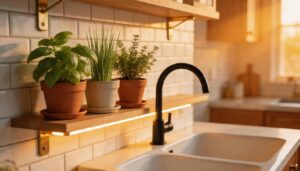
The sink wall is prime real estate that most kitchens waste.
Mount a moisture-resistant floating shelf 18–24 inches above the basin — that’s your Shelf Height Guidelines sweet spot — and you’ve got a working wall storage system for basil, chives, and thyme.
Use rust-proof hardware, add under-shelf lighting for dim kitchens, and water right over the basin for easy sink-friendly water management.
Small-space kitchen herb gardening, sorted.
Magnetic Spice Tins on The Fridge
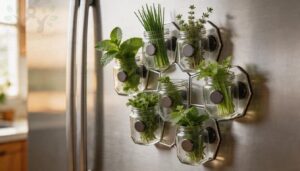
Your fridge door is wasted space — fix that with magnetic pots.
Small hexagon glass jars (1.5–4 oz) with neodymium magnets hold mint, chives, and thyme right at eye level. Nail your indoor herb garden setup with these four tips:
- Magnet Placement: Mount magnets on top of the lid for strongest fridge compatibility
- Jar Size: Match holding strength to weight — bigger jars need two magnets minimum
- Moisture Protection: Wrap magnets in packing tape to prevent corrosion near humid spices
- Labeling System: Use clear lids plus labels so you grab the right herb every time
Wooden Crate Vertical Planter Walls
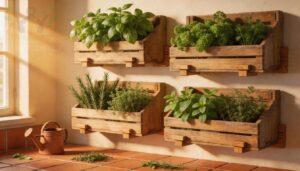
If you’ve got a bare kitchen wall, a wooden crate vertical planter turns it into a living herb display. Frame assembly starts with 1×8 boards, pocket screws, and wood glue for a rigid wooden box herb garden.
Add a plastic Moisture Barrier inside, then secure everything with French cleats for safe wall mounting. Group shallow herbs by light needs — that’s Space Optimization working for you. Trim often for best harvests.
Pegboard Wall Herb Displays
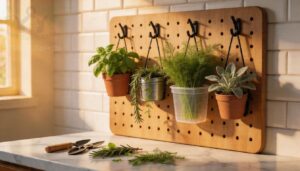
A pegboard wall turns any blank kitchen wall into a flexible, living herb station.
With a Modular Hook Layout and Adjustable Shelf Spacing, you can shift pots around as plants grow — no new holes required. Easy Pot Rotation keeps every herb light-optimized.
Use DIY Pegboard Frames with lightweight tin or plastic containers, and you’ve got one of the smartest small-space kitchen herb gardening tips around.
Portable Utensil Caddy Herb Garden
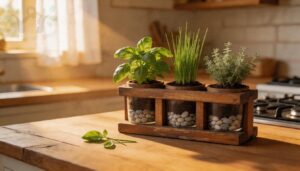
A utensil caddy might be the most underrated portable indoor herb garden you’ll ever set up — and it takes under 10 minutes. Each compartment drainage design works best with a thin gravel layer for drainage.
Grab ready-to-plant herb starters from a retailer, drop in thyme, chives, or basil, and you’re done. Caddy mobility tips: carry it straight from windowsill to stove.
Recycled Tea Tin Herb Containers
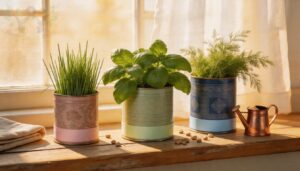
That old tea tin collecting dust in your cabinet? It’s already a herb planter — you just haven’t drilled the holes yet. Upcycling containers for indoor gardening doesn’t get more satisfying than this.
Punch small drainage holes at the bottom, line with a coffee filter, and brush on a rust-free coating inside.
Match tin size to your herb — compact chives fit shallow tins perfectly.
Label each one with washi tape, and your DIY indoor herb garden ideas suddenly look intentional, not improvised.
Macrame Plant Hangers for Herbs
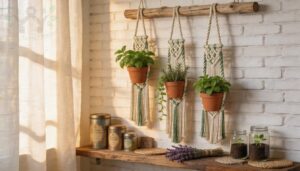
From tea tins to twisted cotton cord — upcycling containers for indoor gardening keeps surprising you. Macrame plant hangers are among the best DIY indoor herb garden ideas for vertical and wall-mounted herb garden ideas.
Use 5mm cotton for Cord Material Choices, try Knot Variations, like spiral or square, and follow Hanging Height Guidelines of 38 inches. Decorative Fringe Details and Seasonal Color Schemes make these creative space-saving ideas for indoor herb gardens genuinely stunning.
Top 4 Smart Herb Gardens
If you want fresh herbs without the fuss of soil, watering schedules, or guessing games, a smart herb garden might be exactly what you need. These countertop systems do most of the heavy lifting for you, from lighting to nutrient delivery.
four worth considering.
1. AeroGarden Indoor Hydroponic System
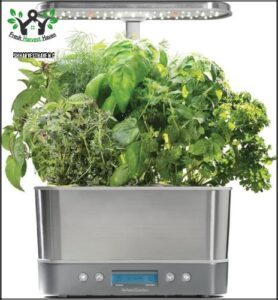
If you want herbs growing year-round with almost zero guesswork, the AeroGarden Harvest is worth a serious look. It fits six pods on your countertop, runs a 20W full-spectrum LED on an automatic timer, and reminds you when to add water or nutrients — right on the front panel.
No soil, no sunlight required. Plants grow up to five times faster than in soil, per the manufacturer.
Just note: some users report a few pods that don’t germinate, so start with that expectation.
| Best For | Anyone who wants fresh herbs or greens on their kitchen counter year-round without any gardening experience or outdoor space. |
|---|---|
| Plant Capacity | 6 pods |
| LED Grow Light | 20W full-spectrum |
| Auto Light Timer | Yes, automatic on/off |
| Water Reservoir | Detachable reservoir |
| Included Starter Kit | Pre-seeded pods + nutrients |
| App/Smart Control | None, onboard panel |
| Additional Features |
|
- Grows up to 6 plants at once with no soil, no sunlight, and no guesswork — the light timer and nutrient reminders handle the routine for you
- Full-spectrum LED pushes growth up to 5x faster than soil, so you’re snipping fresh basil well before a traditional garden would deliver
- Compact stainless-steel design fits easily on a countertop and looks good doing it
- Some users report 3–4 pods that never germinate, so your first harvest may fall short of the full six slots
- No app or Wi-Fi — all controls are on the unit itself, which feels limiting if you like monitoring things remotely
- The LED puts out noticeable heat, so it’s not ideal near a sleeping area or on surfaces that don’t handle warmth well
2. iDOO Indoor Hydroponic Garden Kit
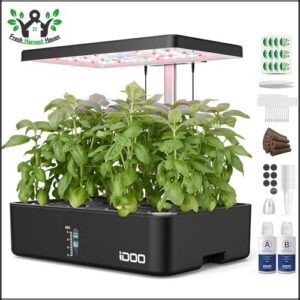
If you need more growing space, the iDOO Hydroponic Garden Kit steps things up — 12 pods instead of six, at $79.98.
It runs a 22W full-spectrum LED on an automatic 16/8 timer and includes a built-in fan that mimics outdoor airflow, which actually helps herbs grow sturdier stems.
The 4.5-liter tank lasts one to two weeks between refills.
One heads-up: replacement sponges aren’t sold directly by iDOO, so source those from a third party early.
| Best For | Anyone who wants to grow herbs or greens year-round indoors and needs room for more than a handful of plants at once. |
|---|---|
| Plant Capacity | 12 pods |
| LED Grow Light | 22W dual-mode |
| Auto Light Timer | Yes, auto-cycles |
| Water Reservoir | 4.5L with window |
| Included Starter Kit | 3-step germination kit |
| App/Smart Control | None, manual only |
| Additional Features |
|
- Fits 12 pods, so you can grow a solid mix of herbs and greens at the same time
- The built-in fan and auto light timer do most of the work for you
- The 4.5L tank only needs a refill every week or two
- Max height of about 11 inches means taller plants are a no-go
- Replacement sponges aren’t sold by iDOO directly, so you’ll need to track down third-party options
- No app or alerts — you have to remember to check the water level yourself
3. Edn Smart Indoor Garden
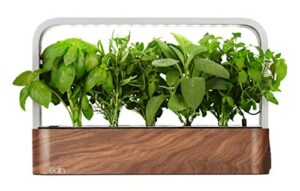
The ēdn SmallGarden sits closer to a piece of furniture than a typical grow kit. Its walnut wood base and anodized aluminum frame look sharp on a countertop or desk — no tangled cords, no awkward plastic.
At $199.98, it manages 10 plant sites with automatic LED lighting and Wi‑Fi alerts through its iOS app, so you’re never guessing when to refill.
One catch: Android users will have to wait, and some sensors throw false "empty" readings.
| Best For | Home cooks and busy households who want fresh herbs on the counter without the hassle of traditional gardening. |
|---|---|
| Plant Capacity | 10 pods |
| LED Grow Light | Low-power auto LED |
| Auto Light Timer | Yes, app-controlled |
| Water Reservoir | Not specified |
| Included Starter Kit | 10 basil SeedPods |
| App/Smart Control | iOS app, Wi-Fi |
| Additional Features |
|
- Grows up to 10 herbs or veggies at once with built-in LED lighting — no window needed
- Wi-Fi alerts tell you when to refill water, so nothing dies while you’re traveling
- Clean, furniture-like design that doesn’t look out of place on a nice countertop
- IOS only — Android users are completely locked out
- Water sensors can misfire and show false "empty" warnings
- SeedPod germination isn’t guaranteed, and getting help when pods don’t sprout can be a hassle
4. Click and Grow Indoor Herb Garden
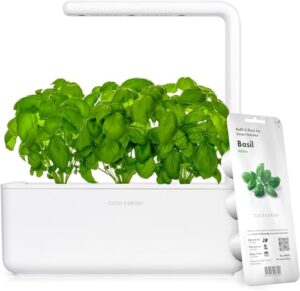
Click & Grow’s Smart Garden 9 is the plug-and-play option that actually delivers on its promise. Drop in the pre-seeded pods, fill the 4-liter tank, and plug it in — you’re done in about 10 minutes.
The LED light adjusts as your plants grow, and the reservoir lasts roughly two weeks between refills.
It accommodates over 65 plant varieties, from basil to mini tomatoes.
At $124.95, it’s beginner-friendly without feeling like a toy.
| Best For | Beginners, busy people, or anyone who wants fresh herbs on the counter without the guesswork. |
|---|---|
| Plant Capacity | Not specified |
| LED Grow Light | Adjustable height LED |
| Auto Light Timer | Yes, 24-hour built-in |
| Water Reservoir | ~14-day capacity |
| Included Starter Kit | Pre-seeded pods compatible |
| App/Smart Control | None, plug-and-play |
| Additional Features |
|
- Totally plug-and-play — pods go in, water goes in, you’re growing in minutes
- LED light adjusts as plants get taller, so you’re not constantly fiddling with it
- Works with 50 plant varieties, from everyday herbs to strawberries and chili peppers
- The smart soil can develop mold over time, so you’ll want to keep an eye on it
- The light timer resets if you unplug it, which can throw off your plants’ light cycle
- The rightmost pod gets less light, so you’ll need to rotate pods occasionally for even growth
Frequently Asked Questions (FAQs)
How to make a simple indoor herb garden?
Start with a pot that has drainage holes, a bag of lightweight potting mix, and a sunny windowsill.
Pick one or two beginner herbs like basil or chives, water when the top inch of soil feels dry, and you’re growing.
How to grow herbs indoors?
Growing herbs indoors comes down to three basics: light, drainage, and consistency.
Give your herbs 6–8 hours of sun, water only when the top inch of soil dries out, and you’re set.
How do you make an indoor herb garden?
Want fresh basil or mint steps away from your stove?
Grab a pot with drainage holes, fill it with light potting mix, place it in a sunny window, and water when the top inch feels dry.
What is the best indoor herb garden?
The best indoor herb garden depends on your space and goals.
If you want zero guesswork, a smart hydroponic kit like the AeroGarden Harvest Elite manages light, water, and timing for you.
Which herbs grow well indoors?
Think of your kitchen like a little ecosystem. The right herbs thrive there naturally. Basil, mint, parsley, chives, thyme, oregano, rosemary, sage, and cilantro all adapt well to indoor conditions.
How do I make an indoor herb garden?
Start with good drainage, the right potting mix, and a sunny south- or west-facing window.
Most herbs thrive with 6 hours of light, monthly feeding, and watering only when the top inch of soil dries out.
Can you have an indoor herb garden all year round?
Yes, absolutely.
As long as you give your herbs steady light, proper drainage, and a little water when the top inch of soil dries out, they’ll keep producing through every season.
What herbs should not be grown indoors?
Fennel, lovage, bay laurel, and dill struggle indoors — they grow too tall or need deep root space. Rosemary and lavender also disappoint without serious direct sunlight and dry airflow.
How do you make a simple indoor herb garden?
Pick a sunny windowsill, grab a pot with drainage holes, fill it with well-draining potting mix, plant your herb, water when the top inch dries, and you’re harvesting within weeks.
What herbs should not be potted together?
Some herbs are terrible neighbors. Keep mint solo — it’ll muscle out everything nearby. Fennel poisons the soil for other herbs.
Never pot basil with sage, or rosemary with parsley — watering needs clash completely.
Conclusion
Contrasting the waste of store-bought herbs, your thriving indoor herb garden ideas bring freshness and fragrance to your space.
With a little care, you can harvest year-round, saving money and enjoying the benefits of homegrown flavors. Your indoor herb garden ideas will flourish, providing a sense of accomplishment and delicious results, making the effort truly worthwhile.
- https://www.johnson.k-state.edu/programs/lawn-garden/agent-articles-fact-sheets-and-more/agent-articles/vegetables/growing-herbs-indoor.html
- https://yardandgarden.extension.iastate.edu/faq/how-can-i-provide-more-light-my-herbs-indoors
- http://freshmommyblog.com/custom-potted-hanging-herb-garden-diy/
- https://grillo-designs.com/indoor-herb-planter-repurposed-baking-tins/
- https://lovelyindeed.com/diy-upcycled-indoor-herb-garden/