This site is supported by our readers. We may earn a commission, at no cost to you, if you purchase through links.

French marigolds can slash nematode populations by 90 percent—not by repelling them, but by trapping and killing them underground. That’s not gardening folklore; it’s documented in peer-reviewed soil science.
Most gardeners still plant marigolds for their color and tuck everything else wherever it fits, leaving serious yield and pest-control gains on the table. The best companion planting arrangements work like a well-designed team: each plant pulling a specific job, filling a gap the others can’t cover. Get the combinations right, and your garden fundamentally controls itself.
Table Of Contents
- Key Takeaways
- Tomato Bed Companion Arrangements
- Three Sisters Garden Arrangement
- Carrot, Onion, and Leek Rows
- Cucurbit Support and Pollinator Partners
- Potato Patch Protection Partners
- Brassica Bed Beneficial Insect Mix
- Frequently Asked Questions (FAQs)
- What are some effective companion planting pairs?
- How to arrange companion plants?
- Can companion planting improve crop flavor and yield?
- Which herbs attract beneficial pollinators to the garden?
- How do legumes naturally enrich surrounding soil nutrients?
- Which plant pairings should be avoided due to competition?
- Conclusion
Key Takeaways
- French marigolds don’t just look pretty along your garden borders — their roots actively kill soil nematodes, cutting populations by up to 90% when planted 12–18 inches apart around tomatoes or potatoes.
- The Three Sisters system (corn, beans, squash) works because each plant fills a different role: corn provides structure, beans fix nitrogen underground, and squash smothers weeds with its broad leaves.
- Pairing scent-heavy plants like garlic, onions, and basil near vulnerable crops isn’t folklore — their sulfur and volatile oil compounds chemically jam pest navigation, reducing aphids and beetles without a single spray.
- Bad neighbors cost you real yield: keep brassicas 3 meters from tomatoes, vigorous squash 6 feet from potatoes, and peppers out of brassica beds entirely to avoid nutrient competition and shared pest pressure.
Tomato Bed Companion Arrangements

Tomatoes don’t have to fight alone. A few well-chosen neighbors can cut pest pressure, boost pollination, and even improve flavor — without any extra spraying or fussing. Here are the companion plants that earn their spot in a tomato bed.
If you’re working with raised beds, the same principles apply — growing tomatoes in raised beds actually makes companion planting easier to manage and control.
Basil Between Tomato Rows
Tucking basil between your tomato rows is one of the smartest moves you can make. Basil’s volatile oils repel aphids, whiteflies, and hornworms naturally, cutting pest pressure without reaching for a spray bottle.
Space plants 12–18 inches from each tomato stem. You’ll improve airflow, retain soil moisture, and — bonus — harvest fragrant leaves right alongside your ripest tomatoes. Additionally, blooming basil can attract bumblebees for pollination to help increase your harvest.
Marigolds Along Borders
Basil manages the rows — marigolds manage the edges.
Plant French marigolds 8 to 12 inches apart along your tomato bed borders. Their roots release compounds that can cut nematode populations by up to 90%, quietly protecting your soil all season.
- Yellow to deep orange blooms mark your garden margins clearly
- Dense plantings reduce moisture evaporation along edge beds
- Hoverflies and parasitic wasps shelter in border foliage
- Seasonal rotation keeps nematode suppression effective year after year
Borage Near Blossoms
While marigolds guard the edges, borage works the interior — right beside your tomato blossoms.
Borage’s blue blossom attraction pulls bees and hoverflies directly to your flowers, boosting pollination. Its cucumber-like scent also confuses nearby pests. Nectar production stays steady even in dry spells, keeping summer garden pollinators active when your tomatoes need them most. Bonus: those edible flowers make a gorgeous salad garnish.
Garlic for Aphid Pressure
Borage takes care of the bees — garlic takes care of the trouble.
Aphids love tomatoes, but garlic’s sulfur compounds, especially allicin, disrupt their cell membranes on contact. Plant garlic cloves between your tomato rows, or make a simple garlic spray recipe: crush four cloves, steep in a quart of water overnight, strain, add a few drops of mild soap, and spray.
Here’s what makes this work as natural pest management:
- Apply your spray early morning or late afternoon — this is your aphid repellent timing sweet spot to avoid leaf burn
- Wet the undersides of leaves thoroughly, since that’s where aphids hide
- Reapply every 5–7 days during heavy pressure for a steady garlic leaf film barrier
- Use careful garlic oil dilution — concentrate burns leaves, so always test a small patch first
- Ladybugs and parasitic wasps show solid beneficial insect tolerance to garlic when you spray targeted and tidy
This combo of companion planting and smart spray timing gives you layered natural deterrents without reaching for synthetic pesticides. Don’t rely on garlic alone if pressure is severe — but as a frontline natural insect repellent and natural pest barrier, it earns its place in any tomato bed.
Avoid Nearby Brassicas
Think of brassicas as the loud neighbors who attract drama — and that drama migrates. Cabbage moths and flea beetles don’t stay politely in one bed; they spread pest pressure to your tomatoes within meters. Brassicas also strip soil sulfur and shift microbial communities, weakening nearby roots.
Keep them at least 3 meters away. Healthy distance means healthier tomatoes.
Three Sisters Garden Arrangement
The Three Sisters — corn, beans, and squash — is one of the oldest and most reliable companion planting systems around, and for good reason. Each plant pulls its own weight while supporting the others, turning a simple garden bed into something that practically runs itself. Here’s how the arrangement works, piece by piece.
Corn as Natural Trellis

Corn is one of the hardest-working structures in your garden — no lumber required. A mature stalk rises 6 to 12 feet tall, giving climbing beans a ready-made ladder to spiral up.
Beyond beans, pairing corn with nectar-rich companions creates a thriving vertical ecosystem — explore the full strategy in this companion planting guide for vegetable gardens.
- Bean vine training starts 2–3 weeks after corn is planted
- Vines cover up to 80% of stalk height at peak growth
- Dried stalks offer post-harvest support for late-season crops
That’s vertical space utilization at its most practical.
Beans Adding Nitrogen

Beans are the quiet chemists of the Three Sisters — doing invisible work underground. Their roots form partnerships with rhizobia bacteria, creating nodules that pull nitrogen straight from the air and push it into the soil.
Inoculate your seeds before planting to fully utilize this. Rotate beans through your beds yearly, and heavy feeders planted after them will thank you.
Squash Suppressing Weeds

Squash doesn’t just fill space — it fights weeds for you. Those wide, overlapping leaves act as a living mulch, blocking light from reaching weed seeds and cutting germination by up to 70 percent during peak growing months. Pair that with natural chemicals squash releases into the soil — called allelopathic compounds — and early-season weeds barely stand a chance.
Squash’s broad leaves block light and release soil chemicals that cut weed germination by up to 70 percent
Here’s what squash ground cover quietly does for your bed:
- Blocks weed-germinating light along the entire soil surface
- Suppresses broadleaf weeds through natural root and leaf chemicals
- Reduces weed biomass by 40–60 percent compared to bare soil in organic systems
- Cuts tillage needs, keeping dormant weed seeds buried deeper in the soil
Space your squash plants 24 to 36 inches apart. Too wide, and gaps open up — and weeds will find them fast.
Moisture-retaining Ground Cover

The Three Sisters isn’t just smart planting — it’s a built-in moisture system. Squash’s broad leaves act as living mulch, cutting soil evaporation by up to 70 percent on hot days and lowering soil surface temperature by 5 to 10 degrees Fahrenheit. That’s free irrigation insurance, working quietly beneath the canopy.
| Ground Cover Benefit | Mechanism | Impact |
|---|---|---|
| Evaporation reduction | Leaf canopy shading | Up to 70% less moisture loss |
| Soil cooling | Surface shade layer | 5–10°F temperature drop |
| Water holding capacity | Organic root matter | 15–25% improvement |
Dense root systems from squash also improve soil infiltration by up to 20 percent, keeping soil health strong all season.
Staggered Planting Sequence

Timing the Three Sisters isn’t guesswork — it’s choreography. Plant corn first, giving it a 2-week head start before adding beans. Wait another week, then tuck squash seedlings into the gaps.
This staggered planting sequence staggers harvest windows too, spreading your yields across the season instead of dumping everything at once.
Carrot, Onion, and Leek Rows
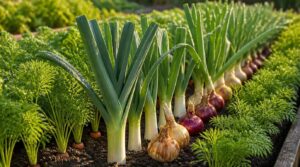
Carrots and onions are one of the oldest pest-fighting duos in the garden, and there’s a good reason they’ve stuck together. The scent combinations, root interactions, and row arrangements you choose can make or break your harvest. Here’s how to set up this planting so every row pulls its weight.
Alternating Root Crop Rows
Alternating carrots and onions in adjacent rows is one of the smartest layouts you can use in a tight bed.
Root depth alternation means carrots dig deep while onion roots stay shallow — no water competition, no nutrient crowding. That contrast also disrupts pest cycles, keeping carrot flies and onion maggots from spreading row to row unchecked.
Onion Scent Barriers
That root depth contrast does more than divide space — it sets the stage for chemistry to take over.
Onions quietly wage chemical warfare through sulfur compound release. When cells are gently disturbed by wind, watering, or brushing, they emit organosulfur volatiles — airborne compounds that scramble pest navigation. Carrot flies and aphids rely on scent to locate host plants. Onion aromas effectively jam that signal.
Wind direction effects matter more than most gardeners realize. Position onion rows upwind of your carrots when possible. That way, volatiles drift across the bed rather than away from it. Temperature plays a role too — warm, dry afternoons push volatile release higher, making your scent barrier strongest when pest pressure often peaks.
Here’s how to make interplanting strategies work harder for you:
- Alternate onion clumps every second or third row rather than bunching them at bed edges.
- Bruise a few leaves occasionally — freshly damaged tissue releases the strongest scent plume for several hours.
- Pair onions with dill or calendula to diversify your aromatic blend and pull beneficial insects like parasitic wasps into the mix.
Onion companion plants won’t eliminate every pest. But as a natural pest barrier woven through your carrot rows, they’re one of the most practical, low-cost tools in companion planting.
Leeks Against Carrot Flies
Leeks bring their own weapon to the fight: a sulfur aroma barrier that confuses carrot fly females before they even find your bed. They emit sulfur-rich essential oils that scramble the fly’s host-finding senses, making your carrots harder to locate.
Plant leeks 15–20 cm from carrot rows for the strongest repellent effect throughout the season.
Varied Root Depths
While the sulfur barrier works above ground, something just as clever is happening below it. Carrots and onions don’t compete — they’re working different soil horizons. Carrots reach 30–60 cm down, while onions stay in the top 15–30 cm, accessing separate moisture and nutrient pockets.
- Carrots open soil aeration channels as taproots push deeper
- Onions handle shallow soil access, pulling recent rainfall quickly
- Each crop taps its own nutrient layer, reducing competition
- Root zone diversity means healthier soil for everyone
Tight-space Garden Layouts
Small space doesn’t mean small harvest.
Narrow beds zoned into thirds — herbs, greens, and root crops — fit carrots and onions in a single 6-foot row. Add wall-mounted trellises for leeks to climb alongside, freeing ground-level space below. Wheeled modular planters let you rotate crops each season without redesigning the whole layout.
Cucurbit Support and Pollinator Partners

Cucurbits — cucumbers, zucchini, squash, and melons — are rewarding to grow, but they need a little help to truly thrive. The right companions give them structural support, keep pests guessing, and bring pollinators right to their flowers. Here’s what works best alongside them.
Sunflowers Supporting Cucumber Vines
Think of sunflowers as free scaffolding your cucumber vines will love. Plant sunflowers 1–2 weeks early, and by the time your cucumbers are climbing, there’s already a sturdy stem waiting.
Vines latch on with tendrils, lifting fruit off the soil and improving airflow. That shaded microclimate also slows moisture loss and reduces heat stress during peak summer.
Nasturtiums as Trap Crops
Nasturtiums are the paramount decoys in a cucurbit bed. Their mustard oil compounds pull aphids, cucumber beetles, and squash bugs away from your main crops like a magnet.
Here’s what they do for you:
- Aphid lure strategy that concentrates pests on sacrificial plants
- Draws lacewings and ladybugs as a beneficial insect magnet
- Supports seasonal rotation tactics by shifting pots to active pest zones
Place one plant every 18–24 inches along bed borders as a border plant spacing guide, and install them 10–14 days before your cucurbits emerge.
Borage Boosting Pollination
Borage is basically a pollinator magnet in your cucurbit bed. Its open, star-shaped blue flowers make nectar easy to reach, so even small native bees drop in repeatedly. That steady traffic means better fruit set on your zucchini and cucumbers.
Plant borage near blossoms, and pollinators will do the rest.
Squash Shading Bare Soil
Squash does more than feed you — those broad leaves act as a living mulch. The canopy creates a shade microclimate that cuts soil evaporation and keeps roots cooler during peak heat.
Under that cover, microbial activity thrives, weed seeds struggle to germinate, and soil moisture retention improves noticeably. It’s simple ground cover working overtime.
Avoid Sage and Rosemary
Here’s one pairing to skip entirely: sage and rosemary near cucurbits. Their strong essential oils can stunt neighboring plants, and their need for dry, well-drained soil clashes badly with the moisture cucumbers demand. That mismatch invites root rot fast.
Instead, reach for borage or nasturtiums — they support pollinators without the conflict.
Potato Patch Protection Partners

Potatoes have more enemies than most gardeners expect, from soil-dwelling nematodes to hungry beetles that can strip a plant overnight. The good news is that the right neighbors can handle most of that pressure for you. Here are five companion plants that turn your potato patch into a well-defended garden bed.
Horseradish for Beetle Deterrence
Think of horseradish as your potato patch’s chemical bouncer. When its tissue is disturbed, it triggers glucosinolate release — producing toxic compounds that confuse and deter Colorado potato beetles. That pungent scent creates a scent barrier lasting roughly 6 to 8 weeks after spring emergence.
- Plant horseradish 1.5 to 2 feet from potato beds for maximum scent reach without root competition
- Use a container border strategy for movable, flexible protection across beds
- Time your seasonal planting before peak beetle flights in late spring for best results
Alyssum Attracting Predators
Horseradish controls the beetles, but it can’t catch everything. That’s where sweet alyssum steps in — a low-growing flower that turns your potato patch into a predator recruiting station.
Its tiny, nectar-rich blooms attract hoverflies, lacewings, and parasitic wasps. Plant border strips in early spring so peak bloom overlaps with aphid season, putting your defenders exactly where you need them.
Beans Improving Soil Fertility
Alyssum manages the pest patrol above ground — but beans are quietly doing something just as valuable beneath it.
Bush beans fix atmospheric nitrogen through a symbiotic relationship with rhizobia bacteria living in their root nodules. That process can deliver 25–60 kg of nitrogen per hectare, steadily enriching the soil your potatoes grow in.
Marigolds for Nematodes
Beans build nitrogen above the nematode problem — but below the surface, root-knot nematodes can quietly devastate your potato roots.
That’s where French marigolds earn their place. Plant them in dense borders, about 12–18 inches apart, and their roots release nematicidal compounds that disrupt nematode feeding and reproduction, reducing pressure by up to 90%.
Keep Vigorous Squash Away
One plant that doesn’t belong near your potato patch is vigorous squash. Summer squash spreads fast — keep it at least 6 feet away. Its roots compete for soil health and its vines can smother smaller crops.
Use scent barriers like garlic chives and practice crop rotation annually to protect your potato companions and maintain balance.
Brassica Bed Beneficial Insect Mix

Brassicas like kale, cabbage, and broccoli tend to attract the most persistent garden pests, so building the right plant community around them makes a real difference. The good news is that certain companion plants actively recruit beneficial insects that do the pest control work for you.
Here’s what to grow alongside your brassica bed.
Dill Attracting Parasitic Wasps
Dill is one of the hardest-working allies in your brassica bed. Its flat, open flower clusters — called umbels — produce nectar that tiny parasitic wasps, like braconids and Trichogramma, can easily reach. These wasps don’t sting you; they parasitize pest eggs and caterpillars instead.
Plant dill within 1–2 meters of your cabbage or kale, and let it do the recruiting.
Calendula Drawing Ladybugs
Calendula is your brassica bed’s quiet powerhouse. Its bright blooms create a nectar corridor that draws ladybugs straight into your garden.
Plant it 12–18 inches apart between rows, and ladybug foraging increases noticeably near aphid-heavy kale. Its seasonal bloom lasts all season with regular deadheading — keeping beneficial insects fed and your biological control running strong.
Garlic Deterring Cabbage Pests
Garlic is a quiet enforcer in the brassica bed. Its sulfur compounds — mainly allicin — mask the scent of your cabbage, making it harder for pests to locate. Diamondback moth larvae and cabbage aphids show noticeably lower populations when garlic grows nearby.
- Use a 2:1 garlic-to-cabbage ratio for best results
- Space cloves 15–30 cm apart within or between rows
- Intercropping between rows outperforms border planting
Chamomile Near Brussels Sprouts
Chamomile is one of those companion plants that quietly does a lot of heavy lifting. Its flowers draw hoverflies and parasitic wasps — both natural predators of cabbage worms and aphids. That alone makes it worth planting near your Brussels sprouts.
Tuck one chamomile plant every two to three sprout rows for even coverage, and plan succession plantings so blooms continue as your sprouts mature.
Avoid Peppers Nearby
One plant that doesn’t belong anywhere near your brassica bed is the pepper. Brassicas compete directly with peppers for soil nutrients, stressing both crops and shrinking yields. Fennel — a common garden herb — releases soil chemicals that inhibit pepper root development.
Keep peppers in a separate bed entirely, where they can thrive without competing neighbors dragging them down.
Frequently Asked Questions (FAQs)
What are some effective companion planting pairs?
Some of the most effective companion planting pairs include basil with tomatoes, beans with corn, and marigolds with most vegetables. These plant combinations deter pests, fix nitrogen, and boost yields naturally.
How to arrange companion plants?
Arranging companion plants means thinking in zones and layers. Match root depths, stagger planting times, and pair crops that trade benefits — like pest deterrence for nitrogen. A little planning upfront makes your whole garden work smarter.
Can companion planting improve crop flavor and yield?
Yes — the right plant neighbors quietly do wonders. Volatile compound exchange, nutrient cycling, and pest deterrent synergy all sharpen flavor and boost your home garden yield naturally.
Which herbs attract beneficial pollinators to the garden?
Basil, lavender, thyme, sage, and oregano are your best bets. Each one draws bees and hoverflies with nectar-rich blooms, keeping pollinators active right where your crops need them most.
How do legumes naturally enrich surrounding soil nutrients?
Legumes quietly do the heavy lifting underground. Their roots host root nodule bacteria that lock atmospheric nitrogen into the soil — free fertilizer your neighboring plants will thank you for.
Which plant pairings should be avoided due to competition?
Not every plant community plays nice. Brassicas near tomatoes steal nitrogen and invite shared pests. Onions and garlic stunt beans. Beets clash with chard. Bad pairings hurt yields fast — rotate them out.
Conclusion
The funny thing about the best companion planting arrangements is that they don’t ask much from you—just a little intention. Put marigolds where nematodes thrive, tuck basil beside tomatoes, let beans feed the corn.
Each plant already knows its job. Your garden isn’t broken; it’s simply waiting for the right neighbors. Set up these partnerships once, and the soil, the insects, and the plants handle the rest together. You just show up and harvest.
- https://www.almanac.com/companion-planting-guide-vegetables
- https://www.rhinogreenhouses.com/blogs/garden-blog/planting-companion-guide-best-plant-combinations
- https://www.azurefarmlife.com/farm-blog/companion-planting-chart-for-a-healthier-happier-garden
- https://gilmour.com/companion-planting-chart-guide
- https://www.milkwood.net/2025/02/19/companion-planting-with-permaculture