This site is supported by our readers. We may earn a commission, at no cost to you, if you purchase through links.
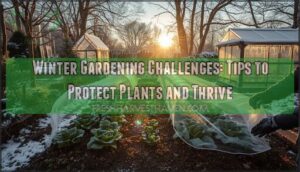
Most gardeners pack it in when the first frost hits—a mistake. Kale survives down to 20°F, carrots push through light freezes, and spinach holds on well below freezing if planted strategically. Knowing your climate and crops transforms winter from a dormant period into an opportunity for fresh greens.
Your USDA hardiness zone is more than a map number; it’s the key to year-round gardening. The 2023 USDA map update, with higher-resolution data, ensures your ZIP code provides an accurate story of your region’s conditions. This precision helps you select crops that thrive in your specific environment.
Find your zone, match your crops, and winter stops being a gap in your harvest calendar. With the right knowledge, December frosts no longer mean a dead garden—they signal the start of a resilient, productive season.
Table Of Contents
- Key Takeaways
- Find Your Winter Garden Zone
- Match Crops to Your Zone
- Plan Around Frost Dates
- Build a Zone Planting Calendar
- Protect and Harvest Winter Crops
- Frequently Asked Questions (FAQs)
- . Why Should You Start Seeds indoors?
- . Which Seeds Should You Start indoors?
- . When Should You Start Seeds indoors?
- . When Should You Transplant seedlings?
- When to plant winter garden zone 7?
- What month do you plant a winter garden?
- When to plant a winter garden zone 8?
- When to plant winter vegetables in zone 9?
- How often should I water winter plants?
- What winter fertilizers work best for vegetables?
- Conclusion
Key Takeaways
- Your USDA hardiness zone—sharpened by the 2023 high-resolution map update—tells you exactly which crops can handle your winters, so look yours up before you plant anything.
- Kale, carrots, spinach, and other cold-hardy vegetables don’t just survive frost—they often taste better because of it, making winter a real growing season rather than a gap.
- Frost dates are your planning anchor: count backwards from your last spring frost to time seed starting, and forward from your first fall frost to know your harvest cutoff.
- Row covers, cold frames, and a 3–4-inch layer of mulch are all you need to protect crops through hard freezes—no greenhouse required.
Find Your Winter Garden Zone
Before anything grows, you need to know your zone. It’s the one number that tells you what your garden can actually handle when temperatures drop. Here’s what to check first.
The USDA zone map is a good starting point, but pairing it with seasonal planting timelines for your spring garden helps you turn that number into an actual plan.
USDA Zone Lookup

The USDA Plant Hardiness Zone Map is your starting point for understanding which plants thrive in your region. Use the interactive GIS map at planthardiness.ars.usda.gov to identify your zone instantly.
- Enter your ZIP code
- View your zone and subzone
- Check real-time temperature updates
- Review historical zone data and climate change adjustments
- Download zone-specific planting calendars
The 2023 update introduced higher resolution mapping, ensuring your results are more accurate than ever. Understanding plant hardiness zones helps you select plants suited to your area’s winter low temperatures.
ZIP Code Garden Tools
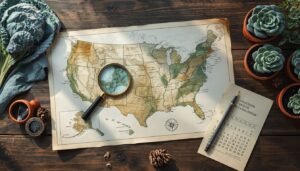
Your ZIP code does more than locate you — it unlocks your garden. Enter it into a ZIP code garden tool to access a Frost Date Calculator, Planting Calendar Generator, and Microclimate Alerts tailored to your exact location. These tools handle gardening by ZIP code with precision.
They offer a real interactive map, Zone Tool Picks, a Local Nursery Finder, and a regional planting calendar matched to your planting zone. This ensures resources align with your specific gardening needs.
Zone Temperature Ranges

Each zone on the USDA Plant Hardiness Zone Map is defined by the average annual minimum winter temperature — the coldest temperatures a plant can withstand.
Here’s what shapes your hardiness range:
- Altitude Effects drop temperatures ~3.5°F per 1,000 feet
- Coastal Moderation raises winter lows several degrees
- Urban Heat Islands add 1–3°F in dense areas
Sub‑Zone Variability, Climate Change Shifts, and Zone Shift Patterns all affect your real-world growing conditions.
Sunset Zone Comparison
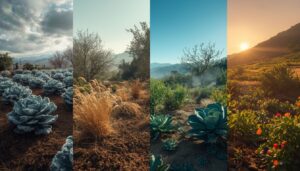
Winter cold alone doesn’t tell the whole story. Sunset’s 24 climate zones layer in Heat Tolerance, Humidity Impact, Frost-Free Days, Elevation Effects, and Coastal Influences — giving you sharper, zone-specific planting calendars than hardiness zones alone.
| Sunset Zone | Growing Season Length | Key Regional Climate Variations |
|---|---|---|
| Zone 1–3 | Under 100 days | High elevation, severe cold |
| Zone 7–9 | 150–200 days | Inland heat, low humidity |
| Zone 15–17 | 250–300 days | Coastal influences, mild winters |
| Zone 21–24 | Year-round | Tropical coastal, minimal frost |
Microclimate Mapping
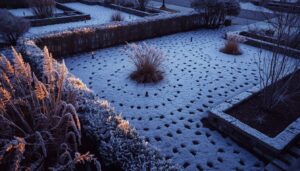
Your garden microclimate can shift conditions by half a zone or more. Sensor Networks, Elevation Modeling, and Solar Radiation Mapping reveal what the USDA Plant Hardiness Zone Map can’t show at ground level.
- Wind Exposure Analysis identifies frost-prone exposed spots
- Soil Moisture Layers reflect root zone winter survivability
- Interactive GIS-based maps integrate microclimates with elevation data
Know your garden microclimate before you plant.
Match Crops to Your Zone
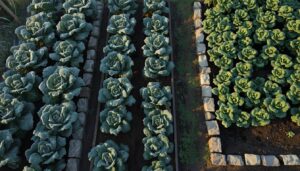
Not every plant belongs in every garden — your zone determines that. Knowing your zone is the first step.
Once you know your zone, exploring flowering plants that thrive through winter helps you build a garden that actually survives the cold.
Once you know your zone, the next step is picking crops that can handle your winters.
Here’s what grows well depending on your location.
Cold-hardy Vegetables
Some vegetables don’t just survive frost — they get better because of it. Use the USDA Plant Hardiness Zone Map to match crops to your conditions. Hardy greens like kale, spinach, and arugula anchor any winter garden. Root crops add depth, while heirloom varieties offer strong frost tolerance and support seed saving across seasons.
| Crop | Cold Tolerance |
|---|---|
| Kale | Down to 20°F |
| Carrots | Light freezes |
| Beets | Near 20°F |
| Spinach | 28–32°F |
| Arugula | Light frost |
Microclimate utilization, nutrient management, and winter succession planting ensure continuous harvests throughout the season.
Winter Herbs
Herbs are the workhorses of your winter garden. Thyme, rosemary, and sage exhibit cold hardiness across USDA Hardiness Zones 5–8, tolerating frost down to –15°C with proper soil drainage.
Container growth allows you to move tender varieties indoors before garden frost dates arrive, ensuring year-round access.
Focus on providing full sun and prune herbs after each harvest to maintain vigor and flavor.
Their culinary pairings—such as rosemary with lamb or sage with squash—remain fresh and vibrant throughout the season.
Root Crops
Root crops are your garden’s underground storage system. Carrots, beets, and turnips thrive across USDA Hardiness Zones 5–8 with smart variety selection and proper soil preparation.
Loose, well-drained soil lets roots expand cleanly. Companion planting with legumes rebuilds nitrogen between seasons. Use cold frames to extend harvest timing into hard frosts.
Good pest management keeps root maggots and wireworms from ruining your yield.
Leafy Greens
Leafy greens are your most reliable cold-season producers. Spinach and kale pack dense nutrient profiles and tolerate low winter minimum temperatures across USDA Plant Hardiness Zones 5–8.
Leaf texture varies by variety — choose smoother types for cold frames where airflow is limited. Harvest frequency stays high with cut-and-come-again methods.
Companion planting with legumes boosts soil nitrogen between cuts, enhancing soil health for sustained growth.
Zone-rated Perennials
Zone-rated perennials anchor your garden year after year — but only when matched to your USDA Plant Hardiness Zone. Check the hardiness zone map and confirm your winter minimum temperature before buying.
Bloom timing, soil amendments, and companion planting all shift by zone.
Division renewal keeps clumps healthy.
Many perennials double as wildlife habitat.
Build them into your zone-specific planting calendars for reliable, season-long structure.
Plan Around Frost Dates
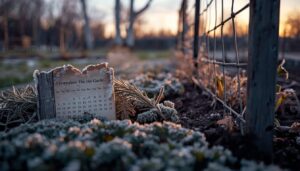
Frost dates are the backbone of any winter garden plan. Knowing your first fall frost and last spring frost ensures everything else—what to plant, when to start seeds, and when to harvest—falls into place.
Here’s what to work with.
First Fall Frost
The first fall frost sneaks in on a clear, calm night through nighttime radiative cooling, pulling heat from the soil upward until temperatures hit 32°F. Watch for these frost damage signs before your harvest cutoff:
- Wilted or blackened foliage
- Ice crystals on leaf surfaces
- Mushy stem bases
- Waterlogged-looking leaves by morning
Use USDA Growing Zones and zone-specific planting calendars for accurate first fall frost dates in your region.
Last Spring Frost
Once the first fall frost closes your season, your eyes shift to spring’s reopening. The average last spring frost marks when it’s safe to plant tender crops again.
Leverage Frost Prediction Tools—using your ZIP code or USDA Growing Zones—to pinpoint frost dates. These resources help anticipate critical planting windows.
Local conditions like Microclimate Pockets, Urban Heat Effect, and Elevation Delay can significantly shift timing. Account for these nuances to refine your schedule.
Long-term Frost Trend Analysis confirms planting zones are warming. This data underscores the need to adapt strategies for earlier springs.
Seed Starting Timeline
Your last frost date isn’t just a calendar note — it’s your seed starting anchor. Count backwards 6–8 weeks for tomatoes, 8–10 for peppers, and 4–6 for brassicas. Your indoor sowing schedule keeps everything on track.
- Maintain germination temperature at 65–75°F
- Provide 12–16 hours daily light duration
- Prep seed trays with sterile, well-draining mix
- Follow zone-specific planting calendars for accuracy
- Begin hardening off 1–2 weeks before outdoor dates
Begin hardening off 1–2 weeks before outdoor dates to ensure smooth transitions for seedlings.
Transplant Timing
Once your seedlings are hardened off, outdoor transplant timing depends on your zone-specific planting calendars. Soil must hit 50°F before transplanting. Don’t rush it.
| Zone | Safe Transplant Window |
|---|---|
| 5–6 | Late April – May |
| 7–8 | March – April |
Cold snaps after transplanting stress roots fast. Watch your local frost dates closely.
Rolling Harvest Windows
Staggered sowing transforms your hardiness zone map into a harvest calendar, not just a cold-tolerance chart. By spacing plantings 2–3 weeks apart and using variety sequencing—prioritizing fast-growing greens before brassicas—you align crops with seasonal shifts.
Seasonal temperature cues, such as a mid-November thaw, act as signals for your next cutting window. This approach ensures continuous productivity while adapting to weather fluctuations.
Harvest tracking maintains labor flexibility, allowing teams to respond dynamically to ripening cycles. A simple winter garden checklist, tailored to zone-specific planting calendars, makes a continuous rolling harvest achievable throughout the season.
Build a Zone Planting Calendar
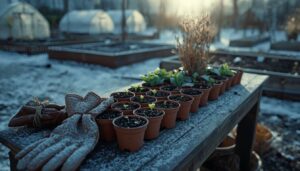
A solid planting calendar turns your zone from a number into a real action plan. Knowing when to sow, transplant, and harvest makes the difference between a thriving winter garden and a missed window.
Here’s how the schedule breaks down by zone.
Zones 5–6 Schedule
Zones 5 and 6 demand tight timing. Your Soil Warmth Threshold sits at 40–45°F — do not transplant cool-season crops before hitting it.
Zone 5’s last frost runs April 15–30; Zone 6 clears by mid-April. Incorporate a Late Frost Buffer of two to three weeks to safeguard transplants.
Use Crop Succession Timing to fill midseason gaps, ensuring continuous productivity. Maintain a Harvest Buffer Period through your winter garden checklist to maximize season extension.
Zone 7 Schedule
In Zone 7, your indoor seed schedule begins in January—roughly 8–10 weeks before your last frost. Watch soil temperature milestones: the transplant readiness window opens once the ground hits 50°F, typically in mid-March.
Include a first frost buffer for late October cold snaps. Cool-season crops and season extension tools—like row covers and cold frames—keep the December garden productive well into winter.
Zone 8 Schedule
Your Zone 8 planting schedule is generous. Late-fall sowing of kale, spinach, and lettuce runs through early November. Mid-winter planting of cool-season crops remain viable during frost-free intervals between temperature dip periods.
Start warm-season seeds indoors in February. Your December garden checklist should include row covers for overnight lows.
Early-spring emergence usually begins by mid-March, after your last frost clears.
Zone 9 Schedule
Your Zone 9 planting schedule practically runs itself. October sowing of cool-season crops like kale, spinach, and beets kicks off outdoor winter gardening before December frost arrives.
Succession planting every two to three weeks keeps harvests rolling, ensuring a continuous yield.
Soil warming remains favorable through early February, allowing your February harvest window to extend longer than in most zones.
Planting Date Exclusions
Missing your crop’s planting window means facing late planting penalties that reduce your insurance coverage. Each crop has its own deadline — for example, corn and soybeans don’t share windows with leafy greens.
Weather events like frost or excessive rain require exclusion documentation to protect your insurance claim. If a crop appears greyed out on your calendar, its planting window has passed.
Focus instead on what you can still plant, as delayed planting impacts coverage eligibility.
Protect and Harvest Winter Crops
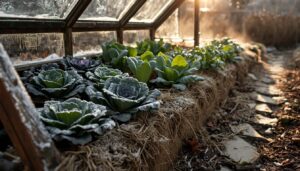
Growing through winter isn’t just about picking the right crops — it’s about giving them a fighting chance once temperatures drop. The good news is you don’t need a greenhouse or a big budget to make it work.
Winter gardening isn’t about a greenhouse — it’s about giving your crops a fighting chance
Here’s what actually keeps your plants alive and your harvests coming.
Row Cover Protection
Row cover is your first line of defense. Choose your cover weight based on your hardiness zone—lightweight frost cloth adds 2–4°F of protection, while heavier fabric provides 6–8°F.
Wind-resistant anchoring with soil or pins stabilizes microclimates under the cover.
Monitor light transmission effects on seedlings and ensure material breathability to prevent overheating during warmer days.
Cold Frames
Cold frames take frost protection further than row covers can. Set yours on a level base — concrete blocks work well. Clear polycarbonate glazing lets light in while locking heat inside. Tilt the lid slightly so rain and snow drain off.
Crack it open on sunny days to avoid overheating. Lubricate hinges each season so access stays easy.
Mulching Strategies
Mulch is your soil’s winter coat. After hard frosts arrive, lay 3–4 inches of straw or shredded leaves across your beds.
That mulch depth locks in soil temperature control and cuts moisture retention loss by up to 70%.
Organic mulch choice matters too — it breaks down and feeds your soil.
It also manages weed suppression quietly all season long.
Cut-and-come-again Harvests
Your leafy greens don’t stop at one cut. The cut and come again method turns a single planting into weeks of food.
- Leaf Selection — take outer leaves only, never the center crown
- Harvest Frequency — cut every 7–14 days during cool-season crops
- Moisture Scheduling — water evenly to speed regrowth management
- Tool Sanitization — clean blades between plants to stop disease spread
Root Crop Storage
Store your root crops at 32–40°F with 90–95% humidity — that’s the sweet spot for carrots, beets, and parsnips. Maintain optimal conditions using breathable packaging like open baskets or bins layered with damp sand to balance humidity and regulate temperature. No root cellar? Insulated boxes with peat moss work just as well.
Check stored crops weekly and pull anything soft before it spreads.
Frequently Asked Questions (FAQs)
. Why Should You Start Seeds indoors?
Starting seeds indoors gives you germination control. Heat mats and the right light spectrum boost seedling vigor.
It’s cost efficiency at its best — more variety, fewer dollars spent at the nursery.
. Which Seeds Should You Start indoors?
Tomatoes, peppers, and eggplants need 8–12 weeks indoors before transplant. Lettuce and kale need just 4–6 weeks. Match your germination timing to your zone-specific planting calendars for best results.
. When Should You Start Seeds indoors?
Count back 6 to 8 weeks from your last frost date. That is your start window.
Match germination temperature to each crop. Use a heat mat and a 14-hour light schedule.
Do not rush the hardening-off period.
. When Should You Transplant seedlings?
Transplant seedlings when they show 4–6 true leaves and soil hits 50°F.
Pick a cloudy afternoon. Check your forecast window.
Hardening off first—7 days minimum—keeps seedling readiness strong and transplant shock low.
When to plant winter garden zone 7?
In Zone 7, plant cool-season crops 6 to 8 weeks before your first fall frost.
Monitor soil temperatures — once they drop to 40–50°F, your Early Fall Transplants and Pre‑Frost Seedlings are ready to go in.
What month do you plant a winter garden?
Most gardeners plant cool-season crops from August sowing through September planting. Your zone decides the window. Pre-frost timing matters most. Match your planting calendar to your first frost date.
When to plant a winter garden zone 8?
In Zone 8, start cool-season crops outdoors from late September through November. Use frost-based planting dates and daylength cues to time late-fall sowing. Soil warming above 50°F signals your transplant window.
When to plant winter vegetables in zone 9?
In Zone 9, your fall planting window opens in late September. Sow cool-season crops through December using local frost timing by ZIP code.
Microclimate shifts matter — always do a soil warmth check before late-season sowing.
How often should I water winter plants?
Skip the calendar. Check your soil. Stick a finger 2 inches deep — if it’s dry, water. If it’s damp, don’t. That simple rule beats any winter irrigation schedule.
What winter fertilizers work best for vegetables?
Use low-nitrogen blends like 5-10-20. Potassium-rich blends strengthen roots. Slow-release organics feed soil steadily. Add phosphorus boosters for root development. Skip high-nitrogen feeds — they invite frost damage.
Conclusion
The theory that winter kills your garden? It doesn’t hold up. Zone by zone, the evidence points the other way—kale standing firm at 20°F, carrots sweetening under frost, spinach outlasting the cold. Your winter garden planning guide zone map isn’t just data; it’s a blueprint for harvests that don’t stop.
Match your crops, protect your beds, and let your garden prove what most gardeners never test: winter is a season for growing, not waiting.
- https://planthardiness.ars.usda.gov/home
- https://www.almanac.com/what-are-plant-hardiness-zones
- https://www.epicgardening.com/winter-vegetables/
- https://www.ufseeds.com/zone-8-planting-calendar.html?srsltid=AfmBOordIieiLx0nRr4yqPlnCpzmeF8poope-zQdA2R877UaAJDTpU0A
- https://gardenbetty.com/cold-hardy-vegetables/