This site is supported by our readers. We may earn a commission, at no cost to you, if you purchase through links.
single infected tomato plant can wipe out an entire bed in under two weeks—most gardeners don’t realize the damage is already done by the time they notice something’s wrong. Disease spreads fastest when it’s invisible, moving through soil, water splash, and pruning tools before a single lesion appears.
The good news is that preventing common garden diseases doesn’t require a chemistry degree or a cabinet full of sprays.
handful of consistent habits—the kind that experienced growers treat as second nature. Master these five, and you’ll spend far less time rescuing plants and far more time harvesting them.
Table Of Contents
- Key Takeaways
- Recognize Early Disease Symptoms
- Choose Resistant Plants and Healthy Starts
- Improve Airflow, Watering, and Drainage
- Proper Spacing to Reduce Humidity Buildup
- Pruning, Staking, and Trellising for Better Airflow
- Watering at The Base Instead of Overhead
- Using Drip Irrigation and Soaker Hoses
- Timing Irrigation to Minimize Leaf Wetness
- Improving Soil Drainage With Compost and Raised Beds
- Mulching to Reduce Soil Splash and Moisture Swings
- Sanitize Tools, Beds, and Plant Debris
- Removing Infected Leaves and Plants Promptly
- Cleaning Up Fallen Foliage and Old Crop Residue
- Why Diseased Material Should Not Be Composted
- Sanitizing Pruners, Pots, Trays, and Containers
- Weed Control to Remove Disease Reservoirs
- Keeping Planting Areas Clean Between Seasons
- Preventing Pathogen Spread During Pruning and Harvest
- Rotate Crops and Act Early
- Crop Rotation to Break Disease Cycles
- Rotating Plant Families Year by Year
- Monitoring for Aphids, Leafhoppers, and Other Vectors
- Using Integrated Pest Management for Prevention
- Applying Copper Fungicides Only When Needed
- Knowing When Bacterial and Viral Diseases Cannot Be Cured
- Setting Treatment Thresholds for Early-season Infections
- Frequently Asked Questions (FAQs)
- Is vinegar an antifungal for plants?
- How to prevent disease in the garden?
- What are the five ways of controlling plant diseases?
- Does hydrogen peroxide work as a fungicide for plants?
- What are the 5 principles of plant disease control?
- How to prevent plant disease symptoms?
- What is the best method for controlling plant disease?
- What are the preventive measures of plant disease control?
- How do you prevent garden diseases?
- Are garden diseases curable?
- Conclusion
Key Takeaways
- Disease spreads before you see it, so scout your plants weekly and act within 48 hours of spotting the first symptom.
- resistant varieties and disease-free transplants from the start cuts your risk more than any spray ever could.
- Keeping foliage dry through base watering, proper spacing, and drip irrigation removes the moisture that most fungal diseases need to take hold.
- Once a bacterial or viral disease reaches the vascular system, there’s no cure—pull the plant, sanitize your tools, and rotate that bed to a different crop family next season.
Recognize Early Disease Symptoms
Catching a disease early is the difference between losing one leaf and losing the whole plant. Your garden will show you warning signs long before things spiral out of control — you just need to know what to look for.
Once you spot those early signs, acting fast with a targeted approach — like the steps outlined for treating blight on tomato plants — can save your harvest before the damage spreads.
Here are the key symptoms to keep on your radar.
Common Signs of Fungal Leaf Diseases
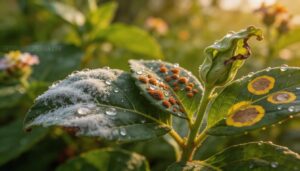
Fungal diseases tend to show their hand early — if you know what to look for.
Powdery mildew patches appear as white, dusty coatings, usually on lower leaves first. Rust pustules erupt orange on leaf surfaces. Leaf spot halos create tan circles with yellow edges. Downy mildew blotches follow leaf veins with fuzzy undersides. Anthracnose lesions curl young leaves and distort growth.
Humidity reduction slows all of them. prune infected shoots promptly to limit disease spread.
Symptoms of Bacterial and Viral Infections
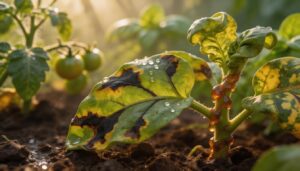
Bacterial and viral diseases play tricks that look nothing like fungal problems.
Bacterial disease often causes water-soaked leaf spot halos, vein necrosis, or stem cankers, oozing in humid heat.
Viral disease twists the story differently — stunted growth, mottled leaves, crown rot, or twig dieback, creeping inward.
Identifying garden disease symptoms early, before spread accelerates, is your sharpest tool for prevention of plant diseases.
Wilting, Root Rot, and Soil-borne Disease Clues
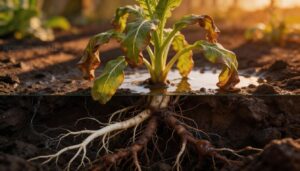
Wilting that persists even after watering is your first red flag. Unlike bacterial or viral symptoms above ground, root rot works silently below — mushy, foul‑smelling roots signal Root Odor Detection issues tied to soilborne fungi.
Poor soil drainage improvement invites Phytophthora and Pythium, classic Fungal Oomycete Signs.
Root Crown Collapse follows quickly. Soil Moisture Tracking regularly, and never reuse unsterilized Potting Mix Sterilization containers.
Distinguishing Disease From Nutrient or Watering Stress
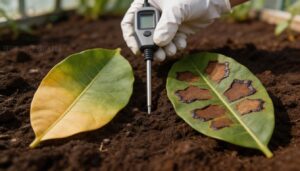
Not every sick-looking plant has a disease. Leaf pattern clues help you tell them apart — vein angular lesions point to bacteria, while nutrient deficiency symptoms spread more uniformly across older or younger leaves based on mobility.
Run soil moisture checks before panicking. Symptom onset timing matters too: wilting that recovers after watering signals stress, not infection.
Leaf discoloration from nutrient deficiency follows predictable patterns; disease symptom identification rarely does.
Why Early Detection Prevents Wider Spread
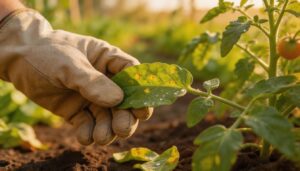
Catch a problem early, and you’re already winning. Removing infected tissue within 24 hours cuts spore load reduction dramatically, while keeping disease spread prevention realistic.
Here’s what early action actually does:
- Early Tissue Quarantine limits inoculum source identification to one zone
- Vector Transmission Cut drops when colonization sites shrink
- Canopy Humidity Control improves with targeted pruning
Disease scouting and consistent disease monitoring save your whole garden.
Choose Resistant Plants and Healthy Starts
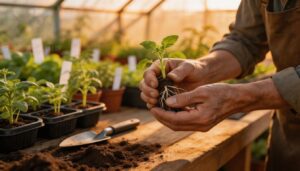
Your best defense against garden disease starts before a single seed goes in the ground. Choosing the right plants from the start cuts your risk more than almost any spray or treatment can.
Here’s what to look for when making those early choices.
Benefits of Disease-resistant Varieties
Planting resistant varieties is one of the smartest moves you can make before a single seed goes in the ground. Use of disease-resistant plant varieties means fewer sprays, lower production costs, and higher yield stability season after season.
Resistant cultivars and varieties hold up under pressure, delivering improved fruit quality and an extended harvest window — without you constantly battling outbreaks.
Selecting Plants Suited to Local Climate Conditions
Climate fit matters as much as genetics regarding disease prevention. Hardiness Zone Matching, Native Plant Adaptation, and Humidity Tolerance Selection aren’t just buzzwords — they’re your first filter when browsing the seed catalog.
- Match plants to your USDA zone; mismatched choices invite winter kill and canker diseases.
- Native plants bring built-in Temperature Extremes Resilience and support beneficial insects that suppress pathogens.
- Site Drainage Optimization through raised beds cuts root rot risk substantially in heavy clay soils.
Resistant cultivars and varieties only perform when your microclimate, soil health, and environmental factors influencing plant pathology align with what that plant actually needs.
Buying Healthy Seeds, Transplants, and Cuttings
What you bring home can make or break your season. Check certification labels for disease‑free testing, and only buy from sellers with solid vendor reputation. Read label details carefully — germination rate, cultivar, lot number.
Store seeds cool and dry. Do a root health inspection before buying transplants; blackened or mushy roots are a hard no.
Using Resistant Rootstocks and Grafted Plants
Grafting onto disease-resistant rootstocks is one of the smartest moves you can make in a pathogen-prone garden. A well-matched scion rootstock pairing limits soil pathogen exclusion at the root level — cutting infection rates by up to 70 percent in infested soils.
Rootstock compatibility and proper graft union healing matter too; a failed union invites disease in. Stick with certified disease-resistant grafts and disease-resistant cultivars suited to your conditions.
Avoiding Seed Saved From Diseased Plants
Saving seed from a sick plant is like bottling a problem for next year. A plant can look fine at harvest and still pass pathogens straight into your next crop.
A healthy-looking plant at harvest can still silently pass disease into next year’s crop
Keep it simple with three non-negotiables:
- Seed Inspection — skip any plant showing spots, mottling, or wilting.
- Hot Water Treatment — reduces surface bacterial load on saved seed.
- Clean Storage and Record Keeping — label what stayed healthy so you don’t repeat mistakes.
When in doubt, buy from certified sources instead.
Improve Airflow, Watering, and Drainage
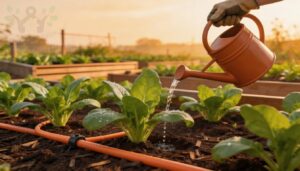
Most garden diseases don’t just appear out of nowhere — they need moisture, stagnant air, and wet foliage to take hold.
The good news is that a few practical changes to how you water, space, and drain your beds can cut that risk considerably.
Here’s what actually matters.
Proper Spacing to Reduce Humidity Buildup
Think of your garden like a crowded room — when plants are packed too tight, humidity gets trapped and disease moves in fast.
row width and plant density matter more than most gardeners realize.
Tomatoes need 18–24 inches between plants, with rows 3–4 feet apart.
Vertical layering, companion spacing, and seasonal adjustments all factor into smart airflow and humidity management — so space plants properly for air circulation, and avoid overcrowding to improve airflow.
Pruning, Staking, and Trellising for Better Airflow
Once your plants are spaced right, the next step is shaping how they grow.
Prune regularly to open up the canopy — Airflow-Optimized Pruning and Open Center Pruning let wind move through instead of getting trapped.
Use Strategic Stake Placement to keep branches lifted, and Staggered Trellis Systems for Vertical Canopy Management.
These pruning techniques for disease management, combined with proper spacing, keep airflow and humidity management working in your favor.
Watering at The Base Instead of Overhead
Where you aim water matters as much as how much you give. Overhead watering leaves a thin film of moisture on leaves — and many fungal spores need that leaf wetness to take hold.
Watering at the base keeps foliage dry, cutting disease pressure substantially.
Root zone hydration also encourages deeper root growth, improving soil moisture control and overall water use efficiency.
Using Drip Irrigation and Soaker Hoses
Drip irrigation and soaker hoses take base watering one step further by delivering moisture directly to roots, keeping foliage completely dry. Emitter placement matters — position drip lines close to root zones, not between rows.
Zoned flow control lets you match water delivery to each plant’s actual needs. Check filtration maintenance regularly, keep pressure regulation steady between 5–15 psi, and adjust for seasonal shifts as plants grow.
Timing Irrigation to Minimize Leaf Wetness
When you water, it matters just as much as how you water. The Morning Irrigation Window—roughly dawn to two hours after sunrise—lets leaves dry within hours, cutting disease risk considerably. Use these timing strategies to reduce leaf wetness:
- Weather-Based Scheduling: Pause watering before rain using a local weather app.
- Leaf Wetness Sensors: Deploy one in your canopy to catch risky moisture windows.
- Soil Moisture Targets: Keep soil at 60–70% field capacity to avoid unnecessary cycles.
Drip Timing Optimization keeps your watering schedule precise and your foliage dry.
Improving Soil Drainage With Compost and Raised Beds
Poor drainage is a disease’s best friend—soggy soil feeds root rot and Phytophthora blight fast. Compost improves soil crumb structure, opening pores so excess water moves through instead of pooling. cultural practices limit pathogen growth before problems start.
| Factor | Recommendation | Why It Matters |
|---|---|---|
| Compost Ratio Guidelines | 3 parts organic matter, 7 parts topsoil | Balances drainage and fertility |
| Bed Depth Optimization | 40–50 cm deep | Maximizes root zone and drainage |
| Base Rubble Layer | Add rubble below 50 cm beds | Prevents waterlogging on deep beds |
| Raised Bed Settling | Fill to the top; wait two weeks | Accounts for organic matter compaction |
| Soil Health and Organic Amendments | Top up 2–4 inches of compost annually | Maintains open, drainable structure |
Raised beds lift roots above poorly draining ground—smart placement beats expensive fixes later.
Mulching to Reduce Soil Splash and Moisture Swings
Mulching for moisture control and disease reduction is one of the simplest cultural practices for disease prevention you can adopt.
A 2–3 inch layer of organic mulch prevents soil splash, which carries soilborne pathogens onto lower leaves during rain.
Match your mulch material selection to the season—straw in spring, bark chips in summer.
Keep mulch away from stems, replenish annually, and you’ll stabilize soil moisture while cutting disease risk substantially.
Sanitize Tools, Beds, and Plant Debris
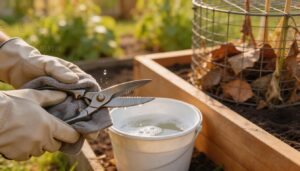
Even infected leaf left on the plant can quietly seed the next outbreak. Sanitation isn’t glamorous work, but it’s most reliable ways to stop diseases before they get a foothold.
Here’s what to tackle to keep your beds, tools, and growing space as clean as possible.
Removing Infected Leaves and Plants Promptly
Speed matters when disease shows up.
Removal timing is everything — acting within 48 hours of spotting symptoms can cut pathogen spread substantially.
Remove infected leaves immediately, wearing protective gloves to avoid cross‑contamination between plants.
Prune affected branches cleanly, then practice smart bagging disposal: seal everything in labeled bags headed for the trash, never compost.
Isolate the bed and focus on spore containment before problems escalate.
Cleaning Up Fallen Foliage and Old Crop Residue
Think of last season’s crop debris as a disease time capsule — it holds fungal spores right through winter.
Fall leaf collection and stalk chopping break that cycle fast. Remove and discard diseased plants, bag debris securely, and practice deep burial or residue incorporation for infected stalks.
These sanitation practices cut next spring’s pathogen load substantially. Whatever you do — don’t COMPOST crop debris from sick plants.
Why Diseased Material Should Not Be Composted
Your compost pile isn’t a cure — it’s a carrier. Pathogen survival is real: fungal spores, bacteria, and viruses can outlast even hot compost conditions when pile management isn’t perfect.
Compost heat failure happens more often than gardeners realize.
Seedborne risk and vector transmission can quietly cycle pathogens back into healthy soil, causing soil health decline over time.
Remove and discard diseased plants instead. Don’t COMPOST them — ever.
Sanitizing Pruners, Pots, Trays, and Containers
Your tools carry disease just as easily as your hands do. Wipe pruners with 70% isopropyl alcohol between cuts, or soak blades in a 10% bleach solution for five minutes.
Residue Rinsing Protocols — unrinsed chemicals burn tissue. Soak pots for ten minutes, scrub crevices using a Tray Inspection Checklist approach, then air-dry completely.
Tool Drying Procedures prevent rust and keep blades sharp.
Weed Control to Remove Disease Reservoirs
Weeds aren’t just unwanted competition—they’re disease reservoirs hiding in plain sight.
Perennial weeds along Edge Buffer Zones can harbor fungal spores, bacteria, and viruses through winter, then feed those pathogens back into your beds come spring.
Weed Host Identification helps you prioritize removal near crop borders first.
Leafhoppers and aphids move freely between weeds and crops, so keep weeds under control before vectors do the damage for them.
Keeping Planting Areas Clean Between Seasons
Between seasons is when garden sanitation really pays off. After harvest, remove diseased plant material completely—bag it for yard waste, never the compost pile.
Pathogen-Free Composting only works with clean inputs. Empty beds benefit from Post-Season Soil Amendments like compost, plus Seasonal Soil Solarization to knock back lingering spores.
Practice Container Sterilization before storing pots, and designate a Quarantine Plant Storage area for anything suspect. A clean planting site now means fewer fights later.
Preventing Pathogen Spread During Pruning and Harvest
Every cut is a potential entry point for pathogens—so Worker Hand Hygiene matters as much as sharp blades.
Sanitize pruners between plants, let Cut Surface Drying happen before bundling harvested stems, and keep Harvest Container Sterilization part of your routine.
Practice Post-Harvest Quarantine for anything suspicious, store clean gear with proper Pruning Tool Storage, and always remove infected leaves before moving to the next row.
Rotate Crops and Act Early
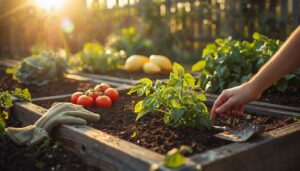
Leaving your tomatoes in the same spot year after year is basically rolling out a welcome mat for disease. soil pathogens build up fast when the same plant families return to the same beds each season.
Here’s what you can do to break that cycle and catch problems before they get out of hand.
Crop Rotation to Break Disease Cycles
Crop rotation is one of the most powerful disease-prevention strategies you have. By denying pathogens their preferred hosts through planned Host-Free Years, you trigger Pathogen Starvation—Fusarium populations crash within 18–24 months without tomatoes or potatoes.
Biofumigant Cover crop like mustard to your Crop Sequence Planning, and you’ll also get a Soil Microbiome Boost that naturally suppresses what survives.
Rotating Plant Families Year by Year
When you rotate crops yearly using a Family Grouping Strategy, you cut off soil-borne diseases before they take hold. Family Rotation Scheduling, paired with Bed Color Coding, keeps your plan clear and avoids repeats.
Soil Health Monitoring and Rotation Data Tracking let you spot trouble early.
For instance:
- Map beds by color
- Track families each year
- Rotate legumes, brassicas, solanaceae
- Monitor soil fatigue
- Adjust based on disease history
Monitoring for Aphids, Leafhoppers, and Other Vectors
Aphids and leafhoppers don’t just damage leaves — they carry mosaic viruses and aster yellows straight into your garden. That’s why plant scouting needs to happen weekly, not when you notice something’s wrong. Check the undersides of new growth with a hand lens, watch for honeydew detection clues like sticky residue or sooty mold, and log what you find.
| Monitoring Method | Key Detail |
|---|---|
| Sticky trap placement | 45–60 cm above soil; replace every 1–2 weeks |
| Scouting frequency | Weekly counts on newest growth |
| Honeydew detection | Signals active aphid-transmitted virus risk |
| Data logging | Track population thresholds by bed and species |
When counts climb past your population thresholds, that’s your cue for insect damage control to prevent pathogen entry before it spreads further.
Using Integrated Pest Management for Prevention
Integrated pest management isn’t just a spray schedule — it’s a system. Layer cultural practices to limit pathogen growth, like crop rotation and sanitation practices for garden hygiene, with biocontrol agents, beneficial insects, and habitat enhancement plantings.
Add trap crops and pheromone traps to catch problems early.
Cover crops rebuild soil between seasons.
Together, these tools keep disease pressure low before it starts.
Applying Copper Fungicides Only When Needed
Copper fungicide spray isn’t a cure-all — think of it as a last line of defense, not your first move. Spray timing matters: apply before disease pressure peaks, schedule around dry windows, and reapply after heavy rain.
- Timing Windows — early-season, preventative fungicide application beats reactive spraying every time.
- Phytotoxicity Risks — young or stressed plants burn easily; always check label compliance before mixing.
- Environmental Impact and Resistance Management — copper accumulates in soil, so rotate with other controls within your integrated pest management plan.
Knowing When Bacterial and Viral Diseases Cannot Be Cured
Some diseases simply won’t respond to any spray or treatment you try. Once a bacterial or viral garden disease moves through the vascular system, you’re facing Irreversible Vascular Damage — the plant can’t recover.
| Condition | Systemic Infection Limits | Removal Decision Criteria |
|---|---|---|
| Fusarium wilt | Full vascular spread | Remove immediately |
| Mosaic virus | No Chemical Cure exists | Pull and destroy |
| Fire blight | Pathogen Persistence in wood | Cut well below damage |
| Bacterial canker | Spreads despite sanitation | Remove infected limbs |
| Verticillium wilt | Soil-borne, incurable | Replace with resistant variety |
Disease diagnosis and pathogen identification matter here — knowing what you’re dealing with tells you when to stop treating and start removing.
Setting Treatment Thresholds for Early-season Infections
Once you’ve pulled diseased plants, shift your focus to timing your next defense. Early blight, for example, responds well to treatment when you catch it before lesions multiply.
Risk modeling tools track weather indices, dew severity, and physiological day values to signal when to spray. 7-to-10-day spray intervals during high-risk stretches, and let seasonal monitoring guide every decision.
Frequently Asked Questions (FAQs)
Is vinegar an antifungal for plants?
Yes, vinegar works as a mild antifungal. Its acetic acid lowers leaf surface pH, suppressing powdery mildew and early leaf spots.
Use diluted vinegar concentration — about one tablespoon per gallon — and mind the leaf burn risk.
How to prevent disease in the garden?
Healthy gardens start with smart habits. Use crop rotation, proper watering techniques to prevent disease, garden sanitation, and air circulation.
Add mulching for moisture control and disease reduction, biological controls, companion planting, soil solarization, seed treatment, and weather forecasting.
What are the five ways of controlling plant diseases?
Five proven ways to control plant diseases: cultural practices, sanitation, biological control, integrated pest management, and chemical treatment.
Each targets how pathogens spread, survive, or infect — giving you real leverage before problems escalate.
Does hydrogen peroxide work as a fungicide for plants?
Hydrogen peroxide works as a short-term organic fungicide when diluted correctly — mix one part 3% solution with three to ten parts water.
Proper application timing, safety precautions, and pairing it with cultural practices make it most effective.
What are the 5 principles of plant disease control?
Think of plant disease control as five pillars:
crop sanitation, crop rotation to reduce disease incidence, use of disease-resistant plant varieties, proper watering techniques to reduce disease, and biological controls through vector management and soil health.
How to prevent plant disease symptoms?
Preventing plant disease starts with catching problems early, then acting fast—proper spacing, base watering, crop rotation, and clean tools stop most pathogens before they ever take hold.
What is the best method for controlling plant disease?
The best method combines integrated pest management strategies with cultural practices to limit pathogen growth — crop rotation to reduce disease incidence, sanitation and tool cleaning to prevent pathogen spread, proper drainage, companion planting, organic amendments, and biological controls.
What are the preventive measures of plant disease control?
Good luck waiting for diseases to fix themselves.
Prevention wins every time: use crop rotation to reduce disease incidence, proper drainage, sanitation, and tool cleaning to prevent pathogen spread, and drip irrigation for consistent watering.
How do you prevent garden diseases?
You prevent garden diseases through preventive cultural practices for disease control: crop rotation strategies in vegetable gardening, air circulation, proper watering techniques to reduce disease, soil solarization, seed treatment, biological controls, companion planting, and improving soil drainage for disease control.
Are garden diseases curable?
Some garden diseases are manageable, but most aren’t fully curable once established.
Fungal issues respond best to early rescue treatments, while bacterial and viral infections usually require removal of infected plant material entirely.
Conclusion
As luck would have it, preventing common garden diseases often coincides with adopting good gardening habits. By mastering these five tips, you’ll both protect your plants and also create a resilient garden ecosystem.
Healthy soil, strong plants, and efficient watering systems all contribute to a thriving garden.
Preventing common garden diseases is a natural byproduct of these efforts, allowing you to enjoy a bountiful harvest while minimizing the need for chemical interventions and reactive measures, always.